
Loan portability, known to lenders as substitution of security, lets many Australian homeowners keep their existing home loan, rate and account when they sell one property and buy another. It always needs lender approval, though, which means a fresh valuation, sometimes a credit reassessment, and an LVR check on the new property. Most banks offer two timing paths: same-day settlement, or deferred security using a term deposit while you wait for the new purchase to settle.
TL;DR:
- Most lenders require a valuation, credit reassessment, and approval for security swap before allowing loan porting.
- Same-day settlement is ideal for equal timing, but deferred security options are available for delays of up to six months.
- Approval depends on property value, property type, current loan-to-value ratio, borrower’s financial circumstances, and product eligibility.
- Costs include security substitution fees, valuation charges, land registry fees, and potential break costs for fixed-rate loans, but exclude stamp duty and conveyancing.
- Engaging a broker early can help verify eligibility, arrange security, and coordinate timing, minimizing the risk of rejection or unexpected costs.
Table of Contents
- What is loan portability (substitution of security)?
- How portability works: lender steps and borrower obligations
- Same-day settlement vs deferred security: which fits your timing?
- Eligibility and common reasons lenders decline a substitution
- Costs, fees and timing to budget for
- When portability is worth it, and when refinancing or bridging wins
- Step-by-step checklist to apply for a substitution
- ZENRG Finance: practical support through a substitution
- Common mistakes and one practical tip from experience
- How ZENRG Finance can help you explore loan portability
- Primary lender pages and ZENRG resources to check
- Sources
- FAQ
What is loan portability (substitution of security)?
Loan portability is the process of swapping the property attached to your existing home loan without closing the loan or opening a new one. Lenders more often call it "substitution of security" or a "security swap," and you'll hit those terms constantly once you start talking to your bank.
What usually carries over:
- Your existing loan account number and repayment history
- Your current interest rate, including any fixed-rate period still running (subject to your lender allowing fixed loans to be ported)
- Linked features such as an offset account or redraw facility, though lenders reserve the right to review these against the new security
Portability doesn't touch the transactional costs of buying and selling property. You'll still pay stamp duty on the new purchase, conveyancing fees on both ends, and any mortgage discharge or registration costs the state government charges to formally swap the title over. Substitution changes the security, not your obligations as a buyer and seller.
How portability works: lender steps and borrower obligations
Substitution follows a fairly fixed sequence once you decide to try it.
- Notify your lender early. Tell them you intend to sell and buy, and ask specifically whether your loan product allows substitution of security.
- Valuation on the new property. The lender orders an independent valuation and recalculates your loan-to-value ratio against it.
- Credit reassessment. Many lenders re-check your income and circumstances, even if your loan balance isn't increasing, because substitution remains subject to a full credit assessment rather than an automatic transfer.
- Confirm names and purpose stay the same. Ownership structure, borrower names and the stated loan purpose (owner-occupied versus investment) usually need to match the original approval.
- Apply separately for extra borrowing, if needed. Buying a more expensive property and needing a bigger loan often triggers a distinct application, sometimes leaving you with a blended rate across the old and new amounts.
Pro Tip: Ask your lender for a written substitution checklist before you sign anything. Verbal reassurance from a call centre doesn't hold up if the file lands with an assessor who reads the policy differently.
Same-day settlement vs deferred security: which fits your timing?
Your settlement dates decide which path you'll use, and it's worth knowing both before you negotiate contract terms with the other side.
Same-day (simultaneous) settlement happens when your sale and purchase settle on the same day. The lender releases the old security and attaches the new one in a single transaction. It's the cleanest option, with the fewest moving parts, but it depends on both settlements landing on the same date, which isn't always something you control.
Deferred security covers you when your sale settles before your purchase, or the timing simply won't line up. The lender holds your sale proceeds as temporary security, usually as a term deposit, for a set window.
- The typical deferred window runs roughly three to six months, though this varies by lender.
- Where lenders mortgage insurance applies to your loan, the LMI provider may impose a shorter allowable period or additional conditions.
- If your lender doesn't offer deferred security, or your gap between settlements is longer than the allowed window, bridging finance becomes the practical fallback.
Deferred windows and LMI rules differ enough between banks that it pays to confirm the exact timeframe in writing before you exchange contracts, not after.
Eligibility and common reasons lenders decline a substitution
Lenders assess substitution requests against the same fundamentals they'd apply to any new loan, just aimed at a different property.
- Valuation and LVR. If the new property values lower than expected, or pushes your LVR past the lender's limit for that loan product, approval can stall or fail outright.
- Property type restrictions. Some security types (rural blocks, certain strata titles, small apartments under a minimum size) fall outside a lender's acceptable security list.
- Income and serviceability. A credit reassessment can flag reduced income, new debts, or changed circumstances since your original approval, even without a bigger loan amount.
- Loan history. Missed payments, current arrears, or a loan flagged for hardship review will usually rule out substitution until the account is back on track.
- Product exclusions. Some loans under government-guaranteed schemes, certain packaged products, or loans with unusual feature bundles may simply be ineligible for substitution, regardless of how strong your finances look.
Check your specific product's terms before assuming portability is available. It's a feature some loans carry and others don't.
Costs, fees and timing to budget for
Substitution isn't free, even though it avoids the establishment fees of a brand-new loan. Lenders typically charge a security substitution fee, and CommBank's published guide uses a figure around $300 per security as an example, alongside a standard property valuation fee and government title registration charges.
What it typically costs: budget for a substitution fee, a valuation fee, land registry charges, and a break cost if you're mid-way through a fixed-rate term and your lender treats the substitution as a rate variation.
Substitution doesn't remove stamp duty or conveyancing costs on either property, and if lenders mortgage insurance applies, the LMI provider may run its own review of the new security. Expect the valuation and credit reassessment stage to take anywhere from a few days to a couple of weeks, depending on the lender's current turnaround times, and remember that deferred-security arrangements carry their own hard cut-off date.
When portability is worth it, and when refinancing or bridging wins
Portability earns its keep when you've got something worth protecting. If you're sitting on a fixed rate well below current market pricing, or your offset account has years of savings discipline baked into it, keeping the loan intact beats starting over.
- Preserving a strong fixed rate or a loyalty-priced variable rate you'd struggle to match elsewhere
- Keeping offset or redraw balances working exactly as they have been
- Avoiding a new loan's establishment fees and a fresh application from scratch
- Protecting a loan history that's helped your standing with that lender
Portability tends to lose its appeal, or fail outright, when you need meaningfully more credit than your current loan provides, when the borrowers or ownership structure are changing, or when the new property simply doesn't meet the lender's security criteria. In those cases, a straightforward refinance or a short-term bridging loan usually moves faster and gives you more flexibility, even if it means paying establishment costs or break fees you'd otherwise avoid.
Step-by-step checklist to apply for a substitution
Getting a substitution over the line comes down to sequencing.
- Contact your lender or broker as soon as you list your property, and confirm your specific loan product allows substitution.
- Request a written breakdown of fees, plus a dated break-cost quote if any part of your loan is fixed.
- Gather your sale contract, purchase contract, identification, proof of income, and confirmed settlement dates.
- Brief your conveyancer or settlement agent so they can align both settlements, or arrange deferred security if dates won't match.
- If you need extra borrowing for the new property, apply for that separately before lodging the substitution request, rather than assuming it'll be bundled in automatically.
ZENRG Finance: practical support through a substitution
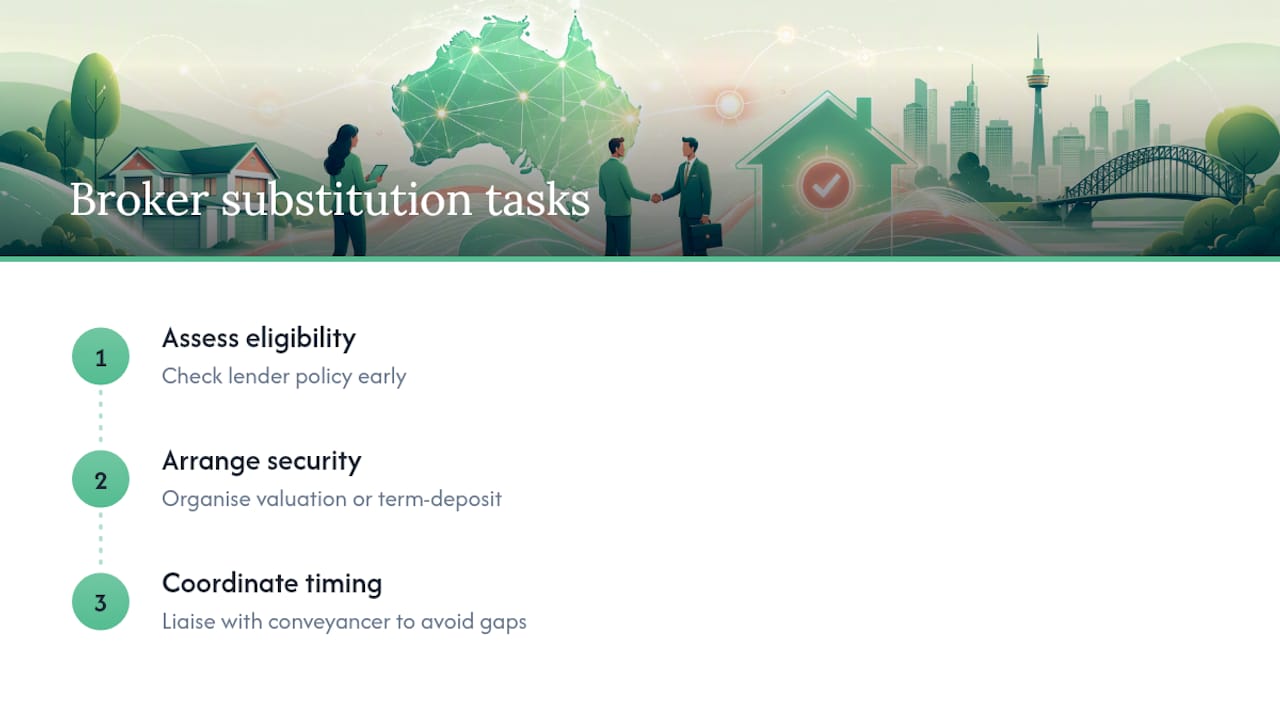
Working out whether substitution will actually get approved, before you commit to a settlement date, is where a broker earns their spot in the process. A mortgage broker can run early eligibility checks against your lender's policy, help arrange the valuation or term-deposit security if you need deferred settlement, and stay in the loop with your conveyancer so nothing falls through a timing gap.
ZENRG's security substitution guide walks through the mechanics in more depth, and the broader Insights hub covers related loan structuring topics if you're comparing your options before deciding which way to go.
Common mistakes and one practical tip from experience
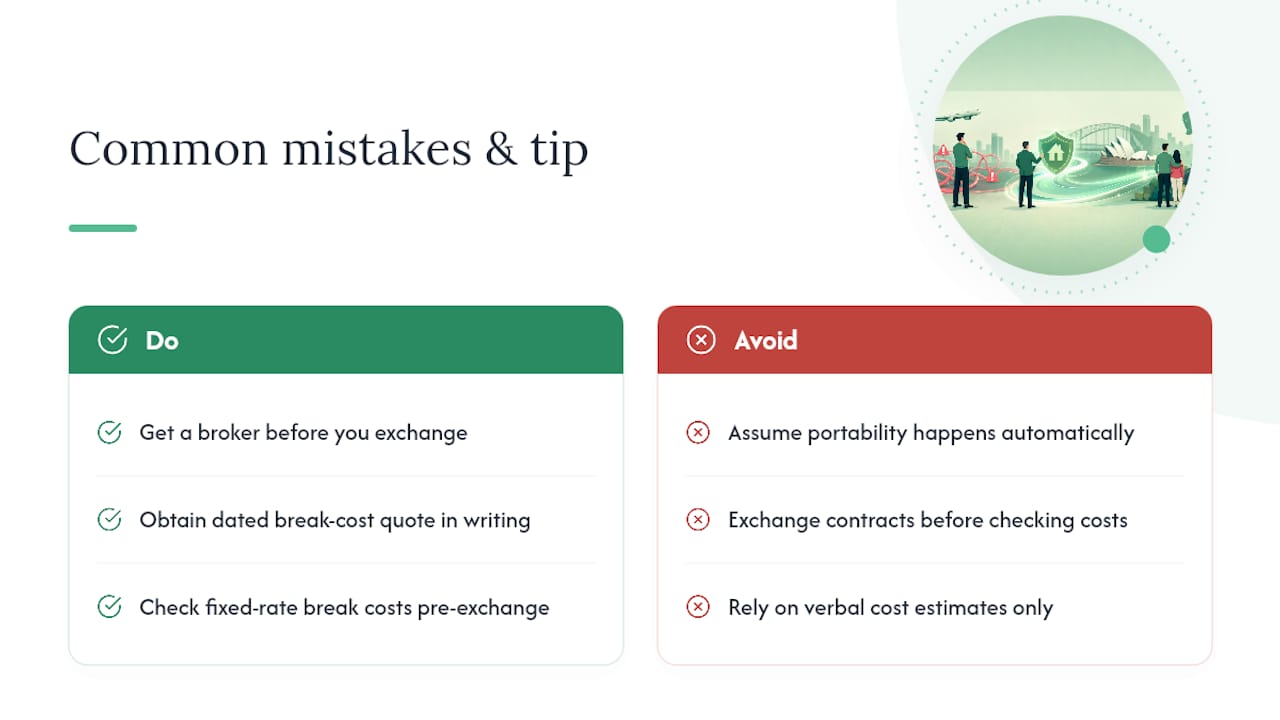
The homeowners who get burnt on substitution are usually the ones who assume it's automatic. One recurring pattern: a borrower exchanges contracts assuming their fixed rate will simply carry over, only to discover their lender treats the swap as a rate variation with its own break-cost calculation. Getting a broker involved before contracts are signed, rather than after, changes that outcome more often than people expect.
If you take one thing from this, get a dated break-cost quote in writing before you exchange contracts, particularly if a fixed rate is the whole reason you're bothering with portability instead of a straight refinance.
— Allen
How ZENRG Finance can help you explore loan portability
A mortgage broker can work through the substitution process directly with you and your lender, running the LVR and serviceability checks upfront so you're not guessing whether approval is realistic. That includes helping arrange term-deposit security for deferred settlements, coordinating timing with your conveyancer, and reviewing lender numbers when a valuation or fee estimate looks off.

If you're weighing up whether to keep your current loan or start fresh, a strategy conversation before you list your property will save you from discovering a product exclusion after contracts are signed. Whether you're a first home buyer working out your next move or considering whether refinancing suits you better than substitution, ZENRG Finance can map out the fastest, cheapest path for your specific loan and timeline.
Primary lender pages and ZENRG resources to check
Lender policies on substitution differ enough that it's worth reading the source directly before you plan around it.
- Home loan portability — St.George
- Security swap option — ANZ
- Substitution of security guide — CommBank
- Home loan portability — Westpac
- Security substitution — ZENRG Finance blog
Fee lists and deferred-security time limits vary by lender, so confirm the current rules with yours before settlement dates are locked in.
This article is general information, not a substitute for advice from a qualified financial advisor. Consult a qualified financial professional about your own circumstances before acting on anything here.
Sources
- Home loan portability — St.George
- Security swap option — ANZ
- Substitution of security guide — CommBank
- Home loan portability — Westpac
- Substituting the security on your home loan — Macquarie
FAQ
What is loan porting?
Loan porting, or portability, lets you swap the property securing your existing home loan for a new one while keeping the same loan account, rate, and repayment history, subject to your lender's approval.
Can you transfer a personal loan the same way?
Personal loans generally aren't secured against property in the same way, so the substitution process described here applies to home loans, not personal loans; check with your lender about what options exist for your specific product.
What salary do you need for a $500,000 loan?
There's no single figure, because serviceability depends on your existing debts, dependants, interest rate buffers and the lender's own assessment criteria; a broker can run your numbers against current lender policy to give you a realistic answer.
How much can you borrow on a disability pension?
Borrowing capacity on a disability pension depends on the specific lender's policy toward government income support, your other income sources, and existing commitments, and it varies significantly between lenders, so a direct serviceability assessment is the only reliable way to know.
Does ZENRG Finance help with loan portability specifically?
Yes. ZENRG Finance checks your eligibility for substitution against your current lender's policy, helps arrange valuations or term-deposit security, and coordinates the process with your conveyancer through to settlement.