
A break cost (also called an early repayment adjustment or break fee) is the charge your lender applies when you exit a fixed-rate loan before the fixed term ends. MoneySmart defines it as a fee for repaying a fixed-rate loan early. For most Australian homeowners, the verdict is straightforward: break costs can range from a few hundred dollars to tens of thousands, so you need the actual number before you decide anything.
Here are your immediate next steps:
- Ask your lender for a written break-cost quote that states the method used, the wholesale rate applied, and every fee included.
- Run a break-even calculation using the worked examples below to see how many months it takes for your refinancing savings to cover the cost.
- Compare that quote with a new loan offer through a broker like Zenrgfinance to see whether the numbers stack up.
- Seek independent financial advice if your situation involves an SMSF, a large balance, or a complex loan structure.
Pro Tip: Always get the break-cost quote in writing with an expiry date. Lenders recalculate daily based on wholesale rates, so a verbal figure from Monday can be meaningfully different by Friday.
Key takeaways
Break costs are recoverable if you model the break-even period correctly and avoid resetting your loan term unnecessarily.
| Point | Details |
|---|---|
| Break cost definition | A charge for exiting a fixed-rate loan early, reflecting the lender's hedging loss, not a penalty. |
| Calculation method matters | IRD and three-month interest methods produce very different figures; always ask which your lender uses. |
| Break-even is the real metric | Divide total switching costs by monthly savings to find how many months to recover the cost. |
| Term reset can wipe savings | Refinancing into a longer term reduces monthly payments but can cost more in lifetime interest. |
| Get it in writing | Request a written quote with the method, wholesale rate, and all fees stated before making any decision. |
| Zenrgfinance can help | Zenrgfinance models break costs, compares lender offers, and runs break-even scenarios for you. |
Table of Contents
- What are refinancing break costs and when do lenders charge them?
- When do break costs apply to your fixed-rate home loan?
- How are break costs calculated?
- Worked examples: calculating break costs for Australian home loans
- Break-even examples: does refinancing still save money after the break cost?
- How do break-cost calculators work, and what are their limits?
- Should you break your fixed loan? A practical decision checklist
- How to get an accurate break-cost quote from your lender or broker
- Practical ways to reduce or avoid break costs
- How Zenrgfinance helped a client navigate a $14,000 break cost
- How Australian regulations shape break-cost calculations
- What do break costs typically cost in Australia?
- What most homeowners get wrong about break costs
- Zenrgfinance can model your break cost and refinancing options
- Sources
What are refinancing break costs and when do lenders charge them?
A break cost is not a penalty in the punitive sense. It is your lender's way of recovering the cost of unwinding the fixed-rate hedge it put in place when you locked in your rate. When you fix your home loan, your lender typically borrows money at a wholesale rate in the swap market to fund your loan at the agreed fixed rate. If you exit early and wholesale rates have since fallen, the lender is left holding a more expensive funding arrangement than it can replace. The break cost covers that shortfall.
MoneySmart uses the term "early repayment adjustment" alongside "break fee," and both names appear in Australian loan contracts. Canstar notes that the exact amount varies by lender and the specific terms of your contract, which is why two borrowers with the same balance and rate can receive very different quotes.
Common triggers for a break cost:
- Refinancing to a new lender mid-fixed term
- Selling your property and discharging the loan early
- Switching from a fixed product to a variable product with the same lender
- Making a large lump-sum repayment above your allowed annual prepayment limit
- Porting your loan to a new property (some lenders allow portability without a break cost, but not all)
Variable-rate loans do not attract break costs in the same way. Some older variable loans carried exit fees, but Treasury's proposal to ban exit fees on new home loans has progressively reduced their prevalence. Fixed-rate loans remain the primary context where break costs apply.
When do break costs apply to your fixed-rate home loan?
The timing of your exit within the fixed term matters enormously. Break costs are highest when wholesale rates have fallen significantly since you fixed, and when you have a long remaining term. They shrink as you approach the end of your fixed period, and they disappear entirely once you roll onto the variable rate at expiry.
Scenarios that commonly trigger a break cost:
- Refinancing to another lender at any point during the fixed term
- Discharging the loan on property sale before the fixed term ends
- Switching to a variable rate with your existing lender mid-term
- Making extra repayments above the lender's annual cap (often $10,000 per year, though this varies)
Scenarios that usually do not trigger a break cost:
- Waiting until your fixed term expires and then refinancing
- Switching products at renewal (when the fixed term ends naturally)
- Making extra repayments within your lender's allowed annual limit
Different lenders use different calculation methods, and that changes outcomes significantly. Some use an interest rate differential (IRD) method based on wholesale swap rates. Others apply a simpler three-month interest penalty. The IRD method tends to produce larger break costs when rates have fallen sharply, while the three-month interest method is more predictable but can understate the lender's actual hedging loss.
Pro Tip: Check your loan contract for a "portability" clause before assuming you must pay a break cost when moving house. Some lenders let you transfer the fixed loan to a new property without triggering a break, provided the new loan amount is similar and the lender approves the new security.
Partial discharges, where you pay down a large chunk but keep the loan open, can also trigger a partial break cost. Ask your lender specifically about this before making any large lump-sum payment. For broader context on how lender policies affect your refinancing options, the Zenrgfinance guide on breaking out of mortgage prison is worth reading alongside this article.
How are break costs calculated?
The core economic idea is simple: your lender compares the rate it is earning on your loan with the rate it could earn if it redeployed that money today. If today's rate is lower, you owe the difference for the remaining term.
The IRD formula (simplified):
Break Cost = (Original Fixed Rate − Current Wholesale Rate) × Remaining Principal × (Remaining Fixed Term in Years)
This is a simplified version. In practice, lenders discount the future cash flows and use swap-curve rates rather than their advertised rates, so the actual figure is more complex. But this formula gives you a useful ballpark.
The three-month interest method:
Break Cost = Remaining Principal × Annual Interest Rate × (3 ÷ 12)
This method is simpler and more predictable. It does not depend on wholesale rate movements, so it tends to produce lower break costs when rates have fallen significantly.
Components that feed into the calculation:
- Remaining principal: the outstanding loan balance at the time of break
- Remaining fixed term: the number of months or years left on your fixed rate
- Original fixed rate: the rate you locked in
- Current wholesale/swap rate: the rate your lender can access in the market today (published by the Reserve Bank of Australia and reflected in swap-curve data)
- Hedging margin: lender-specific adjustment for their cost of funds
- Administration fees: discharge fee, settlement fee, and any other lender-specific charges
The Reserve Bank of Australia publishes interest rate and market data that underpins the wholesale rates lenders use. When the RBA cuts rates and swap rates follow, break costs on existing fixed loans rise because the gap between your locked-in rate and today's wholesale rate widens.
| Component | IRD Method | Three-Month Interest Method |
|---|---|---|
| Wholesale rate movement | Drives the calculation directly | Not used |
| Remaining term | Multiplied through the full period | Fixed at three months |
| Predictability | Low (varies with market) | High |
| Typical outcome when rates fall | Higher break cost | Lower break cost |
| Typical outcome when rates rise | Zero or near-zero | Fixed amount |
A word of caution: lenders are not required to use the same method, and some use hybrid approaches or apply a minimum fee floor. Canstar confirms that break costs vary by lender and contract terms, so two quotes for the same scenario can differ by thousands of dollars.
Worked examples: calculating break costs for Australian home loans
The three examples below use the IRD method, which is the most common approach for Australian lenders with genuine hedging arrangements. Assumptions are spelled out for each so you can adapt the numbers to your own situation.
Assumptions applying to all three examples:
- Wholesale rate used: the current swap rate is assumed to be 1.00% lower than the original fixed rate (a scenario consistent with a rate-cutting cycle)
- Lender method: simplified IRD (no discounting for brevity; actual lender quotes will differ)
- No hedging margin adjustment included (add 0.10%–0.30% for a more conservative estimate)
- Figures are illustrative; request a written quote from your lender for the actual number
Example 1: Small loan, short remaining term
Loan details:
- Remaining principal: $280,000
- Original fixed rate: 5.50% per annum
- Current wholesale rate: 4.50% per annum
- Remaining fixed term: 1 year
Calculation:
- Rate differential: 5.50% − 4.50% = 1.00%
- Break cost: $280,000 × 1.00% × 1 year = $2,800
At this scale, the break cost is manageable. If refinancing saves you $200 per month, you recover $2,800 in 14 months.
Example 2: Medium loan, mid-term break
Loan details:
- Remaining principal: $520,000
- Original fixed rate: 5.75% per annum
- Current wholesale rate: 4.50% per annum
- Remaining fixed term: 2 years
Calculation:
- Rate differential: 5.75% − 4.50% = 1.25%
- Break cost: $520,000 × 1.25% × 2 years = $13,000
This is where break costs start to sting. A $13,000 upfront cost requires careful break-even analysis before you commit.
Example 3: Large loan, long remaining term
Loan details:
- Remaining principal: $850,000
- Original fixed rate: 6.00% per annum
- Current wholesale rate: 4.50% per annum
- Remaining fixed term: 3 years
Calculation:
- Rate differential: 6.00% − 4.50% = 1.50%
- Break cost: $850,000 × 1.50% × 3 years = $38,250
A break cost of this size demands a thorough break-even analysis and, almost certainly, a broker conversation before you proceed.
| Scenario | Balance | Rate Differential | Remaining Term | Estimated Break Cost |
|---|---|---|---|---|
| Small loan | $280,000 | 1.00% | 1 year | $2,800 |
| Medium loan | $520,000 | 1.25% | 2 years | $13,000 |
| Large loan | $850,000 | 1.50% | 3 years | $38,250 |

A shorter remaining term of 18 months instead of 24 months reduces it to $9,750. Small changes in inputs produce large swings in the outcome, which is why a lender-issued written quote is the only reliable number to act on.
Break-even examples: does refinancing still save money after the break cost?
The break-even formula is:
Total switching cost ÷ Monthly savings = Break-even months
Once you know how many months it takes to recover your costs, you can compare that to how long you plan to keep the loan. If you plan to stay longer than the break-even period, refinancing is likely worth it. If you plan to sell or fix again before then, it probably is not.
Break-even example 1: medium loan scenario
Using the medium loan from the previous section:
- Break cost: $13,000
- Additional switching costs (discharge fee $350, legal/settlement $800, valuation $300): $1,450
- Total switching cost: $14,450
- Current monthly repayment at 5.75% on $520,000 over 25 years remaining: approximately $3,390
- New rate: 5.00% on $520,000 over 25 years remaining: approximately $3,040
- Monthly saving: $350
- Break-even: $14,450 ÷ $350 = 41 months (approximately 3.5 years)
If you plan to keep this loan for more than 3.5 years, refinancing makes financial sense despite the $13,000 break cost.
Break-even example 2: large loan scenario
- Break cost: $38,250
- Additional switching costs: $1,600
- Total switching cost: $39,850
- Current monthly repayment at 6.00% on $850,000 over 22 years remaining: approximately $5,870
- New rate: 5.00% on $850,000 over 22 years remaining: approximately $5,360
- Monthly saving: $510
- Break-even: $39,850 ÷ $510 = 78 months (approximately 6.5 years)
At 6.5 years to break even, this is a harder call. Whether it is worth it depends heavily on your plans for the property and how long you expect to hold the loan.
Switching costs to include in your total:
- Break cost (early repayment adjustment)
- Discharge fee (typically $150–$400)
- Legal/settlement fee for the new loan ($800–$1,500)
- Valuation fee ($200–$600)
- Application or establishment fee on the new loan (varies; sometimes waived)
- Any ongoing fees on the new loan that are higher than your current loan
Term reset risk: a lower monthly repayment can hide a higher lifetime interest cost if you reset to a longer term. Refinancing a 22-year remaining loan into a new 30-year loan reduces your monthly payment but adds eight years of interest. Always model the total interest payable over the life of the loan, not just the monthly saving. The Zenrgfinance loan comparison calculator lets you run this comparison side by side.
How do break-cost calculators work, and what are their limits?
Online break-cost and break-even calculators are useful starting points, but they are not substitutes for a lender quote. Here is what they do and where they fall short.
What a calculator needs from you:
- Current outstanding balance
- Remaining fixed term (in months or years)
- Your current fixed rate
- The new rate you have been offered
- Total switching costs (break cost + all fees)
Step-by-step walkthrough using the medium loan example:
- Enter remaining balance: $520,000
- Enter remaining fixed term: 24 months
- Enter current rate: 5.75%
- Enter new rate: 5.00%
- Enter total switching costs: $14,450
- The calculator outputs monthly saving ($350) and break-even period (41 months)
You can run this kind of scenario using the financing calculators at CashflowCalcs or the Zenrgfinance loan comparison calculator to model different rate and term combinations.
Limitations to keep in mind:
- Most calculators use your advertised rate, not the actual wholesale swap rate your lender used. The real break cost can be higher or lower.
- Calculators rarely account for lender-specific IRD methods, hedging margins, or minimum fee floors.
- Rolling closing costs into the new loan (a "no-cost refinance") avoids upfront cash outlay but raises your rate or balance, which the calculator may not model correctly. The Zenrgfinance guide on no-cost refinancing explains the trade-offs clearly.
- Term reset effects are often ignored. A calculator showing a lower monthly payment may not show the extra lifetime interest from a longer term.
- Break-cost estimates from calculators are indicative only. The Reserve Bank of Australia publishes swap-curve and market-rate data that can help you understand the wholesale-rate context, but your lender's actual hedging cost is proprietary.
Use a calculator to get a directional answer and to test sensitivity. Use the lender's written quote to make the final decision.
Should you break your fixed loan? A practical decision checklist
The core decision rule: if you plan to keep the loan longer than your break-even period and the total lifetime interest does not increase significantly from a term reset, breaking the fixed loan is worth considering.
Work through this checklist before deciding:
- How many months remain on your fixed term? If fewer than six months, waiting is almost always cheaper.
- What is your outstanding balance? Smaller balances produce smaller break costs and shorter break-even periods.
- How much will the new rate save you per month? A 0.50% rate improvement on $500,000 saves roughly $200 per month; a 1.00% improvement saves roughly $400.
- Are you planning to sell the property within the next two years? If yes, the break-even period may exceed your holding period.
- Have you included all switching costs, not just the break cost?
- Does the new loan reset your term? If so, model the lifetime interest, not just the monthly saving.
- Could you wait until renewal and refinance then at no break cost?
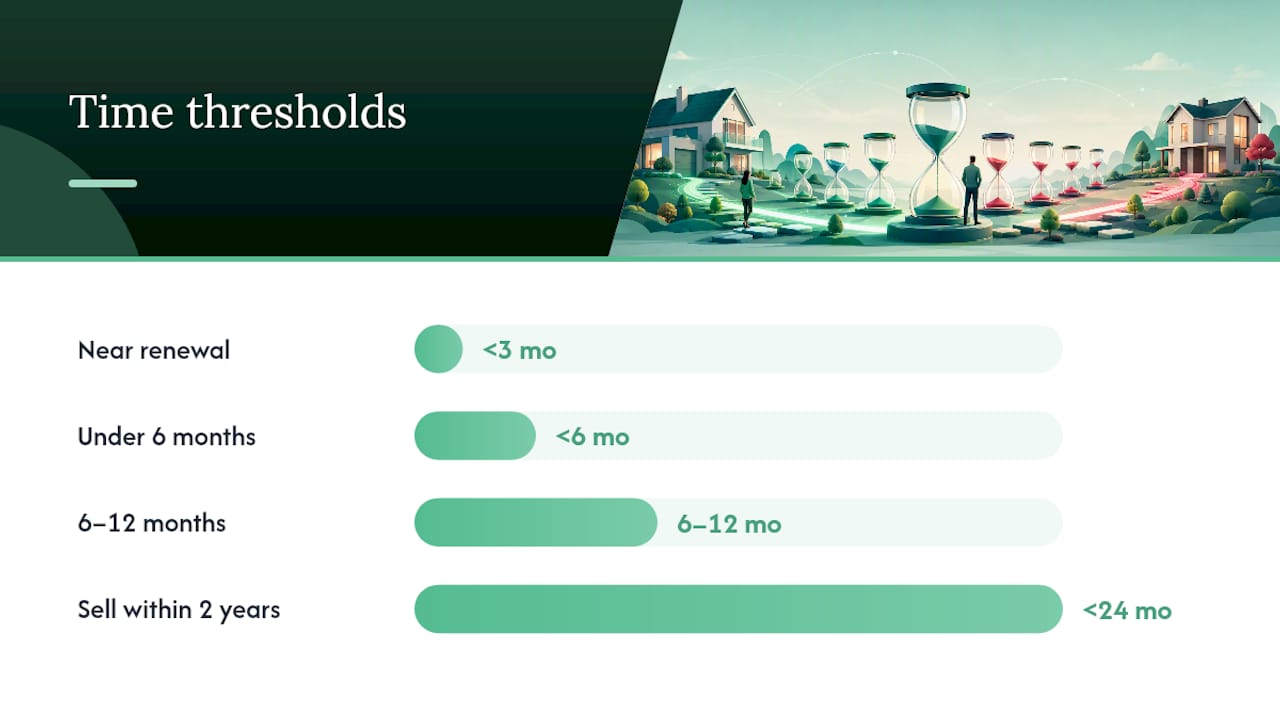
Timeline guidance:
- Near renewal (less than 3 months to go): almost always better to wait.
- 6–12 months remaining: worth running the numbers carefully; break costs are lower and break-even periods are shorter.
- More than 12 months remaining: break costs can be substantial; a broker comparison is strongly recommended before proceeding.
- Fixed-to-fixed refinancing: you pay a break cost on the old loan and lock in a new fixed rate. This only makes sense if the new fixed rate is materially lower and your break-even period is well within your planned holding period.
For detailed timing guidance, the Zenrgfinance article on refinancing timing best practices covers ten rules worth reading before you commit.
When the numbers are borderline, or when your loan involves an SMSF, a trust structure, or a business component, MoneySmart recommends seeking professional advice rather than relying on online calculators alone.
How to get an accurate break-cost quote from your lender or broker
The single most important step is asking for a written quote that specifies the calculation method, the wholesale rate used, and every fee included. A verbal estimate is not enough.
Exact questions to ask your lender:
- "Can you provide a written break-cost quote for my loan account [number]?"
- "Which method do you use to calculate the break cost: IRD or three-month interest?"
- "What wholesale or swap rate are you using in the calculation today?"
- "Does the quote include the discharge fee, settlement fee, and any other charges?"
- "How long is this quote valid for?"
Documents to have ready before you call:
- Your loan account number
- Your current fixed interest rate and the date it was set
- Your fixed term expiry date
- Your current outstanding balance (from your last statement)
- A record of any extra repayments you have made during the fixed term
Pro Tip: Ask for the quote in writing via email or through your online banking portal. Request that the email states the expiry date of the quote, the method used, and the wholesale rate applied. This gives you a comparable document when you approach a second lender or a broker for a new loan offer.
Request quotes from at least two sources: your current lender and a broker who can model the new loan side of the equation at the same time. That way you are comparing the full picture, not just the break cost in isolation.
Practical ways to reduce or avoid break costs
There are several legitimate strategies for minimising or sidestepping a break cost entirely. Each has trade-offs.
Strategies to consider:
- Wait until expiry: the cleanest option. No break cost, full flexibility to refinance at renewal. The trade-off is that you remain on your current rate until then.
- Loan portability: if you are moving house rather than refinancing for a better rate, ask your lender whether the fixed loan can transfer to the new property. Not all lenders offer this, and the new property must meet the lender's security criteria.
- Partial discharge: pay down a portion of the loan using savings or an offset account, then break only the remaining balance. This reduces the principal the break cost is calculated on.
- Blend-and-extend: some lenders will blend your current fixed rate with the new market rate and extend the fixed term, avoiding a formal break. The resulting rate is a weighted average, which may or may not be attractive.
- Roll costs into the new loan: you avoid paying the break cost upfront, but it is added to your new loan balance, increasing the amount you pay interest on. This raises your effective rate or extends your term.
- Negotiate with your lender: smaller lenders and credit unions sometimes have more flexibility than the major banks, particularly if you have a strong repayment history or other products with them.
- Use an offset account or redraw instead: if your goal is to reduce interest costs rather than access a lower rate, maximising your offset balance achieves a similar effect without triggering a break cost.
Pro Tip: If your lender offers a "rate lock" or "rate match" option, ask whether they can reprice your existing fixed loan rather than requiring a full break and refinance. Some lenders do this quietly for good customers, particularly when rates have moved significantly.
| Strategy | Pros | Cons |
|---|---|---|
| Wait until expiry | No break cost, full flexibility | Remain on current rate until then |
| Portability | Avoids break cost on property move | Lender approval required; not always available |
| Partial discharge | Reduces break cost principal | Requires available cash; partial cost still applies |
| Blend-and-extend | No formal break; stays with lender | Blended rate may not be competitive |
| Roll costs into new loan | No upfront cash needed | Increases balance or rate; higher lifetime cost |
| Negotiate with lender | May reduce or waive fees | Inconsistent; depends on lender and relationship |
How Zenrgfinance helped a client navigate a $14,000 break cost
Here is how a Zenrgfinance broker worked through a real client scenario (details anonymised).
Their lender quoted a break cost of $14,200.
The advisory process:
- Zenrgfinance obtained the written break-cost quote from the existing lender, confirmed the method (IRD) and the wholesale rate used.
- The broker modelled three refinance offers side by side, including total switching costs for each (discharge, legal, valuation).
- The break-even calculation showed 38 months to recover total switching costs of $16,100 at a monthly saving of $424.
- The broker modelled the term reset: the client had 23 years remaining. Refinancing into a new 25-year loan would add two years of interest, costing an estimated $18,000 more over the life of the loan despite the lower rate.
- The recommendation was to refinance into a 23-year term (matching the remaining term) at the new lender, accept the break cost, and recover it within the planned holding period of five-plus years.
The key insight for this client was that the break cost was not the deciding factor. The term reset was. By keeping the loan term the same, the lifetime interest saving was real and substantial. The break cost was simply the entry price.
Outcome: the client refinanced, paid the break cost, and is on track to save materially over the remaining loan life. Results like this are not guaranteed and depend on individual circumstances, rates, and lender terms. For a tailored assessment of your own situation, contact Zenrgfinance directly.
How Australian regulations shape break-cost calculations
Break costs in Australia are not purely a commercial matter between you and your lender. Several regulatory frameworks shape what lenders can charge and how they must disclose it.
The National Consumer Credit Protection Act 2009 (NCCP Act) requires lenders to disclose break costs clearly in the loan contract and in any written quote. Lenders cannot charge a break cost that exceeds their actual loss from the early repayment, a principle reinforced by ASIC's responsible lending guidance. This is why the IRD method is tied to actual wholesale rates rather than an arbitrary penalty.
Treasury's proposal to ban exit fees on new home loans applies specifically to variable-rate exit fees, not to fixed-rate break costs. Fixed-rate break costs remain permissible because they reflect a genuine hedging loss, not a deterrent fee. The distinction matters: if your lender is charging a "break cost" on a variable-rate loan, that is worth querying under the regulatory framework.
ASIC's MoneySmart guidance reinforces that lenders must tell you the break cost before you commit to exiting, and that you have the right to request a written calculation. If a lender refuses to provide a written quote with the method disclosed, that is a red flag worth escalating.
The Australian Financial Complaints Authority (AFCA) handles disputes about break-cost calculations. If you believe your lender has overcharged or used an incorrect method, AFCA provides a free dispute resolution pathway. Keep all written quotes and correspondence as evidence.
What do break costs typically cost in Australia?
Break costs vary so widely that a single "average" figure is misleading. The range depends on loan size, remaining term, and how far wholesale rates have moved since you fixed.
As a practical guide based on the worked examples and the IRD formula:
- Small loans ($200,000–$350,000) with 12 months or less remaining: break costs typically fall in the $1,000–$5,000 range when the rate differential is around 1.00%.
- Medium loans ($400,000–$600,000) with 18–24 months remaining: break costs commonly range from several thousand to around eighteen thousand dollars in a rate-cutting environment.
- Large loans ($700,000–$1,000,000+) with two or more years remaining: break costs can exceed tens of thousands of dollars when rates have fallen substantially.
These ranges are illustrative and based on the IRD formula applied to typical Australian loan sizes. Lenders using the three-month interest method will produce lower figures. Lenders applying a hedging margin on top of the IRD will produce higher ones.
The most important variable is the rate differential. When the RBA is in a cutting cycle and wholesale swap rates are falling, break costs on existing fixed loans rise. When rates are rising, break costs on existing fixed loans shrink toward zero, because the lender can redeploy the funds at a higher rate than you locked in.
The lender loyalty penalty guide at Zenrgfinance shows how borrowers in similar situations have navigated this.
What most homeowners get wrong about break costs
The number that appears on a lender's break-cost quote is not the number that should drive your decision. The number that matters is the break-even period, and even that is incomplete without accounting for the term reset.
Most homeowners focus on the break cost in isolation and either dismiss refinancing because the fee looks large, or proceed without modelling the lifetime interest effect of resetting their loan term. Both are mistakes.
The break cost is a one-time, recoverable cost. A term reset that adds five years to your loan is a permanent cost that compounds. A $15,000 break cost on a $500,000 loan is recovered in roughly three years if the rate saving is $400 per month.
The other thing homeowners consistently underestimate is the variation between lenders. Two lenders can quote break costs that differ by $8,000–$10,000 for the same loan scenario, simply because they use different methods or different wholesale rates. Getting a single quote and treating it as definitive is a common and costly mistake.
Zenrgfinance can model your break cost and refinancing options
Paying a break cost without knowing your break-even period is like booking a flight without checking the destination. Zenrgfinance takes the guesswork out of that calculation.

Zenrgfinance's mortgage brokers obtain written break-cost quotes from your current lender, model multiple refinance offers side by side, and run the full break-even analysis including term reset effects. You get a clear picture of whether refinancing saves you money over your actual holding period, not just on paper. For homeowners with SMSF lending needs, the team also covers SMSF loan structuring as part of the same conversation.
The service is commission-based, so there is no upfront fee for the consultation. To get a personalised break-cost assessment and refinancing comparison, visit the Zenrgfinance home refinancing page or book a session with a mortgage relationship manager at Zenrgfinance.
Sources
These are the primary Australian and international sources used in this article. Use them to check regulatory guidance, definitions, and wholesale-rate context when reviewing your own lender's quote.
- break fee — MoneySmart
- competitive and sustainable banking system — ban exit fees for new home loans — Treasury
- Reserve Bank of Australia
- What Are Break Costs? | Canstar
This article is general information, not a substitute for advice from a qualified financial advisor. Consult a qualified financial professional about your own circumstances before acting on anything here.