
Refinancing is the process of replacing your existing loan with a new one that offers better terms, and it is the most direct way to reduce your monthly repayments and free up cash. The industry term for this outcome is improved debt serviceability, and it sits at the heart of why refinancing improves cash flow for both homeowners and property investors. Approximately 2.7 million homeowners with 30-year fixed mortgages could lower their monthly payments by refinancing at current market rates. That figure tells you the opportunity is real and widespread, not just a niche strategy for the financially savvy.
Why refinancing improves cash flow: the core mechanics
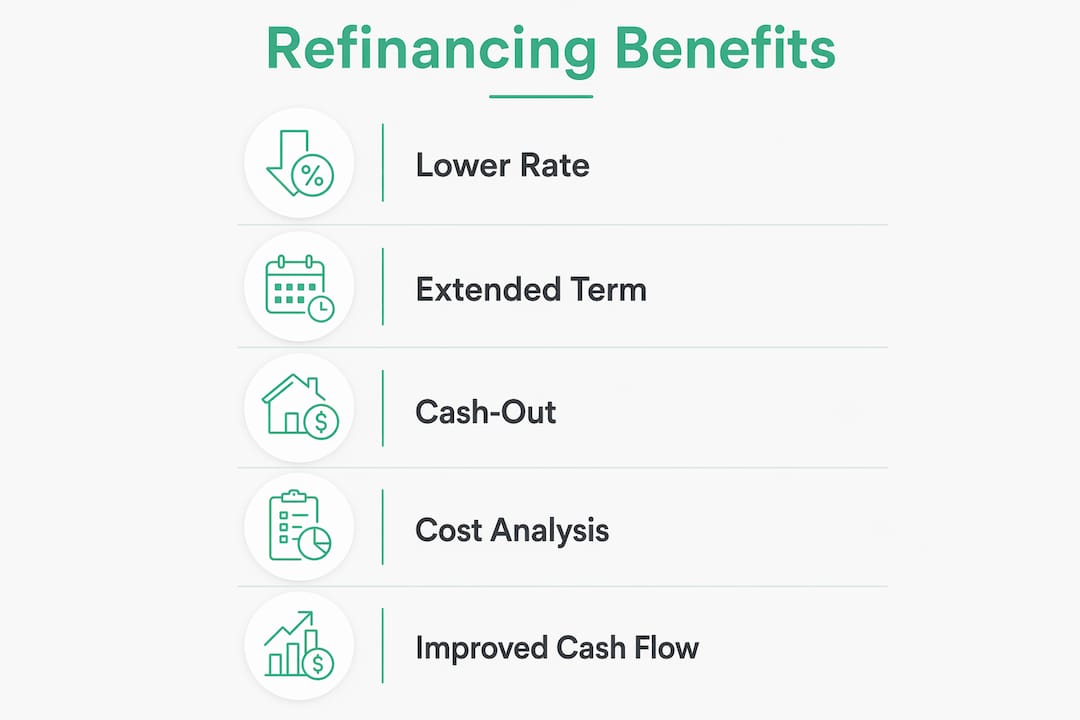
Refinancing lowers your monthly outgoings through three main levers: a lower interest rate, a longer loan term, or a switch in loan structure. Each one reduces the amount you pay each month, which puts more money back in your pocket.
A lower interest rate is the most powerful lever. When your rate drops, a smaller share of each repayment goes toward interest, so your required monthly payment falls. Every 0.01% drop in rates can benefit around 90,000 borrowers. That scale shows just how sensitive monthly repayments are to even small rate movements.

Extending your loan term spreads the remaining principal over more years. If you have 20 years left on your mortgage and refinance into a new 30-year loan, your monthly repayment drops because you are paying off the same debt over a longer period. The trade-off is that you pay more total interest over the life of the loan. For homeowners under financial pressure right now, the immediate cash flow relief often outweighs that long-term cost.
Switching from variable to fixed rates also shapes cash flow predictability. Fixed rates are usually slightly higher, but they lock in your repayment amount so you can budget with confidence. Variable rates can be cheaper when the market moves in your favour, but they carry the risk of rising repayments. For investors managing multiple properties, predictable repayments make portfolio cash flow far easier to manage.
- Lower interest rate: reduces the interest component of each repayment directly
- Extended loan term: spreads principal repayments over more years, lowering the monthly figure
- Fixed rate switch: removes repayment uncertainty, supporting consistent cash flow planning
- Variable rate switch: can reduce repayments when market rates fall, though with added risk
Pro Tip: If you are refinancing primarily for cash flow relief, ask your broker to model both a rate reduction and a term extension simultaneously. The combined effect on your monthly repayment is often larger than either change alone.
What are the costs and breakeven points in refinancing?
Refinancing is not free, and the upfront costs are the main reason some homeowners end up worse off. Understanding the breakeven point is the single most important calculation before you sign anything.
Closing costs typically range from 2% to 5% of the loan amount. On a $350,000 mortgage, that means paying between $7,000 and $12,000 upfront. Those costs need to be recovered through monthly savings before refinancing actually improves your financial position.
The breakeven calculation is straightforward:
- Add up all closing costs. Include lender fees, valuation fees, discharge fees, and any break costs on a fixed-rate loan.
- Calculate your monthly saving. Subtract your new monthly repayment from your current one.
- Divide total costs by monthly saving. The result is the number of months until you break even.
- Compare that to your planned stay. If you plan to sell or move before the breakeven point, refinancing costs you money rather than saving it.
A $7,000 closing cost with $174 monthly savings produces a 40-month breakeven point. That is just over three years. If you plan to stay in the property for five or more years, refinancing makes clear financial sense. If you are selling in two years, it does not.
| Loan amount | Closing costs (3%) | Monthly saving | Breakeven (months) |
|---|---|---|---|
| $250,000 | $7,500 | $150 | 50 |
| $350,000 | $10,500 | $174 | 60 |
| $500,000 | $15,000 | $250 | 60 |
Pro Tip: Ask your lender for a full fee schedule in writing before you apply. Some fees, like discharge fees from your current lender, are easy to overlook but can add $1,000 or more to your total closing costs.
How does cash-out refinancing improve cash flow?
Cash-out refinancing is a specific type of refinance where you borrow more than your current loan balance and receive the difference as cash. It is a way to access the equity you have built up in your property without selling it.
Cash-out refinancing allows you to access home equity up to roughly 80% of your property's current value. If your home is worth $600,000 and your current loan balance is $300,000, you could potentially access up to $180,000 in cash. That liquidity can be used to consolidate high-interest debt, fund renovations, or cover investment costs.
The cash flow benefit is most obvious when you use the funds to pay off high-interest consumer debt. Replacing credit card debt at 20%+ APR with mortgage debt at around 7% reduces your total monthly interest expense significantly. That difference flows directly back into your monthly cash position.
There are real risks to understand before going down this path:
- Higher loan balance: your monthly mortgage repayment increases, which can offset cash flow gains if not managed carefully
- Secured debt conversion: unsecured credit card debt becomes secured against your home, meaning your property is at risk if you cannot repay
- Longer repayment period: spreading consumer debt over a 30-year mortgage term means paying far more total interest, even at a lower rate
- Equity reduction: drawing down equity reduces your financial buffer if property values fall
Cash-out refinancing works best as a deliberate financial strategy, not a quick fix. Used well, it can genuinely improve your monthly cash flow. Used carelessly, it can put your home at risk.
When does refinancing make the most financial sense?
Timing matters as much as the numbers. Refinancing at the wrong moment can cost you more than it saves, even if the rate looks attractive.
The industry standard benchmark is a rate reduction of at least 0.75% to 1.0% for refinancing to be cost-effective. Smaller reductions can still work for long-term homeowners, but the margin for error shrinks. If your current rate is 7.25% and you can access 6.46%, that 0.79% reduction sits right at the threshold where refinancing starts to make clear financial sense.
For property investors, the timing signals are slightly different. Refinancing at least six months before balloon payments or covenant thresholds gives you negotiating leverage and avoids crisis refinancing on poor terms. Waiting until you are under pressure forces you to accept whatever terms the lender offers.
Strong signals that refinancing will improve your cash flow:
- Your current rate is more than 0.75% above the best available rate for your loan type
- You plan to hold the property beyond the breakeven period
- You carry high-interest consumer debt that could be consolidated at a lower rate
- Your loan has a balloon payment approaching within 12 months
- Your fixed-rate period is ending and you face a significant rate increase
Signals to hold off:
- You plan to sell within two to three years
- Your current loan has high break costs on a fixed rate
- The rate difference is less than 0.5% and your closing costs are above average
- Your credit profile has weakened since your original loan, which could result in a higher rate
"Refinancing is not about chasing the lowest rate. It is about finding the right rate at the right time for your specific financial position and goals."
You can also explore refinancing options for homeowners that go beyond rate reductions, including removing lenders mortgage insurance and restructuring loan features. For investors managing a property portfolio, property investment finance strategies can help you assess when refinancing fits your broader plan.
Key takeaways
Refinancing improves cash flow by reducing monthly repayments through lower rates, extended terms, or equity access, but only when the breakeven analysis confirms the numbers work in your favour.
| Point | Details |
|---|---|
| Rate reduction threshold | A drop of at least 0.75% is the standard benchmark for refinancing to be cost-effective. |
| Breakeven analysis | Divide total closing costs by monthly savings to find how many months until you profit. |
| Cash-out equity access | You can access up to 80% of your property's value to consolidate debt and improve monthly cash flow. |
| Timing for investors | Refinance at least six months before balloon payments to maintain leverage and avoid poor terms. |
| Hold-off signals | Selling within two to three years or a rate gap below 0.5% usually means refinancing costs more than it saves. |
Allen's take: what most people get wrong about refinancing
Most homeowners focus entirely on the interest rate and ignore everything else. That is the most common mistake I see, and it costs people real money.
The breakeven analysis is not optional. I have spoken with homeowners who refinanced to save $120 a month, paid $9,000 in closing costs, and then sold the property 18 months later. They lost money. The rate was genuinely lower. The decision was still wrong.
One thing that surprises people is that you do not always need a full refinance to improve your cash flow. Requesting a new appraisal from your current lender can eliminate Private Mortgage Insurance without the cost and paperwork of a full refinance, potentially saving $100–$300 per month. That is a meaningful cash flow improvement with almost no downside.
For investors with multiple properties, I always recommend reviewing the entire portfolio before refinancing a single loan. Sometimes the best move is to consolidate two loans, not just reprice one. And if you have a balloon payment coming up, do not wait. Proactive refinancing six months out gives you options. Waiting until the last month gives the lender all the power.
The other thing worth knowing: one in two Australian families are currently thinking about refinancing. That means lenders are competing for your business right now. Use that to your advantage.
— Allen
Ready to see what refinancing could save you?
Refinancing can genuinely improve your monthly cash flow, but the right outcome depends on your specific loan, property value, and financial goals. A personalised assessment makes all the difference between a refinance that saves you money and one that costs you more than expected.

Zenrgfinance works with homeowners and property investors across Australia to find refinancing solutions that actually improve cash flow, not just lower the rate on paper. Whether you are looking to reduce monthly repayments, access equity, or consolidate debt, a mortgage relationship manager can model your breakeven point, compare current market options, and guide you through the process from start to finish. You can also use the savings calculator to get a quick picture of what refinancing could mean for your monthly budget.
FAQ
Why does refinancing improve cash flow?
Refinancing replaces your existing loan with one at a lower rate or longer term, which reduces your monthly repayment and frees up cash each month. The improvement in cash flow is direct and immediate once the new loan settles.
What is the minimum rate drop that makes refinancing worthwhile?
The standard industry benchmark is a rate reduction of at least 0.75% to 1.0%. Smaller reductions can still work for long-term homeowners, but the savings take longer to offset closing costs.
How long does it take to break even after refinancing?
A typical breakeven period ranges from 40 to 69 months depending on closing costs and monthly savings. If you plan to hold the property beyond that point, refinancing improves your overall financial position.
Can cash-out refinancing really improve monthly cash flow?
Yes, when the funds are used to pay off high-interest debt. Replacing credit card debt at 20%+ with mortgage debt at around 7% reduces your total monthly interest expense, which improves cash flow directly.
Is refinancing a good idea for property investors?
Refinancing works well for investors who can confirm the breakeven period fits their investment horizon. Investors should also refinance well before balloon payments to maintain negotiating leverage and avoid being forced into poor terms.