
A no-cost refinance is not free. The name is a little misleading: what it actually means is that your closing costs are shifted somewhere else, either into a higher interest rate or rolled into your new loan balance. No cash leaves your pocket at settlement, but you will pay for those costs over time.
Here is how lenders typically pull it off:
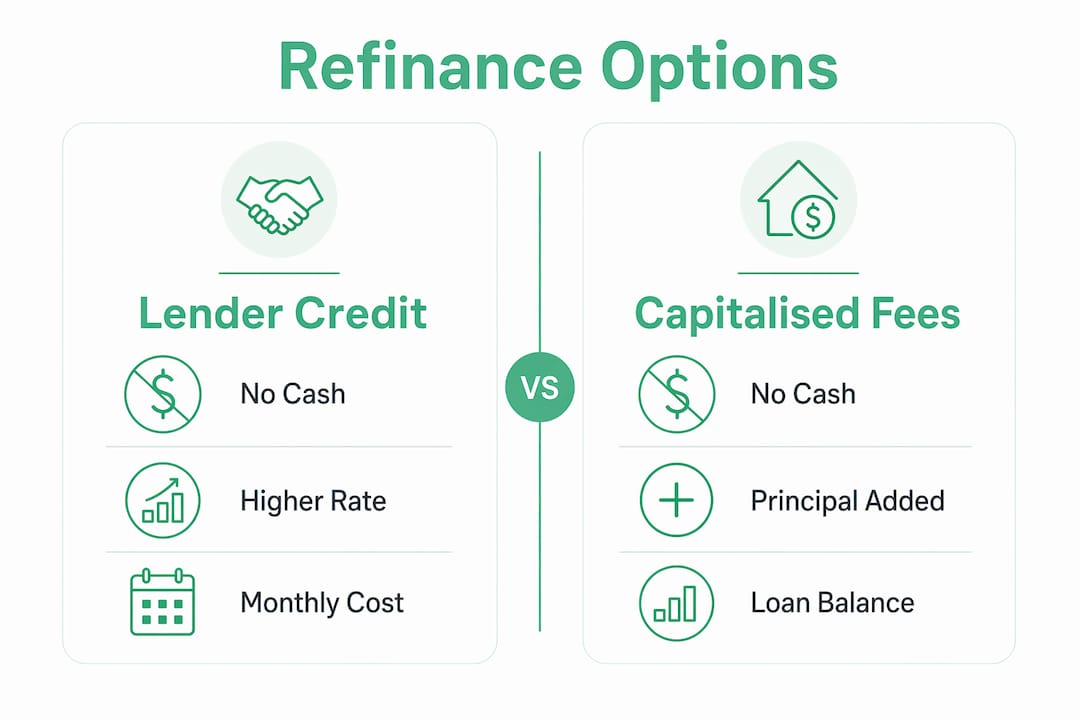
- Lender credit (higher rate): The lender raises your interest rate slightly and uses the extra yield to cover your upfront fees. You pay nothing at settlement but carry a higher rate for the life of the loan.
- Capitalised fees: Your closing costs are added to your loan principal. Your rate stays the same, but your balance grows, which means you are paying interest on those fees for years.
The immediate benefit is obvious: no cash required at settlement. MoneySmart recommends comparing total costs and how long you plan to keep the loan before choosing this path.
Quick verdict: A no-cost refinance suits Australian homeowners who plan to sell or refinance again within a few years, or who simply do not have the upfront savings right now. If you are staying put for the long haul and can afford the closing costs, paying them upfront almost always costs you less overall.
Table of Contents
- How does a no-cost refinance actually work?
- How does a no-cost refinance differ from a traditional one?
- Pros and cons of a no-closing-cost refinance
- Australia-specific factors to check before you decide
- How to calculate your break-even point
- How to arrange a no-cost refinance in Australia
- When does a no-cost refinance make sense? Broker perspective
- Key takeaways
- The case for running the numbers before you commit
- Ready to model your no-cost refinance options?
- Useful sources for Australian homeowners
How does a no-cost refinance actually work?
There are two distinct structures, and understanding both helps you spot which one a lender is offering you.
Option A: Lender credit via a higher interest rate
The lender agrees to cover your closing costs in exchange for a higher rate on your new loan. That rate premium generates extra interest income for the lender over time, which is how they recoup the credit they gave you. The CFPB confirms that both lender credits and capitalised fees increase total interest paid over the loan life.

Option B: Capitalising fees into the loan
Instead of a rate adjustment, the lender simply adds your closing costs to your new principal. Your rate may look competitive, but your starting balance is higher. This affects your Loan-to-Value Ratio (LVR) and, in some cases, can push you above the 80% LVR threshold that triggers Lenders Mortgage Insurance (LMI).

How the two structures compare
| Feature | Lender credit (higher rate) | Capitalised fees |
|---|---|---|
| Cash at settlement | $0 | $0 |
| Monthly repayment | Higher (rate uplift) | Slightly higher (larger balance) |
| Total interest over loan life | Higher | Higher |
| Effect on loan balance | Unchanged | Increased |
| LVR impact | None | Increases LVR |
| LMI risk | Low | Possible if LVR crosses 80% |
Some lenders combine both approaches, using a modest rate uplift plus a partial capitalisation to cover different fee types. Always ask for the Key Facts Sheet and read it line by line. The Federal Reserve's consumer guide warns that lenders define "no-cost" differently, so what one lender includes another may not.
How does a no-cost refinance differ from a traditional one?
With a traditional refinance, you pay closing costs upfront at settlement. In Australia, these typically cover discharge fees, application fees, valuation costs, and government charges. Paying them outright is a real cash hit, but your new loan starts clean: lower balance, lower rate, and no hidden premium baked in.
A no-cost refinance flips that equation. You preserve your cash today, but the loan costs more over time.
Three practical differences worth knowing:
Upfront cash requirement. A traditional refinance requires you to have funds ready at settlement. A no-cost option removes that barrier entirely, which is genuinely useful if your savings are tied up elsewhere or rates have moved and you want to act quickly.
Total interest and cost over the loan life. This is where the no-cost path loses ground. A small rate uplift can add thousands of dollars in interest over a long-term loan. Capitalising fees has a similar compounding effect because you are paying interest on the fee amount for the remainder of the loan.
Effect on equity and LVR. A traditional refinance leaves your equity untouched. Rolling fees into the loan reduces your equity from day one and pushes your LVR higher. If you are close to the 80% LVR mark, that shift could trigger LMI, which is a significant extra cost. Understanding how your deposit size shapes the rate you pay is directly relevant here.
The decision hinge is simple: how long do you plan to keep this loan? If you will sell or refinance again within two to three years, the no-cost path often wins. Beyond that, paying upfront usually saves you more.
Pros and cons of a no-closing-cost refinance
Pros
- Preserves cash at settlement. No upfront fees means your savings stay intact for other priorities, whether that is a renovation, an emergency fund, or an investment.
- Lowers the barrier to refinancing. When rates drop, you can move quickly without needing to accumulate closing cost savings first.
- Can still deliver real savings. If the new rate is meaningfully lower than your current rate, even a slightly higher no-cost rate may beat what you are paying now.
- Useful for short-term holds. If you plan to sell within a few years, you may never reach the break-even point on upfront costs anyway.
Cons
- Higher total interest. Whether through rate uplift or a larger balance, you will pay more over the life of the loan.
- Larger loan balance if fees are capitalised. This reduces your equity and can affect future borrowing capacity.
- Potential LMI trigger. Capitalising fees can push your LVR above 80%, which may require you to pay LMI, often thousands of dollars.
- Possible prepayment penalties. Lenders sometimes include early exit conditions on no-cost deals to protect the yield they sacrificed upfront. Always ask about break fees if you expect to sell or refinance again soon.
- Definitions vary. As industry explainers note, "no-cost" can mean lender fees only, third-party fees, or full coverage including prepaid items. What is covered differs between lenders.
Pro Tip: Before accepting a no-cost offer, ask your lender or broker to itemise exactly which fees are covered and which are not. Some lenders waive their own application fee but still charge you for valuation, title search, or government registration costs. Getting this in writing protects you.
Australia-specific factors to check before you decide
Not all no-cost refinance offers are equal, and a few Australian-specific considerations can make or break the deal.
Key items to verify
- Exact rate uplift: Ask for the rate with and without the lender credit so you can calculate the actual premium you are accepting.
- Which fees are covered: Confirm whether the "no-cost" covers discharge fees, application fees, valuation, and government charges, or just some of them.
- LVR impact: If fees are capitalised, recalculate your LVR. Crossing 80% can trigger LMI, which may cost more than the fees you avoided.
- Early exit or break fees: Fixed-rate loans carry break costs that can be substantial. Variable-rate loans may still have discharge fees.
- Broker incentives: Ask your broker whether any lender rebates or incentives are being used to fund the no-cost arrangement, and how that affects your rate.
Questions to ask your broker or lender
You can copy these directly into an email or bring them to a meeting:
- "What is the rate difference between your standard refinance and the no-cost option?"
- "Which specific fees does the no-cost arrangement cover?"
- "If fees are capitalised, what will my new LVR be, and does that trigger LMI?"
- "Are there any early exit fees or prepayment penalties on this loan?"
- "Are you using a lender rebate or incentive to fund this arrangement?"
MoneySmart's guidance on switching home loans is a solid starting point for understanding your rights and what lenders are required to disclose. ASIC also provides general consumer protections through its financial services licensing framework, which covers mortgage brokers and lenders operating in Australia.
Aligning this decision with your broader financial goals is worth doing before you commit to any refinance structure.
How to calculate your break-even point
The break-even calculation tells you how long it takes for your monthly savings to outweigh the extra cost of a no-cost arrangement. Here is how to work through it.
Step-by-step method
- Identify the closing costs you are avoiding. Typical Australian refinance costs include discharge fees, application fees, valuation, and registration charges. Closing costs are commonly estimated at a few percent of the loan amount internationally; Australian costs tend to be lower but still meaningful.
- Calculate your monthly saving from the new rate. Subtract the new monthly repayment from your current monthly repayment.
- Divide costs avoided by monthly saving. The result is your break-even in months.
Break-even formula:
Break-even (months) = Upfront costs avoided ÷ Monthly repayment saving
Worked example in AUD
Suppose you have a loan and are refinancing with a traditional refinance paying closing costs upfront, or a no-cost refinance that covers fees but results in a higher rate. The break-even period depends on your monthly savings versus avoided closing costs. If you sell or refinance again within a few years, the no-cost path leaves you ahead; beyond that, paying upfront typically saves more. Capitalising fees increases your loan balance and results in paying interest on the added amount for the remaining term.
Adjusting the assumptions
Change the term length and the numbers shift considerably. A shorter remaining term means less time for interest to compound, which can make capitalising fees less damaging. A larger rate uplift (say 0.40% instead of 0.20%) pushes the no-cost break-even out further. Use a tool like the property buying cost calculator to model your specific numbers.
How to arrange a no-cost refinance in Australia
Getting a genuine no-cost outcome takes a bit of preparation and the right negotiation approach.
Practical steps to get started
Start by gathering your current mortgage details: your outstanding balance, current rate, remaining term, and any fixed-rate expiry dates. Then approach multiple lenders through a broker who can compare offers side by side. Ask each lender for a Key Facts Sheet that shows the comparison rate, total fees, and the exact structure of any no-cost arrangement.
What to negotiate
The role of a broker in the refinancing process is particularly valuable here. Brokers can access lender incentives and rebates that are not available directly to consumers, and professional negotiation frequently produces better outcomes than simply accepting a standard advertised no-cost product. Specifically, ask your broker to:
- Request explicit lender credits rather than capitalised fees where possible, to protect your LVR.
- Negotiate selective fee waivers on discharge and application fees before accepting any rate uplift.
- Compare the rate premium across at least three lenders so you know whether the uplift is competitive.
What lenders typically require
Australian lenders generally want recent payslips or tax returns, a current loan statement, a property valuation (which may be covered under the no-cost arrangement), and evidence of your current expenses. Your credit score and LVR both affect whether a lender will offer a no-cost structure and at what rate premium.
When does a no-cost refinance make sense? Broker perspective
There are situations where a no-cost refinance is clearly the right call, and others where it quietly costs you more than it saves.
Three scenarios where it works well
Short hold or planned sale. If you expect to sell within two to three years, you will likely never reach the break-even point on upfront costs. A no-cost structure lets you capture a lower rate now without the cash outlay.
Quick rate drop play. When rates fall sharply, acting fast can save you significantly even on a slightly higher no-cost rate. Waiting to accumulate closing cost savings could mean missing months of lower repayments.
Cash preservation. If your savings are committed to a renovation, a tax bill, or an investment opportunity, keeping that cash liquid may be worth more than the interest saving from paying costs upfront.
When it does not make sense
Long-term holders who plan to keep the loan for ten or more years will almost always pay less by covering costs upfront. The compounding effect of even a small rate uplift over a decade is substantial.
Zenrgfinance broker tips
The team at Zenrgfinance recommends three steps before committing to any no-cost arrangement:
- Run a break-even model using your actual loan size, remaining term, and the exact rate uplift on offer.
- Have your broker calculate the LVR impact before agreeing to capitalise any fees, particularly if you are near the 80% threshold.
- Negotiate fee waivers first. Brokers can often negotiate waived fees or access lender credits while keeping rate uplift minimal, which is a better outcome than simply accepting a standard no-cost product.
For a deeper look at the benefits of refinancing beyond cost structures, it is worth understanding the full picture before you decide.
A Zenrgfinance consultation typically covers a break-even model for your specific loan, a comparison of lender offers including no-cost and traditional structures, and a negotiation plan tailored to your situation. Prepare your most recent loan statement, two recent payslips, and your property's estimated current value before your first meeting.
This article is general information only, not personal financial advice. Confirm current rates, fees, and eligibility with a qualified mortgage broker or your lender before making any refinancing decision.
Key takeaways
A no-cost refinance shifts closing costs into your rate or loan balance rather than eliminating them, so the decision always comes down to how long you plan to keep the loan.
| Point | Details |
|---|---|
| It is not free | Costs move into a higher rate or larger loan balance; you pay over time, not upfront. |
| Two structures exist | Lender credit (higher rate) or capitalised fees; each affects your LVR and total interest differently. |
| Break-even is the key test | Divide upfront costs avoided by your monthly saving to find how many months until you come out ahead. |
| LVR and LMI risk | Capitalising fees increases your loan balance and can push LVR above 80%, potentially triggering LMI. |
| Zenrgfinance can model it for you | A broker consultation covers a break-even calculation, lender comparison, and negotiation plan for your exact situation. |
The case for running the numbers before you commit
Most homeowners I speak with assume "no-cost" means the lender is doing them a favour. It rarely works that way. What lenders are actually doing is converting a one-time fee into a recurring revenue stream, either through a rate premium or a larger balance. That is not inherently bad, but it means the value of the arrangement depends entirely on your timeframe.
What I find underappreciated is the negotiation angle. Many homeowners accept the first no-cost offer they see without realising that a broker can often achieve a similar cash outcome through selective fee waivers and lender rebates, without the rate uplift. That distinction matters because it means you can sometimes get a genuine low-cash refinance without paying the long-term price of a higher rate.
The break-even calculation is not complicated, but most people skip it. If you are planning to stay in your home for five or more years, run the numbers before you decide. A $4,500 fee paid upfront at a lower rate will almost always beat a no-cost arrangement over that horizon. If you are selling in two years, the maths flips completely.
The right answer is not universal. It is specific to your loan size, your remaining term, the rate difference on offer, and how long you plan to stay. That is exactly what a good broker helps you model.
Ready to model your no-cost refinance options?
Sorting through lender offers and rate trade-offs on your own takes time, and the numbers can shift significantly based on your specific loan details. Zenrgfinance gives you a clearer path: a mortgage relationship manager who builds a break-even model for your exact situation, compares no-cost and traditional refinance offers from multiple lenders, and puts together a negotiation plan before you sign anything.

Before your consultation, pull together your most recent loan statement, two payslips, and a rough estimate of your property's current value. That is all you need to get a personalised comparison. From there, the Zenrgfinance team handles lender outreach, fee negotiation, and the paperwork.
Book a mortgage consultation with Zenrgfinance today and get a clear picture of what a no-cost refinance would actually cost you over your timeframe, before you commit to anything.
Useful sources for Australian homeowners
- MoneySmart — Switching home loans: ASIC's consumer guidance on comparing refinance costs, understanding lender fees, and knowing when switching makes financial sense. Start here for a regulator-backed overview.
- CFPB — No-cost or no-closing-cost loans explained: A plain-language US consumer finance explainer on how lender credits and capitalised fees work. Useful for understanding the mechanics, though Australian fee structures differ.
- Federal Reserve — A Consumer's Guide to Mortgage Refinancings: Covers prepayment penalties, break-even analysis, and what to look for in loan disclosure documents. Internationally focused but the principles apply directly.
- HSH — What is a no-cost refinance?: A detailed industry explainer covering the different forms of no-cost arrangements and common misconceptions about what lenders actually cover.
- Zenrgfinance — Home refinancing services: Overview of how Zenrgfinance approaches refinancing for Australian homeowners, including the broker process and what to expect at each stage.