
Refinancing is defined as replacing your existing home loan with a new loan, typically from a different lender, to secure a lower interest rate or better terms. Done right, it is one of the most direct ways to reduce home loan repayments refinancing delivers real monthly savings. Homeowners who haven't reviewed their loans in over two years may be overpaying by $400 or more per month compared to current market rates. That gap is not a small rounding error. It adds up to thousands of dollars a year sitting on the table. This guide walks you through how refinancing works, what it costs, how to do it step by step, and what to watch out for so you come out ahead.
How does refinancing reduce your home loan repayments?
Refinancing lowers your mortgage payments by moving you onto a loan with a lower interest rate, a longer term, or both. The interest rate reduction does most of the heavy lifting. For a $500,000 loan, a 0.30% rate reduction saves roughly $1,500 per year, or $45,000 over a 30-year term. That is a meaningful outcome from a single financial decision.

The industry benchmark for whether refinancing is worth pursuing is the break-even point. If your annual interest savings exceed your total switching costs within 12–18 months, refinancing stacks up. Refinancing is worthwhile when you cut 0.25% to 0.5% off a balance above $250,000. Below that threshold, the maths gets tighter and the decision needs more careful thought.
Zenrgfinance works with homeowners at exactly this point, running the numbers to confirm whether a switch genuinely saves money before any application is lodged. That kind of analysis upfront prevents costly mistakes later.
Are you eligible to refinance your home loan?
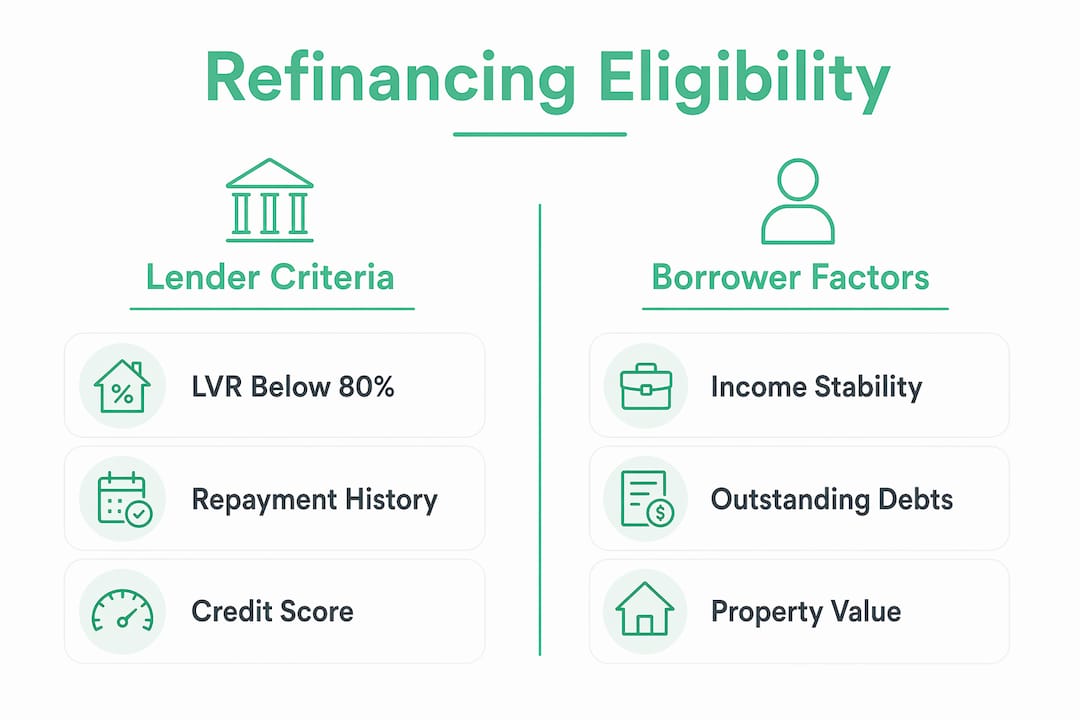
Not every homeowner qualifies for the best refinancing rates straight away. Lenders assess several factors before approving a new loan, and understanding these upfront saves time and frustration.
Key eligibility factors:
- Repayment history. A clean record of on-time repayments over the past 12 months signals low risk to lenders and unlocks better rates.
- Loan-to-value ratio (LVR). Your LVR is your loan balance divided by your property's current value. An LVR below 80% gives you access to the widest range of products and avoids Lenders Mortgage Insurance (LMI).
- Equity position. If your property has grown in value since purchase, your equity may have increased enough to push your LVR below 80%, removing LMI and improving your rate options.
- Credit score. Lenders pull a credit report as part of every application. Missed payments, defaults, or multiple recent credit enquiries can reduce your borrowing power.
- Employment stability. A recent job change can complicate an application. Read more about how job changes affect your mortgage before you apply.
The refinancing process typically takes 4–6 weeks from application to settlement. Switching costs generally fall between $500 and $2,000, covering discharge fees, application fees, and valuation costs. Knowing this upfront lets you calculate your break-even point accurately.
| Factor | What lenders look for |
|---|---|
| LVR | Below 80% for best rates; above 80% may require LMI |
| Repayment history | 12 months of clean, on-time payments |
| Credit score | No recent defaults or excessive credit enquiries |
| Employment | Stable income, ideally 6+ months in current role |
| Equity | Sufficient to support new loan amount at current property value |
Step-by-step process to refinance your home loan
Refinancing follows a clear sequence. Moving through each step methodically avoids delays and ensures you capture the savings you are targeting.
-
Review your current loan. Pull out your loan statement and note your current interest rate, remaining balance, loan term, and any exit fees. This is your baseline for comparison.
-
Compare home loan offers. Shop across lenders and compare rates, comparison rates, features, and fees. The comparison rate includes most fees and gives a truer picture of cost than the headline rate alone. Use the loan repayment calculator to model different scenarios.
-
Calculate your break-even point. Divide your total switching costs by your monthly saving. If switching costs are $1,500 and you save $200 per month, your break-even is 7.5 months. That is well within the 12–18 month benchmark.
-
Gather your documents. Lenders require payslips, tax returns, bank statements, your current loan details, and proof of identity. Having these ready before you apply speeds up the process considerably.
-
Lodge your application. Submit your application to the new lender. They will order a property valuation and conduct a credit assessment. This stage typically takes 2–3 weeks.
-
Review and sign the loan offer. Read the loan contract carefully. Confirm the rate, fees, repayment schedule, and any conditions before signing.
-
Settlement. Your new lender pays out your old loan. Your old lender discharges the mortgage. You begin repayments on the new loan. The full refinance application process from application to settlement typically wraps up within 4–6 weeks.
Pro Tip: Request a rate match from your current lender before lodging an application elsewhere. Lenders often have retention rates not advertised publicly, and a quick phone call can sometimes secure a better deal without the paperwork of a full switch.
Common mistakes to avoid when refinancing
Refinancing can backfire if you focus only on the monthly repayment figure and ignore the bigger picture. These are the errors that cost homeowners the most.
-
Resetting your loan term. Refinancing often resets your loan back to a 30-year term. Extending the term lowers monthly payments but significantly increases total interest paid over the life of the loan. If you have 22 years left on your current loan, refinancing into a new 30-year loan adds 8 years of interest. Use the loan term reset guide to understand this impact before you commit.
-
Rolling fees into the loan balance. Adding switching costs to your new loan balance means you pay interest on those fees for the life of the loan. Financial advisors highlight that this approach can quietly erode the savings you were chasing.
-
Ignoring break costs on fixed-rate loans. If you are mid-way through a fixed-rate period, your lender may charge a break cost that runs into thousands of dollars. Always get a written break cost figure before proceeding.
-
Refinancing for the wrong reason. Lower monthly repayments feel good. But if the rate saving is minimal and the term resets, you may pay more in total. Refinancing is best viewed as a strategy to reduce lifetime interest costs, not just to ease short-term cash flow.
"The goal of refinancing is not just a lower number on your monthly statement. The goal is to pay less interest over the life of your loan. Those two things are not always the same."
Alternatives to refinancing: home loan restructuring and recasting
Refinancing is not the only way to lower your mortgage payments. Two alternatives are worth knowing: mortgage recasting and home loan restructuring.
Mortgage recasting suits homeowners who are happy with their current interest rate but want lower monthly repayments. You make a lump-sum payment against your principal, and the lender re-amortises the loan over the remaining term. Recasting re-amortises your loan with a fee of just $150–$500, no credit check, and no new appraisal. This makes it a low-cost option for anyone with a windfall, such as an inheritance or a bonus, who wants to reduce monthly commitments without the paperwork of a full refinance.
Home loan restructuring is different again. Restructuring modifies the terms of your existing loan with your current lender, rather than replacing it. Restructuring is typically reserved for temporary financial hardship, adjusting repayments without switching loans. It is a collaborative process between you and your lender, not a market-driven rate comparison exercise.
| Option | Best for | Cost | Credit check |
|---|---|---|---|
| Refinancing | Better rate or features | $500–$2,000 | Yes |
| Mortgage recasting | Lower payments, same rate | $150–$500 | No |
| Loan restructuring | Temporary hardship relief | Varies | Usually no |
Pro Tip: Before lodging a refinance application, call your current lender and ask for a rate review. Negotiating with your lender can sometimes secure a better rate without the cost and effort of switching. It takes 10 minutes and costs nothing.
Key takeaways
Refinancing delivers the greatest benefit when your annual interest savings exceed switching costs within 12–18 months, and when you avoid resetting your loan term unnecessarily.
| Point | Details |
|---|---|
| Break-even benchmark | Annual savings must exceed switching costs within 12–18 months for refinancing to make sense. |
| Rate reduction threshold | A cut of 0.25%–0.5% on balances above $250,000 typically justifies switching costs. |
| Loan term risk | Resetting to a 30-year term lowers monthly payments but increases total interest paid. |
| Low-cost alternatives | Mortgage recasting reduces monthly payments for $150–$500 with no credit check required. |
| Lender negotiation | Asking your current lender for a rate match costs nothing and sometimes avoids a full refinance. |
What I've learned about refinancing after years in the mortgage industry
Refinancing is one of those decisions where the numbers tell most of the story, but the behaviour around the numbers matters just as much.
The homeowners I see come out ahead are the ones who treat refinancing as a financial review, not a one-time fix. They check their rate every 12–24 months, ask their lender for a review before shopping elsewhere, and when they do switch, they keep their repayments at the same level rather than pocketing the monthly saving. That last habit is the one most people skip. If your repayment drops by $300 per month and you keep paying the old amount, you chip away at principal faster and save significantly more over the life of the loan.
The biggest mistake I see is homeowners refinancing purely to lower the monthly number, then extending back to 30 years and feeling great about it. The monthly relief is real. The long-term cost is also real. Both things are true at the same time, and a good broker will show you both before you sign anything.
My honest advice: if you haven't reviewed your current home loan rate in the past two years, you are almost certainly paying more than you need to. The market has moved. Your loan probably hasn't. That gap is worth closing.
— Allen
How Zenrgfinance can help you lower your mortgage repayments
Knowing the theory behind refinancing is one thing. Knowing whether it makes sense for your specific loan, property value, and financial goals is another.

Zenrgfinance works with Australian homeowners to analyse their current loan, model the real cost of switching, and identify whether refinancing, recasting, or a lender negotiation is the right move. The team brings hands-on experience across a wide range of loan structures, from standard variable loans to complex investment portfolios. If you are ready to find out whether you are overpaying, connect with a mortgage relationship manager at Zenrgfinance for a personalised review. No jargon, no pressure, just clear numbers and practical advice.
FAQ
How long does refinancing a home loan take?
The refinancing process typically takes 4–6 weeks from application to settlement, depending on lender speed and loan complexity.
What does it cost to refinance a home loan in Australia?
Switching costs generally range from $500 to $2,000, covering discharge fees, application fees, and valuation costs.
How much do I need to save to make refinancing worthwhile?
Refinancing makes financial sense when you can reduce your rate by 0.25%–0.5% on a balance above $250,000 and recover switching costs within 12–18 months.
What is the difference between refinancing and home loan restructuring?
Refinancing replaces your loan with a new one, usually from a different lender. Restructuring modifies your existing loan with your current lender and is typically used for temporary financial hardship.
Can I lower my repayments without refinancing?
Yes. Mortgage recasting re-amortises your loan after a lump-sum payment for a fee of $150–$500, with no credit check or new application required.