
For most borrowers, yes: a broker earns their keep if you're self-employed, juggling a complex income, buying an investment property, or simply too time-poor to compare dozens of lenders yourself. The trade-off is real too, since brokers can't always access every direct-only deal, and fee structures vary between them and can include lender commissions and/or direct fees. Before you commit to one, ask for fee disclosure and a written comparison of at least two or three loan options.
TL;DR:
- Brokers are most valuable for borrowers with complex incomes, investment properties, or those needing guidance in market-wide lender options.
- Most brokers are paid through lender commissions, but borrowers should request written fee disclosures and total-cost comparisons before proceeding.
- For self-employed, credit-impaired, or investor borrowers, brokers can identify suitable lenders and navigate product complexities more effectively.
- Direct applications suit straightforward, low-risk borrowers, while brokers broaden access and improve approval chances for more nuanced financial profiles.
- Always check licensing, fee arrangements, and ask for detailed reasons behind lender recommendations to avoid red flags or suboptimal outcomes.
Table of Contents
- Pros and cons: what brokers add and where they fall short
- How mortgage brokers get paid and what to check in the fee arrangement
- When a broker is worth it: clear borrower scenarios
- How to choose a mortgage broker and what to ask in the first meeting
- Limitations and red flags: how to avoid weak outcomes
- The mortgage application timeline and who handles each step
- Mortgage broker vs direct lender: what actually differs
- Does your credit score change how useful a broker is?
- How brokers handle complex loans and special situations
- ZENRG Finance perspective: how we reduce risk and add value
- If you decide a broker is right for you: how to engage ZENRG Finance
- Sources
Pros and cons: what brokers add and where they fall short
The strongest argument for using a broker is time. Brokers manage the loan process from application through to settlement, which means less time spent chasing paperwork, decoding lender jargon, and following up on stalled applications. A good broker often has access to intermediary-only deals not widely advertised and can help present your application effectively to credit assessors.
There's a legal backstop here too. Brokers operate under a Best Interests Duty, a legal requirement to prioritise your outcomes over their own commission when giving credit assistance, and they must be licensed or operate under an authorised licence to provide that advice. A properly run brokerage will also hand you a written quote covering fees, features, loan term, and rate before you sign anything.
The downsides are just as worth knowing:
- Not every lender or product sits on a broker's panel, so a genuinely competitive direct-only deal can slip past you.
- Commission structures can create subtle incentive misalignment, even under the Best Interests Duty.
- Panel size and service quality vary enormously between brokerages, so one broker's "market-wide search" might be another's shortlist of six lenders.
Pro Tip: Ask your broker to name one lender they didn't recommend and why. A broker who can explain a rejected option in detail is doing real comparison work, not just picking whichever lender processes fastest.
Pros tend to outweigh cons when your situation has any complexity at all. For a straightforward, low-risk borrower with a simple PAYG income, the gap between broker and DIY narrows considerably.
How mortgage brokers get paid and what to check in the fee arrangement
Most brokers in Australia are paid through lender commission, often called a procuration fee, which is why the service can appear free to you as the borrower. Some brokers instead charge a direct fee, flat or percentage based, particularly for complex commercial or SMSF structuring work.
Many brokers offer a fee-free service while others charge borrowers directly, so confirming which model applies to you before engaging is worth the five minutes it takes. Our guide to mortgage broker fees breaks down both structures in more detail.
Before signing anything, ask for:
- Written fee disclosure including all costs and the source of any commissions.
- A total-cost comparison across the loan's likely fixed term, not just the headline rate.
- Clarity on whether the fee structure affects which lenders get recommended first.
When a broker is worth it: clear borrower scenarios
Complexity is the biggest signal. Brokers add most value for borrowers with non-standard incomes, investors and those refinancing who need a market-wide check, rather than for the simplest loan applications.
- Self-employed or variable income. Lenders assess these applications differently, and a broker who knows which ones are flexible on tax returns or business activity statements can save weeks of back-and-forth.
- Thin or damaged credit history. A broker familiar with which lenders take a pragmatic view of past hiccups can steer you away from an outright rejection.
- SMSF or investor lending. These loan structures involve extra compliance steps, and a broker experienced in this space understands the traps that catch first-timers.
- Previous bank decline. If one lender says no, a broker can often identify why and match you with a lender whose credit policy fits your profile.
- Simple salaried income with a strong direct offer already on the table. Here, a broker adds less. If your existing bank has offered a competitive rate or product transfer, the savings from switching may not offset the effort.
Even when you lean towards a broker, check both routes. Comparing a broker's recommendation against a direct offer from your own bank costs nothing and confirms you're not missing a better deal sitting in plain sight.
How to choose a mortgage broker and what to ask in the first meeting
Start by confirming licensing. Every legitimate broker operates under an Australian Credit Licence, either their own or as an authorised credit representative, and you can check this before you ever sit down with them.
Ask directly:
- How many lenders sit on your panel, and is it whole-of-market or restricted?
- How are you paid, and do you charge me a fee on top of lender commission?
- Can you show me a written fee disclosure before we go further?
- Can you give me an example of a similar case you've handled, and explain in writing why you're recommending this particular loan over the alternatives?
Pro Tip: Bring your last two payslips, two years of tax returns if self-employed, and a recent bank statement to the first meeting. A broker who can give you a genuine indication of borrowing power on the spot, rather than a vague "we'll get back to you," is one worth taking seriously.
Budget 30 to 60 minutes for that first consultation. Anything shorter usually means a surface-level chat rather than a real assessment of your position.
Limitations and red flags: how to avoid weak outcomes
Watch for pushy sales tactics, reluctance to put fees in writing, or a refusal to show you alternatives they considered and ruled out. Some mortgage products remain direct-only, so a broker's shortlist is never automatically the entire market.
- No written fee disclosure offered unprompted.
- No willingness to explain why a lender was chosen for speed rather than price.
- No comparison against at least one direct alternative.
Use our home loan comparison checklist to verify total cost, offset and redraw features against what's recommended. If something feels off, a second opinion is free and ASIC publishes guidance on where to escalate a complaint about credit assistance.
The mortgage application timeline and who handles each step
A broker-assisted loan generally moves through five stages, and knowing who owns each one helps you spot delays early. First comes the fact-find, where the broker gathers your income, expenses, and goals, usually within the first meeting. Second is the lender shortlist and recommendation, where the broker compares products and hands you a written explanation of why a particular loan fits.
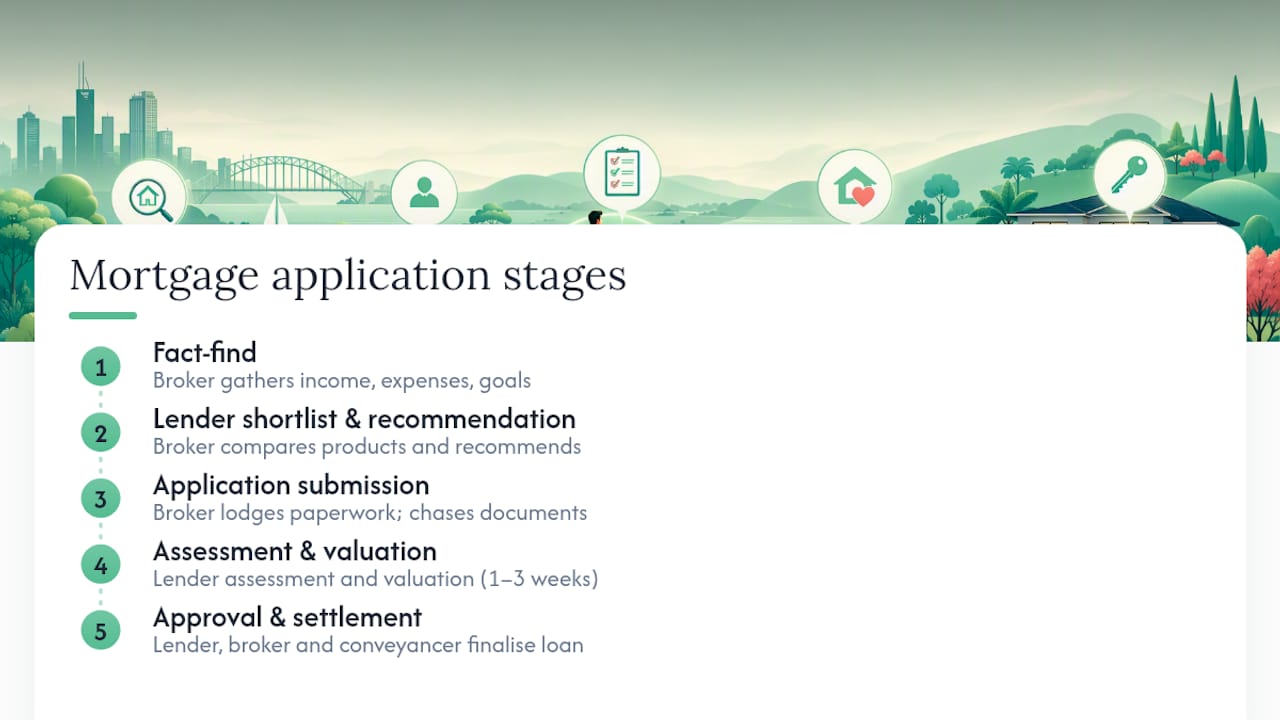
Third is the application submission, where the broker prepares and lodges paperwork with the chosen lender on your behalf, chasing supporting documents as needed. Fourth is assessment and valuation, which sits entirely with the lender's credit team. This stage typically takes one to three weeks depending on the lender's current volume and how clean your file is. A broker's job here is chasing updates and flagging issues before they become rejections.
Fifth is formal approval and settlement, where your broker, the lender, and often a conveyancer or solicitor coordinate to finalise the loan and transfer funds. Throughout this process, the broker acts as your single point of contact rather than you fielding calls from multiple lenders. That coordination role is often the single biggest time saving a broker offers, particularly for buyers juggling a job and a property search simultaneously. A comparable explanation of how a lender or broker process moves through hand-offs shows this pattern holds across different lending categories, not just home loans.
Mortgage broker vs direct lender: what actually differs
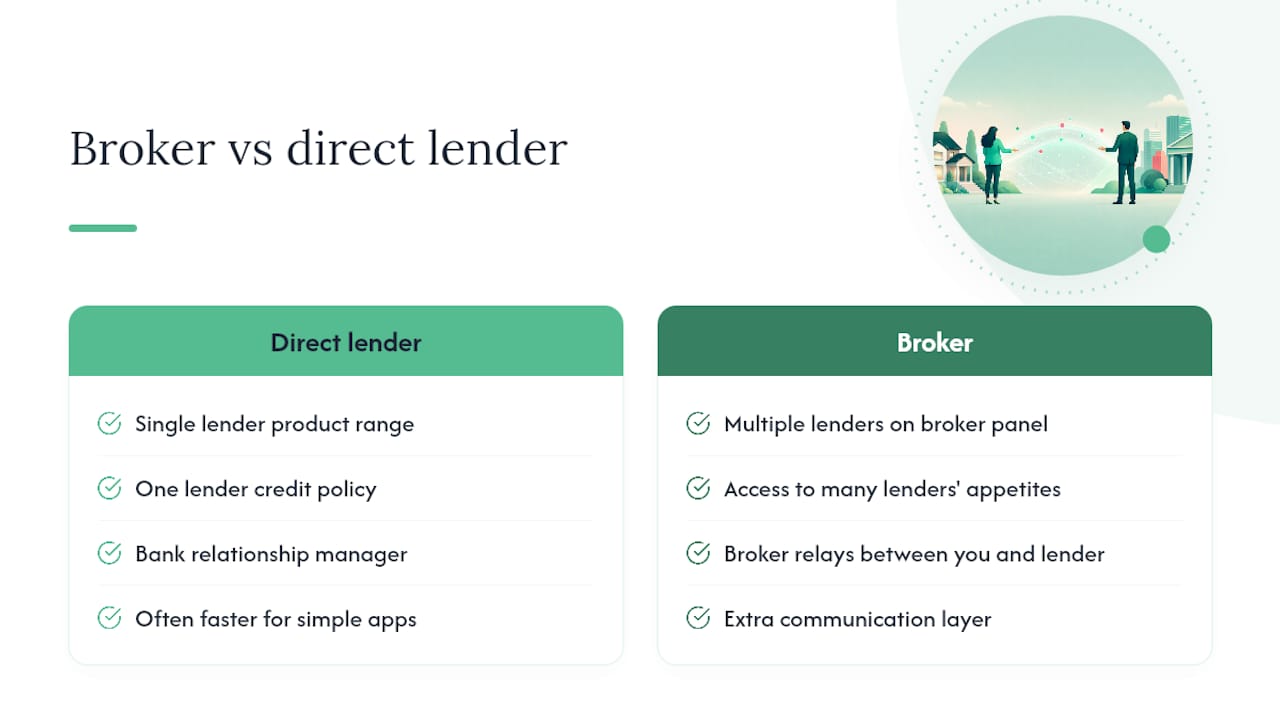
Going direct to a bank means dealing with one lender's product range, one credit policy, and one relationship manager who works for that bank, not for you. The experience is often faster for simple applications because there's no intermediary step, but you only see what that single lender is willing to offer.
A broker widens the field. Instead of one product range, you're looking at however many lenders sit on that broker's panel, which can range from a handful to dozens depending on whether they're tied or whole-of-market. The trade-off is an extra layer of communication, since your broker relays information between you and the lender rather than you speaking to the credit team directly.
Outcomes tend to differ most on approval likelihood rather than headline rate. A direct lender will only tell you if you fit their policy. A broker can often pre-empt a decline by matching your profile to a lender's known appetite before you apply, which matters more than people expect. A rejected application can leave a mark on your credit file, so avoiding an obvious mismatch has real value beyond convenience.
Where direct lending wins is simplicity for borrowers who already know exactly which bank and product they want, and who don't need help interpreting fine print or comparing structures. Where broking wins is breadth, particularly for anyone unsure which lender's policy actually fits their situation.
Does your credit score change how useful a broker is?
The stronger your financial profile, the smaller the gap between broker and DIY. Borrowers with excellent credit, stable PAYG income, and a low loan-to-value ratio are the customers every lender wants, so competitive offers tend to find them regardless of channel.
Flip that profile and the value of a broker rises sharply. A patchy credit history, inconsistent income, or a high loan-to-value ratio narrows your options fast, and not every lender assesses risk the same way. Some are notably more flexible on a default from years ago; others treat any blemish as an automatic decline. A broker who tracks these differences across their panel can steer you towards lenders likely to say yes, saving you from a string of rejected applications that could dent your file further.
Self-employed borrowers sit in a similar position even with strong finances, because inconsistent lender treatment of business income makes market knowledge genuinely valuable. If your last two years of tax returns tell an unusual story, a broker's familiarity with which lenders read that story generously is often worth more than any rate difference.
How brokers handle complex loans and special situations
Standard PAYG home loans are the easiest case for any channel. Complexity is where a broker's market knowledge earns its place.
SMSF lending is a clear example. These loans involve trustee structures, compliance checks, and a narrower set of lenders willing to fund them at all, making specialist experience genuinely valuable rather than optional. Guidance is available on self managed super fund lending for readers weighing this path.
Business owners seeking commercial or equipment finance face a different complexity: lenders assess business cash flow and asset types quite differently from residential income, and a broker who understands both worlds can package an application that a generalist lender would otherwise misread. Property investors juggling multiple existing loans face servicing calculations that vary between lenders too, meaning the same borrower can be approved by one bank and declined by another for the identical loan amount.
In every one of these cases, the broker's job is translation: presenting your financial situation in the format each lender's credit policy actually rewards.
ZENRG Finance perspective: how we reduce risk and add value
The mortgage broker debate usually gets framed as brokers versus banks, yet the more useful question is whether your broker actually treats the relationship as ongoing rather than transactional. Some brokerages build mortgage relationships around the client, whether that's a first home buyer working through their first pre-approval, an investor structuring a second or third property purchase, or a business owner navigating SMSF lending rules that punish guesswork.
Fee transparency isn't a courtesy, it's the whole basis of trust in this industry. We document our recommendations in writing and stay involved through settlement rather than disappearing once an application is lodged. Whichever broker you choose, run them through the checklist above. If they can't answer it comfortably, that tells you something.
— Allen
If you decide a broker is right for you: how to engage ZENRG Finance
If the scenarios above sound like your situation, whether that's self-employed income, an SMSF structure, or simply not having the hours to compare panels yourself, some mortgage relationship services are built around exactly that kind of complexity. They don't just find a rate; they stay attached to your file from first conversation through to settlement, with fee disclosure and written recommendations at every step.

You can start two ways. Book a session with a mortgage relationship manager to talk through your specific situation, or run your own numbers first through our loan comparison calculator to see how a broker-sourced deal stacks up against what you already have on the table. Either way, you'll know within one conversation whether the fit is right.
Sources
For deeper reading, MoneySmart's guide on using a mortgage broker covers the Best Interests Duty in full, ASIC outlines consumer protections and complaint pathways, and Mozo's broker guide compares direct-only deals worth checking.
This article is general information, not a substitute for advice from a qualified financial advisor. Consult a qualified financial professional about your own circumstances before acting on anything here.
- Using a mortgage broker - MoneySmart
- What are mortgage brokers good for? - Mozo
- What is a mortgage broker & should you use one? - Canstar