
Most home loan borrowers never pay their mortgage broker a single dollar. Instead, the lender pays the broker two ways: an upfront commission worth roughly 0.65% to 0.70% of the loan amount on settlement, and a trail commission of around 0.15% of your outstanding balance for as long as you keep the loan, according to the Mortgage & Finance Association of Australia. Moneysmart confirms this lender-paid model is standard practice across Australia.
On a $500,000 loan, that translates to a few thousand dollars upfront, plus an ongoing annual trail commission while you owe the full amount. On an $800,000 loan, upfront commission is proportionally higher.
- Lenders pay upfront and trail commission in the vast majority of cases
- Direct borrower-paid fees exist but require a signed written quote first
- Commission percentages are business revenue, not broker take-home pay
Below, we break down exactly how those commissions are calculated, when a direct fee might apply, and how to check a broker is registered and acting in your interest.
Key Takeaways
Most borrowers pay nothing directly for a mortgage broker because lenders fund upfront and trail commissions, though disclosure and verification remain the borrower's responsibility.
| Point | Details |
|---|---|
| Lenders usually pay | Upfront commission runs about 0.65–0.70% of the loan, trail around 0.15% annually, per MFAA data. |
| Direct fees need a written quote | A broker can only charge you directly after providing a signed quote in advance, per Moneysmart. |
| Clawbacks protect you | Lenders reclaim commission if you refinance within 18–24 months, but brokers can't pass that cost to you. |
| Verify before you commit | Check the ASIC register and ask for a Credit Guide before signing anything. |
| Zenrgfinance discloses upfront | Zenrgfinance explains fee and commission structures before applications progress, including for SMSF and investor lending. |
Table of Contents
- How mortgage brokers get paid: commissions, trail and clawbacks
- Do you have to pay a fee for a mortgage broker?
- What do broker commissions look like in real dollars?
- What conflicts of interest should you watch for?
- Can commissions affect the rate you get?
- How do you verify a mortgage broker is legitimate?
- Can you negotiate mortgage broker fees?
- Is paying a mortgage broker fee ever worth it?
- How Zenrgfinance approaches fees and disclosure
- Get clarity on your own broker fees and rate options
- Why brokers rarely charge you, and what that changes
- Sources
How mortgage brokers get paid: commissions, trail and clawbacks
Two payment streams make up most broker income, and understanding both helps you read a Credit Guide without squinting.
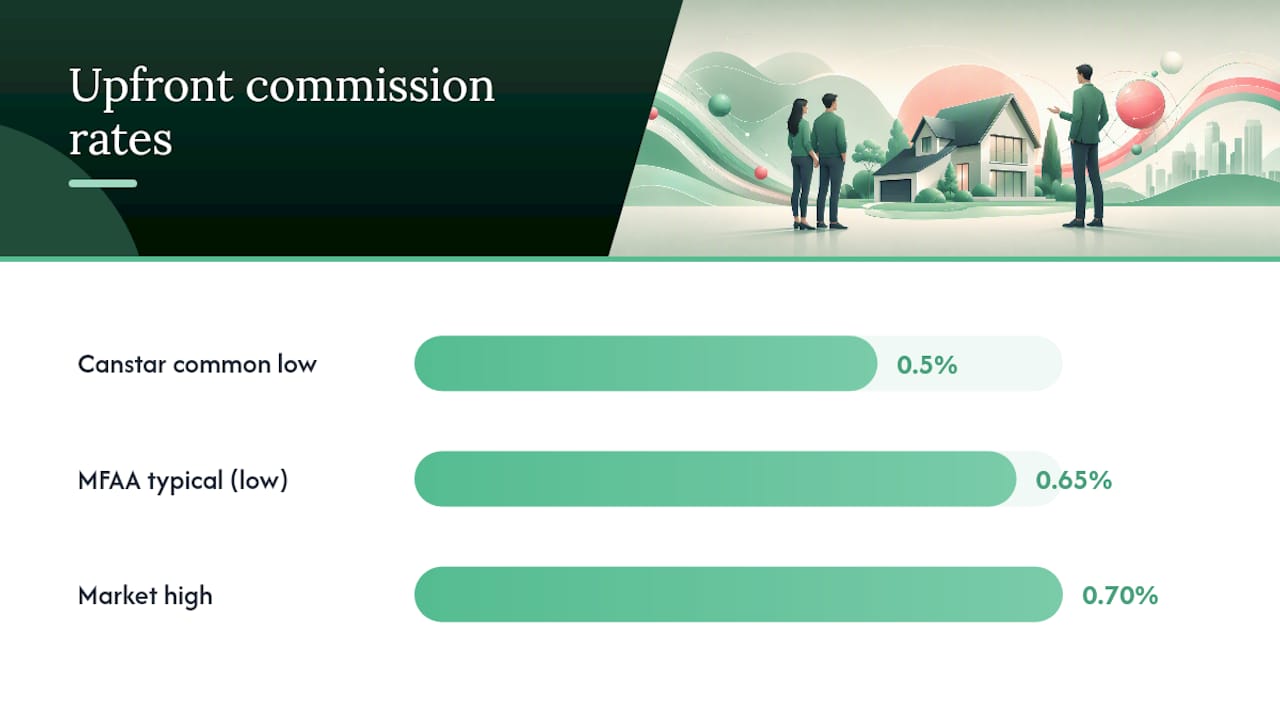
Upfront commission is calculated as a percentage of the amount you draw down, generally net of any offset balance, and paid by the lender once your loan settles. Payment can land in the broker's account anywhere from immediately to around 90 days after settlement, depending on the lender's payment cycle. The the MFAA's remuneration data puts the typical rate at 0.65% to 0.70% of the loan amount, though Canstar notes market figures commonly sit anywhere from 0.5% to 0.7%.
Trail commission works differently. Fall into default or arrears and that trail can stop. It's also why your balance matters: as you pay down the loan, the trail commission naturally shrinks too.
Clawbacks are the part most borrowers have never heard of. If you refinance or discharge your loan within roughly 18 to 24 months of settlement, the lender can claw back some or all of the upfront commission it paid the broker. This exists to discourage brokers from chasing quick refinances purely for repeat commission. Critically, a broker cannot lawfully pass that clawback cost on to you as the client.
- Upfront commission: paid once, on settlement, based on the drawn loan amount
- Trail commission: paid monthly, based on the outstanding balance
- Clawback: lender reclaims upfront commission if you exit within 18–24 months
- Other payments: some aggregators offer volume bonuses to brokerage groups, though these are less visible to individual clients
Pro Tip: Ask your broker directly whether they'd face a clawback if you refinanced within two years. A broker who answers plainly, and explains what that means for their advice, is one worth trusting.
Do you have to pay a fee for a mortgage broker?
For the large majority of home loans, no. The lender pays the broker, and you pay nothing extra on top of your loan repayments. This lender-paid structure is why brokers are often described as "free" to the borrower, even though the cost is technically built into the lending system rather than into your specific loan.
Borrower-paid fees do exist, though they're the exception rather than the rule. Moneysmart is explicit that if a broker wants to charge you directly, they must give you a written quote and you must sign it before any work begins. A broker cannot legally ask for payment before providing the service.
Direct fees tend to show up in more complex scenarios:
- SMSF lending, where structuring and compliance work is more involved
- Commercial or business loans outside standard residential lending
- Cases where a client wants ongoing advisory support beyond a single settlement
Pro Tip: If a broker proposes a direct fee, ask to see the same deal costed both ways: with the fee and a slightly better rate, versus no fee and a standard rate. The written comparison often settles which option actually saves you more.
What do broker commissions look like in real dollars?
Percentages are abstract until you see them against an actual loan amount. Using the typical rates the MFAA reports, here's how upfront and first-year trail commission compare across three common loan sizes.

| Loan Amount | Upfront Commission (0.65%) | Trail Commission (0.15% p.a.) |
|---|---|---|
| $500,000 | $3,000 | $750 per year |
| $700,000 | $4,500 | $1,000 per year |
| $800,000 | $5,200 | $1,200 per year |
These figures assume the commission is calculated on the loan amount net of any offset account balance, which is standard practice. If you park $50,000 in an offset against an $800,000 loan, the commission base drops to $750,000, trimming both the upfront and trail figures slightly. Redraws work similarly. Drawing extra funds back out increases the balance the commission is calculated against going forward.
- These numbers use midpoint rates from MFAA data; your broker's actual rate may sit slightly above or below 0.65%
- GST treatment and exact payment timing can vary by lender and aggregator arrangement
- Trail commission compounds annually against your reducing balance, so year-ten trail is smaller than year-one trail
Ask your broker to show you the exact commission structure attached to your specific loan, not just the industry average. Every lender's agreement with every aggregator differs slightly, and that's the number that actually applies to you.
What conflicts of interest should you watch for?
Broker commissions create a structural question worth asking honestly: does the payment model ever tempt a broker to recommend a loan that suits them more than you? Regulation exists specifically to manage this.
Under ASIC's RG 273 guidance, mortgage brokers operate under a Best Interests Duty. This is a legal obligation requiring them to act in your interest when providing credit assistance, not simply to present products that pay the highest commission. Brokers must also provide a Credit Guide detailing how they're paid and disclose any potential conflicts before you commit to anything.
Common conflict sources still worth knowing about include volume-based incentives from certain lenders, panel arrangements that limit which lenders a broker actually compares, and aggregator relationships that can subtly shape which products get recommended first.
If a broker won't show you a Credit Guide, hesitates when asked how they're paid on your specific loan, or pushes you to sign quickly without comparing at least two or three lenders, treat that as a genuine warning sign rather than an awkward question to drop.
- Refusing to disclose commission structure or Credit Guide details
- Pressure to accept a product without time to compare alternatives
- Vague answers about which lenders were actually considered on your panel
If a broker's conduct concerns you, ASIC regulates credit licensees, and the Australian Financial Complaints Authority handles unresolved disputes free of charge.
Can commissions affect the rate you get?
Here's the myth worth retiring: "free" doesn't automatically mean cheapest. Lenders build commission costs into their overall cost of doing business, which can show up in rate spreads across their product range rather than as a separate line item on your statement.
A broker being paid by the lender doesn't mean you're getting the market's best rate by default. It means you're getting a rate from whichever lenders that broker's panel includes, at whatever margin that lender has set.
- Ask your broker for a comparison across at least two or three lenders, not just their preferred option
- Request the comparison rate, not just the headline rate, since fees and features change the real cost
- Remember that a 0.10% rate difference on a $700,000 loan over 25 years adds up to thousands in extra interest
A small rate gap compounds quietly. It's worth five minutes of comparison before you sign anything.
How do you verify a mortgage broker is legitimate?
Checking credentials takes less time than most borrowers expect, and it's the single best protection against dealing with someone unlicensed.
- Search the ASIC professional registers to confirm the broker is a registered credit representative or holds a credit licence
- Ask for a copy of their Credit Guide, which must explain how they're paid and what to do if you have a complaint
- Request a written fee quote if any direct charge is proposed, and don't proceed until you've signed it
- Ask for examples of past client scenarios similar to yours, particularly for SMSF or commercial lending
- The ASIC register confirms whether a broker is currently licensed
- AFCA provides free, independent dispute resolution if a broker won't resolve a complaint directly
Can you negotiate mortgage broker fees?
Yes, at least in the areas that are actually negotiable. Fee type, scope of service, and whether the broker will genuinely shop your loan across a wide panel or push a narrower shortlist are all fair questions to raise upfront.
Ask directly:
- "Who pays you on this loan, and what percentage?"
- "Can I get that in writing before we go further?"
- "What happens to your commission if I refinance in two years?"
Sample scripts help take the awkwardness out of it. Try: "Before we proceed, can you walk me through exactly how you're paid on this deal and show me the Credit Guide?" Or, if a direct fee is proposed: "Can you compare this fee-based option against a standard lender-paid loan so I can see the real difference in total cost?"
Pro Tip: Brokers expect these questions. A broker who bristles at being asked how they're paid is telling you something worth listening to.
Is paying a mortgage broker fee ever worth it?
Sometimes, yes, particularly when the loan itself is more complex than a standard owner-occupier mortgage.
Consider a paid or specialist broker when:
- You need SMSF lending, where structuring, compliance and lender appetite vary significantly
- Your finance involves business or commercial elements outside typical residential lending
- You value ongoing advisory support beyond a single settlement, and are willing to pay for that time
Pros of a direct fee arrangement include potential access to a wider lender panel and clearer fee transparency. Cons include an upfront out-of-pocket cost that a lender-paid broker wouldn't require.
How long you intend to keep the loan matters too. If you expect to refinance within a couple of years, a lender-paid broker avoids triggering clawback complications on their end and keeps your own costs lower.
How Zenrgfinance approaches fees and disclosure
We treat fee transparency as a conversation, not fine print buried in a document you're handed to sign. Before any loan application progresses, clients see exactly how we're paid, whether that's the standard lender commission structure or, in specialised cases, a direct fee with a written quote to review first.
Zenrgfinance works across a genuinely broad client base: first home buyers navigating their first Credit Guide, property investors juggling multiple loans, and clients pursuing SMSF lending, where structuring expertise genuinely changes outcomes. From initial application through to settlement, clients get a single point of contact who explains not just what a rate costs, but what the broker relationship costs too, in plain language, before anything is signed.
Get clarity on your own broker fees and rate options
Reading about commission percentages is one thing. Seeing your own numbers is another. If you want to know exactly what an upfront and trail commission would look like on your specific loan amount, or whether a direct-fee arrangement genuinely beats a standard lender-paid structure for your situation, that's a conversation worth having before you sign anything.

Zenrgfinance's mortgage relationship managers walk you through fee transparency and worked cost comparisons for your actual loan amount, not just industry averages. For borrowers exploring SMSF lending specifically, where fee structures and lender appetite both get more complex, the SMSF lending strategy session covers structuring options and cost expectations in one sitting. You can also run your own numbers first using the loan comparison calculator to see how fee and rate combinations stack up before you talk to anyone. Book a session, bring your loan amount and timeframe, and get a clear answer on what you'd actually pay.
Why brokers rarely charge you, and what that changes
Most borrowers assume a broker's independence must be compromised because a lender pays them. That assumption misses the more interesting story: the commission model exists precisely because manual loan comparison across dozens of lenders is genuinely hard work, and someone has to be compensated for doing it properly.
The real risk isn't that commissions exist. It's that a small number of brokers treat the Best Interests Duty as a compliance checkbox rather than an actual standard to meet. Headline commission percentages also mislead people into overestimating what brokers actually earn. Once you account for aggregator fees, insurance, and running an office, that 0.65% figure the MFAA reports shrinks considerably by the time it reaches a broker's actual income. That context doesn't excuse poor disclosure, but it does explain why volume matters to brokers in ways that can occasionally nudge behaviour if left unchecked by regulation.
What actually protects borrowers isn't refusing to trust the commission model. It's insisting on the disclosure the law already requires: the Credit Guide, the written quote if a direct fee applies, and a straight answer when you ask how someone's getting paid on your loan.
Sources
For deeper detail beyond this guide, check these primary sources directly:
- RG 273 – Mortgage brokers: best interests duty
- Mortgage broker fees, costs and commissions
- ASIC professional registers search
Save or screenshot your Credit Guide and any written fee quote. You'll want them on hand if a question ever arises later.
This article is general information, not a substitute for advice from a qualified financial advisor. Consult a qualified financial professional about your own circumstances before acting on anything here.