
You need four things to get a home loan moving in Australia: proof of who you are, proof of what you earn, proof of your savings and assets, and a full picture of your debts. Add a signed contract of sale once you've found a property. Lenders check identity using the 100-point system, and recent PDF payslips and bank statements stop applications stalling. Self-employed borrowers, guarantors, SMSF applicants and first home buyers each need extra paperwork on top of this base kit.
TL;DR:
- Most applicants only need one primary identity document, like a passport, plus one secondary document to reach the 100-point check requirement.
- Two recent payslips or two years' tax returns and NOAs are typically needed to verify stable income, with self-employed applicants providing detailed financial statements.
- Lenders prefer bank statements showing three to six months of regular savings and traceable sources for deposit proofs, not large or unexplained lumps sums.
- Current statements for all debts, including credit cards, loans, and buy now pay later accounts, are necessary to assess borrowing capacity accurately.
- Once a contract is signed, applicants must provide property sale documents, proof of building insurance, and conveyancer details to proceed toward settlement.
Table of Contents
- Your quick home loan documents checklist
- What is the 100-point identity check for a home loan?
- What income documents do banks need for a home loan?
- How do you prove genuine savings for a deposit?
- What liability documents do lenders check?
- What documents do you need once you've found a property?
- What extra paperwork do special cases need?
- When do lenders ask for each document?
- What do lenders actually flag when reviewing your file?
- Where to check the official rules
- What actually gets your loan approved faster
- Sources
Your quick home loan documents checklist
Before you sit down with a broker or lender, this is the shortlist worth having ready. It covers what most applicants need for a standard PAYG application; special cases get their own section further down.
- Identity: passport or driver licence plus a secondary document (Medicare card, utility bill)
- Income: two recent payslips, ATO income statement or Notice of Assessment (NOA)
- Savings: three to six months of bank statements showing regular deposits
- Debts: current statements for credit cards, personal loans, BNPL accounts and HECS/HELP
- Property: signed contract of sale, once you have one
Stick to PDFs exported straight from internet banking or your employer's payroll system, not photos or screenshots. Payslips should be dated within the last 30 to 60 days. Set up a labelled digital folder (subfolders for ID, income, savings, debts) before your first meeting. It saves you chasing documents later and makes you look organised to the person assessing your file.
What is the 100-point identity check for a home loan?
Every Australian lender requires at least 100 points of identification before they'll process an application. It's the same logic banks use to open an account, and it works on a points system rather than a single document.
Primary documents, such as an Australian passport, birth certificate or citizenship certificate, are typically worth 70 points each. Secondary documents, like a Medicare card, driver licence or a utility bill showing your name and address, generally contribute a moderate number of points. You stack them until you reach the 100-point threshold.
Statistic callout: A primary document alone often gets you 70 of the 100 points needed, meaning most applicants only need one solid secondary document to clear the bar.
The combinations lenders see most often:
- Australian passport + Medicare card
- Passport + Australian driver licence
- Birth certificate + Medicare card + utility bill
If you've recently arrived in Australia and don't yet hold a licence or Medicare card, a passport combined with a rental agreement or a bank statement in your name usually works. Lenders want originals or certified copies, not photos of a card sitting on a kitchen bench. Digital alternatives like Australia Post Digital iD are increasingly accepted, which is worth asking about if you'd rather avoid printing everything.
What income documents do banks need for a home loan?
Lenders want to see stable, verifiable income, and PAYG employees and self-employed applicants supply very different paperwork to prove it.
For PAYG employees:
- Two recent, computer-generated payslips (not handwritten or edited)
- An employer letter confirming your role and salary, if the lender requests one
- Your ATO income statement or NOA, pulled from myGov
- A bank statement showing your salary actually landing in your account
For self-employed applicants:
- The last two years' personal and business tax returns
- NOAs matching those two years
- Profit and loss statements and a balance sheet
- Recent BAS lodgements, plus an accountant's letter confirming your income is representative
Banks and brokers commonly request two payslips for PAYG borrowers and two years of tax returns and NOAs for self-employed applicants, and this is where most delays happen if the numbers on your payslip don't match your bank deposits.
Pro Tip: Download your NOA and income statement directly from myGov before your first meeting. Lenders trust ATO-sourced documents more than a payslip PDF you've edited, and it shaves days off processing.
If you need a template for the employer confirmation letter, ZENRG Finance has put together employment verification letter examples that lenders actually accept.
How do you prove genuine savings for a deposit?
Lenders don't just want to see money sitting in your account. They want to see where it came from, and that means a consistent savings pattern over time, not a lump sum that appeared last week.
Most lenders ask for three to six months of bank statements showing a history of regular saving and a traceable source of your deposit. A deposit that's built up slowly through payday transfers looks far better than one large deposit with no explanation attached.
If part of your deposit came from somewhere else, expect to document it:
- Sale of an asset (car, shares): settlement statement or transfer receipt
- Inheritance: a copy of the will or executor's letter
- Family gift: a formal gift letter or statutory declaration confirming it's not a loan
- Other assets: share or managed fund statements, or property sale settlement papers
Provide everything as PDFs with account details visible. A screenshot with the account number cropped off will bounce straight back to you with a request for the real thing.
What liability documents do lenders check?
Every existing debt affects how much you can borrow, so lenders want current statements for anything you owe, not just a rough total you've estimated yourself.
Bring statements for:
- Credit cards (even ones sitting at zero balance)
- Personal loans and car loans
- Any existing mortgage
- Buy now, pay later accounts (Afterpay, Zip and similar)
- HECS/HELP balance
Lenders typically factor in minimum repayment amounts as part of their serviceability calculation, which is why an undisclosed credit card can quietly shrink your borrowing power even if you never use it. Request updated statements within a week or two of submission. A three-month-old credit card statement showing a different balance than what's live raises questions you don't need.
What documents do you need once you've found a property?
Once you sign a contract, a fresh batch of paperwork lands on your desk. This is where settlement timelines start to matter.
You'll need to provide:
- The signed contract of sale
- Vendor disclosure documents (Section 32 in Victoria, or the equivalent statement in your state)
- Your conveyancer or solicitor's contact details
From here, the lender orders its own valuation on the property, independent of what you paid. You'll also need to arrange building insurance before settlement, since most lenders won't release funds without proof it's in place.
If you're eligible for the First Home Owner Grant or a stamp duty concession, check your state revenue office for the exact forms, since eligibility and paperwork differ by state and most lenders lodge the FHOG application on your behalf at settlement.
What extra paperwork do special cases need?
Standard PAYG applicants have it relatively simple. If you fall into one of these categories, add the following to your pack.
Self-employed: two years' business financials, matching tax returns and NOAs, an accountant's letter, and company or trust documents if you operate through one.
Guarantor loans: the guarantor's ID, evidence of their property (a recent rates notice), their financial statements, and signed consent forms confirming they understand the guarantee.
SMSF lending: the fund's trust deed, trustee meeting minutes, SMSF financial statements, and lender-specific SMSF templates, since SMSF lending runs on a different set of rules to standard home loans.
First home buyer grants: state-specific eligibility evidence, which varies depending on where you're buying and whether you're buying new or established.
Each of these adds one to two weeks to processing if the documents aren't ready upfront, so gather them early rather than after your broker asks twice.
When do lenders ask for each document?
Documents arrive in three waves, and knowing which wave you're in stops you scrambling for paperwork you don't need yet.
- Pre-approval: ID, one to three months of bank statements, recent payslips, and preliminary ATO income evidence
- Conditional approval: full income documentation, NOAs, verified assets, and statements for every liability
- Unconditional approval and settlement: signed contract, proof of building insurance, and your conveyancer's details
If you're not sure what stage you're at, ZENRG Finance's guide to home loan pre-approval breaks down exactly what's expected before you start house hunting.
What do lenders actually flag when reviewing your file?
Underwriters aren't hunting for reasons to reject you, but certain patterns slow everything down. A large, unexplained deposit is the most common one. So is income that jumps around month to month with no letter from your accountant explaining why. Missing pages in a bank statement, or a payslip that doesn't match the number on your bank deposit, both trigger a follow-up request that can add days to your timeline.

File hygiene matters more than people expect. Name your PDFs clearly ("Payslip_Oct_2026", not "Scan001"), and make sure every bank statement shows the BSB and account number, not just a cropped screenshot. Screenshots are routinely rejected because they're easy to edit and hard to verify.
Pro Tip: Write a one-line cover note next to anything unusual, like "$8,000 deposit is proceeds from selling my car, receipt attached." A short explanation upfront often stops a lender's query before it's even raised.
Presenting a clear financial narrative upfront, explaining large deposits, the source of your savings, and any irregular income before a lender asks, consistently reduces the back-and-forth that stretches out approval timelines.
This is exactly the kind of packaging a broker does as a matter of course. At ZENRG Finance, Allen and the team assemble the full document pack, chase the gaps before a lender even asks, and manage the back-and-forth so you're not the one fielding five separate email requests. If you'd rather have someone handle that coordination for you, talk to a mortgage relationship manager about getting your file lender-ready from the start.
Where to check the official rules
For the exact point values, use the AFP's 100-point identification checklist. For NOA and income statement requests, log in via myGov. For a broader borrower checklist, Lofirate's loan approval requirements guide is a useful second opinion.
What actually gets your loan approved faster
Most guides on this topic treat every document as equally important, and that's where they get it wrong. A missing payslip is a five-minute fix. A large unexplained deposit or an inconsistent income pattern is what actually stalls a file for weeks, because it forces an underwriter to stop and ask questions instead of ticking a box.
If you take one thing from this checklist, prioritise the explanation, not just the document. A gift letter without context reads differently to a gift letter with a one-line note about who gave it and why. The paperwork proves the fact; the narrative proves it's not a red flag.
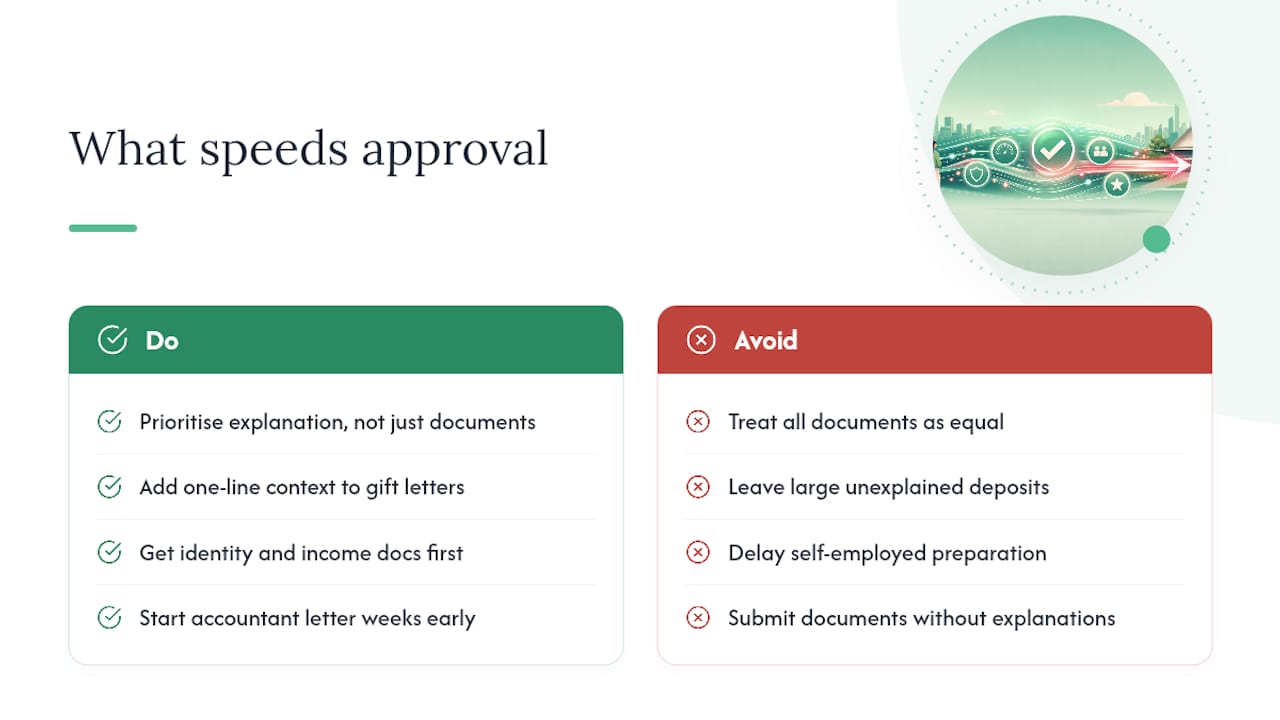
The other thing worth saying plainly: self-employed applicants and guarantors are treated as afterthoughts in most generic checklists, when in practice they're the files that need the most preparation time. If that's you, start your financials and accountant's letter weeks before you plan to apply, not the week you find a property you like.
Get your identity and income documents sorted first. Everything else, the savings history, the liability statements, the property paperwork, moves faster once a lender already trusts who you are and what you earn.
— Allen
Sources
- 100-point identification checklist (AFP)
- Home Loan Approval Checklist Australia — Documents & FHOG (GoodSuburb)
- Required Documents for Your Home Loan Application (Odin Mortgage)
- Proof of identity in Australia: the 100-point system (Australia Hub)