
An employment verification letter for a home loan needs to sit on official company letterhead, be dated, and carry a signature with a working phone number or email for verbal verification. Miss any one of those three things and a lender will likely bounce it straight back to you, which costs days you probably don't have mid-application.
Here's what to do right now:
- Ask HR or your manager for the letter today, and specify the exact income breakdown you need included.
- Attach your two most recent payslips alongside it, since most lenders want both.
- Check your lender's timeframe — most want the letter dated within 30 to 60 days of submission, according to Finder.
If you're self-employed or contracting, an employer letter won't exist for you. You'll need tax returns, Notices of Assessment, or an accountant's letter instead, which we'll cover further down.
Key Takeaways
An employment verification letter for a home loan is accepted only when it's on letterhead, dated within the lender's window, signed by an authorised contact, and shows income broken into separate lines.
| Point | Details |
|---|---|
| Get the timing right | Request the letter once your loan moves to credit assessment, keeping it within the 30 to 60 day window most lenders expect. |
| Ask for detail upfront | Request bonuses, overtime and commissions on separate lines from HR at the first request, not after a reissue. |
| Attach supporting evidence | Send recent payslips alongside the letter, since lenders commonly cross-check both documents. |
| Self-employed needs different proof | Provide two to three years of tax returns, Notices of Assessment, and an accountant's letter instead of an employer letter. |
| Use a broker to avoid rework | A broker can match wording to lender requirements and coordinate verbal verification calls before submission. |
Table of Contents
- Two templates for your employment letter for loan application
- What exact details does a lender need in the letter?
- How do you request the letter from HR without delays?
- What if you're self-employed? Alternatives to an employer letter
- Your lender-ready checklist before you submit
- How does a broker help fix employment verification issues?
- What actually matters most in this process
- Sources
Two templates for your employment letter for loan application
You don't need to write this from scratch, and honestly, you shouldn't. HR teams often reach for a generic template that skips the detail lenders actually want, according to Sprintlaw. Give them something ready to adapt and you'll get a usable letter back faster.
Template 1: Short confirmation (fine for straightforward PAYG applicants with stable pay)
To Whom It May Concern, This letter confirms that [Employee Name] has been employed with [Company Name] (ABN [XX XXX XXX XXX]) since [Start Date] as a [Job Title], on a [full time/part time/casual] basis. Their current gross annual salary is $[Amount]. Please contact me on [Phone/Email] for verification. [Signatory Name, Title, Signature, Date]
Template 2: Detailed lender-ready version (use this one if you have variable income)
To Whom It May Concern, This letter confirms [Employee Name] has been employed with [Company Name] (ABN [XX XXX XXX XXX]) since [Start Date] in the role of [Job Title], employed on a [permanent full time/part time/fixed term/casual] basis with [guaranteed hours per week, if applicable]. Income breakdown: Base salary: $[Amount] per [annum/hour] Guaranteed hours: [Number] per week Bonuses/commissions (average, last 12 months): $[Amount] Overtime (average, last 12 months): $[Amount] This employment is ongoing with no indication of change to status. For verbal verification, contact [Signatory Name] on [Phone/Email]. [Signature, Title, Date, Company Letterhead]
If you're part-time or casual with guaranteed hours, make sure that guarantee is stated explicitly. Lenders treat guaranteed hours very differently from ad hoc casual shifts, and a letter that's vague on this point often triggers a follow-up request.
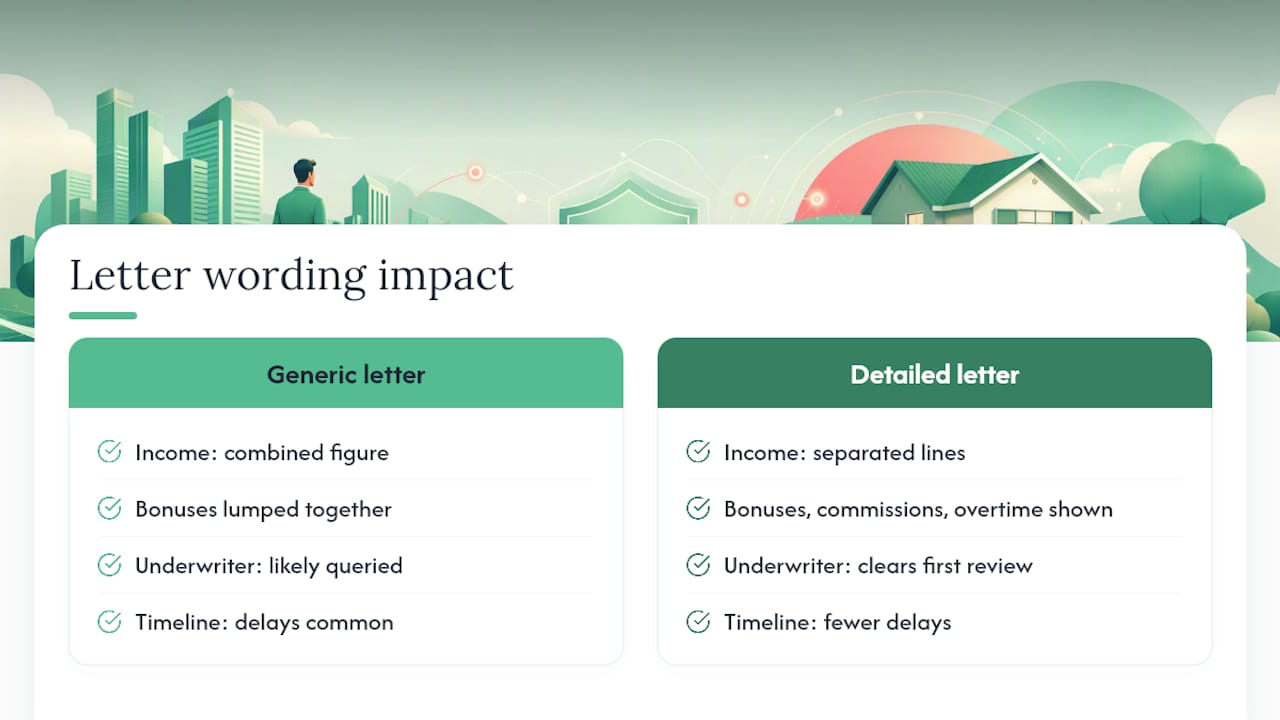
Pro Tip: Ask HR to list bonuses, commissions and overtime on separate lines rather than folded into one number. Underwriters assess each income type differently, and a combined figure usually just gets queried, according to Homewise.

What exact details does a lender need in the letter?
Beyond the basic confirmation, lenders are checking specific fields, and if even one is missing, expect a request for an updated version. Here's what to make sure is there:
- Employer details: company name, ABN, official letterhead, business address, and a named authorised contact.
- Employment status and dates: job title, exact start date, and whether you're full-time, part-time, casual, or on a fixed-term contract, plus any guaranteed hours.
- Income details: gross annual salary or hourly rate, pay frequency, and bonuses, commissions or overtime broken out on their own lines rather than combined.
- Administrative essentials: a signature from someone authorised to confirm employment, their name and title, and a direct contact number or email.
Most lenders expect the letter dated within roughly 30 to 60 days of submission, and some will re-verify employment again just before settlement, according to Finder. If your loan is taking a while to settle, don't be surprised if you're asked for a fresh letter later in the process.
How do you request the letter from HR without delays?
Timing and clarity are everything here. Ask too early and the letter goes stale before settlement; ask too late and you've blown your submission deadline. Here's the sequence that works.
- Wait until your loan is progressing to credit assessment before requesting the letter, so it stays within your lender's freshness window rather than expiring mid-process.
- Contact HR or payroll first. If there's no dedicated HR function, go to your direct manager or a senior leader who can sign with authority.
- Be specific in your request. State the loan reference or your broker's name, and ask explicitly for base pay, guaranteed hours, bonuses and overtime to appear on separate lines.
- Mention that a lender or broker may call the listed contact for verbal verification, so nobody's caught off guard.
- If HR drags its feet or refuses extra detail, escalate to your manager, request signed pay advices instead, or ask your lender to conduct a verbal verification directly.
Pro Tip: Send your request by email rather than asking verbally. A written trail with the exact wording you need means HR can copy-paste it straight into the letter, and you're not relying on someone's memory of a hallway conversation.
What if you're self-employed? Alternatives to an employer letter
There's no employer to write you a letter if you work for yourself, so lenders lean on a different evidence set. Typically that means two to three years of tax returns and Notices of Assessment, according to Investopedia, alongside business financial statements, recent BAS lodgements, and sometimes a letter from your accountant confirming trading history and income consistency.
Lenders are essentially trying to answer one question: is this income stable and likely to continue? A single strong year following two lean ones raises more questions than it answers.
- Two to three years of personal and business tax returns
- Notices of Assessment from the tax office
- Recent BAS statements and profit and loss summaries
- An accountant's letter attesting to income and business continuity
Bundle everything into clearly labelled PDFs before uploading, and get documents certified where your lender requires it. A broker can help structure this evidence so it tells a coherent story rather than landing as a pile of disconnected paperwork. Our guide on self-employed home loan applications breaks this down further.
Your lender-ready checklist before you submit
Run through this before you hit send on your application documents:
- Letter is on company letterhead with the ABN visible.
- Dated within your lender's window, typically 30 to 60 days.
- Signed, with the signatory's name, title, and a direct phone or email listed.
- Income lines separated — base pay, guaranteed hours, bonuses, overtime, commissions.
- Recent payslips attached alongside the letter, not sent separately days later.
- Files named clearly (e.g. "Smith_EmploymentLetter_2026.pdf") and bundled in one upload where possible.
Tell your broker or lender who signed the letter and how they can be reached, so if a verbal verification call is needed, nobody's left guessing.
How does a broker help fix employment verification issues?
A broker's real value here is knowing exactly what each lender wants before you submit, not after it gets rejected, as explained by Mortgage Broking Melbourne | Amber Wealth. Zenrgfinance works through this with clients regularly:
- Matching your letter's wording to the specific lender's checklist before submission.
- Arranging verbal verification calls so they land smoothly rather than catching your employer off guard.
- Advising self-employed applicants on which alternative documents will satisfy a given lender's policy.
- Helping you compare loan products once your documentation is sorted, using tools like the loan comparison calculator.
Pro Tip: If you're juggling multiple lenders with different requirements, ask your broker to confirm the exact freshness window and letter format for each one before you request anything from HR. One well-timed letter beats three reissued ones.
What actually matters most in this process
Most guides on this topic treat the employment letter as a formality, a box to tick. It isn't. It's the document underwriters use to judge whether your income is real and durable, and that's why a vague or combined income figure causes more delays than almost anything else in a home loan file.
The conventional advice, "just ask HR for a letter," undersells how much the wording matters. A generic template that lumps bonuses into a single number will get queried nearly every time. Asking for separated income lines from the start isn't fussy, it's the difference between one letter and three.
If there's one thing worth prioritising, it's timing. Request too early and your letter expires before settlement; too late and you've stalled your own application. When documentation gets messy, particularly for self-employed applicants juggling BAS statements and accountant letters, that's precisely where a broker earns their keep, translating what a lender actually wants into paperwork that clears the first time.
This article is general information, not a substitute for advice from a qualified financial advisor. Consult a qualified financial professional about your own circumstances before acting on anything here.
Sources
For further reading and template guidance, see Sprintlaw's employment verification letter template, Finder's confirmation of employment guide, Investopedia's lender verification breakdown, and Homewise's copy-paste letter template. For personalised help preparing your documents, get in touch through Zenrgfinance's mortgage relationship manager.
- Confirmation of employment letter template (Finder)
- How mortgage lenders verify employment (Investopedia)
- Mortgage letter of employment: copy-paste template (Homewise)