
Your loan-to-value ratio (LVR) is the single quickest signal lenders use to decide whether to approve your refinance and on what terms. It is calculated by dividing your remaining loan balance by the lender's assessed property value, expressed as a percentage. Get it right and you unlock competitive rates, broader product choice, and no extra insurance costs. Get it wrong and you may face a narrower lender pool, higher rates, or a fresh lenders' mortgage insurance (LMI) charge.
Here is what the role of LVR in refinance approval means for you right now:
- Approval odds: An LVR at or below 80% puts you in the strongest position with most Australian lenders. Having more than 20% equity improves your refinance chances and helps you avoid LMI costs entirely.
- Pricing and LMI risk: Cross above 80% and LMI typically kicks in, adding a one-off cost to your loan. Rates also tend to rise as LVR climbs.
- Product access: The most competitive advertised rates are usually reserved for borrowers with lower LVRs, typically significantly below the 80% threshold. Higher LVR borrowers see fewer lenders willing to compete for their business.
If you want to calculate your current LVR or find ways to improve it before applying, read on. Or speak with Zenrgfinance for a quick valuation check before you commit to anything.
Table of Contents
- How do lenders calculate LVR for a refinance?
- How does LVR affect your refinance approval and loan terms?
- What do the key LVR thresholds mean for your refinance?
- How do lenders value your property when you refinance?
- Practical ways to lower your LVR before you refinance
- What does refinancing cost, and how long does it take?
- How a mortgage broker helps you navigate LVR challenges
- Key takeaways
- What most homeowners get wrong about LVR
- Zenrgfinance can help you refinance with confidence
- Useful Australian sources on LVR and refinancing
How do lenders calculate LVR for a refinance?
LVR is calculated as your loan amount divided by the lender's valuation of your property, multiplied by 100.
The formula:
- Take your current loan balance (what you still owe).
- Divide it by the lender's assessed property value (not your estimate or the original purchase price).
- Multiply by 100 to get a percentage.
Worked example:
| Item | Amount |
|---|---|
| LVR | 75% |

In this example, the borrower sits comfortably below 80%, which means no LMI and access to competitive rates.
One thing many homeowners miss: lenders use their own valuation, not the price you paid or what a real estate agent quotes you. Banks arrange either an automated valuation model (AVM), a desktop assessment, or an on-site inspection. If the bank's figure comes in lower than you expected, your LVR rises, and so does your risk profile. That is why understanding the valuation process matters just as much as knowing the formula.
How does LVR affect your refinance approval and loan terms?
The significance of LVR in refinance decisions goes well beyond a simple yes or no. It shapes almost every dimension of your new loan.
Direct effects on your refinance outcome:
- Approval likelihood: Lenders assess LVR as a primary risk indicator. A lower LVR signals you have built equity and are a lower-risk borrower, which widens the pool of lenders willing to approve you.
- Interest rates: Some lenders reserve their best rates for borrowers with LVRs below 60%. As your LVR rises, you move into higher rate bands.
- LMI requirement: Cross the 80% threshold and most lenders require LMI, which protects the lender (not you) if you default. Refinancing above 80% LVR typically narrows your lender choice and can mean paying LMI again even if you paid it on your original loan.
- Advertised rate assumptions: Lenders' published rates often include an LVR condition — "rates shown are based on an LVR of X." Always check the fine print before comparing offers.
- Loan features and product tiers: Offset accounts, redraw facilities, and cashback offers are more commonly available to lower-LVR borrowers. High-LVR applicants may find these features restricted or priced out.
Two quick scenarios to make this real:
A borrower with a 75% LVR walks into a refinance with strong approval odds, access to the sharpest rate tiers, no LMI, and multiple lenders competing for their business. A borrower at 90% LVR faces a smaller lender pool, a higher rate, and an LMI charge that can run into thousands of dollars, all before they have saved a cent on their repayments.

Pro Tip: If your LVR sits just above 80%, ask your broker to request a manual review or a fresh on-site valuation before the lender locks in an AVM figure. A higher valuation can push you below the threshold and eliminate LMI entirely.
What do the key LVR thresholds mean for your refinance?
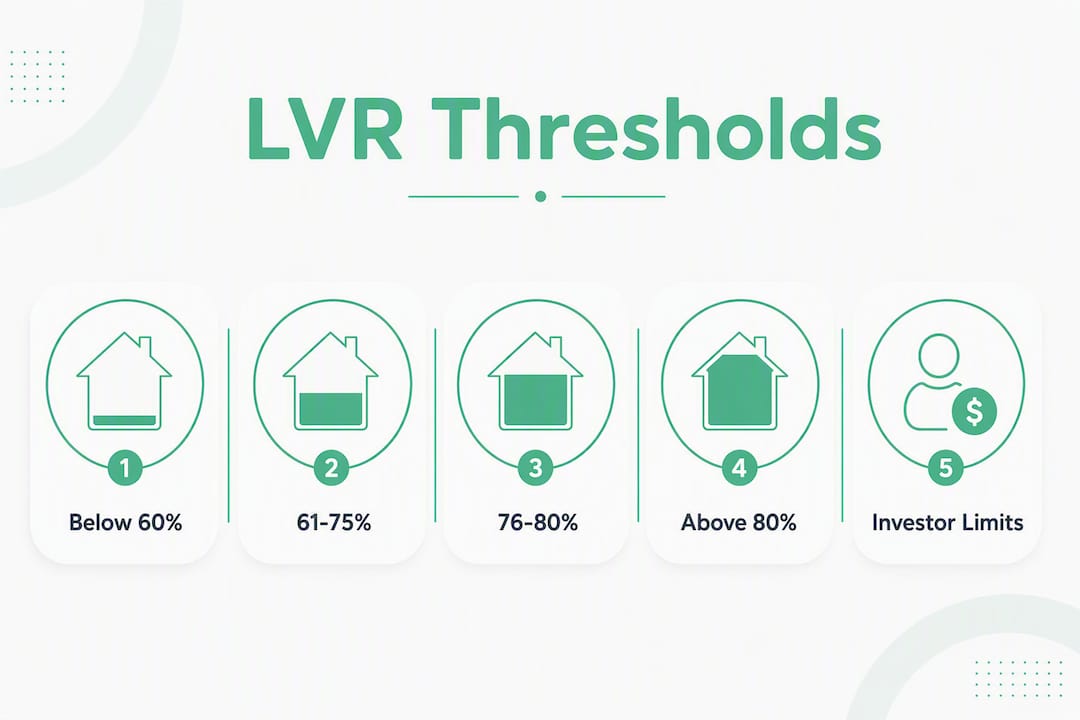
Australian lenders use a series of LVR bands to set pricing and policy. Here is what each one typically means in practice:
- Under 60–65%: You are likely to access the most competitive interest rates on the market. Lenders view you as very low risk and will compete hard for your business.
- 60–80%: A solid, competitive position. You avoid LMI and have access to a broad range of products, though the very sharpest rates may still require a lower LVR.
- 80% (the tipping point): Above 80% LVR, LMI is typically triggered and the most competitive rates become harder to access. Crossing back below this line is the single most valuable move most refinancers can make.
- 90–95%: Product choice narrows significantly. Fewer lenders will approve at this level, and those who do charge a premium. LMI costs at this range are substantially higher than at 85%.
- Above 100% (negative equity): Your loan exceeds the property's value. Refinancing options are very limited, and most mainstream lenders will not approve a standard refinance. Specialist lenders exist but come with higher costs.
Investors face tighter conditions. Lenders commonly cap maximum allowable LVRs by loan purpose, and refinances for investment properties are often subject to stricter LVR limits than owner-occupier loans. If you hold an investment property, expect the ceiling to be lower and the pricing premium to be higher at equivalent LVR levels.
Individual lenders also set their own overlays on top of these general bands, particularly for low-doc loans or non-standard income situations. The thresholds above reflect common practice, not a universal rule.
How do lenders value your property when you refinance?
The valuation your lender orders determines your LVR, so understanding how it works gives you real leverage.
- Automated valuation model (AVM): A computer-generated estimate based on recent comparable sales and property data. Fast and low-cost, but can undervalue properties with unique features or in thin markets.
- Desktop valuation: A valuer reviews data remotely without visiting the property. More considered than an AVM but still reliant on available comparable sales.
- On-site assessment: A qualified valuer inspects the property in person. The most accurate method and the one most likely to capture improvements or unique features that lift value.
- Latest-sale comparables: All methods rely heavily on recent sales of similar properties nearby. Timing your application after a strong local sale can materially improve your assessed value.
Banks arrange online or on-site valuations and use the result to confirm the LVR for approval. You generally do not choose the method; the lender does, based on loan size and risk profile.
If you believe the bank's valuation is too low, you can supply evidence: recent comparable sales, council rates notices showing a higher land value, or documentation of renovations. A private valuation from a certified practising valuer can also support your case, though it does not bind the lender. Speak to a broker before spending on a private valuation; they can often tell you whether the lender's figure is likely to shift.
Practical ways to lower your LVR before you refinance
Improving your LVR before you apply can save you thousands in LMI and unlock a meaningfully lower rate. Here are the most effective approaches:
- Make extra repayments or use redraw: Paying down your principal directly reduces your loan balance and your LVR. Even a modest lump sum can tip you below a key threshold.
- Use available savings as a cash deposit: If you have savings outside your loan, applying them to reduce the balance before refinancing lowers your LVR without waiting for property values to move.
- Access cashback refinancing offers strategically: Some lenders offer cashback on refinance. Applying that cash to reduce your balance immediately after settlement can improve your LVR for future refinances.
- Wait for property value growth: If your suburb has seen strong recent sales, a fresh valuation may lift your assessed value and reduce your LVR without any change to your loan balance. This is passive but often the fastest route.
- Use equity from another property: If you own multiple properties, cross-collateralisation or a separate equity release can reduce the LVR on the property you want to refinance. This is complex and worth discussing with a broker.
- Split your loan: In some cases, restructuring into a split loan can improve how lenders assess your overall LVR position, particularly for investors with multiple securities.
Each strategy has trade-offs. Extra repayments cost you liquidity. Waiting for market growth is free but uncertain. Cross-collateralisation adds complexity and risk. The right choice depends on your timeline, cash position, and how far you are from the next threshold.
Pro Tip: Check the likely valuation date before you apply. Valuation timing matters: applying immediately after a strong local comparable sale can materially improve your LVR without changing your repayments at all.
What does refinancing cost, and how long does it take?
Costs and timelines both shift depending on where your LVR lands.
Typical costs to budget for:
- Valuation fee: Usually $200–$600, though some lenders waive this for straightforward refinances.
- Application or establishment fee: Varies by lender; some charge nothing, others up to several hundred dollars.
- Exit fees and break costs: Fixed-rate loans can carry significant break costs if you exit early. Variable-rate loans generally have minimal exit fees.
- LMI: Triggered above 80% LVR, LMI is calculated on the insured portion of the loan relative to the property value. The higher your LVR above 80%, the larger the insured portion and the higher the premium. At 85% LVR the cost is materially lower than at 90% or 95%, which is why crossing back below 80% is so valuable.
- Conveyancing fees: A refinancing transfer requires legal work to discharge the old mortgage and register the new one. Budget for conveyancer fees as part of your total refinance cost.
Typical timeline:
- Low LVR (under 80%): Valuation is often an AVM, completed within days. Underwriting is straightforward. Settlement can occur in 2–4 weeks from application.
- Higher LVR (above 80%): An on-site valuation may be required, adding 1–2 weeks. LMI assessment adds another layer of underwriting. Total timeline can stretch to 4–8 weeks.
The practical takeaway: the closer you are to 80% LVR, the faster and cheaper your refinance tends to be.
How a mortgage broker helps you navigate LVR challenges
A broker's value in a refinance goes well beyond finding a lower rate. When LVR is the sticking point, the right broker can change the outcome.
- Lender matching: Not every lender applies the same LVR overlays. A broker with access to a wide panel can identify lenders whose policies suit your specific LVR position, loan purpose, and income profile.
- Valuation support: Brokers can present comparable sales evidence and property documentation to support a higher valuation, reducing your assessed LVR before the lender locks in a figure.
- Application structuring: The way a loan is packaged, including security type, loan purpose, and repayment structure, affects how lenders assess LVR. A broker can structure the application to present your position in the strongest light.
- Timing strategy: Applying at the right moment in the property cycle, or just after a strong local sale, can lift your valuation and push you below a key threshold. Brokers track this actively.
- Avoiding repeat LMI: If you paid LMI on your original loan and your LVR is still above 80%, a broker can sometimes negotiate with your existing lender for a retention offer that avoids a fresh LMI charge on the new loan.
Zenrgfinance works with homeowners across these exact scenarios every day. A strategy session typically starts with your current loan balance, a recent rates notice, and a quick discussion of your property's likely value. From there, the team can identify whether you are close to a threshold worth targeting and which lender is most likely to approve at your current LVR.
For a deeper look at why equity matters when refinancing, the Zenrgfinance blog covers the mechanics in detail.
Key takeaways
Your LVR is the primary metric lenders use to assess refinance risk, set your interest rate, and determine whether LMI applies, making it the most important number to know before you apply.
| Point | Details |
|---|---|
| 80% is the critical threshold | Staying below 80% LVR avoids LMI and opens access to competitive rate tiers. |
| Lender valuation sets your LVR | Banks use their own assessed value, not market estimates, so timing and evidence matter. |
| Higher LVR means higher cost | Above 80%, expect narrower lender choice, higher rates, and potential LMI charges. |
| Practical steps can shift your LVR | Extra repayments, savings, and valuation timing are the fastest ways to improve your position. |
| Zenrgfinance can map your options | A strategy session with Zenrgfinance identifies your LVR position and the fastest route to better terms. |
What most homeowners get wrong about LVR
The conventional wisdom is that LVR is just a number you calculate once and move on. In practice, it is a moving target, and the homeowners who get the best refinance outcomes are the ones who treat it that way.
The most common mistake is applying for a refinance without first checking what the lender's valuation is likely to be. Many homeowners assume the bank will value their property at or near what they believe it is worth. When the AVM comes in lower, they are suddenly above 80% LVR, facing LMI they did not budget for, and wondering what went wrong.
The second mistake is treating LMI as unavoidable once you are above 80%. It often is not. A broker who knows which lenders offer retention pricing, or who can present strong comparable sales to lift a valuation, can sometimes eliminate the LMI charge entirely. That is not a theoretical outcome; it is a practical one that comes from knowing the lender's policy and the local market at the same time.
The third thing people underestimate is how much the 60% threshold matters. Crossing from 75% to 59% LVR is not just a number change. It can shift you into a completely different rate tier with some lenders, worth tens of thousands over the life of a loan. If you are close to that line, it is worth running the numbers before you apply.
Zenrgfinance can help you refinance with confidence
Refinancing with a clear LVR strategy is the difference between a better rate and a costly mistake. Zenrgfinance gives you direct access to a wide panel of lenders, personalised loan structuring, and hands-on valuation support so your application lands in the strongest possible position.

Whether your LVR is comfortably below 80% or you are working to get there, the team at Zenrgfinance will assess your current position, identify the fastest path to better terms, and handle the paperwork from start to settlement.
To get started, book a session with a mortgage relationship manager at Zenrgfinance. Bring your most recent mortgage statement, a current rates notice, your property address, and proof of income. That is all it takes to get a clear picture of where you stand and what your next move should be.
Useful Australian sources on LVR and refinancing
Lender policies vary, and the thresholds and costs in this article reflect common practice rather than any single lender's rules. Always confirm current terms with your lender or a qualified broker.
- Australian Securities and Investments Commission (ASIC) — MoneySmart: Consumer guidance on home loans, refinancing, and understanding loan costs.
- Australian Prudential Regulation Authority (APRA): Sets the prudential standards that govern how lenders assess LVR and serviceability.
- ANZ: What is a loan-to-value ratio?: A clear lender-published explainer on LVR and how it affects approval.
- Beyond Bank: How to calculate LVR: Practical breakdown of the LVR formula and its role in lending decisions.
- Zenrgfinance: Refinancing eligibility requirements: Up-to-date guidance on what Australian lenders look for in a refinance application.
Policies differ by lender, loan purpose, and borrower profile. Check the product disclosure statement for any loan you are considering, and speak to a broker for advice specific to your situation.
This article provides general information only and is not financial advice. Confirm current lender requirements and your personal eligibility with a qualified mortgage broker or financial adviser.