
Home equity is defined as the difference between your property's current market value and the outstanding balance on your mortgage. Understanding why equity matters when refinancing is the single most important factor in determining what loan terms you can access, how much you will pay in interest, and whether you qualify at all. Australian lenders use equity to measure risk. The more equity you hold, the less risk they carry, and the better the deal they are willing to offer you. Industry standards set by regulators like ASIC and APRA reinforce these thresholds across the lending market.
Why equity matters when refinancing: the core mechanics
Equity directly controls the loan-to-value ratio (LVR) on your mortgage. LVR is calculated by dividing your loan balance by the property's appraised value. A lower LVR means more equity, and that number is the first thing a lender checks when you apply to refinance.
Most lenders set 80% LVR as the key threshold. Cross below it and you access standard rates with no extra costs. Stay above it and you face a different picture entirely. Refinancing with low equity often leads to higher interest rates, additional fees, or lending limitations that reduce the overall financial benefit of switching loans.
The cost difference is real and lasting. A small rate increase caused by insufficient equity can add hundreds of thousands of dollars in extra interest across a 30-year loan term. That is not a rounding error. It is the difference between a refinance that saves you money and one that costs you more than staying put.

When your equity sits between 3% and 20%, most lenders require you to pay Lenders Mortgage Insurance (LMI). LMI protects the lender, not you, and it adds thousands of dollars to your upfront costs. Refinancing eligibility hinges on these equity thresholds, and LMI is the penalty for falling short.
Pro Tip: Get an independent property valuation before you apply to refinance. Lenders use their own valuers, and the figure they land on determines your LVR. Knowing your number in advance lets you plan rather than react.
| Equity level | LVR | LMI required? | Likely rate outcome |
|---|---|---|---|
| Less than 5% | Above 95% | Yes | Highest rates, limited lenders |
| 5%–20% | 80%–95% | Yes | Above-average rates |
| 20%+ | Below 80% | No | Standard competitive rates |
| 40%+ | Below 60% | No | Best available rates, strong negotiating position |
Should you build equity before refinancing?
Building equity before you refinance is often the most cost-effective move you can make. Stronger equity secures better refinancing interest rates and helps you avoid LMI fees that can run into tens of thousands of dollars on larger loans.
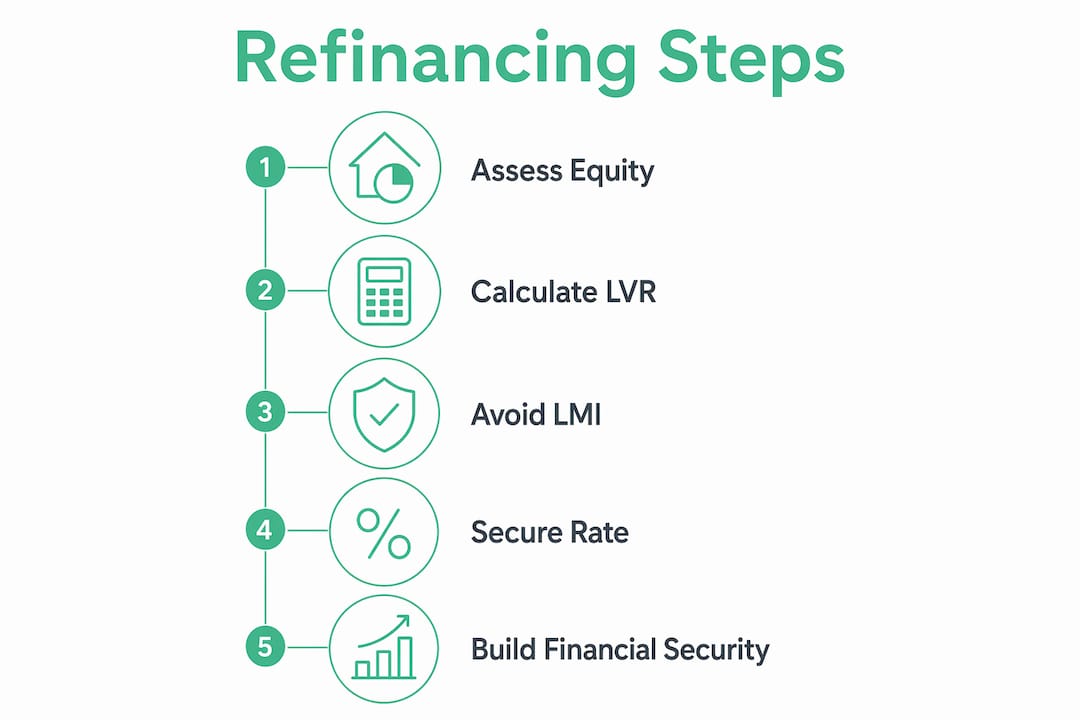
There are two reliable ways to build equity faster. The first is making extra repayments on your existing mortgage. Even modest additional payments each month reduce your principal faster and lift your equity position. The second is market appreciation. If property values in your area rise, your equity grows without you doing anything extra. Understanding how property valuation affects equity is worth your time before you lock in a refinancing decision.
The risks of refinancing with low or negative equity are significant:
- You may be locked out of competitive lenders entirely
- LMI premiums add to your loan balance, increasing what you owe
- Higher interest rates compound over the life of the loan
- Negative equity means you owe more than the property is worth, which limits your options severely
- Some lenders will decline your application outright if equity is too thin
Timing your refinance to align with a strong property market can make a meaningful difference. If values in your suburb have risen recently, a fresh valuation may reveal equity you did not know you had.
Pro Tip: Ask your broker to run the numbers on waiting six to twelve months versus refinancing now. In some cases, a modest equity improvement eliminates LMI entirely and more than offsets any short-term rate benefit from switching sooner.
What is cash-out refinancing and how does equity affect it?
A cash-out refinance replaces your existing mortgage with a larger loan. The difference between the two loan amounts is paid to you as cash. It is a popular way to fund renovations, consolidate debt, or invest in other assets. A rate-and-term refinance, by contrast, simply changes your interest rate or loan structure without increasing the principal.
Equity is the gatekeeper for cash-out refinancing. Lenders typically cap new loan amounts at 80%–85% of the property's appraised value. That means you must retain at least 15%–20% equity after the cash withdrawal. If your property is worth $800,000 and you owe $500,000, you hold $300,000 in equity. A lender capping at 80% LVR would allow a new loan of up to $640,000, meaning you could access up to $140,000 in cash while keeping the required equity buffer.
Cash-out refinancing allows homeowners to replace an existing mortgage with a larger one and withdraw equity as cash. The trade-off is a higher loan balance and, often, a longer repayment period.
Key points to understand before pursuing a cash-out refinance:
- Your new loan balance will be higher, which increases monthly repayments
- Withdrawing equity reduces your financial buffer against market downturns
- If property values fall after you cash out, you could move into negative equity
- The cash you receive is not income, but it does increase your debt
- Refinancing for cash flow works best when the funds are used for assets that grow in value or reduce other high-interest debt
| Scenario | Property value | Existing loan | Max new loan (80% LVR) | Cash available |
|---|---|---|---|---|
| Low equity | $600,000 | $520,000 | $480,000 | $0 (not eligible) |
| Moderate equity | $600,000 | $400,000 | $480,000 | $80,000 |
| Strong equity | $600,000 | $300,000 | $480,000 | $180,000 |
How equity shapes your long-term financial security
Equity acts as a security buffer for lenders and a financial safety net for homeowners. Sufficient equity reduces lender risk and gives borrowers real financial resilience when markets shift or personal circumstances change.
Homeowners with strong equity are in a fundamentally different position when negotiating loan terms. High equity improves negotiation power and reduces the chance of foreclosure or negative equity risks. A larger equity stake enables borrowers to secure more favourable mortgage conditions and provides a cushion against falling property values.
The risks of refinancing with low equity extend beyond the immediate costs:
- Higher LVR loans carry stricter conditions and less flexibility
- Lenders may impose exit fees or rate lock restrictions on higher-risk loans
- A drop in property values can push a low-equity borrower into negative equity, where selling the home would not cover the loan balance
- Reduced equity limits your ability to access funds in a future emergency
Consider a homeowner with 25% equity who refinances to a lower rate. They save on monthly repayments, build equity faster, and retain the ability to access funds through a future cash-out if needed. Compare that to a homeowner with 8% equity who refinances, pays LMI, accepts a higher rate, and starts from a weaker position. The gap between those two outcomes widens every year the loan runs.
The refinancing advantages available to high-equity borrowers are not just about rates. They include access to offset accounts, redraw facilities, and the ability to switch lenders freely without penalty. Low-equity borrowers often find those features locked behind additional conditions.
Key takeaways
Equity is the single most important variable in determining the quality of your refinancing outcome, from the rate you receive to the fees you pay and the options available to you.
| Point | Details |
|---|---|
| LVR threshold matters | Keeping your LVR below 80% avoids LMI and unlocks competitive interest rates. |
| Low equity costs more | Refinancing with less than 20% equity typically means higher rates and added insurance fees. |
| Build equity before cashing out | Lenders cap cash-out loans at 80%–85% LVR, so you need strong equity to access funds. |
| Equity protects long-term stability | A solid equity buffer reduces foreclosure risk and gives you room to negotiate better terms. |
| Timing affects your outcome | A property valuation timed to a rising market can reveal equity that changes your refinancing options entirely. |
What I have learned about equity and refinancing timing
Working with Australian homeowners across different market cycles, the most common mistake I see is treating refinancing as a rate-chasing exercise without first checking the equity position. Homeowners focus on the advertised rate and miss the fact that their LVR will push them into LMI territory, which wipes out the savings they were hoping for.
The LVR calculation is only as good as the valuation behind it. Lenders use their own panel valuers, and those figures can come in lower than you expect, especially in a softening market. I have seen refinancing applications fall apart because the valuation came in $30,000 below the owner's estimate, pushing the LVR just above 80% and triggering LMI. Getting an independent valuation first, or at least checking recent comparable sales in your area, is not optional. It is the foundation of a sound refinancing decision.
In 2026, lender policies around equity have tightened in some segments of the market. Some lenders have reduced the maximum LVR they will accept for cash-out refinancing, particularly for investment properties. That shift makes it even more important to understand your exact equity position before you approach a lender. Checking whether a home inspection or formal valuation is warranted before you apply can save you from a declined application or an unexpected LMI bill.
My honest advice is this: if your equity is close to a threshold, wait. A few extra months of repayments or a modest rise in local property values can move you from one category to another. That shift can save you more than the rate difference you were chasing in the first place.
— Allen
Refinancing with confidence: how Zenrgfinance can help
Understanding equity is one thing. Knowing exactly where you stand and what your options are is another. Zenrgfinance works with Australian homeowners to assess their equity position, run the LVR numbers, and identify refinancing options that genuinely improve their financial situation.

Whether you are looking to reduce your rate, access cash for a renovation, or simply understand what your current equity means for your next move, a mortgage relationship manager at Zenrgfinance can walk you through the numbers without the jargon. The conversation is straightforward, and the advice is personalised to your property, your loan, and your goals. Reach out to Zenrgfinance today and find out what your equity can do for you.
FAQ
What is the minimum equity needed to refinance?
Most conventional loans require at least 3% equity for a rate-and-term refinance. Cash-out refinancing generally requires 20% equity, with lenders capping new loans at 80%–85% of the property's appraised value.
Does low equity stop you from refinancing?
Low equity does not always prevent refinancing, but it does increase the cost. Borrowers with less than 20% equity typically pay Lenders Mortgage Insurance and face higher interest rates, which can reduce or eliminate the financial benefit of switching loans.
How does equity affect the interest rate I am offered?
Lenders use your LVR to assess risk. A lower LVR, meaning more equity, signals lower risk and results in a more competitive interest rate. Higher LVR loans carry higher rates because the lender has less security if you default.
Can I refinance if I have negative equity?
Refinancing with negative equity is extremely difficult. Most lenders will decline the application, and those that do accept it impose strict conditions and high costs. Building equity back above zero before applying is the most practical path forward.
How do I calculate my home equity?
Subtract your outstanding mortgage balance from your property's current market value. If your home is worth $750,000 and you owe $550,000, your equity is $200,000, which represents roughly 26.7% of the property's value.