
Refinance cashback offers are worth taking — but only when the numbers actually stack up. The short answer: if the cashback covers your switching costs and the new loan's ongoing rate is competitive, you come out ahead. If the lender is quietly charging a higher rate or loading up fees to fund that lump sum, you'll likely pay it back within a year or two without realising it.
Three things determine whether a cashback deal works in your favour:
- The rate trade-off. A cashback can sound attractive, but a slightly higher ongoing rate can cost you more over time, so always compare both carefully.
- Fees and features. Some cashback loans strip out offset accounts or redraw facilities. Losing those features can cost far more than the cashback is worth.
- Clawback conditions. Many lenders require you to hold the loan for 12–24 months or repay part of the cashback. If you refinance again quickly, you may owe money back.
Who benefits most: Homeowners with loans above A$250,000 who plan to stay with the new lender for at least two years and whose new rate is equal to or better than their current one.
Who should be cautious: Anyone chasing the headline cashback figure without comparing the comparison rate and total fees, or anyone likely to refinance again within 12 months.
When to talk to a broker: Before you accept any offer. A broker can model the break-even point for your specific loan size and holding period in about 20 minutes.
Table of Contents
- What a refinance cashback offer is and how it works in Australia
- Why cashback offers appeal to homeowners
- The catches: how a cashback can cost you more over time
- Which lenders offer cashback refinancing in Australia right now
- How to work out if a cashback refinance is worth it
- How to claim your cashback and what to check in the fine print
- When a mortgage broker can make all the difference
- Key takeaways
- The cashback trap most homeowners fall into
- How Zenrgfinance helps you evaluate cashback refinance offers
- Useful sources and further reading
What a refinance cashback offer is and how it works in Australia
A refinance cashback offer is a one-off lump sum a lender pays you after you settle a new home loan with them. It is a marketing incentive, not an interest rate discount. Cashback promotions are designed to attract borrowers away from other lenders by making the upfront cost of switching feel lower. The cash goes into your nominated transaction account, usually within 30–90 days of settlement.
How eligibility typically works:
- You must be refinancing from another lender, not just switching products within the same bank.
- Most offers require a minimum loan amount, commonly A$250,000, though larger cashbacks are reserved for higher balances.
- LVR (loan-to-value ratio) limits apply, often capped at 80% or below.
- Certain loan types are usually excluded: construction loans, SMSF loans, and interest-only loans frequently fall outside the eligible category.
The payment timeline looks like this:
- You apply and are approved for the new loan.
- Settlement occurs and your old loan is discharged.
- The lender confirms eligibility and processes the cashback.
- Payment lands in your nominated account, typically within 30–90 days of settlement.
Clawback clauses are the catch most borrowers miss. If you close or refinance away from the new loan within a set period (often 12–24 months), the lender can reclaim part or all of the cashback. This condition sits in the Product Disclosure Statement (PDS), not the marketing brochure.
Why cashback offers appeal to homeowners
The most obvious draw is immediate cash. Refinancing has real upfront costs: discharge fees from your old lender, application fees with the new one, valuation costs, and sometimes legal fees. Cashback offers can absorb many of those costs, making the switch feel financially neutral from day one.

There is also a psychological pull that is worth naming honestly. Switching lenders takes effort — paperwork, phone calls, waiting periods. A visible lump sum in your account shortly after settlement feels like a reward for that effort. Lenders know this, which is why cashback promotions tend to spike when refinancing activity rises and competition for borrowers heats up.
Some cashback deals come bundled with additional perks: waived annual fees for the first year, discounted package rates, or a free offset account for an introductory period. These can add genuine value, but they also add complexity. The introductory perks often expire, and the underlying loan terms are what you live with for years.
Pro Tip: Before you get excited about the cashback amount, write down your actual switching costs first. If the cashback exceeds those costs and the new rate is competitive, you're ahead. If it barely covers them and the rate is higher, you're not.
The catches: how a cashback can cost you more over time
The most common trap is a higher ongoing interest rate. A lender offering A$3,000 cashback on a A$500,000 loan at a rate 0.25% above the market's best available rate will cost you roughly A$1,250 extra in interest in the first year alone. By year three, you've paid back the cashback twice over. Higher long-term interest costs can cancel the benefit of a cashback within months — the exact timeline depends on your loan balance and the rate gap.
Clawback clauses deserve a second mention here because they catch borrowers off guard. Some lenders require the loan to remain active for 12 months or more, or they reclaim part of the cashback. If you find a better deal six months after switching and want to move again, you may owe money back to the lender you just joined.
Feature trade-offs are subtler but equally costly. Cashback loans sometimes exclude:
- Offset accounts (which can save thousands in interest over a loan's life)
- Redraw facilities
- Fixed rate options
- Split loan structures
Chasing a cashback without checking the comparison rate is like accepting a discount on a car and only later noticing the engine has been removed. The headline number is real — but so is what's missing underneath it.
'Honeymoon' rates are another version of the same problem. A lender might offer a low introductory rate alongside the cashback, which resets to a higher standard variable rate after 12–24 months. By then, the cashback is spent and you're locked into a less competitive product.
Pro Tip: The comparison rate folds in fees and the interest rate into a single annual figure. Always compare this number across lenders, not the headline rate. A loan with a 6.10% headline rate and a 6.45% comparison rate is telling you something important about its fees.
Which lenders offer cashback refinancing in Australia right now
Current market roundups show typical cashback deals ranging from A$1,000 to A$4,000, with the largest amounts generally attached to loans above A$750,000. Most homeowners with smaller balances will qualify for the lower tiers or may not qualify at all.
Here are four lenders that regularly appear in Australian cashback roundups:
| Lender | Cashback range | Min. loan size | Est. payment window |
|---|---|---|---|
| IMB Bank | A$2,000–A$4,000 (tiered) | A$250,000 | 30–60 days |
| Border Bank | A$2,000 | A$250,000 | 30–90 days |
| ME Bank | A$2,000–A$3,000 | A$250,000 | 30–90 days |
| Newcastle Permanent | A$2,000–A$3,000 | A$250,000 | 30–90 days |
IMB Bank's tiered structure is worth understanding as a model. IMB Bank offers A$2,000 for loans between A$250,000 and A$499,999; A$3,000 for A$500,000–A$749,999; and A$4,000 for loans of A$750,000 or more. A holding period applies, and partial clawback kicks in if the loan closes early.
A few eligibility patterns apply across most offers:
- Refinance must come from an external lender (not an internal product switch).
- LVR typically must be 80% or below at settlement.
- Construction, SMSF, and interest-only loans are frequently excluded.
- Some lenders add regional restrictions or exclude certain property types.
Always verify current terms directly on the lender's product page or PDS. Cashback offers change frequently and the figures above reflect market conditions at time of writing.
How to work out if a cashback refinance is worth it
The only reliable way to answer "is this worth it?" is a break-even calculation. Here is a straightforward method you can run in about ten minutes.
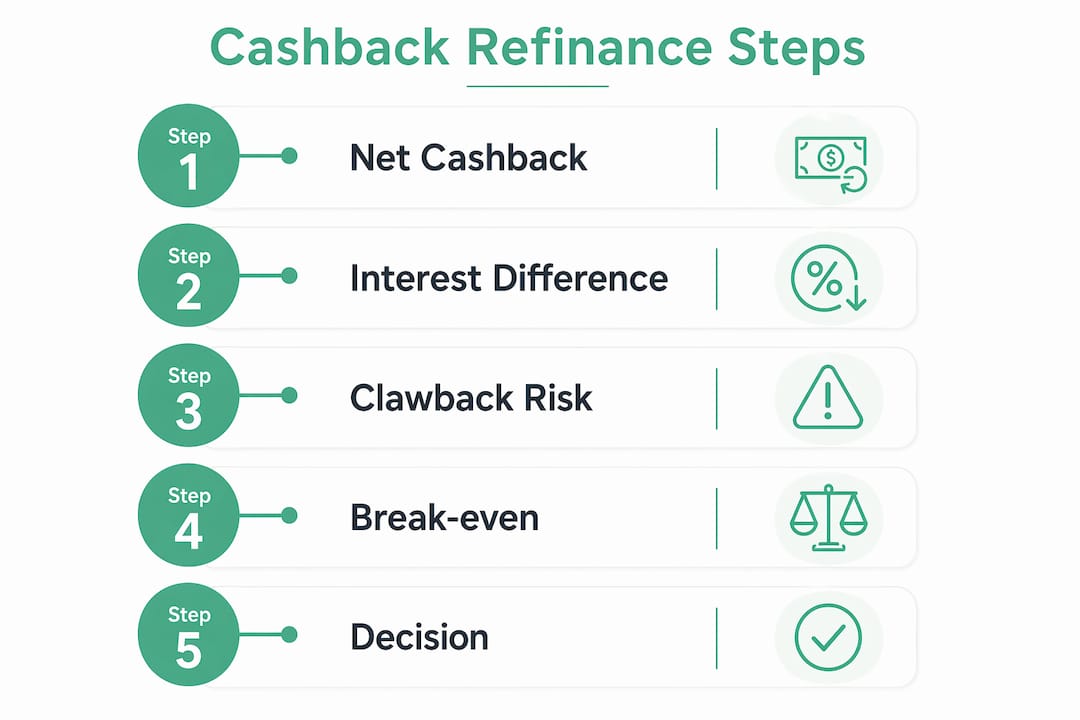
Step 1: Add up your one-off costs and net cashback
List every cost you'll pay to switch:
- Discharge fee from your current lender (typically A$150–A$400)
- Application or establishment fee with the new lender
- Valuation fee (often A$200–A$600)
- Legal or conveyancing fees if applicable
Subtract these from the cashback amount. The result is your net cashback gain.
Step 2: Calculate the annual interest difference
Compare your current loan's comparison rate with the new loan's comparison rate. Multiply the difference (as a decimal) by your outstanding loan balance to get the annual saving or extra cost.
Worked example:
- Outstanding loan balance: A$500,000
- Current comparison rate: 6.50%
- New loan comparison rate: 6.25%
- Annual interest saving: 0.25% × A$500,000 = A$1,250 per year
- Cashback offered: A$3,000
- Switching costs: A$800
- Net cashback gain: A$2,200
- Break-even point: A$2,200 ÷ A$1,250 = 1.76 years (approximately 21 months)
If you plan to hold the loan for more than 21 months, this deal works in your favour. If you're likely to move or refinance again within 18 months, it probably doesn't.
Step 3: Factor in clawback risk
Check the minimum holding period. If the lender requires 24 months and your break-even is 21 months, you're cutting it close. Any early exit within the clawback window could mean repaying part of the cashback, which changes the maths entirely.
| Input | Your figure |
|---|---|
| Outstanding loan balance | A$_______ |
| Current comparison rate | _______ % |
| New comparison rate | _______ % |
| Annual interest saving (or cost) | A$_______ |
| Cashback offered | A$_______ |
| Estimated switching costs | A$_______ |
| Net cashback gain | A$_______ |
| Break-even (months) | Net gain ÷ annual saving × 12 |
| Clawback holding period | _______ months |
Pro Tip: Run the numbers across three time horizons: 1 year, 3 years, and the remaining loan term. A cashback that looks marginal at one year often looks excellent at three, and vice versa. This sensitivity check takes five minutes and can save you thousands.
How to claim your cashback and what to check in the fine print
The claiming process is mostly handled by your lender, but there are steps you need to take to make sure nothing delays payment.
Typical claiming steps:
- Confirm eligibility before you apply — check the PDS for minimum loan size, LVR requirements and excluded loan types.
- Provide a nominated transaction account in your name at application or settlement.
- Complete settlement and discharge your old loan.
- Wait for the lender's confirmation that cashback eligibility has been verified.
- Payment arrives in your nominated account within the stated window, typically 30–90 days after settlement.
Fine print checklist — read these in the PDS before you sign:
- Clawback clause: How long must you hold the loan? What percentage is reclaimed if you exit early?
- Minimum holding period: Is it 12 months, 24 months, or longer?
- Exclusions: Does your loan type qualify? Owner-occupier P&I loans are most commonly eligible.
- Payment conditions: Is the cashback contingent on setting up a specific account or direct debit?
- Comparison rate disclosure: Does the cashback affect the comparison rate calculation?
A note on tax: For owner-occupiers, cashback payments are generally not treated as taxable income. If you hold the property as an investment, the tax treatment may differ. Check with your accountant before assuming the cashback is tax-free in your situation.
When a mortgage broker can make all the difference
A mortgage broker does more than find you a loan. When it comes to cashback offers, they can model the break-even scenario for your exact loan size and holding period, explain the PDS terms in plain language, and often negotiate rate or fee waivers that a direct application won't get you.
Questions to ask your broker or lender before switching:
- What are the clawback terms, and how long must I hold the loan?
- How and when is the cashback paid, and what account does it go into?
- What loan features are restricted or excluded under this offer?
- Is the headline rate a promotional rate that resets? If so, when and to what?
- What is the comparison rate, and how does it compare to my current loan?
The best cashback deals aren't always the ones with the biggest number on the banner. They're the ones where the ongoing rate, features and clawback terms all work together for your specific situation and timeline.
Zenrgfinance offers tailored refinance assessments that model whether a cashback deal genuinely improves your net position over your chosen holding period. The team brings experience across owner-occupier loans, investment properties and SMSF lending, which matters when your situation doesn't fit a standard template. For SMSF lending questions specifically, the eligibility rules around cashback offers are more restrictive, and getting the structure right from the start saves significant cost.
Pro Tip: Bring three things to your first broker meeting: your current loan statement (showing your rate, balance and remaining term), a list of the cashback offers you've seen, and a rough idea of how long you plan to hold the property. That's enough to run a meaningful comparison on the spot.
Key takeaways
A cashback refinancing offer is only worth taking when the new loan's ongoing rate is genuinely competitive, the net cashback exceeds your switching costs, and you plan to hold the loan beyond the break-even point.
| Point | Details |
|---|---|
| Check the comparison rate first | The comparison rate reveals the true cost; a lower headline rate with high fees can still be worse value. |
| Run a break-even calculation | Divide your net cashback gain by your annual interest saving to find how many months until you're ahead. |
| Read the clawback clause | Most lenders require 12–24 months minimum holding or they reclaim part of the cashback. |
| Typical offers range about A$1,000–A$4,000 | Larger cashbacks are generally tied to higher loan balances; loans under A$250,000 often don't qualify. |
| Zenrgfinance models the full picture | Zenrgfinance can run break-even scenarios for your loan size and holding period before you commit to any offer. |
The cashback trap most homeowners fall into
The most common mistake isn't accepting a bad cashback deal. It's stopping the search once a cashback is on the table.
There's a real behavioural pull at work here. Once a lender puts A$3,000 in front of you, the conversation shifts from "is this the best loan for me?" to "how do I get that money?" The cashback becomes the anchor, and everything else gets evaluated relative to it rather than on its own merits. That's exactly what lenders are counting on.
The practical fix is simple but most people skip it: treat the cashback as one input in a spreadsheet, not the headline of the decision. Run the break-even calculation before you get emotionally attached to the number. If the ongoing rate is higher than your current loan, the cashback is effectively a loan you're repaying through interest, just invisibly.
The other thing worth saying plainly: a cashback offer from a lender you've never heard of, on a loan with features you can't verify, is not a gift. Read the PDS. Check the comparison rate. Ask the clawback question directly. The homeowners who come out ahead on these deals are the ones who treated the cashback as a bonus on a good loan, not as a reason to take a mediocre one.
How Zenrgfinance helps you evaluate cashback refinance offers
Sorting through cashback offers takes more than a quick Google search. The rate, the features, the clawback terms and your own holding period all interact in ways that aren't obvious from a product page.

Zenrgfinance works with Australian homeowners to model exactly this. In a first meeting, the team reviews your current loan, maps out the real cost of switching to any offer you're considering, and shows you where the break-even point sits for your specific balance and timeline. There's no pressure to take any particular product. The goal is to make sure you understand what you're signing before you sign it.
For investors and SMSF borrowers, the home refinancing process involves additional eligibility layers that affect which cashback offers are even available. Zenrgfinance has specific experience here and can navigate those restrictions without you having to decode the fine print yourself.
Ready to see whether a cashback deal actually works for your situation? Book a refinance assessment with Zenrgfinance and get a clear, numbers-based answer before you commit to anything.
Useful sources and further reading
These Australian resources will help you verify current cashback offers and check the fine print before making any decisions:
- Best home loan refinance cashback offers — Finder: regularly updated market roundup of current Australian cashback deals, with eligibility notes.
- Best home loan refinance cashback offers — Money.com.au: detailed breakdown of current offers including tiered cashback examples and clawback conditions.
- Refinance cashback schemes: are they really worth it? — Mason Finance Group: practical broker perspective on when cashback deals work and when they don't.
- Refinancing benefits homeowners: 8 real advantages — Zenrgfinance blog: covers the broader case for refinancing and how to assess total loan value.
- Why refinancing improves cash flow — Zenrgfinance blog: explains the cash-flow mechanics of refinancing, useful context for evaluating any cashback offer.
Always read the Product Disclosure Statement and cashback terms and conditions on the lender's own website before accepting any offer. Cashback amounts, eligibility criteria and clawback conditions change regularly, and the lender's current PDS is the only authoritative source.
This article provides general information only and is not financial or tax advice. Confirm current rates, eligibility and tax treatment with a qualified professional for your own situation.