
A cash-out refinance replaces your existing home loan with a larger mortgage and pays you the difference as a lump sum at settlement. Unlike a rate-and-term refinance, which simply adjusts your interest rate or loan term without touching your loan balance, a cash-out refinance increases what you owe and puts real cash in your hands.
Three things every Australian homeowner or investor should know before reading further:
- Your loan balance goes up. You are borrowing more against your property, so your monthly repayments will increase.
- Common uses include renovations, debt consolidation and buying investment property — though using the funds for everyday spending is generally a poor financial decision.
- The main risks are negative equity and default. If property values fall or your income drops, a larger secured loan can become a serious problem.
This guide covers everything specific to the Australian market: loan-to-value ratio (LVR) limits, Lender's Mortgage Insurance (LMI), typical fees, the settlement timeline, and the questions you should ask before you sign anything.
Key takeaways
A cash-out refinance works best when your equity is strong, your use of funds is productive, and your repayments remain affordable under a rate-rise scenario.
| Point | Details |
|---|---|
| Definition | Replaces your existing loan with a larger mortgage; the difference is paid to you as a lump sum at settlement. |
| LVR and equity | Most lenders cap cash-out refinances at 80% LVR; going above this triggers LMI, which can cost tens of thousands. |
| Fees reduce net cash | Discharge, application, valuation, and settlement fees typically total $1,500–$3,500 and come off your cash at settlement. |
| Use of funds matters | Investment-purpose funds may attract tax deductibility; personal-use funds generally do not — confirm with a tax agent. |
| Zenrgfinance | Zenrgfinance compares lenders across a broad panel and manages the full cash-out refinance process at no upfront cost to you. |
Table of Contents
- How does a cash-out refinance work in Australia?
- What does the maths actually look like?
- How much can you borrow? LVR, equity and lender rules
- What can you use the funds for?
- The real pros and cons of cash-out refinancing
- Fees and costs to budget for in Australia
- Alternatives to a cash-out refinance
- Tax and credit score implications you should know
- Your checklist before you commit
- Should you use a mortgage broker for a cash-out refinance?
- One thing most people get wrong
- Zenrgfinance can help you run the numbers
- Sources
How does a cash-out refinance work in Australia?
The cash-out process mirrors a standard refinance — application, credit check, property valuation, approval, and settlement — but the new loan is larger because it includes the cash you are withdrawing. Here is the sequence from start to finish.
Step-by-step process:
- Calculate your usable equity. Subtract your outstanding loan balance from your property's current market value. Most lenders will only let you borrow up to 80% LVR, so your accessible equity is typically the gap between your current balance and 80% of the property's value.
- Gather your documents. You will need recent payslips or tax returns, bank statements, a current rates notice, and identification. Self-employed borrowers should review income documentation requirements early, as lenders apply stricter servicing tests.
- Submit your application. Your broker or lender lodges the application with supporting documents. The lender runs a credit check and assesses your income against the new, larger repayment.
- Property valuation. The lender orders an independent valuation. This is one of the most common causes of delay — disputes over the assessed value can stall approval by weeks.
- Conditional and formal approval. Once the valuation confirms the LVR is within limits and your income passes the serviceability test, the lender issues formal approval.
- Settlement. Your new, larger loan pays out the old mortgage. Any remaining funds, after fees and costs are deducted, are deposited into your nominated account.
- Repayments begin. Your new repayment schedule starts immediately, based on the higher loan balance.
What commonly causes delays:
- Appraisal disputes or a valuation that comes in lower than expected
- Title searches uncovering encumbrances or caveats
- Incomplete income documentation, particularly for self-employed applicants
- Lender backlogs during peak refinancing periods
Allow 45–60 days from application to settlement and keep short-term liquidity available until the funds clear. Do not plan a renovation start date around the settlement date until formal approval is confirmed.
Pro Tip: Order a desktop valuation estimate before you apply. Several Australian lenders offer free indicative valuations through their online portals. If the estimate is lower than you expected, you can adjust your borrowing amount before the formal application — saving time and a credit enquiry.
What does the maths actually look like?
Say your property is currently valued at $800,000 and your outstanding loan balance is $450,000.
- Maximum new loan at 80% LVR: $800,000 × 80% = $640,000
- Less your current balance: $640,000 − $450,000 = $190,000 available in theory
Before you celebrate, fees come off the top. Discharge fees, application fees, valuation costs, and settlement charges typically total $1,500–$3,500 for a straightforward refinance. Your net cash at settlement might be closer to $186,500–$188,500 depending on your lender.
- Maximum new loan at 90% LVR: $800,000 × 90% = $720,000
- Less your current balance: $720,000 − $450,000 = $270,000 available
On a loan of this size, LMI premiums can run into the tens of thousands of dollars, which either reduces your net cash or gets capitalised onto the loan, costing you interest for years. Australian lenders treat LMI as a significant cost item that borrowers must factor into their budget before deciding how much to draw.
Staying below it keeps your costs lower and your options wider.
How much can you borrow? LVR, equity and lender rules
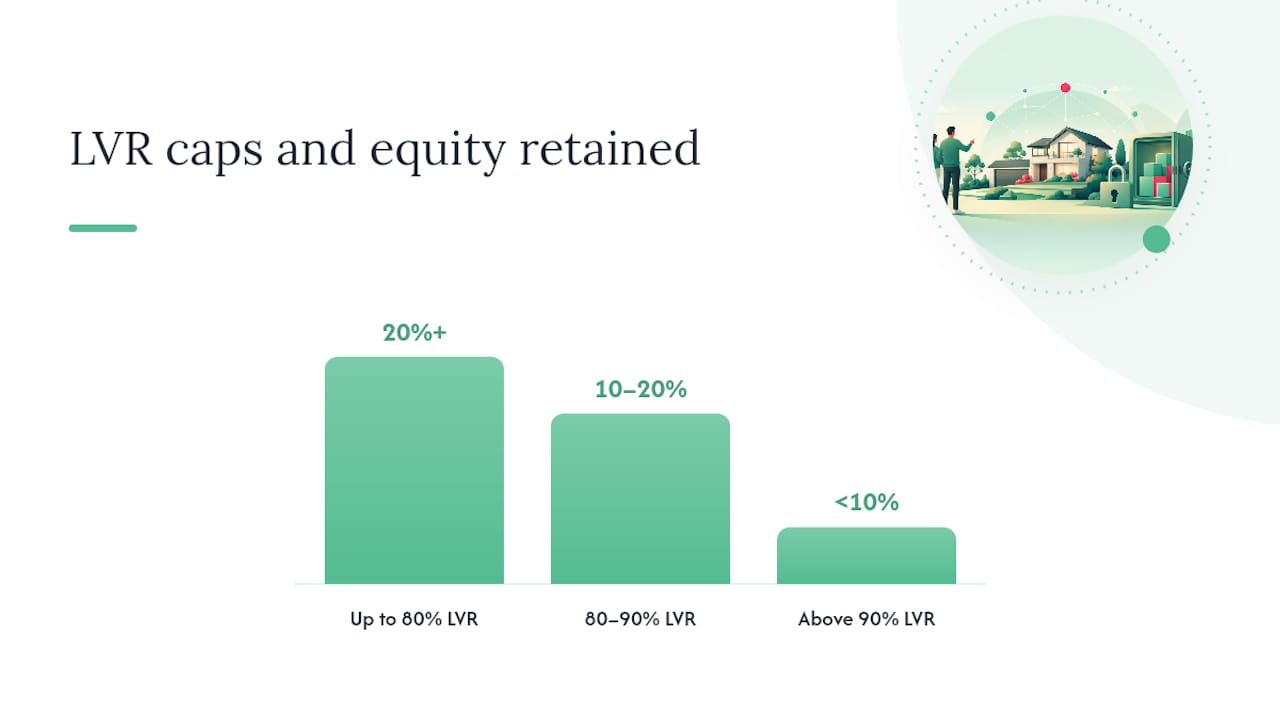
Lenders commonly cap cash-out refinances at around 80% LVR, meaning you need to retain at least 20% equity in your property after the refinance settles.
Understanding how LVR shapes your approval is the single most important step before you approach a lender.
Factors lenders assess beyond LVR:
- Income and serviceability: The lender stress-tests your ability to repay the new, larger loan at a rate typically 3% above the current rate (the APRA serviceability buffer).
- Credit score: A history of missed payments or multiple recent credit enquiries can reduce your borrowing capacity or result in a higher interest rate.
- Property type: Standard residential properties in metro areas attract the most favourable LVR treatment. Rural properties, units in high-density postcodes, and unusual property types may face lower LVR caps.
- Employment stability: Lenders prefer at least two years in the same role or industry. Recent job changes can complicate approval.
- Existing debts: Credit cards, car loans, and HECS-HELP balances all reduce your assessed borrowing capacity.
| LVR cap | Equity retained | LMI required? | Typical use case |
|---|---|---|---|
| Up to 80% | 20% or more | No | Standard cash-out refinance |
| 80%–90% | 10%–20% | Yes | Higher cash need, accepts LMI cost |
| Above 90% | Less than 10% | Yes, higher premium | Rarely approved for cash-out |
Lenders also vary on how recent the valuation must be and which property types they accept at standard LVR. A broker with access to multiple lenders can sometimes secure more favourable LVR treatment for certain property types — particularly for investors or those with non-standard properties.
What can you use the funds for?
Proceeds from a cash-out refinance can be used for any purpose, but some uses make far more financial sense than others.
Productive uses that tend to justify the cost:
- Renovations that add value — a kitchen or bathroom upgrade that increases your property's market value or rental yield
- Debt consolidation — paying out high-interest credit cards or personal loans and replacing them with lower-rate mortgage debt
- Buying an investment property — using equity as a deposit on a second property, potentially building your portfolio
- SMSF strategies — some investors use equity access as part of a broader property investment or self-managed super fund structure
- Business investment — funding equipment or working capital at mortgage rates rather than commercial loan rates
Uses that are generally discouraged:
- Holidays, cars, or everyday living expenses — you are converting short-term spending into long-term secured debt, paying mortgage interest on a holiday for potentially 25 years
- Speculative investments — using your home as collateral for volatile assets amplifies your risk significantly
Pro Tip: If you plan to use the funds for investment purposes or renovations on a rental property, the interest on that portion of the loan may be tax deductible. Talk to a registered tax agent before settlement — the way the loan is structured at the time of drawdown affects deductibility, and it is much harder to fix retrospectively.
The real pros and cons of cash-out refinancing
A cash-out refinance can be one of the cheaper ways to borrow — mortgage rates are typically well below personal loan or credit card rates. Used well, it replaces expensive debt with cheaper secured debt or funds an asset that grows in value. Used poorly, it turns short-term spending into decades of secured debt.
Benefits:
- Access to large sums at mortgage interest rates, which are lower than most other borrowing options
- Opportunity to consolidate multiple debts into one manageable repayment
- Can be combined with a loan restructure — for example, moving from a variable to a fixed rate, or extending the term to reduce monthly repayments
- Funds can be deployed for value-adding renovations or income-producing investments
Risks:
- Your loan balance increases, and so do your monthly repayments
- If property values fall, you could end up in negative equity — owing more than your home is worth
- Defaulting on a larger secured loan puts your home at risk of foreclosure
- Removing equity reduces your buffer for future borrowing, such as a line of credit in an emergency
A larger mortgage is not just a bigger number on a statement — it is a bigger consequence if your circumstances change. Rate rises, job loss, or a property market correction can each turn a manageable loan into a genuine hardship. Model your repayments at 2%–3% above your new rate before you commit.
The interest-rate environment matters here. A cash-out refinance taken at a low rate can look very different two years later if rates have risen. Practical brokers recommend modelling repayments under several rate-rise scenarios before committing to a larger secured loan.
Fees and costs to budget for in Australia
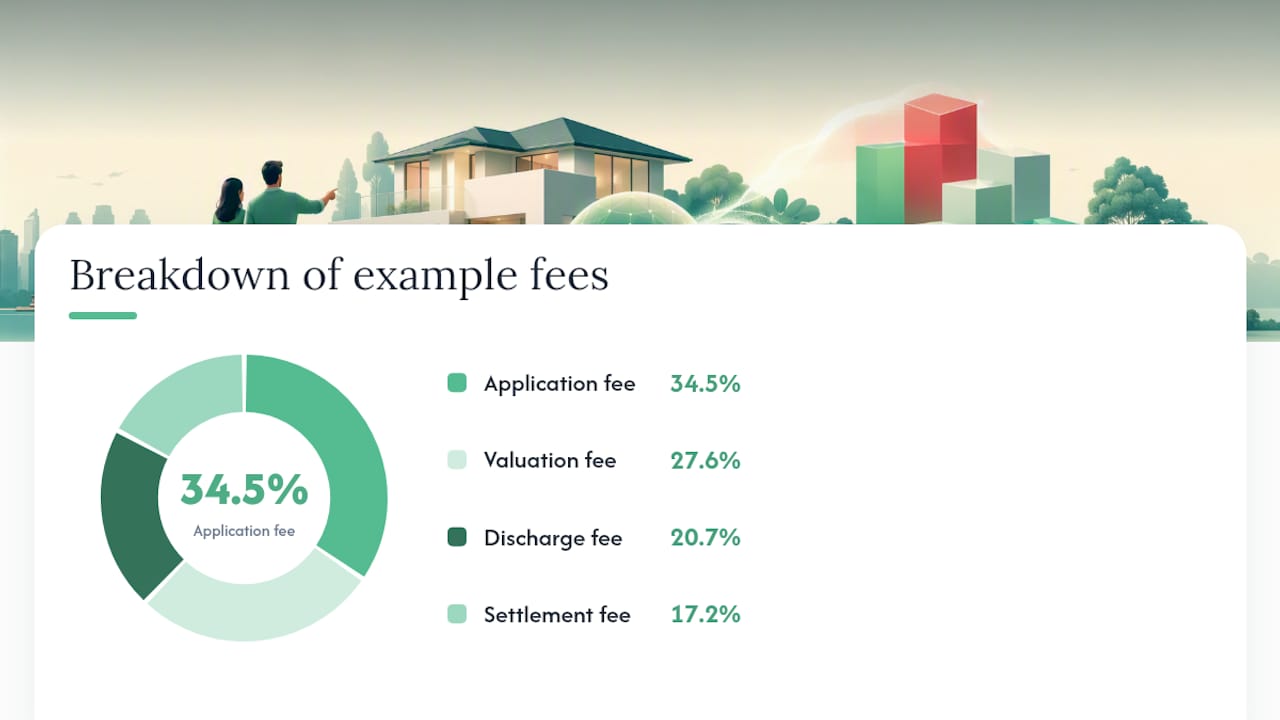
Australian lenders apply a range of fees to cash-out refinances that can meaningfully reduce your net cash at settlement. Budget for all of these before you decide how much to draw.
Common fees to expect:
- Discharge fee on your existing loan: typically $150–$400, paid to your current lender to close the old mortgage
- Application or establishment fee on the new loan: $0–$600 depending on the lender
- Valuation fee: $200–$600 for a standard residential property; higher for rural or complex properties
- Settlement fee: $150–$300, charged by the lender or their conveyancer
- Break costs on a fixed-rate loan: can be thousands of dollars if you are mid-term on a fixed rate; always get a written break-cost estimate before proceeding
- LMI premium: applies above 80% LVR; on a $720,000 loan at 90% LVR, this can exceed $10,000–$15,000 depending on the lender and insurer
- Ongoing fees: some lenders charge annual or monthly fees on the new loan that did not apply to your old one
It is worth comparing a no-cost refinance structure against a standard cash-out refinance to understand whether rolling fees into the loan rate makes sense for your situation.
How fees reduce your net cash — a quick example:
- Gross cash available at 80% LVR: $190,000
- Less discharge fee: −$300
- Less application fee: −$500
- Less valuation fee: −$400
- Less settlement fee: −$250
- Net cash at settlement: approximately $188,550
If break costs apply on a fixed-rate loan, that figure could drop by several thousand dollars more.
Alternatives to a cash-out refinance
A cash-out refinance is not the only way to access your equity. Depending on your situation, one of these alternatives may suit you better.
- Redraw facility: If your existing loan has a redraw feature and you have made extra repayments, you can access those funds without refinancing. No new application, no new fees, no change to your loan structure. Best for smaller amounts when your current rate is already competitive.
- Home equity loan (second mortgage): A separate loan secured against your property's equity, sitting alongside your existing mortgage. You keep your current loan untouched, which matters if you are on a low fixed rate. The trade-off is a second set of fees and a separate repayment.
- Home equity line of credit (HELOC): A revolving credit facility secured by your home, similar to a credit card with a much lower rate. Useful for ongoing or unpredictable expenses — a renovation with uncertain costs, for example. You draw and repay as needed rather than taking a single lump sum.
- Personal loan: No property security required, faster approval, but interest rates are significantly higher. Only sensible for smaller amounts over shorter terms where the speed and simplicity outweigh the cost.
- Reverse mortgage: Available to homeowners aged 60 and over, allowing equity access without regular repayments. Interest compounds over time and reduces the estate's value. Worth exploring for retirees with limited income but substantial equity.
- Selling and downsizing: For investors or homeowners with significant equity and a desire to simplify, selling and reinvesting the proceeds avoids debt entirely.
For flexible, ongoing access to funds, a HELOC or redraw is usually simpler and cheaper.
Tax and credit score implications you should know
Cash proceeds from a refinance are not income — you are borrowing money, not earning it, so the lump sum is not taxable. What does matter for tax is how you use the funds.
Tax deductibility of interest:
- If you use the cash for income-producing purposes — buying an investment property, funding renovations on a rental, or investing in shares — the interest on that portion of the loan may be deductible against your rental or investment income.
- If you use the funds for personal spending (a holiday, a car, home renovations on your primary residence), the interest is generally not deductible.
- Mixed use is where it gets complicated. If you split the funds between investment and personal purposes, you need to apportion the interest correctly. This is a job for a registered tax agent, not a guess.
Credit score impact:
- The lender will run a hard credit enquiry when you apply, which can temporarily reduce your credit score by a small amount.
- Your debt-to-income ratio increases with the larger loan balance, which may affect future borrowing capacity.
- Consistent, on-time repayments on the new loan will rebuild any short-term dip over time.
Pro Tip: Before settlement, ask your lender or broker to confirm in writing how the loan is split between the investment-purpose portion and any personal-use portion. Getting this documented at the time of drawdown makes your tax agent's job straightforward and protects your deductibility claim.
Your checklist before you commit
Before you sign anything, work through this list. It takes 30 minutes and can save you thousands.
Checklist:
- Calculate your usable equity at 80% LVR and confirm whether the amount meets your actual need.
- Get a written fee schedule from the lender covering discharge, application, valuation, settlement, and any break costs.
- Confirm whether LMI applies at your chosen LVR and get a written premium estimate.
- Compare the new interest rate against your current rate — and against the market.
- Model your new monthly repayment at your new rate, then at 2% and 3% above it.
- Check the new loan term: a longer term reduces monthly payments but increases total interest paid.
- Confirm the expected timeline from application to settlement and whether that fits your plans.
- Ask whether the new loan structure (fixed, variable, split) suits your risk tolerance.
Questions to ask your lender or broker in writing:
- What is the exact LVR cap for my property type and postcode?
- What are all the fees, including any ongoing monthly or annual fees?
- Does LMI apply, and if so, what is the exact premium?
- What is the break cost on my current fixed-rate loan?
- What is the realistic timeline from application to settlement?
- How will you communicate if there are delays?
Red flags to watch for:
- Vague or verbal-only fee disclosures
- Pressure to borrow more than you need
- No written break-cost estimate before you commit to leaving a fixed-rate loan
- A broker or lender who cannot clearly explain the serviceability test they applied
ASIC's guidance on switching home loans is worth reading before you start comparing lenders — it covers your rights and what lenders must disclose.
Should you use a mortgage broker for a cash-out refinance?
A mortgage broker does more than find you a rate. For a cash-out refinance, the practical value is in lender selection, structuring, and paperwork management.
What a broker does for you:
- Compares cash-out refinance products across a panel of lenders, including those with more favourable LVR treatment for your property type
- Structures the loan to separate investment-purpose and personal-use portions where relevant
- Manages the application, valuation order, and communication with the lender
- Flags break costs and LMI implications before you commit
- Keeps the process moving and follows up on delays
Questions to ask any broker before engaging them:
- How many lenders are on your panel, and do any specialise in cash-out refinances for investors?
- How is your commission structured, and which lenders pay you the most?
- What is your expected timeline for this type of application?
- Can you provide examples of similar refinances you have managed?
On commission: Australian mortgage brokers are paid a commission by the lender when your loan settles — you generally pay nothing directly. The broker is legally required to act in your best interests under the Best Interests Duty introduced by ASIC. Ask your broker to confirm this in writing and to explain why they are recommending a particular lender over alternatives.
Zenrgfinance works across a broad lender panel and handles the full process from initial equity calculation through to settlement. The introduction to mortgage brokers podcast is a good starting point if you want to understand what to expect from a brokerage engagement before your first conversation.
Seeing the numbers side by side — total interest, monthly repayment, net cash — makes the decision much clearer than comparing rates alone.*
One thing most people get wrong
Most homeowners focus almost entirely on the interest rate when they consider a cash-out refinance. The rate matters, but it is rarely the deciding factor.
What actually determines whether the refinance works in your favour is the combination of fees, the LVR you land at, how you use the funds, and whether your repayments remain manageable if rates rise. A slightly higher rate on a loan with no LMI, low fees, and a well-structured investment purpose can outperform a lower rate that triggers LMI and capitalises $12,000 onto your balance.
If the higher-rate scenario still fits your budget comfortably, the refinance is worth exploring. If it stretches you, you need a smaller drawdown or a longer term — and you need to know that before you apply, not after.
Zenrgfinance can help you run the numbers
Knowing what a cash-out refinance is and knowing whether it is right for your specific property, income, and goals are two different things. Zenrgfinance works with homeowners and property investors across Australia to compare lenders, structure the loan correctly, and manage the process from equity calculation to settlement.

There are no upfront fees for brokerage services — Zenrgfinance is paid a commission by the lender when your loan settles, and you receive a written disclosure of that commission before you commit to anything. The process starts with a conversation about your goals, your current loan, and the equity you have available.
To get a clear picture of your borrowing capacity and what a cash-out refinance would cost in your situation, book a call with a mortgage relationship manager or use the budget planner to model your repayments before you pick up the phone.
Sources
External sources used in this guide:
- Cash-Out Refinancing: Unlock Home Equity and When to Refinance
- Cash out refinancing explained - Home Loans - Finder
- Cash‑Out Refinancing: What It Is, How It Works | Bankrate
- Cash‑Out Refinance: A Complete Homeowners Guide for Cash‑Out Loans | Zillow
- What Is a Cash‑Out Refinance? | Experian
Zenrgfinance resources for next steps:
This article provides general information only and is not a substitute for professional financial, tax, or legal advice. Confirm current lender requirements and tax rules with a qualified professional before proceeding.