
If you're refinancing and unsure which loan structure to choose, here's the short answer by borrower type:
- Risk-averse borrowers who need predictable repayments: go fixed-heavy with a larger fixed portion and smaller variable portion.
- Savers with a solid offset balance: a variable-heavy structure or fully variable loan will likely save you more over time.
- Renovators with planned cashflow commitments: a roughly equal split gives you certainty on part of your debt while keeping redraw access on the rest.
- Property investors: the right mix depends on your tax strategy and whether you're claiming interest deductions, so a split or fully variable structure is worth modelling carefully.
- Short-term movers (planning to sell within a few years): lean variable or keep any fixed term short to avoid break costs on exit.
Not sure which profile fits you? Run your numbers through the split loan calculator or book a consult with a Zenrgfinance broker before you commit.
Pro Tip: The best loan structure isn't the one with the lowest advertised rate. It's the one that costs least across your actual plans, including what you'll pay if those plans change.

Table of Contents
- How fixed, variable and split home loans work in Australia
- What you gain and give up with a fixed-rate loan
- What you gain and give up with a variable-rate loan
- How split loans work and the traps worth knowing
- How to decide between fixed, variable and a split when refinancing
- What refinancing actually costs: timeline, fees and break costs
- Worked examples: how 50/50, 70/30 and 30/70 splits compare
- Which structure suits you? A practical verdict
- Key takeaways
- A broker's honest view on choosing your loan structure
- How Zenrgfinance can help you structure your refinance
- Useful sources and further reading
How fixed, variable and split home loans work in Australia
These three loan types sit at the heart of every refinance comparison. Understanding what each one actually does to your repayments is the starting point for any good decision.

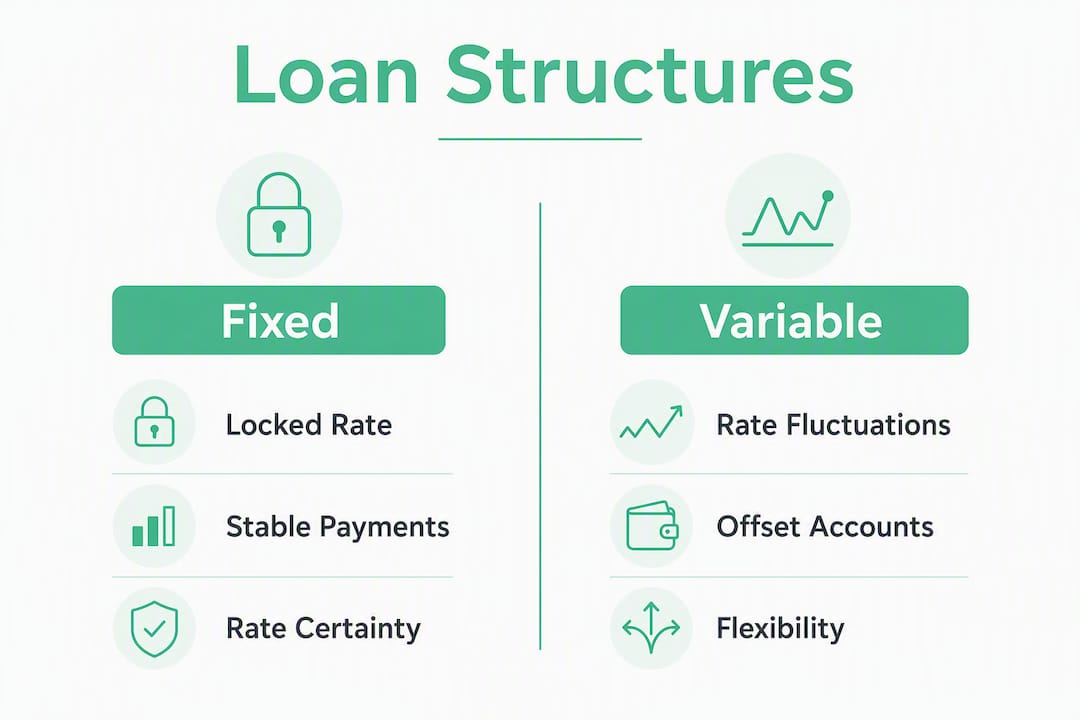
Fixed-rate home loan: Your interest rate is locked for a set period, usually a few years in Australia. During that term, your repayments don't move regardless of what the Reserve Bank of Australia (RBA) does. At the end of the fixed term, the loan usually reverts to the lender's standard variable (revert) rate unless you actively renegotiate or refinance again.
Variable-rate home loan: Your rate moves with the lender's pricing decisions, which are influenced by RBA cash rate changes and funding costs. Variable loans commonly allow unlimited extra repayments, offset accounts and redraw facilities, which can significantly reduce the interest you pay if you keep savings working against your balance.
Split home loan: A split loan divides your mortgage into two portions — one fixed and one variable. Most lenders treat them as a single account with two tranches, so you make one repayment that is allocated internally. Common splits include 50/50 and 70% fixed / 30% variable, though you can usually negotiate any ratio.
The table below shows how each structure behaves when rates move.
| Feature | Fixed | Variable | Split (example: 50/50) |
|---|---|---|---|
| Repayment changes if RBA cuts rates | No | Yes, usually | Only on variable portion |
| Repayment changes if RBA raises rates | No | Yes | Only on variable portion |
| Offset account available | Rarely | Usually yes | Yes, on variable tranche only |
| Unlimited extra repayments | Usually no | Yes | Yes, on variable tranche only |
| Break costs on early exit | Yes | No | Yes, on fixed tranche only |
| Typical fixed term length | 1–5 years | N/A | 1–5 years (fixed tranche) |
What you gain and give up with a fixed-rate loan
Fixing your rate is essentially buying insurance against rate rises. You pay a premium for certainty, and that premium can look expensive in hindsight if rates fall or stay flat.
The genuine benefits:
- Repayments are locked, making monthly budgeting straightforward.
- You're protected if the RBA lifts the cash rate during your fixed term.
- Predictable cashflows suit borrowers with tight margins, such as those on a single income or managing a renovation budget.
The real trade-offs:
- Fixed loans do not benefit from rate cuts while the fixed term runs. If rates drop, your repayment stays the same.
- Most fixed products limit extra repayments each year, so aggressive repayers may face restrictions.
- Break costs can be substantial if you exit early — more on this in the refinancing costs section below.
- The revert rate at term end is often higher than competitive variable rates, so passive rollovers cost you money.
What to check before fixing:
- The fixed term length and the revert rate that applies on expiry.
- Whether extra repayments are allowed and up to what annual limit.
- The lender's break-cost methodology (this varies significantly between lenders).
- The comparison rate versus the advertised rate — the gap reveals ongoing fees.
For a deeper look at the fixed versus variable trade-off, Zenrgfinance's guide to fixed vs variable home loan rates walks through the decision in plain language.
Pro Tip: Review your fixed term 2–3 months before it expires. Lenders' revert rates are usually higher than their competitive offers, and shopping the market at that point can save you thousands annually.
What you gain and give up with a variable-rate loan
Variable loans reward borrowers who actively manage their money. The flexibility is real, but so is the exposure to rate movements.
Core benefits:
- Rate cuts from the RBA flow through to your repayments, usually within a billing cycle.
- Unlimited extra repayments mean you can pay down principal faster without penalty.
- Offset accounts let your savings work directly against your loan balance. Every dollar sitting in offset reduces the interest calculated each day.
- Redraw facilities give you access to any extra repayments you've made, so your money isn't locked away.
The drawbacks:
- Repayments can rise if the RBA or your lender increases rates, which makes budgeting harder over longer horizons.
- Introductory discounts ("honeymoon rates") sometimes expire, leaving you on a less competitive rate if you don't stay alert.
The offset account is where variable loans really earn their keep for savers. Offset and redraw features are often linked to the variable tranche, so borrowers who keep significant savings in offset can materially reduce their effective interest rate without making extra repayments. Zenrgfinance's home loan offset calculator lets you model exactly how much your offset balance saves you each month.
For borrowers with regular surplus income and a growing offset balance, a fully variable loan often outperforms a fixed or split structure over the same period, even when variable rates are slightly higher on paper. Zenrgfinance's piece on why variable rate refinancing suits some homeowners explains the mechanics in detail.
How split loans work and the traps worth knowing
Split loans let you combine repayment certainty on one portion with flexibility on the other. The appeal is real, but the structure comes with a few traps that catch borrowers off guard.
How lenders handle the mechanics:
Most lenders set up two sub-accounts under a single loan facility. Your repayment is one amount, split internally between the fixed and variable tranches according to their rates and balances. Some lenders charge a fee for managing two tranches; others include it in the loan.
Common split ratios and who typically chooses them:
- 70% fixed / 30% variable: Suits borrowers who prioritise certainty — single-income households, those on tight monthly budgets, or anyone who'd lose sleep over a rate rise. The variable portion still gives access to offset and redraw.
- 50/50: A genuine middle ground. Useful when you're uncertain about the rate direction and want partial protection without giving up too much flexibility. Popular with owner-occupiers who have moderate savings.
- 30% fixed / 70% variable: Works well for borrowers with substantial offset balances or those who make regular extra repayments. The fixed portion provides a floor of certainty while the variable portion does the heavy lifting on interest reduction.
Advantages of splitting:
- Partial protection against rate rises on the fixed tranche.
- Access to offset and redraw on the variable tranche.
- Smoother budgeting: you know exactly what the fixed portion costs each month.
- If rates fall, the variable portion benefits even while the fixed portion stays put.
The traps:
- Some lenders charge additional fees for managing two tranches — always inquire about this.
- The fixed tranche restricts extra repayments, so you can't throw a windfall at the whole loan.
- Rate cuts only reduce repayments on the variable portion. If you've fixed 70%, a 0.5% cut from the RBA saves you much less than you might expect.
- Offset accounts and redraw are typically only available on the variable tranche — confirm this with your lender before structuring the split.
Deciding your ratio: Align the fixed portion to the share of your balance where you genuinely need certainty. If you have significant upcoming costs like school fees or renovations, fix enough to cover those commitments and keep the rest variable.
How to decide between fixed, variable and a split when refinancing
A structured approach beats gut instinct here. Work through these questions before you speak to a lender.
Self-assessment checklist:
- How long do you plan to stay in the property? (Under 3 years: avoid long fixed terms.)
- How much do you currently keep in an offset account?
- Do you make regular extra repayments beyond your minimum?
- Is this an investment property where interest deductibility affects your preference?
- Could your income change in the next 1–2 years (parental leave, career change)?
- How would a 1% rate rise affect your monthly budget?
Questions to ask your broker or lender:
- What is the break-cost methodology for the fixed tranche?
- What is the revert rate when the fixed term expires?
- How many extra repayments are permitted annually on the fixed portion?
- Is an offset account available on the variable tranche, and is there a fee?
- Are there ongoing fees for maintaining a split structure?
A quick risk-tolerance test:
- Conservative: Rate rises would genuinely stress your budget. Fix a larger portion (60–70%) and keep a smaller variable tranche for flexibility.
- Balanced: You can absorb moderate rate movements but want some certainty. A 50/50 split is a reasonable starting point.
- Opportunistic saver: You keep $50,000 or more in offset and make regular extra repayments. A variable-heavy structure (or fully variable) will likely cost you less over the fixed period.
Using break-even thinking:
Don't compare rates in isolation. A break-even variable rate — the variable rate at which total cost over the fixed period equals the fixed option — is a useful decision tool. If you believe variable rates will stay below that break-even level for most of your fixed term, fixing looks expensive. If you think they'll exceed it, fixing looks cheap. The loan comparison calculator at Zenrgfinance lets you run this analysis side by side.
What refinancing actually costs: timeline, fees and break costs
Refinancing isn't free, and the costs can easily outweigh the savings if you move at the wrong time. Here's what to expect.
Typical refinance timeline:
- Application and document collection: 1–2 weeks
- Lender assessment and conditional approval: 1–3 weeks
- Valuation: 1–2 weeks (sometimes concurrent with assessment)
- Formal approval and loan documents: 1–2 weeks
- Settlement: 1–2 weeks after signing
Total: roughly 4–10 weeks from application to settlement, depending on the lender and property complexity.
Typical costs breakdown:
| Cost category | What it covers | Typical range |
|---|---|---|
| Application / establishment fee | New lender's setup charge | $0–$600 |
| Valuation fee | Lender's property valuation | — |
| Discharge fee | Releasing the existing mortgage | — |
| Title registration fee | State government charge for title transfer | — |
| Break cost (fixed tranche) | Lender's hedging loss on early exit | Varies widely |
| Lenders mortgage insurance (LMI) | If LVR exceeds 80% at refinance | Can be thousands |
Break costs deserve special attention. They are calculated from the lender's cost of hedging and the difference between your locked fixed rate and current hedging rates for the remaining term. These costs can be large and are non-linear — meaning the further rates have moved since you fixed, and the longer your remaining term, the bigger the number. Refinancing costs can reach 2–5% of the loan amount in some scenarios when break costs are included.
A simple break-cost estimate: If you fixed $400,000 at 5.5% for 3 years and rates have since dropped to 4.5%, your lender has effectively lost 1% per year on the remaining term. On $400,000 with 18 months remaining, that's roughly $6,000 before any discounting. Your lender must provide a break-cost estimate on request — always get this in writing before deciding.
When break costs are high, it often makes more sense to wait until the fixed term expires, then refinance. Review your options 2–3 months before expiry so you're ready to move the moment the fixed period ends.
Worked examples: how 50/50, 70/30 and 30/70 splits compare
These examples use consistent assumptions so you can see the structural difference clearly. Real lender rates and discounts will change the exact figures — use these as a framework, not a quote.
Assumptions: $600,000 loan balance, 25-year total term, 3-year fixed period. Example fixed rate: 5.80% p.a. Example variable rate: 6.20% p.a. (base case). Sensitivity tested at variable rate +1% (7.20%) and variable rate -1% (5.20%).
Monthly repayments during the 3-year fixed period (principal and interest):
Note: repayments are approximate, calculated on a standard P&I basis. Offset balances on the variable tranche would reduce the effective interest and lower the variable-portion repayment further.
What the sensitivity shows:
A rise in variable rates increases payments more on variable-heavy splits, while a fall in variable rates benefits those splits more.
- The 50/50 split sits in the middle on both upside and downside.
Calculator walkthrough:
- Open the split loan calculator at Zenrgfinance.
- Enter your total loan balance, the fixed and variable rates you've been quoted, and your preferred split ratio.
- Adjust the variable rate by +1% and -1% to see your repayment range under different scenarios.
- Check the break-even point: at what variable rate does the fixed option become cheaper than going fully variable?
Pro Tip: The most meaningful comparison window is the fixed term itself, not the full loan term. Comparing costs across 25 years is misleading because the fixed rate ends and a new rate applies from year 4 onwards. Focus your modelling on the 1–5 year fixed period.
Which structure suits you? A practical verdict
Here's a concise summary of recommended next steps by borrower type.
-
Owner-occupiers who value certainty (single income, tight budget, or planning a renovation): start with a 70/30 or 50/50 split. Fix enough to cover your non-negotiable monthly commitments and keep the rest variable for offset access.
-
Savers with a growing offset balance ($30,000+): model a variable-heavy or fully variable structure using the home loan offset calculator. The offset benefit often outweighs the certainty of fixing.
-
Property investors: consider how interest deductibility interacts with your split. A variable loan with an offset can complicate tax records if personal savings mix with investment funds — speak to your accountant and a broker together.
-
Short-term movers (selling within 2–3 years): avoid fixing beyond your expected sale date. Break costs on exit can easily wipe out any rate saving.
-
Anyone approaching fixed-term expiry: don't roll passively to the revert rate. Review your options 2–3 months before expiry and compare the market actively.
Next steps:
- Use a split loan calculator with your actual balance and rates.
- Gather your loan statement, PDS, and fixed-term expiry notice.
- Consult a broker if you want personalized modeling and lender advice.
Key takeaways
A split loan structure is the most flexible refinancing option for most Australian borrowers, but the right fixed-to-variable ratio depends on your offset balance, repayment habits, and how long you plan to stay in the property.
| Point | Details |
|---|---|
| Fixed loans buy certainty at a cost | Fixed rates protect against rises but miss out on cuts; always check the revert rate before committing. |
| Variable suits active savers | Unlimited extra repayments and offset access make variable loans cheaper for borrowers with strong savings habits. |
| Split ratios change your exposure | A 70/30 split absorbs more of a rate rise; a 30/70 split captures more of a rate cut. |
| Break costs can be large | Exit a fixed loan early and you may pay thousands; always get a written break-cost estimate before refinancing. |
| Zenrgfinance broker support | Zenrgfinance's split loan calculator and mortgage relationship managers help you model scenarios and choose the right structure. |
A broker's honest view on choosing your loan structure
Most borrowers come to this decision with a single question: "Which rate is lower?" That's understandable, but it's the wrong starting point.
What actually determines your outcome is the interaction between your loan structure and your financial behaviour. A borrower who keeps $80,000 in an offset account and makes $1,000 in extra repayments each month will almost always be better served by a variable or variable-heavy split, even if the fixed rate looks cheaper on paper. The offset savings compound daily and the extra repayments reduce principal faster than any rate discount can.
The mistake I see most often is borrowers fixing a large portion of their loan right before a rate-cutting cycle, then feeling locked in while variable borrowers benefit. The reverse also happens: borrowers go fully variable heading into a rising-rate environment and find their budget squeezed. Neither outcome is catastrophic, but both are avoidable with a little scenario modelling.
The practical approach is to model three scenarios — rates rise, rates fall, rates stay flat — and choose the structure you'd regret least across all three, rather than the one that looks best under your single most likely forecast. A split loan is often the answer precisely because it limits regret in both directions.
Where a broker genuinely adds value is in knowing which lenders offer the best fixed-rate features (extra repayment allowances, offset on the variable tranche, competitive revert rates) and in running the break-cost numbers before you sign anything. DIY calculators are a great starting point, but lender-specific pricing and policy details can shift the outcome meaningfully.
How Zenrgfinance can help you structure your refinance
Sorting through fixed, variable and split options is genuinely complex once you factor in your offset balance, break costs, lender policies and rate forecasts. Zenrgfinance's mortgage relationship managers do this modelling every day, across dozens of lenders, for borrowers at every stage.

The loan comparison calculator lets you compare two loan offers side by side and find your break-even point in minutes. The split loan calculator models your exact repayments across different ratios and rate scenarios. Both tools are free and built for Australian borrowers.
When you're ready for a personalised recommendation, Zenrgfinance's mortgage relationship managers can review your current loan, model the right split for your situation, and handle the refinancing process from application through to settlement. Book a strategy session and bring your current loan statement — that's all you need to get started.
Useful sources and further reading
Before committing to any refinancing decision, check the following authoritative sources to verify break-cost methodology, comparison rates, and lender-specific policies.
- Choosing a home loan — MoneySmart (ASIC): Australia's primary consumer finance regulator explains fixed, variable and split loans, comparison rates, and what to watch for in a product disclosure statement.
- Fixed vs variable home loan or split — AMP: Covers the trade-offs between fixing and going variable, including the break-even concept and borrower profiles.
- Fixed vs variable mortgage calculator — AusCalcs: Interactive tool for comparing fixed and variable costs over a set term, including break-even variable rate analysis.
- Split loan calculator — Zenrgfinance: Model your own split ratio and rate scenarios before speaking to a broker.
A note on product disclosure statements: Every lender calculates break costs differently. Before you refinance a fixed loan, request a written break-cost estimate from your current lender and read the break-cost clause in your PDS. The methodology matters as much as the headline number.
This article provides general information only and does not constitute financial advice. Loan structures, rates, fees and tax implications vary by lender, loan type and individual circumstances. Confirm current details with your lender's PDS and speak with a qualified mortgage broker or financial adviser before making any refinancing decision.