
Variable rate refinancing is defined as a home loan restructure where the interest rate moves up or down in line with market conditions, rather than staying locked in place. For Australian homeowners weighing up their options, understanding why variable rate refinancing suits some borrowers is the difference between a confident decision and a costly mistake. The industry term for this product is a variable rate mortgage, sometimes called an adjustable rate mortgage in other markets. The core appeal is straightforward: variable rate loans typically start lower than fixed rate alternatives, and when rates fall, your repayments fall with them automatically.
Why variable rate refinancing suits some homeowners
Variable rate loans typically carry initial rates 0.5%–0.75% lower than fixed rate mortgages. That gap translates directly into lower monthly repayments from day one. For a homeowner on a $360,450 loan, a 0.50% rate reduction saves over $100 per month and more than $40,000 across a 30-year term. That is not a trivial number.
The benefits of variable rate loans go beyond the starting rate. When the Reserve Bank of Australia cuts the cash rate, variable rate borrowers see their repayments drop without needing to refinance again. Fixed rate holders miss that benefit entirely until their fixed term expires. This automatic pass-through of rate cuts is one of the most underappreciated advantages of adjustable-rate refinancing.

Variable rate products also tend to offer greater flexibility. Many allow extra repayments, offset accounts, and redraw facilities without penalty. These features suit homeowners who want to pay down their loan faster or access funds when needed.
The advantages are strongest for homeowners with a short to medium-term ownership horizon. If you plan to sell or upgrade within five to seven years, locking into a fixed rate can expose you to break costs worth thousands when you exit early. A variable loan avoids that trap entirely.
- Lower starting interest rate than fixed alternatives
- Automatic savings when market rates fall
- Flexibility features like offset accounts and extra repayments
- No break costs when selling or switching loans
- Suits borrowers planning to move or refinance within 3–7 years
Pro Tip: A rate drop of at least 0.50% is the minimum threshold worth acting on. Refinancing closing costs typically run 2%–6% of the loan amount, and you need that rate gap to recover those costs within a reasonable timeframe, usually 12–24 months.
What risks and challenges come with variable rate refinancing?
Payment variability is the defining risk of a variable rate loan. Your monthly repayment can rise sharply if market rates increase, and that unpredictability makes budgeting harder. Homeowners on tight margins can find themselves stretched when rates move against them.
The concept of payment shock is real. A borrower who stretches their budget to the limit at a low variable rate may struggle badly if rates climb by 1%–2% within a year. Stress-testing your budget against a 2%–3% rate increase is not optional. If your budget cannot absorb that scenario, a variable rate loan is the wrong product for you.
Long-term holders face the greatest exposure. A homeowner planning to stay in their property for 20 or more years will ride through multiple rate cycles. Some of those cycles will be painful. The psychological burden of watching repayments climb can outweigh any mathematical savings, particularly if your financial buffer is thin.
Common pitfalls include:
- Ignoring break costs when switching from a fixed loan to variable mid-term
- Choosing variable rates based on forecasts alone, without assessing personal risk capacity
- Underestimating how quickly rates can move in a volatile economic environment
- Failing to maintain an emergency fund to cover repayment spikes
Pro Tip: Before committing to a variable rate, calculate what your repayment looks like at 2% above your current rate. If that number makes you uncomfortable, that discomfort is telling you something important.
How does variable rate refinancing compare to fixed rate refinancing?
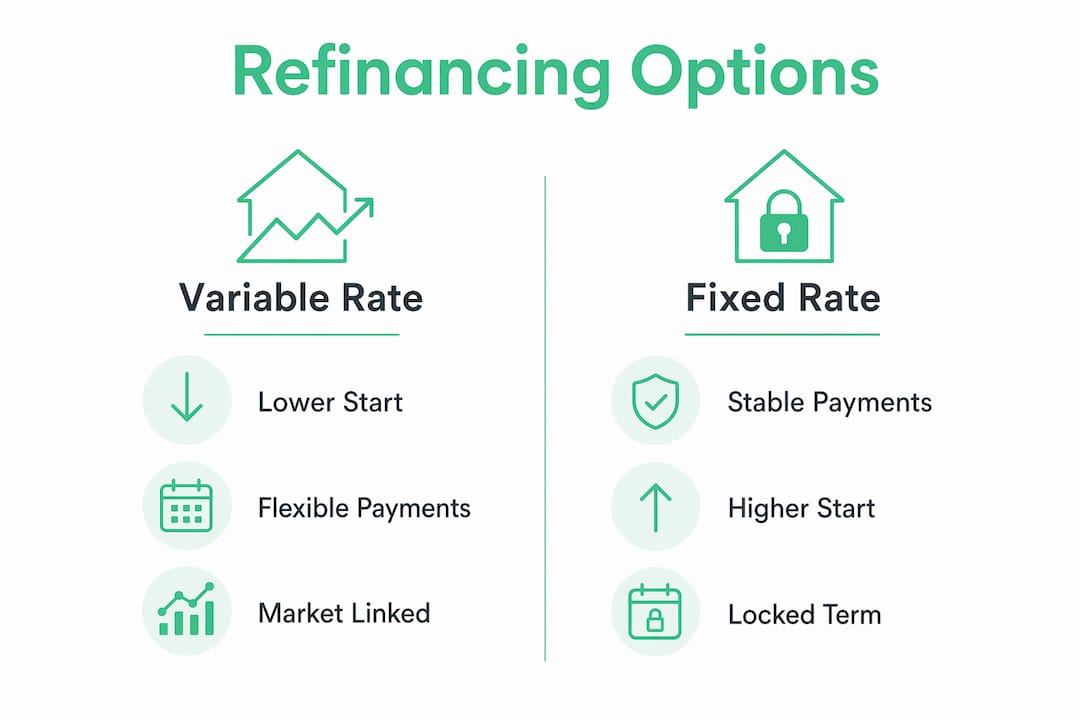
The core difference is certainty versus flexibility. Fixed rate loans lock in your repayment for a set period, typically one to five years in Australia. Variable rate loans move with the market. Neither is universally better. The right choice depends on your financial position and your plans for the property.
Historically, variable rate mortgages have cost less than fixed rate loans over rolling five-year periods about 80% of the time. Variable borrowers also faced average payment increases of only 4% at renewal, compared to 26% for fixed rate holders. That is a significant gap in long-term cost.
In 2026, variable rates reflect expected central bank cuts, making them potentially cheaper in the short term. Fixed rates respond more slowly because they are tied to bond yields, which can diverge from monetary policy. This means variable rates may hold an edge for the next one to two years, though no forecast is guaranteed.
The break-even analysis matters too. Refinancing costs money upfront. You need your monthly savings to exceed those costs within a reasonable period. A 0.50%–0.75% rate reduction is the standard threshold to justify the switch, with break-even periods typically running 12–24 months.
| Feature | Variable rate | Fixed rate |
|---|---|---|
| Starting interest rate | Generally lower | Generally higher |
| Repayment certainty | None, moves with market | Locked for fixed term |
| Benefits from rate cuts | Automatic | Only at term end |
| Break costs on exit | Rarely applies | Can be thousands of dollars |
| Flexibility features | Offset, redraw, extra repayments | Often restricted |
| Best suited to | Short to medium-term holders, rate-drop environments | Long-term holders, rate-rise environments |
Pro Tip: Check the ASIC MoneySmart refinancing guide before comparing products. ASIC's framework helps you assess total loan cost, not just the headline rate, which is where most homeowners get caught out.
When should you decide if variable rate refinancing suits you?
The decision starts with an honest look at your own finances, not the market. Risk capacity, meaning your emergency savings and budget flexibility, is the most critical factor. Without it, a variable rate loan can destabilise your finances quickly.
Work through these steps before making a call:
- Calculate your break-even point. Divide your total refinancing costs by your expected monthly saving. If that number exceeds your planned ownership period, refinancing does not make financial sense yet.
- Stress-test your budget. Add 2%–3% to the variable rate on offer and calculate the new monthly repayment. If you cannot comfortably cover that amount, reconsider.
- Assess your ownership timeline. If you plan to sell or upgrade within five years, variable rates are likely a better fit. If you are settling in for the long haul, the certainty of a fixed rate may serve you better.
- Monitor rate signals. Watch Reserve Bank of Australia announcements and economic commentary. Variable rate refinancing is most effective when rates are expected to fall, giving you immediate savings without paying refinancing fees again later.
- Check your current loan for break costs. If you are on a fixed rate now, exiting early may cost thousands. Factor that into your total cost calculation before switching.
- Speak with a mortgage professional. A broker who understands your full financial picture can identify products and timing that a rate comparison website cannot. Zenrgfinance works with homeowners at every stage of this process, from first assessment through to settlement.
The ASIC refinancing tips published for Australian borrowers reinforce one consistent message: refinancing decisions should be driven by your personal financial position, not by rate headlines alone.
Key takeaways
Variable rate refinancing suits homeowners who have financial flexibility, a short to medium-term ownership horizon, and the capacity to absorb rate increases without financial hardship.
| Point | Details |
|---|---|
| Lower starting rates | Variable loans typically start 0.5%–0.75% below fixed rates, saving money immediately. |
| Automatic rate cut benefits | When the RBA cuts rates, variable borrowers save without refinancing again. |
| Break-even threshold matters | A 0.50% rate reduction is the minimum needed to recover typical refinancing closing costs. |
| Stress-test before committing | Budget must withstand a 2%–3% rate increase or variable rates are unsuitable. |
| Ownership timeline is decisive | Variable rates suit short to medium-term holders; fixed rates suit long-term owners in rising rate environments. |
My honest read on variable rate refinancing
I have worked with a lot of homeowners who come to me convinced that variable rates are either the obvious answer or a trap to avoid. The truth sits firmly in the middle, and it depends almost entirely on the person, not the product.
The homeowners who do well with variable rates share a few traits. They have a genuine financial buffer. They are not stretching to meet repayments at the current rate. They have a clear plan for the property, whether that is selling in three years or upgrading in five. And they are comfortable checking in on their loan periodically rather than setting and forgetting.
What I see go wrong is when someone chooses a variable rate because the starting number looks attractive, without running the stress-test scenario. A 2% rate rise is not a worst-case fantasy. It has happened within a single year in Australia before. If that scenario would put you under real pressure, the lower starting rate is not worth it.
The 2026 environment does favour variable rates in the short term, with central bank cuts priced into current variable pricing. But I would caution against making a 20-year decision based on a 12-month forecast. The maths of variable rates over time is genuinely compelling, with historical cost advantages in most rolling five-year periods. The psychology, though, is something only you can assess. If rate fluctuations will keep you up at night, that cost is real even if it does not show up in a spreadsheet.
My advice: run the numbers, stress-test honestly, and talk to someone who knows your full financial picture before you sign anything.
— Allen
How Zenrgfinance can help you weigh up your options
Choosing between variable and fixed rate refinancing is not a decision that should rest on a single article or a rate comparison table alone.

Zenrgfinance works with Australian homeowners at every stage of the refinancing process, from initial assessment through to settlement. The team's mortgage relationship managers take the time to understand your full financial picture, your ownership plans, your risk tolerance, and your goals, before recommending a product. Whether you are considering a variable rate for the flexibility it offers or weighing it against the certainty of a fixed term, Zenrgfinance can model both scenarios with your actual numbers. You can also use the loan comparison calculator to get a clearer picture of how different rates affect your repayments before you book a conversation.
FAQ
What is variable rate refinancing?
Variable rate refinancing is the process of switching your home loan to one where the interest rate moves with market conditions. Repayments rise or fall as the lender's rate changes, typically in response to Reserve Bank of Australia decisions.
Who benefits most from variable rate mortgages?
Homeowners with financial buffers, flexible budgets, and short to medium-term ownership plans benefit most. Those planning to sell or upgrade within five to seven years avoid break costs and gain from any rate cuts automatically.
How much of a rate drop justifies refinancing?
A rate reduction of at least 0.50%–0.75% is the standard threshold. At that level, monthly savings typically recover refinancing closing costs, which run 2%–6% of the loan amount, within 12–24 months.
What is the biggest risk of a variable rate loan?
Payment variability is the primary risk. If market rates rise sharply, repayments increase and can strain budgets. Stress-testing against a 2%–3% rate increase before committing is the most reliable way to assess your readiness.
Is variable rate refinancing right in 2026?
Variable rates in 2026 are priced to reflect expected central bank cuts, making them potentially cheaper in the short term than fixed alternatives. However, the right choice depends on your personal financial position, not market forecasts alone.