
Lenders assess your business financials to answer one question above everything else: can this business reliably repay the loan? The answer shapes whether you get approved, what interest rate you pay, and whether you need to put up security. Understanding the lender's perspective before you apply is one of the most practical things you can do to improve your odds.
Three signals sit at the top of every lender's checklist:
- Cash flow: Does the business generate enough operating cash to cover existing and proposed debt repayments, with a buffer to spare?
- Stability and trends: Are revenue and margins consistent across periods, or are there sharp swings that suggest fragility?
- Balance-sheet strength: Does the business own more than it owes, and are there tangible assets that could serve as security if things go wrong?
The single most impactful thing you can do right now is get your last two years of financial statements reconciled, lodged, and ready to hand over. Lenders who receive clean, current documents move faster and price more favourably.
Table of Contents
- Why lenders need your financial data to make a credit decision
- The three financial statements lenders want and what each reveals
- Key ratios, thresholds, and red flags lenders use to assess risk
- Why lenders ask for cash-flow forecasts and how they stress-test them
- Documents lenders commonly request for Australian business loans
- Step-by-step: how to make your financials lender-ready
- Worked stress-test examples and what they mean for your application
- Key takeaways
- A broker's view: what actually makes the difference
- How Zenrgfinance can help you prepare for a business loan
- Useful Australian sources and further reading
Why lenders need your financial data to make a credit decision
A lender's job is not to admire your business idea. It is to test whether the numbers support repayment under realistic, and sometimes pessimistic, conditions. Commercial credit analysis involves spreading your financial statements into a standard format, calculating coverage and leverage ratios, and assigning a risk rating that drives both the approval decision and the interest rate you are offered.
Financials feed into at least five distinct lender tasks:
- Sizing the facility — so the repayments fit within the business's demonstrated cash flow.
The Five C's of credit — character, capacity, capital, collateral, and conditions — frame how banks think about applicants. Capacity, which is judged through cash flow, sits at the centre. Collateral is a backstop, not the primary basis for lending. A business with strong cash flow and modest assets will usually get a better outcome than one with significant assets but erratic income.
Qualitative factors matter too. Lenders weigh management quality, customer concentration, industry trends, and the clarity of the loan's purpose alongside the numbers. Strong figures paired with poor financial controls or a vague loan purpose still raise concerns. The RBA's analysis of small-business conditions shows that broader economic and interest-rate conditions also shift lender risk appetite, which means the same set of financials can produce different outcomes depending on the credit cycle.
The three financial statements lenders want and what each reveals
Every lender will ask for three core documents. Each one answers a different question about your business.
| Statement | Primary question it answers | Key lender checks |
|---|---|---|
| Balance sheet | What does the business own and owe right now? | Net worth, tangible assets available as security, overdue liabilities, related-party loans |
| Profit and loss (income) statement | Is the business profitable, and is that profit recurring? | Revenue consistency across periods, gross and net margins, one-off items, owner drawings |
| Cash-flow statement | Does the business actually generate cash, not just accounting profit? | Operating cash flow as the repayment source, investing outflows, financing movements |
Balance sheet
The balance sheet tells a lender whether your business is solvent and what security might be available. Lenders check net worth (total assets minus total liabilities), the composition of assets (tangible versus intangible), and whether any liabilities are overdue or undisclosed. Related-party loans sitting on the liability side are a common flag — lenders want to know whether those are genuine arms-length obligations or informal arrangements that could be subordinated.
Profit and loss statement
Lenders prefer recurrent earnings over one-off gains. A business that shows a strong profit in one year because it sold a piece of equipment or received an insurance payout looks very different from one with steady, growing revenue. Analysts reconcile P&L line items against tax returns and bank statements to check consistency. A mismatch between reported revenue and bank deposits is one of the fastest ways to trigger additional scrutiny.
Cash-flow statement
Operating cash flow is the actual repayment source, and lenders treat it as the most reliable indicator of serviceability. The cash-flow statement breaks into three sections:
- Operating activities: — cash generated from the core business, the number lenders focus on most.
Accurate and timely financial reporting is not just good housekeeping. Businesses that keep statements current and clearly presented are treated more favourably by lenders because the analyst can spread the numbers quickly and with confidence.
Key ratios, thresholds, and red flags lenders use to assess risk
Ratios translate your financial statements into a common language lenders can compare across industries and borrowers. Here are the ones that appear most often in Australian commercial lending decisions.
| Ratio | Formula | What it tests | Indicative threshold |
|---|---|---|---|
| DSCR (debt service coverage ratio) | Net operating income ÷ total debt service | Repayment capacity | ≥ 1.25x (minimum) |
| Interest cover | EBIT ÷ interest expense | Ability to cover interest alone | — |
| Current ratio | Current assets ÷ current liabilities | Short-term liquidity | — |
| Debt-to-equity (gearing) | Total debt ÷ total equity | Financial leverage | — |
| Debtor days | (Accounts receivable ÷ revenue) × 365 | Working capital efficiency | Industry-dependent; lower is better |
Many lenders use a DSCR minimum of around 1.25x as a pass/fail benchmark. A ratio below that threshold typically means the business cannot comfortably service the proposed debt from its current earnings, which leads to a smaller loan, a request for additional security, or a decline.
Common red flags that derail applications
- Inconsistent or declining deposits across bank statements that do not match reported revenue.
- Large, unexplained transfers or evidence of merchant cash advance holdbacks in transaction history.
- Regular non-sufficient fund (NSF) events, which suggest the business is operating close to its cash limits.
- Mismatches between tax returns and the P&L submitted with the application.
- High owner drawings that reduce reported profit and distort the true cash available for debt service.
- Undisclosed liabilities, including ATO payment plans, that do not appear on the balance sheet.
- Overdue BAS lodgements, which signal poor financial discipline and potential hidden tax debt.
The ATO's guidance on banking records is clear that bank statements are the primary tool for verifying reported revenue. Lenders use the same logic: if the deposits do not match the invoices, the revenue figure is questioned.
Pro Tip: Normalise your accounts before you apply. Strip out one-off expenses (legal disputes, equipment write-offs, non-recurring consulting fees) and add them back to calculate an adjusted EBITDA. Lenders routinely normalise accounts to estimate recurring cash flow, so doing it yourself first — and documenting each adjustment — shows you understand your own numbers and removes ambiguity from the analyst's work.
Why lenders ask for cash-flow forecasts and how they stress-test them
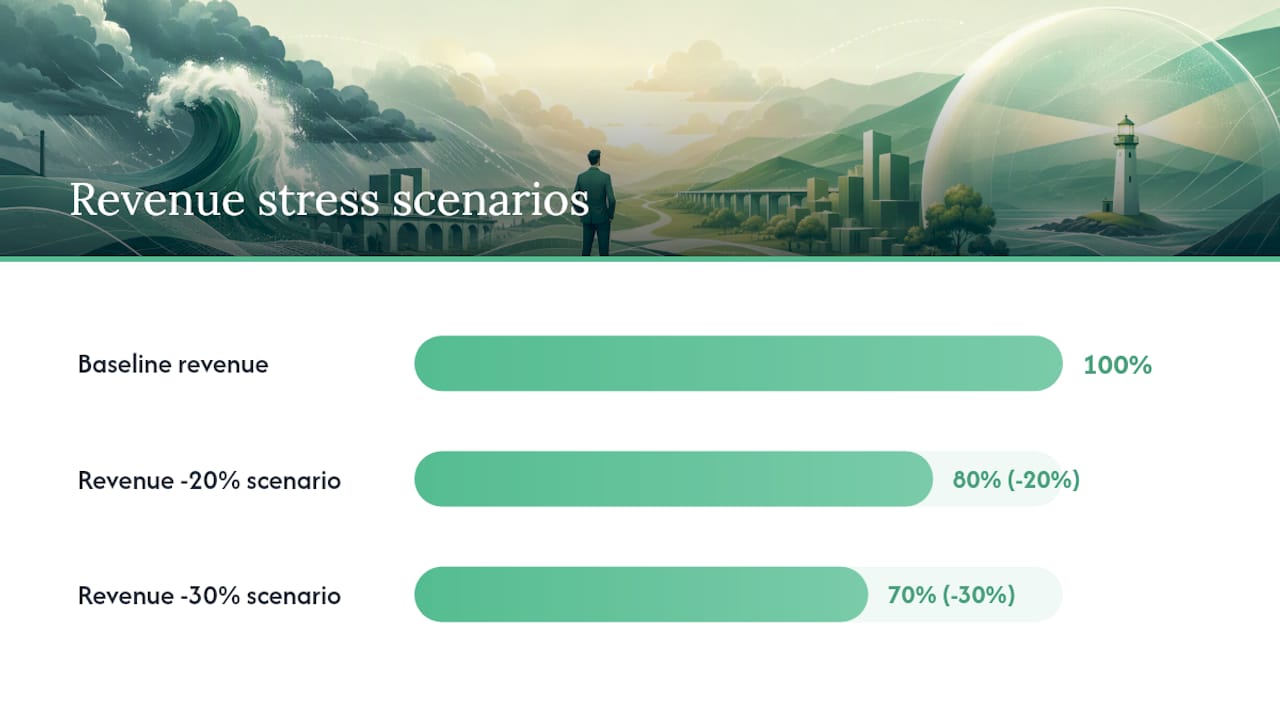
Historical financials tell a lender what happened. Forecasts tell them what you expect to happen over the loan term, and whether the business can still repay if conditions deteriorate. Lenders stress-test cash flow by modelling how a 20–30% revenue fall affects the ability to service debt, focusing on resilience rather than best-case scenarios.
A credible forecast includes monthly cash-flow projections tied to the loan's repayment schedule, including:
- Clearly stated assumptions (growth rate, seasonality, pricing, cost inflation) with supporting evidence.
- A sensitivity analysis showing at least one downside scenario (revenue down 20–30%).
- Linkage between the cash-flow forecast, the projected P&L, and the opening balance sheet.
The assumptions matter as much as the numbers. A forecast showing very high revenue growth with no explanation is a red flag, not a selling point. Lenders want to see contracts already signed, a documented sales pipeline, supplier quotes for cost assumptions, or industry benchmarks that support the projections. Vague optimism does not survive a credit committee.
If your business is seasonal, show that in the monthly breakdown. A hospitality business that projects flat monthly revenue across the year tells a lender the owner does not understand their own trading pattern — and that undermines confidence in every other number in the document.
Documents lenders commonly request for Australian business loans
Australian government guidance sets out the documents lenders typically ask for when you apply for a business loan. Gathering these before you approach a lender saves weeks.
Core financial documents:
- Business and personal tax returns for the last two years
Business and legal documents:
- Existing debt schedule listing all current loans, leases, and ATO payment plans
Personal documents (for guarantors):
Once you submit, a typical assessment follows this path: document submission → financial spreading → ratio analysis → credit memo preparation → credit committee review → formal offer. For a straightforward application with clean documents, this can take two to four weeks. Complex structures or incomplete submissions can stretch to eight weeks or more.
Expect application fees, valuation fees (if property security is involved), and legal fees for loan documentation. These vary by lender and facility size, so ask for a full fee schedule upfront.
Step-by-step: how to make your financials lender-ready
Getting your books into shape before you apply is the difference between a smooth approval and a frustrating back-and-forth. Here is a prioritised sequence.
- Check BAS and tax lodgements — All BAS must be lodged and any ATO debt disclosed. Overdue lodgements suggest financial disorganisation and can hide tax liabilities.
Pro Tip: Use a consistent chart of accounts across all periods and link invoices to receipts in your accounting software (Xero, MYOB, or QuickBooks). Lenders' analysts spread your numbers into a standard template, and inconsistent categorisation forces them to make assumptions — assumptions that rarely favour the borrower.
As a rough timeline: if your books are reasonably current, a tidy-up takes two to four weeks. If you need reviewed or audited statements, or your records have gaps, allow six to twelve weeks. Starting the process early gives you time to fix issues rather than explain them under pressure.
For owners exploring options beyond traditional banks, understanding alternative funding eligibility criteria can open doors when the major lenders apply stricter thresholds.
Worked stress-test examples and what they mean for your application
Here is how a lender-style DSCR calculation works in practice, and what happens when you apply a revenue shock.
Base case:
- Annual operating cash flow (EBITDA adjusted) comfortably exceeds total debt service.
Stress test:
-
Operating cash flow declines by a significant margin, but remains above total debt service, indicating resilience.
-
If the ratio falls below the lender's threshold under stress, they may require additional security, reduce the loan amount, or decline the application.
When DSCR falls below 1.25x under a stress scenario, lenders typically respond in one of three ways: require additional security (property, equipment), reduce the loan amount, or decline the application. The RBA's research on small-business financial conditions confirms that tighter economic conditions push lenders toward more conservative coverage thresholds, so the buffer you build into your numbers matters more during periods of rising rates or slowing growth.
Business.gov.au's guidance on applying for a business loan recommends preparing financial projections that account for realistic downside scenarios, not just the expected case. Running your own stress test before you apply tells you exactly where the risk sits and gives you time to address it.
Key takeaways
Lenders assess business financials to test repayment capacity, price risk accurately, and determine whether security or covenants are needed before approving a facility.
| Point | Details |
|---|---|
| DSCR is the central metric | A minimum of 1.25x is the common benchmark; stress-test your own numbers before applying. |
| Three statements, one picture | Balance sheet, P&L, and cash-flow statement together answer every core lender question about solvency, profitability, and repayment capacity. |
| Clean records move faster | Reconciled accounts, lodged BAS, and current management accounts reduce assessment time and improve pricing outcomes. |
| Normalise before you submit | Document one-off items and calculate adjusted EBITDA so the lender sees your true recurring earnings, not a distorted figure. |
| Zenrgfinance supports preparation | Zenrgfinance's business finance brokerage service helps owners structure their application, review forecasts, and access lenders suited to their profile. |
A broker's view: what actually makes the difference
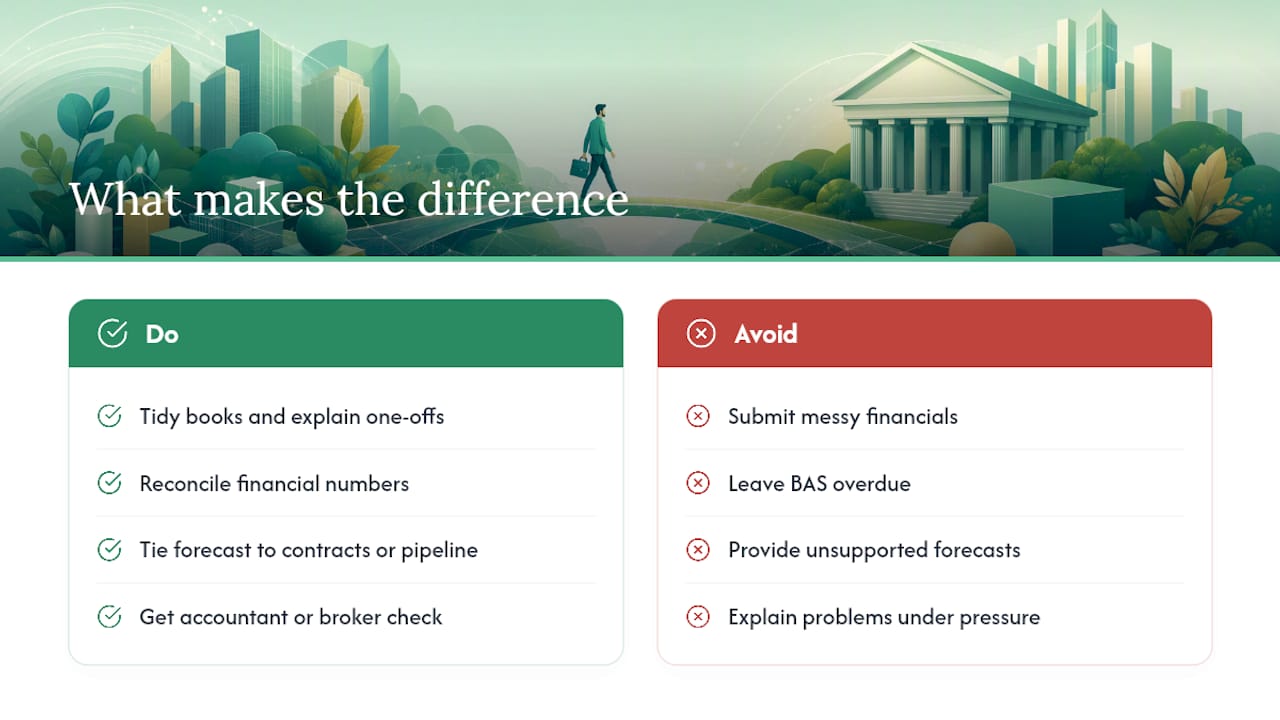
The most common issue I see with business loan applications is not bad financials. It is good financials presented badly. A business with solid cash flow and a reasonable balance sheet can still get knocked back because the analyst cannot reconcile the numbers, the BAS is six months overdue, or the forecast has no supporting assumptions.
Lenders are not trying to find reasons to say no. They are trying to build a credit case they can defend internally. When your documents are clean, your one-offs are explained, and your forecast is tied to real contracts or a credible pipeline, you make that job easy. When the numbers are a mess, you make it hard, and hard applications get conservative outcomes.
The businesses that get the best terms are usually not the most profitable ones in the room. They are the ones whose owners understood what the lender needed and prepared accordingly. A two-week investment in tidying your books and building a simple forecast can shift the outcome from a decline or a high-rate approval to a competitive offer with reasonable covenants.
If you are not sure where your numbers stand, a financial assessment with your accountant or a broker who works in commercial lending is the fastest way to find out. Preparing before you apply is always cheaper than explaining problems under pressure.
How Zenrgfinance can help you prepare for a business loan
Getting your financials lender-ready is one thing. Knowing which lenders will look at your profile favourably, and how to present your application to them, is where a broker adds real value.

Zenrgfinance works with business owners across Australia to structure commercial loan applications, review cash-flow forecasts, and match borrowers to lenders whose criteria fit the business profile. Rather than sending a single application to one bank and waiting, Zenrgfinance accesses a panel of lenders and knows which ones apply more flexible DSCR thresholds, which ones are comfortable with certain industries, and which ones move fastest for time-sensitive deals. For owners with SMSF structures or mixed commercial and residential security, that lender-matching step alone can save months.
The process starts with a strategy session where you walk through your current financials, the loan purpose, and the timeline. From there, Zenrgfinance helps you identify gaps, prepare the document package, and present the application in the format lenders respond to best.
Book a business finance strategy session with Zenrgfinance to get a clear picture of where your application stands and what it takes to get it across the line.
Useful Australian sources and further reading
These are the authoritative Australian sources worth bookmarking as you prepare your application.
-
business.gov.au — Apply for a business loan: — The official government checklist of documents lenders typically request. Start here to build your document pack and understand what each item is used for.
-
ATO — Banking records: — Explains what banking records you are required to keep and why they matter for both tax compliance and lender verification. Useful for understanding why bank statements are cross-referenced against your P&L.
-
RBA — Small-business economic and financial conditions (October 2025): — The RBA's bulletin on how broader economic conditions affect small-business lending. Check this for context on current lender risk appetite and how interest-rate movements are affecting approval conditions.
This article provides general information only and is not financial, legal, or accounting advice. Confirm current documentation requirements, lending criteria, and regulatory obligations with a qualified professional or the relevant authority before making decisions.