
Property type is the single most influential variable in how lenders assess, price, and approve investment loans in Australia. Whether you are buying a residential house, an apartment, a commercial building, or a multi-family complex, lenders apply different risk frameworks, underwriting methods, and pricing tiers to each. Understanding why property type affects investment lending is not just useful background knowledge. It is the difference between getting your loan approved and watching it fall over at assessment.
Why property type affects investment lending decisions
Lenders do not treat all investment properties the same way. Each property classification carries a distinct risk profile, and that profile shapes every part of the loan: the interest rate, the deposit required, the assessment method, and the maximum amount you can borrow.
Residential houses and apartments are assessed primarily on the borrower's income. Lenders look at your salary, rental income, and existing debts to determine whether you can service the loan. Commercial properties and multi-family assets follow a different path entirely. Lenders assess those based on the property's ability to generate income, using a metric called the Debt Service Coverage Ratio, or DSCR.

APRA requires lenders to apply a minimum 3.0 percentage point buffer above the loan's interest rate in serviceability assessments. A 6.0% loan rate becomes a 9.0% assessment rate, which typically reduces borrowing power by roughly 20–25%. That buffer applies before any property-type risk adjustment is factored in, so the combined effect on your borrowing capacity can be substantial.
Vacant land and properties under construction carry the highest risk in lenders' eyes. No rental income exists to support the loan, and construction delays can extend exposure periods. Most lenders either decline these applications outright or impose significantly tighter conditions.
How do lenders assess different property types?
Lender assessment frameworks split cleanly into two models depending on the property classification.
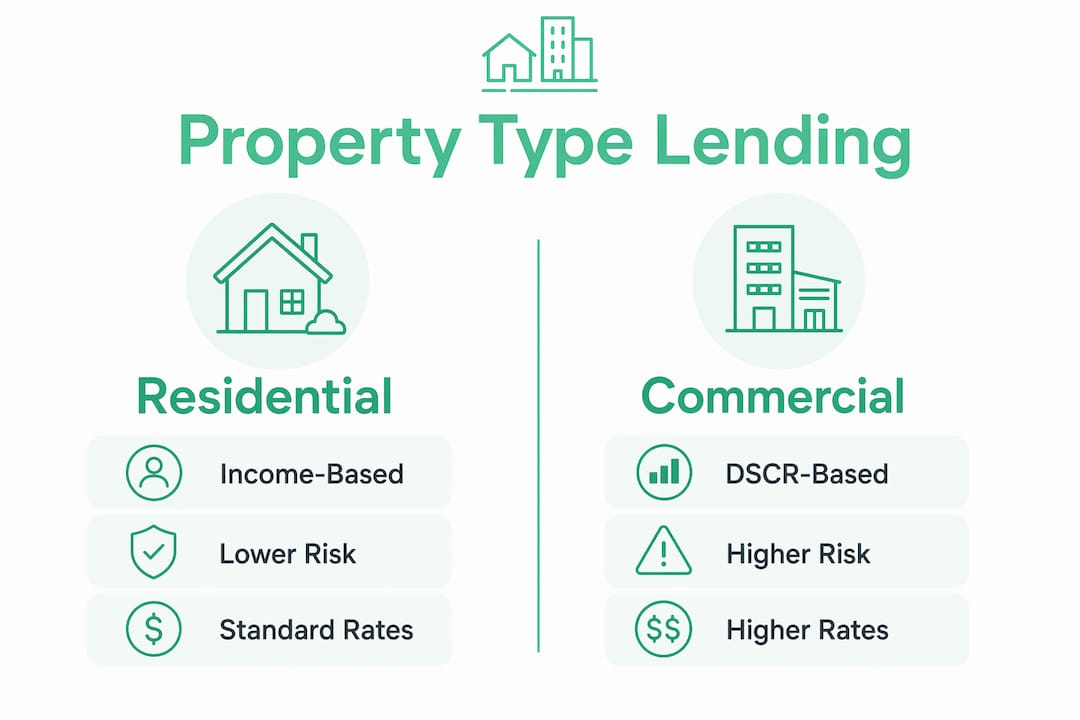
Borrower income underwriting applies to standard residential investment properties. The lender calculates your total income, subtracts your existing commitments, and tests whether you can service the new debt at the buffered assessment rate. Your personal financial position drives the outcome.
Property income underwriting applies to commercial and multi-family assets. Here, the lender focuses on the property's net operating income (NOI), which is the rental income minus operating expenses like rates, insurance, and management fees. The lender then divides NOI by the annual debt obligation to calculate the DSCR.
DSCR lending requires a minimum ratio of around 1.20x to 1.25x. A DSCR of 1.20x means the property generates $1.20 in income for every $1.00 of debt repayment. That buffer protects the lender if vacancy rises or operating costs increase.
- Residential houses and apartments: Assessed on borrower income, rental income counted at a discount (typically 80% of gross rent), and APRA serviceability buffer applied.
- Commercial properties: Assessed on NOI and DSCR; borrower income plays a secondary role.
- Multi-family or multi-unit: May use either model depending on the number of units and lender policy.
- Vacant or under-construction properties: Excluded from DSCR lending since no stable income exists to underwrite; financing options are limited and conditions are strict.
Pro Tip: If you are buying a commercial property, prepare a detailed rent roll and lease schedule before approaching lenders. Vacancy assumptions and lease quality directly affect your DSCR calculation and can shift your maximum loan amount significantly.
How does property type affect interest rates and LVR?
The effect of property type on lending shows up most clearly in interest rate pricing and loan-to-value ratio (LVR) requirements.
Investment property loans carry an interest rate 0.25% to 0.875% higher than owner-occupied mortgages. Lenders price this premium because investment properties carry higher default risk. If a borrower faces financial stress, they are more likely to stop paying an investment loan than their home loan.
LVR is equally important. Keeping your LVR at 80% or below avoids Lenders Mortgage Insurance (LMI) and secures better pricing. Property type influences the acceptable LVR threshold because lenders assign different security values to different asset classes.
| Property type | Typical minimum deposit | LVR limit (indicative) | Underwriting method |
|---|---|---|---|
| Residential house | 20% | 80% | Borrower income |
| Apartment (standard) | 20–25% | 80% | Borrower income |
| Multi-unit (4+ units) | 25–30% | 70–75% | Mixed or DSCR |
| Commercial property | 30–40% | 60–70% | DSCR / NOI |
| Vacant land | 30–40% | 60–70% | Borrower income, restricted |
Investment properties typically require deposits of 20–25% for houses, with higher requirements for multi-unit and commercial assets. Credit score minimums generally sit between 620 and 720 depending on the lender and property type.
Pro Tip: For apartments, check the building's total unit count before applying. Many lenders apply stricter LVR caps to high-density buildings with more than 50 units, which can push your required deposit higher than you expect.
What is the practical impact on borrowing capacity and approval odds?
Property type affects your borrowing capacity through three compounding factors: the APRA serviceability buffer, property-specific rate pricing, and LVR restrictions.
Small changes in underwriting inputs based on property type can turn a borderline loan into an approval or a rejection. A commercial property with a DSCR of 1.18x sits below the typical 1.20x threshold. That small gap can mean the difference between full approval and a reduced loan amount or outright decline.
- Understand your assessment method first. Residential investors are assessed on personal income. Commercial investors are assessed on property income. Knowing which method applies changes how you prepare your application.
- Model your DSCR before you make an offer. For commercial and multi-family assets, calculate NOI using conservative vacancy assumptions. A small increase in assumed vacancy can push DSCR below lender thresholds.
- Check the LVR cap for your specific property type. A 20% deposit is sufficient for a standard house but may fall short for a multi-unit block or commercial building.
- Do not assume rate parity means approval parity. Identical interest rates do not guarantee identical approval chances. Property-type valuation adjustments and underwriting inputs create materially different outcomes for the same rate.
You can use Zenrgfinance's borrowing power calculator to model how different property types and deposit levels affect your borrowing capacity before you commit to a purchase.
Residential versus commercial investment lending: how do they compare?
The gap between residential and commercial investment lending is wider than most investors realise. The two asset classes operate under fundamentally different rules, and mixing up the frameworks leads to costly mistakes.
Residential investment loans are underwritten on the borrower's ability to repay. The lender cares about your income, your existing debts, and your credit history. The property's rental income is counted as a supplement, not the primary repayment source. This means your personal financial position is the main lever you can pull to improve your approval odds.
Commercial and multi-family properties are underwritten on the property's income. Occupancy rates, lease terms, and rent stability all feed directly into the DSCR calculation. A property with a strong long-term tenant on a commercial lease is a fundamentally different lending proposition than a vacant shopfront, even if both are priced at the same purchase value.
Key differences investors should know:
- Lease quality matters in commercial lending. A 5-year lease with a national tenant supports a higher DSCR than a month-to-month arrangement with an individual operator.
- Residential lenders discount rental income. Most Australian lenders count only 80% of gross rental income in serviceability calculations to account for vacancy and costs.
- Commercial lenders stress-test vacancy. Lenders apply vacancy assumptions to NOI before calculating DSCR, which can reduce the effective income figure used in assessment.
- Loan terms differ. Residential investment loans often have 25–30 year terms. Commercial loans frequently have shorter terms of 10–15 years with balloon payments or refinance requirements.
For a deeper look at how commercial property loans work compared to residential investment lending, Zenrgfinance has a dedicated 2026 guide that covers the key differences in structure and eligibility.
Key takeaways
Property type shapes every dimension of investment lending, from the underwriting method used to the deposit required and the rate you pay.
| Point | Details |
|---|---|
| Underwriting method varies by type | Residential loans use borrower income; commercial loans use DSCR based on property income. |
| Rate premium applies to all investment loans | Investment property loans cost 0.25% to 0.875% more than owner-occupier rates regardless of property type. |
| LVR limits tighten for complex assets | Commercial and multi-unit properties typically require deposits of 30–40%, compared to 20% for houses. |
| DSCR threshold is a hard filter | Lenders require a minimum DSCR of 1.20x to 1.25x for commercial assets; falling below this reduces loan proceeds. |
| Serviceability buffer compounds the impact | APRA's 3.0 percentage point buffer reduces borrowing power before property-type risk adjustments are even applied. |
What I have learned about property type and lending the hard way
Allen's perspective on navigating investment lending by property type
The most common mistake I see investors make is assuming that because they have been approved for a residential investment loan, they understand how investment lending works. Residential lending is the entry point. Commercial lending is a different game entirely.
The shift from borrower income underwriting to DSCR underwriting catches people off guard. I have seen investors with strong personal incomes get knocked back on commercial deals because the property's DSCR sat at 1.15x instead of the required 1.20x. Their income was not the problem. The property's lease structure was. That is a nuance that does not show up in most general finance advice.
The other thing worth saying plainly: rate parity is a trap. Two investors can be quoted the same interest rate on two different properties and end up with completely different loan outcomes. Property-type valuation adjustments and underwriting inputs create real differences in what gets approved and at what LVR. Knowing this before you make an offer puts you in a much stronger position.
My practical advice is to work backwards from the lender's assessment method, not forwards from the purchase price. For residential assets, model your serviceability at the buffered rate. For commercial assets, build a conservative NOI estimate and check it against the 1.20x DSCR threshold before you get emotionally attached to a deal.
— Allen
Zenrgfinance can help you match the right loan to the right property
Property investors who understand how property type shapes lending outcomes make better decisions at every stage of the process.

Zenrgfinance works with investors across residential, commercial, and multi-family assets to match the right lending structure to each property type. Whether you need help modelling DSCR for a commercial acquisition, understanding LVR requirements for a multi-unit block, or comparing investment loan options across property classes, the team at Zenrgfinance brings the experience to get it right. Speak with a mortgage relationship manager at Zenrgfinance to build a lending strategy tailored to your specific property type and investment goals.
FAQ
Why do investment property loans cost more than owner-occupier loans?
Investment property loans carry higher interest rates because lenders assign greater default risk to rental properties. Rates are typically 0.25% to 0.875% above owner-occupier rates.
What is DSCR and when does it apply?
DSCR stands for Debt Service Coverage Ratio. It applies to commercial and multi-family investment properties, where lenders assess whether the property's net operating income covers the loan repayment, with a typical minimum of 1.20x to 1.25x.
How does property type affect the deposit I need?
Residential houses generally require a 20% deposit, while multi-unit and commercial properties often require 30–40%. Higher deposits reflect the tighter LVR limits lenders apply to more complex asset classes.
Does the APRA serviceability buffer apply to all property types?
Yes. APRA requires lenders to test all residential investment loans at a minimum of 3.0 percentage points above the loan rate. This buffer reduces borrowing power before any property-type risk adjustment is applied.
Can I use rental income to qualify for an investment loan?
For residential properties, most Australian lenders count 80% of gross rental income in serviceability calculations. For commercial properties, rental income feeds into the DSCR calculation, which becomes the primary qualification metric rather than your personal income.