
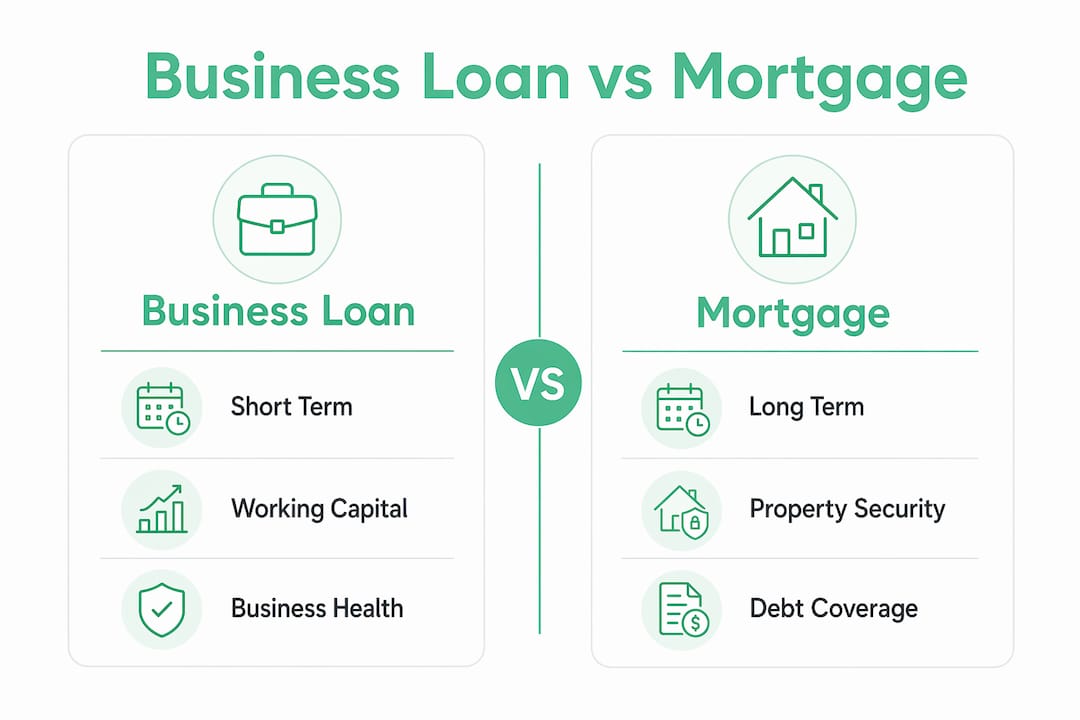
A business loan provides short-term funding for operational needs, while a mortgage secures long-term investment in property. These are two distinct financing products, and confusing them is one of the most expensive mistakes Australian borrowers make. Getting the business loan vs mortgage explained clearly upfront saves you from mismatched repayments, refinancing stress, and unnecessary costs down the track.
The core difference comes down to purpose, term, and security. Business loans fund working capital, payroll, inventory, or equipment. Mortgages fund property acquisition or development. Choosing the wrong product for the wrong purpose creates financial strain that compounds over time.
What are the typical features and terms of business loans vs mortgages?
Commercial mortgages typically range from 1 to 30 years, while business loans are far shorter, often running just 3 to 18 months. That gap in term length reflects a fundamental difference in what each product is built for.
Mortgage underwriting focuses on the property itself. Lenders assess the Debt Service Coverage Ratio (DSCR), Net Operating Income (NOI), and Loan-to-Value (LTV) ratios. A DSCR above 1.25 is the standard benchmark, meaning the property's income must exceed its debt payments by at least 25%. Properties below a 1.20 DSCR often face higher rates or outright rejection.
Business loan underwriting works differently. Lenders focus on your business's financial health, cash flow history, and credit profile rather than a property's income. This makes business loans more accessible for newer businesses but also riskier for lenders, which is why rates are higher.

Collateral is another key dividing line. Mortgages are always secured against property. Business loans can be secured against business assets, backed by a personal guarantee, or entirely unsecured. Unsecured business loans cost more but preserve your borrowing flexibility. Mortgaged properties, on the other hand, restrict your ability to refinance or take on secondary lending without lender approval.
| Feature | Business loan | Mortgage |
|---|---|---|
| Typical term | 3–18 months (short term) | 1–30 years |
| Underwriting focus | Business cash flow and credit | Property income, DSCR, LTV |
| Security | Unsecured, personal guarantee, or assets | Property |
| Repayment structure | Often weekly or monthly, shorter amortisation | Monthly, long amortisation |
| Flexibility | Higher, but at greater cost | Lower, restricted by property security |
Pro Tip: If you are buying a property your business will occupy, look at SBA 504 loan structures. These blend bank and government funding to reduce your equity requirement to as little as 10%, with fixed long-term rates.
How do costs and interest rates compare?
Commercial mortgage rates are generally lower than business loan rates because property provides strong security for the lender. Commercial mortgage rates typically sit between 7% and 10%, reflecting the reduced risk that comes with asset-backed lending.
Business loan rates vary enormously depending on the product type and your risk profile. Here is a practical breakdown:
- Bank term loans and SBA loans: Lower rates, but slower approval and stricter eligibility
- Lines of credit: Rates ranging from 8% to 40% APR, with flexibility to draw and repay as needed
- Merchant cash advances (MCAs): APR can exceed 350% in some cases, making them one of the most expensive funding options available
- Invoice financing and equipment loans: Mid-range rates, tied to specific assets or receivables
The wide rate range in business lending reflects speed and flexibility. A merchant cash advance can fund in hours with minimal paperwork. That convenience carries a steep price. A commercial mortgage takes weeks or months to settle but costs a fraction of the interest over time.
Your credit score shapes which products you can access. Credit scores above 700 unlock better SBA and bank loan rates. Scores below 600 typically push borrowers toward expensive short-term options like MCAs. Knowing your credit position before you apply saves you from accepting terms that hurt your cash flow.
You can use the Zenrgfinance loan comparison calculator to model repayment costs across different loan types before committing to any product.
What is the application process and timeline difference?
Speed is where business loans and mortgages diverge most sharply. Traditional mortgage applications take 30 to 90 days or longer, driven by property appraisals, title searches, and detailed financial assessments. Online business loans can fund in as little as 24 to 48 hours with minimal documentation.
The mortgage process typically follows these steps:
- Pre-approval: Lender reviews your financials, credit history, and borrowing capacity
- Property valuation: Independent appraisal to confirm market value and LTV ratio
- Due diligence: Title search, building inspection, and legal review
- Formal approval: Lender issues a formal offer subject to conditions
- Settlement: Funds transfer and title registration, usually 30 to 90 days from application
Business loan applications are far less uniform. A bank or SBA loan still requires tax returns, profit and loss statements, and business plans. An online lender may only ask for three months of business bank statements and approve you within a day.
Pro Tip: Plan your financing timeline before you commit to any purchase or contract. A 90-day mortgage settlement can derail a deal if you have not started the process early enough. For urgent operational needs, a fast-access business loan may be the only realistic option.
For a deeper look at what commercial mortgage applications involve, the Zenrgfinance guide on commercial property loans covers the process in detail.
When should you choose a business loan vs a mortgage?
Matching your loan type to your actual need is the single most important decision in this process. Getting it wrong costs more than a higher interest rate ever would.
Choose a business loan when you need to:
- Cover short-term working capital gaps or seasonal cash flow dips
- Purchase inventory, equipment, or supplies with a clear repayment timeline
- Fund payroll during a growth phase or contract delay
- Respond quickly to a time-sensitive business opportunity
Choose a mortgage when you need to:
- Acquire commercial or residential property for long-term use or investment
- Refinance an existing property to release equity
- Fund a development project with a long construction and lease-up timeline
- Secure stable, long-term financing for an owner-occupied business premises
Using a short-term business loan to fund a long-term property asset creates refinancing risk. When the loan matures, you may be forced to refinance at a worse rate or under financial pressure. The reverse is equally problematic. Using a long-term mortgage to fund short-term operational needs ties up your borrowing capacity and can strain cash flow for years.
Some businesses use blended financing. For example, an SBA 504 loan covers the property purchase while a separate line of credit handles working capital. This approach keeps each product matched to its purpose and avoids the cost of misalignment. Explore the range of investment property loan types available in Australia if you are weighing up property acquisition options.
What are common pitfalls when choosing between a business loan and a mortgage?
The biggest mistake borrowers make is choosing a product based on rate alone without considering term alignment. A lower rate on a short-term loan means nothing if you cannot repay it before the property generates income.
"Refinancing pressures and cash flow constraints often cost more than headline interest rates. Matching loan structure to asset life avoids the most expensive mistakes in business finance."
Credit health is a factor many borrowers underestimate. Your credit score does not just affect your rate. It determines which products you can access at all. A score below 600 may lock you out of SBA loans and bank mortgages entirely, leaving only high-cost alternatives.
Lender rigidity is another hidden cost in mortgage lending. Once a property is mortgaged, refinancing or taking on secondary lending requires lender approval. That limits your flexibility when business conditions change. Business loans, while more expensive, give you more room to move. Consulting a finance broker before you commit to either product is the most reliable way to avoid these traps.
Key takeaways
Matching your loan type to your financing purpose is the single most effective way to reduce cost and avoid refinancing stress across both business loans and mortgages.
| Point | Details |
|---|---|
| Term length defines the product | Business loans run 3–18 months; mortgages run 1–30 years. Match term to asset life. |
| Rates reflect risk and speed | Commercial mortgages sit at 7–10%; business loan APR ranges from 8% to over 350%. |
| Application timelines vary widely | Mortgages take 30–90 days; online business loans can fund in 24–48 hours. |
| Mismatching loan type is costly | Using short-term loans for long-term assets creates refinancing risk and cash flow strain. |
| Credit score shapes your options | Scores above 700 unlock SBA and bank products; below 600 limits you to high-cost funding. |
Allen's take on picking the right product
I have seen borrowers get this wrong in both directions. A small business owner takes a 12-month loan to buy a commercial fitout that will take three years to pay for itself. A property investor uses a mortgage to fund operating costs because the rate looks better on paper. Both end up in trouble within 18 months.
The rate is not the story. The structure is. When a loan matures before your asset generates a return, you are forced to refinance under pressure. That is when lenders have all the power and you have none. The cost of that position almost always exceeds whatever you saved on the headline rate.
My honest advice: treat the loan term as the first filter, not the last. Ask yourself how long this asset or need will take to pay for itself. Then find a product whose term matches that timeline. If no single product fits, a blended approach using a mortgage for the property and a line of credit for operations is usually cleaner than forcing one product to do two jobs.
The Zenrgfinance business finance page is a good starting point if you are weighing up your options and want to see what products are available before speaking to a broker.
— Allen
How Zenrgfinance can help you choose the right loan
Choosing between a business loan and a mortgage is not just a numbers exercise. It is a decision that shapes your cash flow, your borrowing capacity, and your financial flexibility for years. Getting it right from the start matters.

Zenrgfinance works with first-time buyers, property investors, and small business owners across Australia to match the right financing structure to the right need. Whether you are buying your first commercial property, refinancing an existing asset, or sorting out working capital, the team at Zenrgfinance brings the experience to cut through the complexity. Speak with a mortgage relationship manager at Zenrgfinance today and get personalised guidance on the loan structure that fits your situation.
FAQ
What is the main difference between a business loan and a mortgage?
A business loan funds short-term operational needs and typically runs 3 to 18 months. A mortgage funds property acquisition and spans 1 to 30 years, with underwriting based on property income and value.
Can I use a business loan to buy property?
You can, but it creates significant refinancing risk. Short-term business loans mature before most properties generate sufficient returns, forcing costly refinancing under pressure.
How do interest rates differ between business loans and mortgages?
Commercial mortgage rates generally sit between 7% and 10%. Business loan rates range from 8% APR for lines of credit up to 350% or more for merchant cash advances, depending on risk and speed.
What credit score do I need for a business loan or mortgage?
A credit score above 700 gives you access to SBA loans and competitive bank mortgage rates. Scores below 600 typically restrict you to higher-cost, short-term funding options.
What is DSCR and why does it matter for a mortgage?
DSCR stands for Debt Service Coverage Ratio. Lenders require a DSCR above 1.25, meaning the property's income must exceed its debt payments by at least 25% for the loan to be approved at standard rates.