
A mortgage health check is a structured review of your home loan to confirm it still suits your financial situation and property goals. The process assesses your interest rate, loan-to-value ratio (LVR), repayment frequency, loan features, and remaining term against your current circumstances. Think of it as a financial check-up for your biggest debt. Most Australian mortgage brokers recommend reviewing your loan every one to two years, or whenever a significant life event or market shift occurs. Zenrgfinance works with homeowners and buyers through exactly this kind of mortgage health assessment, helping you stay ahead rather than react.
What is a mortgage health check and what does it cover?
A mortgage health check is a thorough review of whether your current home loan remains the best fit for your needs. The industry also refers to this process as a mortgage review or loan health assessment. Both terms describe the same thing: a structured look at your loan's performance, cost, and alignment with your financial life.
Core metrics assessed during a review include your current interest rate, remaining loan term, amortisation schedule, repayment amount, LVR, and existing loan features such as offset accounts and redraw facilities. Each metric tells a different part of the story. Your LVR, for example, shows how much equity you have built, which directly affects your access to better rates and products.

The review also looks at your loan structure beyond the headline rate. Features like offset accounts, redraw facilities, and split loans can significantly affect your total interest paid over the life of the loan. Leveraging these features effectively can improve your loan's value without requiring a full refinance.
Key areas covered in a mortgage health assessment
- Interest rate: Is your current rate competitive with what lenders are offering new borrowers today?
- Loan features: Are you using your offset account or redraw facility to their full potential?
- Repayment frequency: Weekly or fortnightly repayments reduce interest faster than monthly payments.
- LVR and equity: Has your property value increased enough to unlock a lower rate tier?
- Loan term: Are you on track to pay off your loan within your target timeframe?
- Loan portability: Can your loan move with you if you sell and buy another property?
Pro Tip: Request a current loan statement before your review. Having your exact balance, rate, and remaining term in front of you makes the process faster and more accurate.
Why regular mortgage health checks matter for homeowners
Life changes, and your mortgage should keep up. A pay rise, a new baby, a renovation, or a shift in the property market can all affect whether your current loan still works for you. Mortgage health checks focus beyond interest rates to align your loan with broader life goals like renovations, investment, or debt consolidation. That broader view is what separates a genuine review from simple rate shopping.
One of the most common and costly mistakes Australian homeowners make is allowing their fixed rate to auto-renew. Many borrowers unknowingly pay higher rates due to automatic renewals without a review. An annual check prevents this from happening to you.
A mortgage health check is best framed as a proactive financial habit rather than a reactive fix. Borrowers who review regularly maintain control over their loan terms and avoid the slow financial drain of a poorly structured mortgage.
The benefits of a regular mortgage check go well beyond saving on interest:
- Avoiding rate creep: Lenders often offer sharper rates to new customers. Existing borrowers who never review can end up paying significantly more.
- Accessing better features: Your financial situation may now qualify you for products with superior offset or redraw options.
- Preparing for investment: If you plan to buy an investment property, your current loan structure may need adjusting first. Zenrgfinance can help you map that out through its property investment planning service.
- Debt consolidation: A review may reveal an opportunity to roll higher-interest debts into your home loan at a lower rate.
Pro Tip: Set a calendar reminder every 12 months to check your mortgage. Pair it with your annual tax return so it becomes a natural part of your financial year.
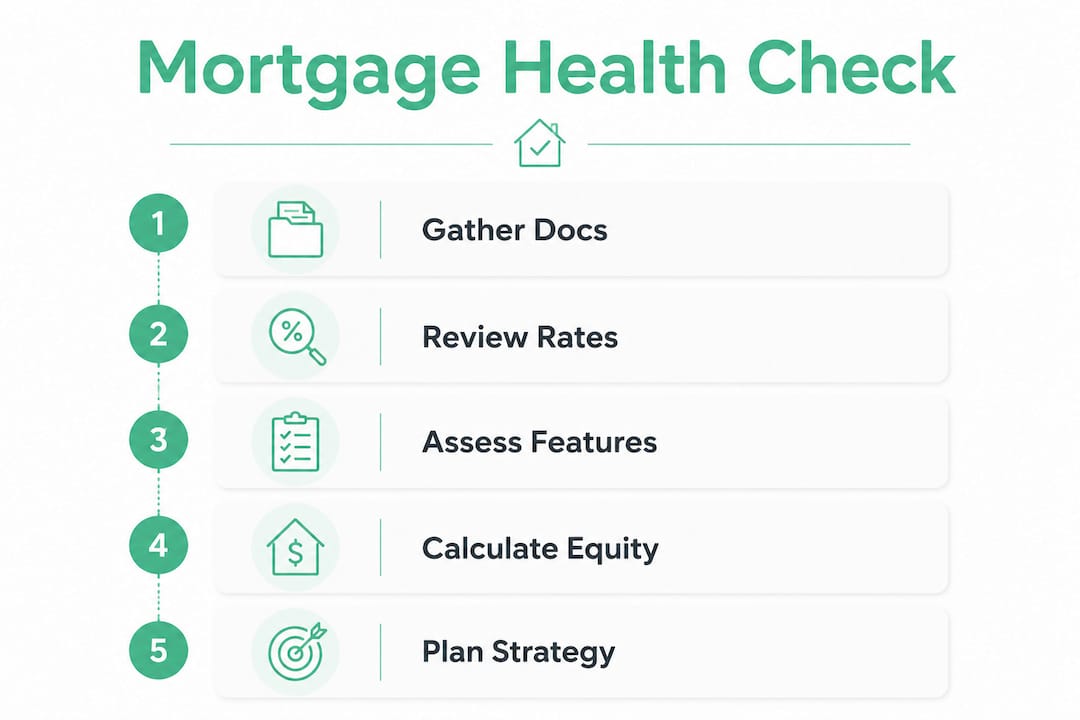
How to check mortgage health: practical steps
Performing a mortgage health check does not require a finance degree. A clear, step-by-step approach gets you the answers you need.
-
Gather your current loan details. Pull together your interest rate, loan balance, remaining term, repayment frequency, and a list of your current loan features. Your lender's online portal or a recent statement will have all of this.
-
Compare your rate to the market. Look at what lenders are currently offering new borrowers for a similar loan size and LVR. If your rate is more than 0.5% above current market rates, that gap is worth investigating.
-
Review your loan features. Check whether you have an offset account and how much sits in it. Understanding offset accounts shows you exactly how much interest you are saving, or could be saving, each month.
-
Check for break costs and penalty fees. Evaluating penalties upfront can save substantial future costs. Fixed-rate loans often carry interest rate differential (IRD) fees if you exit early. Know what you would owe before making any decisions.
-
Stress-test your repayments. Stress-testing for rate increases gives you clarity on your cash flow resilience. Ask yourself: if rates rose by 2%, could you still comfortably meet repayments?
-
Assess your equity position. If your property has grown in value since you bought it, your LVR may have improved. A lower LVR can unlock better rate tiers or remove the need for lenders mortgage insurance.
-
Seek professional advice. A mortgage broker brings market knowledge and lender access that most homeowners do not have on their own. Mortgage brokers typically review loans every one to two years or when a significant life event occurs. Engaging one at this stage ensures you are not missing options.
Pro Tip: When verifying lenders or comparing offers, checking lender credibility is a step many borrowers skip. Reputable lenders are transparent about fees, rates, and exit conditions from the outset.
What outcomes can a mortgage health check produce?
A mortgage review does not always lead to refinancing. Reassessing your loan can confirm that your current terms remain optimal, which is a genuinely useful outcome. Knowing your loan is working well gives you confidence and removes the nagging doubt that you might be overpaying.
When the review does identify an opportunity, you will typically face one of several decisions:
- Refinance to a new lender: This makes sense when the rate saving outweighs the switching costs, including discharge fees, application fees, and any break costs.
- Renegotiate with your current lender: Many lenders will match or beat a competitor's offer to retain your business. This option avoids switching costs entirely.
- Restructure your loan: You might shift from a variable to a fixed rate, or split your loan across both. You might also add or remove an offset account.
- Adjust repayment frequency: Switching from monthly to fortnightly repayments can shave years off your loan term with no change to your rate.
Loan portability and break costs are critical considerations if you plan to sell and buy again. A portable loan moves with you, avoiding the need to refinance at the point of sale. Understanding this before you list your property saves both time and money.
The best outcome aligns your mortgage with your broader financial strategy. If you are planning to invest in property, your loan structure today affects your borrowing capacity tomorrow. Zenrgfinance helps clients think through these decisions as part of a complete financial picture, not just a rate comparison. You can explore how refinancing benefits homeowners in practical terms before committing to any change.
Key takeaways
A mortgage health check is the most reliable way to confirm your home loan still serves your financial goals and to catch costly problems before they compound.
| Point | Details |
|---|---|
| Review every 1–2 years | Mortgage brokers recommend annual or biennial reviews, or after any major life event. |
| Look beyond the interest rate | Loan features, repayment frequency, and LVR all affect your total loan cost. |
| Check for break costs first | IRD fees and discharge costs can offset rate savings if not evaluated upfront. |
| Refinancing is not always the answer | A review may simply confirm your current loan remains the right fit. |
| Stress-test your repayments | Modelling a 2% rate rise tells you whether your cash flow can handle future changes. |
Why I think most homeowners leave money on the table
Most people I speak with assume a mortgage health check is something you do when you are in financial trouble. That assumption costs them money every single year. The homeowners who benefit most from regular reviews are the ones who are already doing fine. They have equity, stable income, and a loan that was right for them three years ago. The problem is, the market has moved and their loan has not.
The other misconception I see constantly is that switching lenders is the only outcome worth pursuing. That framing stops people from even starting the process. A review that confirms your loan is competitive is just as valuable as one that leads to refinancing. You walk away with certainty, and certainty has real financial value.
Many homeowners underestimate how much loan structure, beyond the interest rate, affects their long-term outcomes. Repayment frequency, offset account usage, and loan portability are the details that quietly determine whether you pay off your loan in 25 years or 21. None of those details require refinancing to fix. They just require attention.
My practical suggestion: treat your mortgage review the same way you treat your annual car service. You do not wait for the engine light to come on. You book it in, get the report, and make decisions from a position of knowledge. That habit, applied to your mortgage, is worth far more than any single rate cut.
— Allen
Zenrgfinance and your mortgage health check
Zenrgfinance offers a personalised Mortgage Relationship Manager service designed to take the guesswork out of your mortgage review. Whether you are a first home buyer trying to understand your options, or an experienced investor looking to restructure before your next purchase, the team at Zenrgfinance builds a review around your specific goals.

The service covers rate benchmarking, loan feature analysis, equity assessment, and refinancing strategy, all in one conversation. Zenrgfinance works with a wide panel of lenders, which means you get a genuine market comparison rather than a single lender's perspective. If you are ready to find out whether your mortgage is still working as hard as it should, reach out to Zenrgfinance today.
FAQ
What is a mortgage health check?
A mortgage health check is a structured review of your home loan that assesses your interest rate, loan features, LVR, repayment structure, and equity position to confirm the loan still suits your financial goals.
How often should I review my mortgage?
Mortgage brokers recommend reviewing your loan every one to two years, or sooner if you experience a significant life event such as a change in income, a property purchase, or a major rate movement.
Does a mortgage health check always lead to refinancing?
No. A mortgage review can simply confirm that your current loan terms remain competitive and suitable, which is a valuable outcome in itself.
What is an IRD fee and why does it matter?
An interest rate differential (IRD) fee is a break cost charged when you exit a fixed-rate loan early. Calculating this fee upfront is critical before deciding to refinance, as it can significantly reduce or eliminate any rate saving.
Can I do a mortgage health check myself?
You can complete a basic self-assessment by gathering your loan details and comparing your rate to current market offers. For a thorough mortgage health assessment that includes lender negotiations and feature analysis, working with a mortgage broker like Zenrgfinance delivers better results.