
Most homeowners who regret refinancing made the same handful of errors. They chased a low headline rate, ignored the fees that ate their savings, or reset a 30-year loan clock without running the maths. MoneySmart's switching guide makes the point plainly: compare total cost, not just the rate. Here are the biggest refinancing mistakes to avoid, each with one immediate action you can take right now.
The top mistakes at a glance:
- Comparing only the headline interest rate — check the comparison rate and total fees
- Ignoring discharge, application, and break costs — calculate your break-even period first
- Extending the loan term to lower repayments — run the full interest calculation before agreeing
- Chasing introductory offers without knowing the revert rate — ask for the revert rate in writing
- Accepting the first offer — get quotes from at least three lenders
- Skipping a credit check or document prep — pull your credit report before you apply
Before you do anything else, grab these three things:
- Your most recent loan statement (current balance, rate, and remaining term)
- A written payoff figure from your current lender (the exact amount to close the loan)
- A free copy of your credit report from a service such as Equifax or illion
Key takeaways
Avoiding costly refinancing errors comes down to one discipline: calculate total cost before you compare rates, and compare multiple offers before you sign anything.
| Point | Details |
|---|---|
| Calculate break-even first | Divide total upfront costs by monthly saving; aim for under 36 months. |
| Compare 3–5 offers | Rate, fees, revert rate, and features all affect total cost, not rate alone. |
| Check prepayment penalties | Request a written payoff figure from your current lender before proceeding. |
| Watch the term reset | Matching your remaining term avoids thousands in extra interest over the loan life. |
| Zenrgfinance broker support | Zenrgfinance compares lenders, runs the numbers, and manages the process end to end. |
Table of Contents
- 1. Why comparing only the headline rate costs you money
- 2. Ignoring fees and break costs wipes out your savings
- 3. Extending your loan term lowers repayments but raises total interest
- 4. Chasing introductory offers without a plan for the revert rate
- 5. Accepting the first offer instead of shopping around
- 6. Skipping your credit check or document prep before applying
- 7. Trying to do everything yourself when a broker adds real value
- 8. A practical checklist for comparing refinance offers
- 9. When refinancing typically makes sense
- What experienced brokers see that most homeowners miss
- Zenrgfinance can help you avoid these refinancing traps
- Sources
1. Why comparing only the headline rate costs you money
The headline interest rate is the number lenders put in big font. The comparison rate sits quietly underneath, and it tells a more honest story. It folds in most ongoing fees and charges to give you a single annual percentage that reflects closer to the real cost of the loan.
Beyond the comparison rate, loan features change the value of a product significantly. An offset account can reduce the interest you pay daily. Redraw facilities give you access to extra repayments. Repayment flexibility matters if your income varies. A loan with a slightly higher rate but a full-offset account can outperform a cheaper-looking product with no offset at all, depending on your balance.
Pro Tip: When you receive a loan estimate, go straight to the total repayment figure over the life of the loan. That single number cuts through the rate noise faster than anything else.
2. Ignoring fees and break costs wipes out your savings
Refinancing is not free, and the costs add up faster than most people expect. Typical charges in Australia include a discharge fee from your current lender, a new application or establishment fee, a valuation fee, and legal or settlement costs, varying by lender and loan type. If you are on a fixed-rate loan, break costs can be substantial, calculated by the lender based on wholesale interest rate movements.

FinanceDevil's analysis of common refinance errors flags ignoring closing costs as one of the most frequent and costly blunders homeowners make. The fix is a simple break-even calculation.
Worked example:
If you plan to stay in the property for at least 20 months, the refinance pays for itself. If you are selling in 12 months, it does not. Use the MoneySmart mortgage switching calculator to run your own numbers before committing.
Always request a written payoff figure from your current lender before finalising anything. Unplanned shortfalls at settlement are a common and avoidable surprise when borrowers skip this step.
3. Extending your loan term lowers repayments but raises total interest
Resetting to a fresh 30-year term when you have 22 years remaining feels like relief on paper. Your monthly repayment drops. But you have just added eight years of interest to your loan, and that extra time compounds.
The monthly saving might be $250, but the total cost is far higher.
The smarter move: ask your new lender to match your remaining term, or choose a compromise term that keeps repayments manageable without blowing out total interest.
CrestmontCapital's refinancing guide makes the same point for business borrowers: extending the term can eliminate the apparent savings entirely once you calculate total cost over the loan life. The principle applies equally to home loans.
4. Chasing introductory offers without a plan for the revert rate
Honeymoon rates look attractive. If you have not planned for that revert, your repayments jump and the savings from the intro period evaporate quickly.
Before you sign an introductory offer, check:
- What is the revert rate, and how does it compare to other lenders' standard variable rates?
- What will your monthly repayment be after the intro period ends?
- Is there a lock-in period that prevents you from refinancing again once the honeymoon ends?
- Are there exit fees if you leave before a set date?
Pro Tip: Ask the lender to provide a written schedule showing your repayment at the revert rate. If they hesitate, that tells you something. A good lender will show you both figures without prompting.
5. Accepting the first offer instead of shopping around
One quote is not a market. Rates, fees, and loan features vary meaningfully between lenders, and the difference between the first offer and the best offer can be worth thousands over the loan term. MoneySmart cautions that comparison websites vary in lender coverage, so relying on a single aggregator site can leave gaps. Read product disclosure statements and verify which lenders are actually included.
A practical process for comparing offers:
- Identify 3–5 lenders or use a broker who accesses multiple lenders at once
- Request loan estimates from each within a short window (around 14 days) to limit credit enquiry impact
- Record the comparison rate, total fees, break costs, monthly repayment, and revert rate for each
- Calculate break-even for each option using the same formula: total upfront costs ÷ monthly saving
- Shortlist the two best offers and negotiate, using competing quotes as leverage
Submitting multiple enquiries within roughly 14 days is often treated as a single mortgage enquiry by Australian credit reporting bodies, which limits the credit score impact of shopping around.
6. Skipping your credit check or document prep before applying
Your credit score directly affects the rate a lender will offer you. Walking into an application without knowing your score is one of the more avoidable common refinancing errors. Errors on your credit file, high credit card balances, or recent missed payments can push you into a higher rate tier or trigger a decline.
Documents to prepare before you apply:
- Last two payslips and most recent tax return (or two years of tax returns if self-employed)
- Current loan contract and most recent statement
- Evidence of assets (savings account statements, property valuations)
- Photo ID (passport or driver's licence)
- Three months of bank statements
Pro Tip: Pull your credit report at least 30 days before applying. That gives you time to dispute any errors and, if needed, pay down a credit card balance before the lender runs their own check.
Check your refinancing eligibility requirements early so there are no surprises during underwriting.
7. Trying to do everything yourself when a broker adds real value
For a straightforward refinance on a single owner-occupied property with stable income, doing it yourself is manageable. For anything more complex, a broker typically saves you time, money, and stress.
Scenarios where professional help is worth it:
- You hold multiple investment properties
- Your income is self-employed, contract, or irregular
- You are refinancing through an SMSF structure
- You have had credit issues in the past two years
- You are unsure whether your current loan has break costs or prepayment penalties
A broker accesses products from multiple lenders, handles the paperwork, negotiates on your behalf, and is required by law to disclose how they are paid. Before engaging one, ask them how many lenders they compare, whether they receive higher commissions from any lender, and what the total cost of the loan looks like across the full term, not just the first year.
8. A practical checklist for comparing refinance offers
Use this framework to rank any offer you receive. The goal is total cost over your remaining term, not the lowest monthly repayment.
For each offer, record:
- Headline rate and comparison rate
- All upfront fees (application, valuation, legal, settlement)
- Discharge fee from your current lender
- Break costs if you are on a fixed rate
- Monthly repayment at the standard rate (not the intro rate)
- Revert rate and repayment after any introductory period
- Loan features: offset, redraw, extra repayment flexibility
Worked comparison (rounded figures):
Offer A costs more upfront but breaks even quickly and includes an offset account. Offer B has lower fees but no offset, which matters if you hold savings. Your choice depends on your balance and how long you plan to stay. Run both through the MoneySmart mortgage switching calculator to confirm.
Questions to ask each lender before signing:
- What is the revert rate after any introductory period?
- Are there any prepayment penalties or exit fees?
- What is the total interest payable over the remaining loan term?
- Can I make extra repayments without penalty?
9. When refinancing typically makes sense
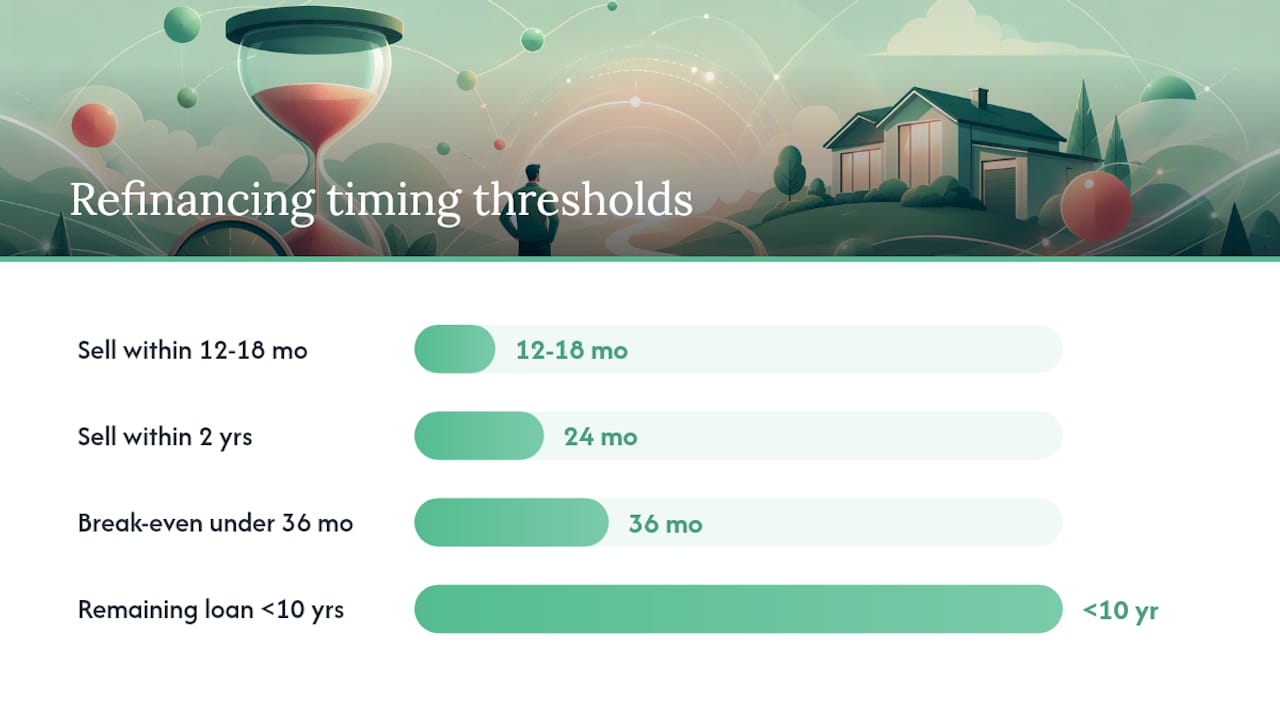
A break-even period under 36 months is a reasonable rule of thumb for most homeowners who plan to stay in the property. If you are selling within two years, the upfront costs rarely justify the switch.
Red flags that suggest you should wait or reconsider:
- You are planning to sell within 12–18 months
- Your remaining loan term is under 10 years (the interest savings window is short)
- You are on a fixed rate with large break costs that extend your break-even past 36 months
- Your employment situation has changed recently (a job change can affect your application)
- You have not yet checked your credit score or gathered documents
Rate forecasts are tempting to follow, but acting on numbers that work for you now is more reliable than waiting for a predicted rate cut that may or may not arrive on schedule. For more on refinancing timing best practices, the rules of thumb above are a solid starting point.
What experienced brokers see that most homeowners miss
Most people who come to refinancing conversations focus on the rate. That is understandable, but in practice the rate is rarely where the real money is lost or saved. The three surprises that derail refinances most often are a lower-than-expected property valuation (which changes the loan-to-value ratio and the rate tier offered), documentation gaps that slow the application by weeks, and prepayment fees the borrower did not know existed on their current loan.
The sequence that works: confirm your payoff figure and break costs first, then check your credit, then compare total cost across at least three lenders. Zenrgfinance works through exactly this sequence with clients, and the preparation that makes the biggest difference is simple: bring your current loan contract, your last two payslips, and a clear sense of how long you plan to stay in the property.
Zenrgfinance can help you avoid these refinancing traps
Refinancing done well saves you money. Done poorly, it costs you more than staying put. Zenrgfinance gives you access to loan products across multiple lenders, runs the break-even and total-cost comparison for you, and handles the paperwork from application to settlement. That includes complex scenarios: SMSF lending, investment properties, and self-employed income structures that standard online calculators do not handle well.

To get started, bring your current loan statement, a recent payslip, and your loan contract to a free initial session. A Zenrgfinance Mortgage Relationship Manager will compare live offers, calculate your break-even, and outline a clear next step, typically within a few days of your first conversation. Book your session here and find out exactly where you stand.
Sources
- Switching home loans (MoneySmart)
- 8 Mortgage Refinance Mistakes Homeowners Make (and How to Avoid Them) - Financedevil
- How to Refinance a Business Loan: The Complete 2026 Guide
This article provides general information only and is not a substitute for professional financial advice. Verify current rates, fees, and eligibility requirements with your lender or a licensed mortgage broker before making any refinancing decision.