
Refinancing after a property value increase is defined as replacing your existing mortgage with a new loan that reflects your home's higher current value, typically to access better rates or release equity. When your property rises in value, your loan-to-value ratio improves, which reduces lender risk and opens the door to more competitive loan terms. Industry guidelines suggest a rate reduction of at least 0.75%–1.0% is needed to make refinancing worthwhile, or 0.5% for loans above $500,000. Zenrgfinance works with Australian homeowners to assess exactly these scenarios, matching your financial position to the right refinancing option. Getting the timing and numbers right is what separates a genuinely profitable refinance from one that costs you more in the long run.
When is refinancing after a property value increase financially beneficial?
The clearest signal that refinancing makes financial sense is a meaningful drop in your interest rate. A rate reduction of 0.75%–1.0% is the standard threshold most lenders and financial advisers use to justify the costs involved. For larger loans above $500,000, even a 0.5% reduction can produce significant monthly savings.

Before you act, calculate your break-even point. The formula is straightforward: divide total closing costs by your expected monthly savings. If the result is under 36 months and you plan to stay in the home that long, refinancing is likely worth it. If you are planning to sell within two years, the upfront costs will almost certainly outweigh the savings.
Increased home equity also creates a specific opportunity: removing lenders mortgage insurance (LMI). Refinancing removes LMI once your equity surpasses 20% of the property's current value. That saving alone can be hundreds of dollars per month, making it one of the most compelling reasons to refinance after appreciation.
Here are the key financial indicators that justify refinancing:
- Your interest rate reduction is at least 0.75% on a standard loan, or 0.5% on a loan above $500,000.
- Your break-even period is under 36 months based on closing costs divided by monthly savings.
- Your equity now exceeds 20% of the property's current value, qualifying you for LMI removal.
- You plan to stay in the home long enough to recoup the upfront refinancing costs.
- Your cash flow needs have changed and accessing equity for renovations or investment is a clear, costed plan.
Pro Tip: Don't focus only on your new monthly repayment. A lower payment spread over a longer loan term can cost you significantly more in total interest. Always compare the total loan cost, not just the monthly figure.
One common pitfall is refinancing without aligning the decision to your long-term goals. Focusing only on monthly savings can be misleading when a longer loan term quietly adds years of interest to your total repayment. Run the full numbers before you commit.
What eligibility requirements apply after property appreciation?
Higher property values improve your position, but lenders still assess several financial metrics before approving a refinance. Understanding these criteria helps you walk into an application with realistic expectations.
Your loan-to-value ratio is the first metric lenders review. When your property appreciates, your LTV drops, which signals lower risk to the lender. A lower LTV typically unlocks better interest rates and broader loan options, including cash-out refinancing.
Higher equity does not guarantee better terms if your debt-to-income (DTI) ratio or credit score has worsened since your original mortgage. Lenders scrutinise both metrics carefully. HUD guidelines recommend keeping housing costs below 30% of gross monthly income, and most Australian lenders apply a similar serviceability standard.
Key eligibility factors lenders assess include:
- LTV ratio: A ratio below 80% removes LMI requirements and improves rate access.
- Credit score: A strong credit history signals repayment reliability. Any deterioration since your original loan will affect your options.
- DTI ratio: Total monthly debt repayments as a percentage of gross income. Most lenders prefer this below 35%–40%.
- Employment and income stability: Lenders want consistent, verifiable income, particularly for self-employed applicants.
- Property valuation: An independent appraisal confirms the current market value and drives the LTV calculation.
| Eligibility factor | What lenders look for |
|---|---|
| LTV ratio | Below 80% for best rates; below 90% to avoid LMI |
| Credit score | Strong history with no recent defaults or missed payments |
| DTI ratio | Housing costs below 30%–35% of gross monthly income |
| Employment | Stable, verifiable income for at least two years |
| Property appraisal | Current independent valuation confirming appreciated value |
One option worth knowing: many homeowners can request a PMI removal appraisal once equity hits 20%, without completing a full refinance. This avoids closing costs entirely if your only goal is removing LMI.
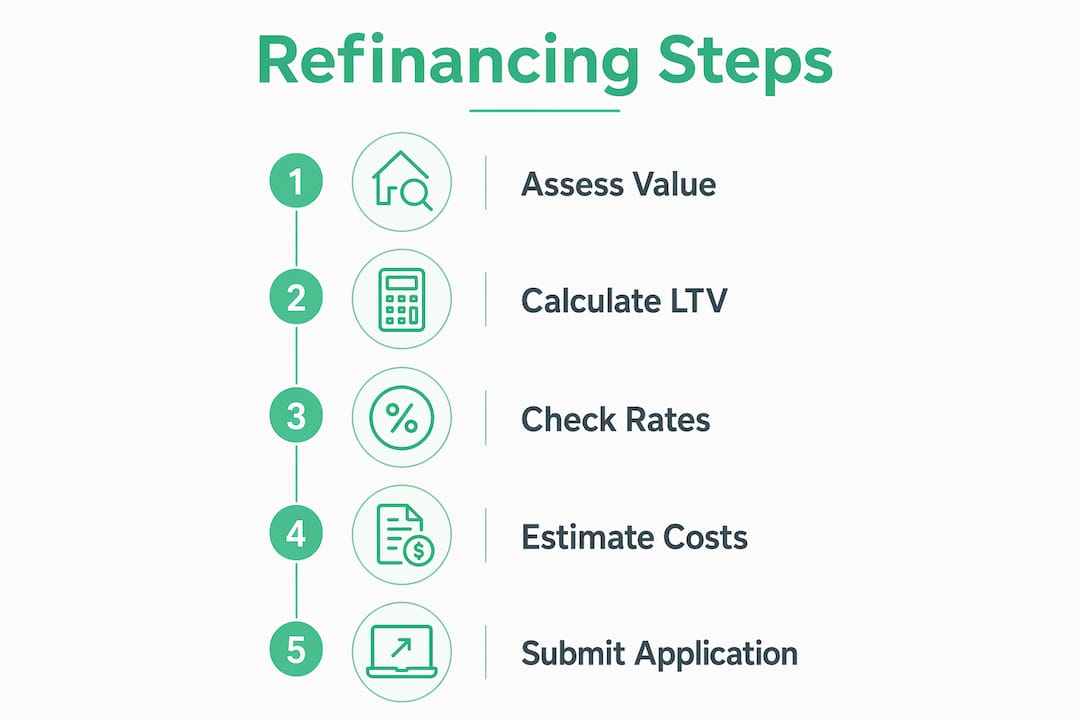
How to refinance after your property's value has increased
A clear process reduces stress and improves your chances of approval. Follow these steps to move from appreciation to a better loan.
- Review your current mortgage. Pull out your loan documents and note your current interest rate, remaining balance, loan term, and any exit fees or break costs.
- Get an updated property valuation. Commission an independent appraisal or use a lender's valuation service. This confirms your new LTV and equity position.
- Define your refinancing goal. Are you after a lower rate, LMI removal, a shorter loan term, or cash-out access? Your goal determines which loan type suits you.
- Check your credit and DTI. Obtain your credit report and calculate your current debt-to-income ratio. Address any errors or outstanding debts before applying.
- Choose your refinancing type. Rate-and-term refinancing adjusts your rate or loan length without changing the principal. Cash-out refinancing increases your loan balance to release equity as cash.
- Compare lenders and products. Use a loan comparison calculator to model different rate and term scenarios side by side.
- Submit your application. Provide payslips, tax returns, bank statements, and the property valuation. The lender's underwriting team will assess your full financial picture.
- Review the loan offer carefully. Check the comparison rate, total repayment amount, and all fees before signing.
- Settle and close. Closing costs typically range from 2%–5% of the loan amount. Budget for these upfront and factor them into your break-even calculation.
| Refinancing type | Best suited for | Key consideration |
|---|---|---|
| Rate-and-term | Lowering rate or shortening loan term | Minimal change to loan balance |
| Cash-out | Accessing equity for renovation or investment | Increases total debt; requires clear repayment plan |
| LMI removal | Equity now above 20% | May not require full refinance |
Pro Tip: Gather all your documents before approaching lenders. Incomplete applications slow underwriting and can affect your rate lock window. A mortgage broker like Zenrgfinance can prepare a checklist specific to your situation.
Property appreciation combined with improving market rates and a stronger personal financial position creates the best conditions for refinancing. Waiting for all three factors to align, rather than acting on appreciation alone, produces the most favourable outcomes.
Pros and cons of refinancing after a property value increase
Refinancing after appreciation carries real benefits, but it also comes with risks that deserve honest consideration.
Benefits:
- Lower interest rate: A reduced rate cuts your monthly repayment and total loan cost, provided the rate drop meets the 0.75%–1.0% threshold.
- LMI removal: Equity above 20% eliminates this ongoing cost, often saving hundreds of dollars per month.
- Cash-out access: You can release equity for home improvements, investment, or debt consolidation at mortgage rates, which are typically lower than personal loan rates.
- Improved cash flow: Lower repayments free up monthly income for savings, investment, or living costs. See how refinancing improves cash flow for a detailed breakdown.
- Shorter loan term: Refinancing into a shorter term increases monthly payments but reduces total interest paid significantly.
Risks:
- Upfront closing costs: At 2%–5% of the loan amount, these costs require a long enough stay in the home to recover.
- Longer loan term: Resetting to a 30-year loan after years of repayments increases total interest, even at a lower rate.
- Qualification hurdles: A worsened credit score or higher DTI can block approval despite strong property values.
- Credit impact: A new mortgage application triggers a hard credit enquiry, which temporarily lowers your credit score.
"A meaningful rate drop alone is not enough. Factoring in closing costs and your planned duration in the home is essential for any break-even analysis to hold up. Property appreciation should be combined with changing market rates and personal financial improvements for a solid refinance decision."
Refinancing is not advisable if you plan to sell within two years, if your credit has deteriorated significantly, or if exit fees on your current loan wipe out the projected savings. Nearly 2.7 million homeowners with 30-year fixed mortgages could save through refinancing, but that figure includes many who will not act because the numbers simply don't stack up for their situation.
Common mistakes to avoid when refinancing after property value increases
Most refinancing regrets trace back to a handful of avoidable errors. Knowing them in advance keeps you on the right side of the numbers.
- Underestimating closing costs. At 2%–5% of the loan amount, these fees are substantial. Always include them in your break-even calculation before committing.
- Ignoring total loan cost. A lower monthly repayment on a longer term can cost tens of thousands more in interest over the life of the loan.
- Assuming appreciation guarantees approval. Lenders assess DTI and credit scores alongside property value. A higher valuation does not override a weak financial profile.
- Not shopping around. Accepting the first offer from your current lender leaves money on the table. Different lenders price risk differently, and a broker can access a wider range of products.
- Skipping the eligibility check. Review your refinancing eligibility requirements before applying. An unsuccessful application affects your credit score and delays future attempts.
- Cashing out equity without a plan. Accessing equity increases your debt. Without a clear repayment strategy, you risk eroding the financial gains that appreciation created.
Pro Tip: Request a written fee schedule from every lender you approach. Compare the comparison rate, not just the headline rate. The comparison rate includes most fees and gives you a truer picture of the loan's total cost.
The benefits of refinancing are real, but they only materialise when the decision is grounded in complete financial analysis rather than enthusiasm about rising property values.
Key takeaways
Refinancing after property value increases is most beneficial when the rate reduction, equity position, and break-even timeline all align with your personal financial goals.
| Point | Details |
|---|---|
| Rate reduction threshold | A reduction of at least 0.75%–1.0% is needed to justify refinancing costs on most loans. |
| Break-even calculation | Divide total closing costs by monthly savings; aim for a payback period under 36 months. |
| LMI removal opportunity | Equity above 20% from appreciation qualifies you to remove lenders mortgage insurance. |
| Lender eligibility factors | DTI ratio, credit score, and income stability matter as much as your improved LTV. |
| Avoid common pitfalls | Always compare total loan cost, not just monthly repayments, and shop across multiple lenders. |
The real lesson appreciation teaches you about refinancing
I've worked with homeowners who received a property valuation that made their eyes light up, and then rushed straight into a refinance application without running the numbers. The excitement is understandable. Watching your home's value climb is genuinely satisfying. But appreciation is only one piece of the puzzle.
The homeowners who come out ahead are the ones who treat a higher valuation as the starting point for analysis, not the conclusion. They check their DTI, pull their credit report, calculate the break-even period, and then decide. That process takes a few hours. Skipping it can cost years of unnecessary interest.
The other thing I see too often is cash-out refinancing without a concrete plan for the funds. Releasing equity at mortgage rates is genuinely useful for a well-costed renovation or a considered investment. Releasing it to fund lifestyle spending is a different matter entirely. The debt is real, even when the rate feels low.
My honest advice: treat your property's appreciation as an invitation to review your mortgage, not a reason to automatically act. Sometimes the review confirms that refinancing is the right move. Sometimes it tells you to wait six months for rates to shift further. Both outcomes are valuable. The financial goals and refinancing framework Zenrgfinance uses is built exactly for this kind of structured review, and it removes the guesswork from what should be a deliberate decision.
— Allen
How Zenrgfinance can help you refinance with confidence
If your property has increased in value and you are weighing your home refinancing options, getting personalised guidance makes the process far clearer.

Zenrgfinance offers a dedicated mortgage relationship manager service that walks you through your current loan position, updated property valuation, and refinancing eligibility in one structured conversation. The team assesses your LTV, DTI, and credit profile against current lender criteria, so you know exactly where you stand before you apply. Whether your goal is a lower rate, LMI removal, or cash-out access for property investment, Zenrgfinance matches your situation to the right product across a broad panel of lenders. Reach out today for a no-obligation mortgage review.
FAQ
What is the minimum rate reduction to justify refinancing?
A rate reduction of at least 0.75%–1.0% is the standard threshold for most loans. For loans above $500,000, a 0.5% reduction can be sufficient given the larger loan balance.
How does property appreciation affect my refinancing eligibility?
A higher property value lowers your LTV ratio, which reduces lender risk and can improve your available rates and loan options. However, lenders also assess your DTI ratio and credit score, so appreciation alone does not guarantee approval.
Can I remove LMI without doing a full refinance?
Yes. Many homeowners can request a PMI removal appraisal once their equity reaches 20%, which avoids the full closing costs of a refinance.
What are typical closing costs for refinancing in Australia?
Closing costs typically range from 2%–5% of the loan amount and include lender fees, an independent appraisal, and title-related charges. Always include these in your break-even calculation before proceeding.
What is the difference between rate-and-term and cash-out refinancing?
Rate-and-term refinancing adjusts your interest rate or loan term without changing your principal balance. Cash-out refinancing increases your loan balance to release a portion of your equity as cash, which is useful for renovations or investment but increases your total debt.