
If you're paying off your own home for the long haul, principal and interest (P&I) will almost always leave you better off, because it builds equity and costs less in total interest. Interest-only (IO) tends to suit investors and people who need short-term cash-flow breathing room, but it comes with a real sting later, often called the IO cliff. Moneysmart and the RBA both track this trade-off closely, and running your own numbers through ZENRG Finance's calculators is the fastest way to see where you land.
TL;DR:
- Interest-only loans typically carry a higher interest rate, around 0.90%, and lead to larger total interest payments over the loan term compared to principal and interest loans.
- When the interest-only period ends, borrowers face a significant repayment increase, often over 700 dollars more per month, due to accelerated principal repayment within a shorter timeline.
- Making extra repayments during the interest-only phase can soften the shock at the reset, but many borrowers overlook this crucial step and face unexpected costs.
- The majority of new borrowers choose principal and interest loans because they build equity steadily and cost less overall, especially for owner-occupiers planning long-term residence.
- Borrowers should model post-IO repayments at least 12 months in advance and verify lender policies closely to avoid repayment shocks and ensure refinancing options are viable.
Table of Contents
- Interest only vs P&I: a quick side-by-side
- What are the pros and cons of each option?
- Who should choose IO, and who should choose P&I?
- What happens when your interest-only period ends?
- How much more does interest-only actually cost?
- Where to get help modelling your own numbers
- Why the "just pick IO for cash flow" advice falls short
- Get a repayment plan built around your numbers
- Sources
Interest only vs P&I: a quick side-by-side
The two structures shape your repayments in completely different ways. With P&I, every payment chips away at both the interest owed and the amount you originally borrowed, so your loan balance shrinks month by month. With IO, your repayment only covers interest, meaning the principal sits untouched for the length of the IO term, commonly around five years.
Lenders don't hand out IO terms indefinitely. Owner-occupiers typically get access to IO for up to five years, while investors can sometimes stretch that to ten years, depending on the lender's appetite and APRA's macroprudential settings at the time.
In numbers: APRA reports that roughly four in five new home borrowers choose P&I, and IO loans typically carry an interest-rate premium of around 0.90% for owner-occupiers compared with equivalent P&I loans.
- P&I: repayments reduce principal and interest from day one
- IO: repayments cover interest only, principal stays fixed during the IO term
- Owner-occupier IO limit: typically up to 5 years
- Investor IO limit: typically up to 10 years, lender-dependent
What are the pros and cons of each option?
Neither structure is universally "better." The right one depends on what you're trying to achieve and how long you plan to hold the loan.
Principal and interest:
- Builds equity in your property from the first repayment
- Usually attracts a lower interest rate than IO
- Costs less in total interest over the life of the loan
- Higher repayments upfront compared with an equivalent IO period
Interest only:
- Lower repayments during the IO term, which frees up cash flow
- Can suit investors chasing capital growth or maximising tax-deductible interest on investment loans
- No equity is built while the IO term runs
- Triggers a repayment jump when the IO period ends, and usually costs more in total interest
Pro Tip: Even if you're on an interest-only loan, making voluntary extra repayments during the IO term (where your loan allows it) chips away at the principal early and softens the shock when repayments reset to P&I.
Who should choose IO, and who should choose P&I?
Your circumstances matter more than any general rule. Here's a rough map:
- Owner-occupiers planning to stay long-term usually do best on P&I. You want equity building steadily, and the lower rate compounds in your favour over 25 to 30 years.
- Long-term investors often lean towards IO to manage cash flow and maximise deductible interest, provided they have a clear exit strategy and don't rely purely on capital growth.
- Borrowers needing temporary relief (parental leave, a business slowdown, renovation costs) may use IO as a short bridge, not a permanent structure.
Before locking in either option, ask your broker: what will my repayment look like the day IO ends? Does this lender allow an IO extension, and on what terms? How likely am I to refinance before the IO period expires? If a lender can't answer these clearly, treat that as a red flag.
What happens when your interest-only period ends?
This is where a lot of borrowers get caught out. Once the IO term finishes, the outstanding principal has to be repaid over whatever's left of the loan term, not over the original 25 or 30 years. A 30-year loan with a five-year IO period leaves the remaining principal to be repaid over just 25 years, which immediately pushes repayments higher than if you'd been on P&I from the start.
You've got a few ways to manage this transition:
- Make extra repayments during the IO term to reduce the eventual jump
- Refinance to a better rate before the reset hits
- Ask about extending the IO period, if your lender allows it and your situation supports it
- Convert to P&I earlier than required if cash flow allows
- Sell, if the numbers no longer stack up
Pro Tip: Model your post-IO repayments 12 to 24 months before the term ends, not the month before. That gives you time to refinance, renegotiate, or adjust your budget instead of reacting under pressure. If your IO period is approaching, this guide on what to do before it ends walks through the practical steps.
How much more does interest-only actually cost?
Numbers make this real. Monthly repayments sit around $3,597, and the total interest paid over the full term lands near $695,000.
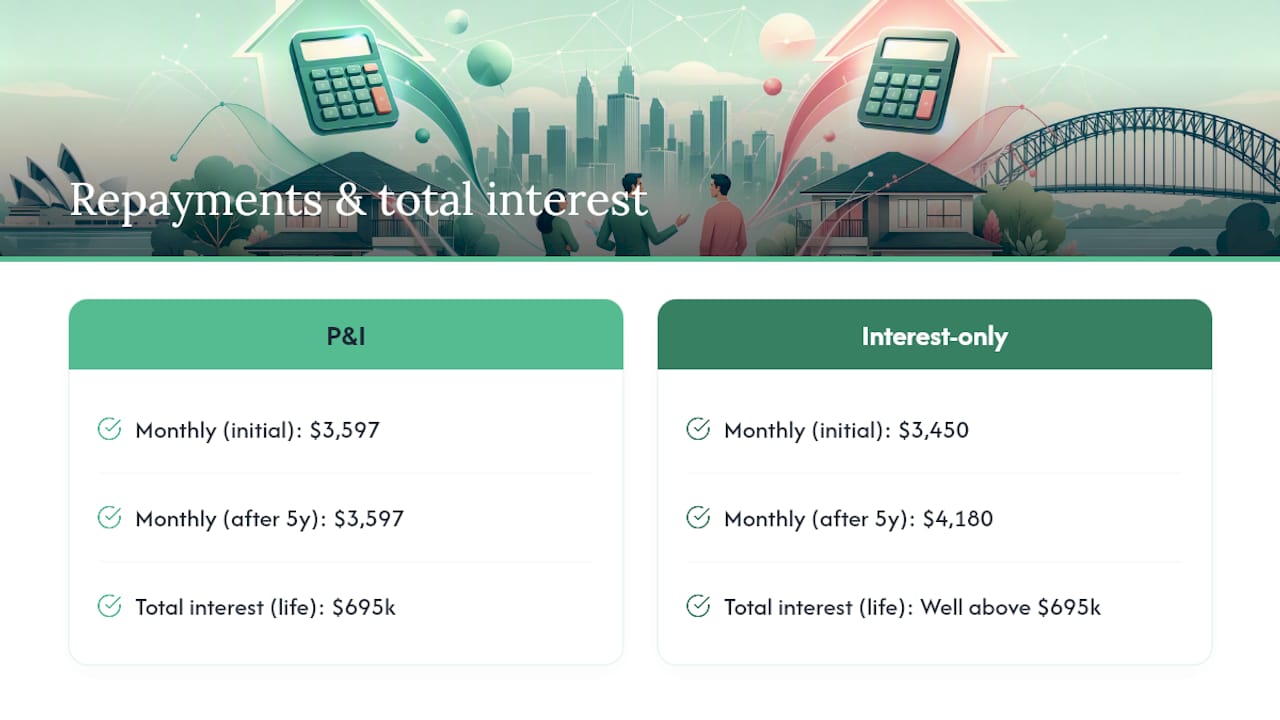
Now run the same loan with a five-year IO period. Using the roughly 0.90% rate premium IO loans typically carry, your rate might sit closer to 6.90%. During those first five years, you'd pay interest-only repayments of about $3,450 a month, lower than the P&I equivalent. But once the IO period ends, the remaining $600,000 has to be repaid over just 25 years at that higher rate, pushing repayments up to roughly $4,180 a month, a jump of more than $700. Over the life of the loan, total interest paid climbs well above the $695,000 P&I figure, often by tens of thousands of dollars, because you're paying a higher rate on the full principal for longer.
These figures are illustrative, built on the RBA's published rate-premium data, not a quote for your specific loan. Run your actual numbers through the interest-only mortgage calculator or the loan comparison calculator to see your real repayment path.
Where to get help modelling your own numbers
ZENRG Finance built its interest-only mortgage calculator and loan comparison calculator specifically so borrowers can test IO against P&I with their own loan amount, rate, and term, rather than relying on generic examples.
A broker's job in this conversation is to check things a calculator can't: the specific lender's IO extension policy, whether refinancing is realistic given your equity position, and whether structures like SMSF lending change the calculation entirely. For a broader look at why investors lean towards IO, this guide on interest-only loans for investment property covers the cash-flow and tax angles in more depth. If you'd like a plain-English explainer on how owner-occupier and investor loans differ more generally, WealthStacker's breakdown is a solid outside reference.
Why the "just pick IO for cash flow" advice falls short
The advice you'll hear most often, "go interest-only if you want lower repayments," treats IO like a free lunch. It isn't. It's a deferral, and deferrals have to be repaid eventually, usually at a higher rate and over a shorter runway than borrowers expect.
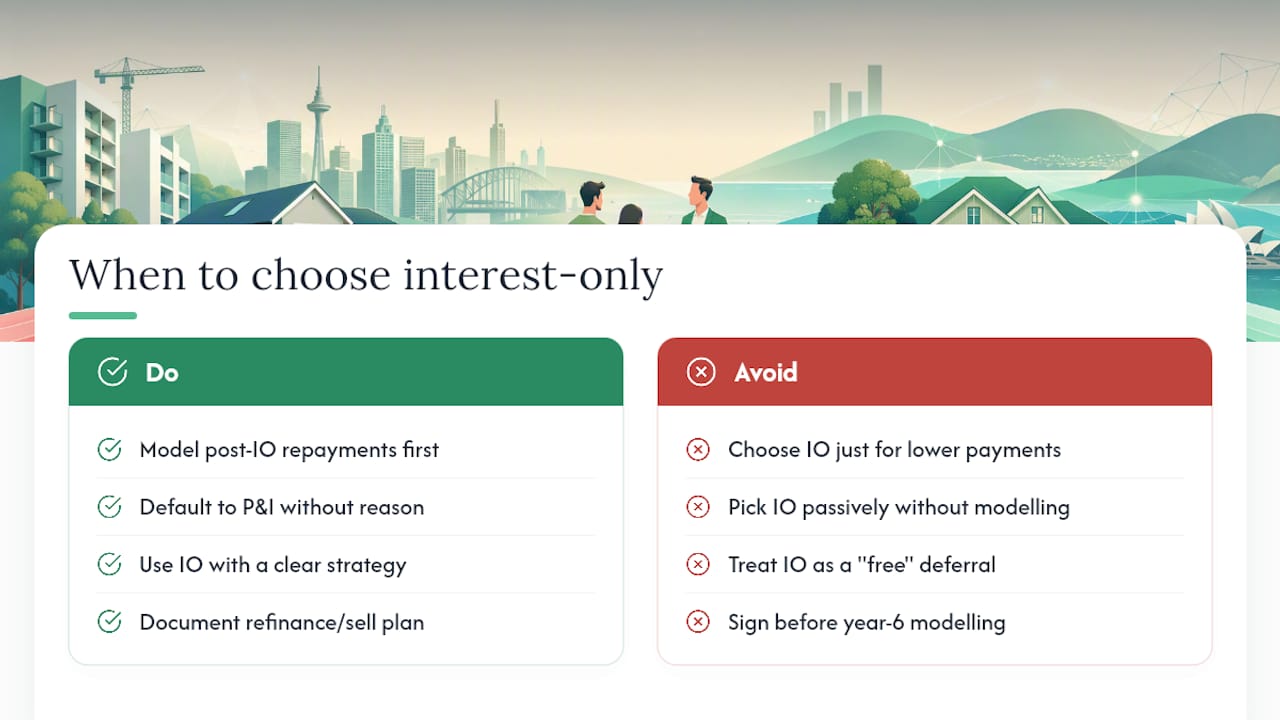
What the research actually supports is more specific: P&I is the sound default for anyone without a clear reason to deviate from it, and IO only earns its place when there's a genuine strategy behind it, tax efficiency for an investor, a temporary cash-flow gap with a defined end date, or a documented plan to refinance or sell before the term resets. Where I think most borrowers go wrong isn't choosing IO itself, it's choosing it passively, without modelling what happens in year six.
If you take one thing from this, model the post-IO repayment before you sign anything, not after. That single habit would prevent most of the repayment shock stories that make headlines every time rates move. Get that number first, then decide if IO still makes sense for your situation.
— Allen
Get a repayment plan built around your numbers
There's a real cost to guessing your way through an IO versus P&I decision, and it usually shows up years later as a repayment jump nobody budgeted for. Zenrgfinance's Mortgage Relationship Manager service exists to close that gap before it opens: a strategy session that walks through your specific loan amount, timeline, and goals, then models both structures side by side so you can see the actual numbers, not a generic example.

Start by running your figures through the interest-only mortgage calculator to get a feel for your own repayment shape. Once you've got a rough picture, book a session with a Mortgage Relationship Manager to stress-test it against lender policy, refinance timing, and your longer-term goals. It's a straightforward next step, and it beats finding out the hard way what your repayments look like the day your IO term ends.
This article is general information, not a substitute for advice from a qualified financial advisor. Consult a qualified financial professional about your own circumstances before acting on anything here.
Sources
- Interest-only home loans – Moneysmart
- RBA – interest rates
- APRA – macroprudential settings and commentary
- ATO – rental expenses you can claim