
Interest-only terms suit business loans because they lower your near-term repayments and protect working capital while a predictable revenue event, project completion, or refinancing plan is in place. Australian government guidance from Moneysmart confirms that interest-only repayments can help manage cash flow by temporarily reducing monthly obligations, with the principal remaining unchanged during the interest-only window.
The core advantages at a glance:
- Lower monthly outgoings free cash for payroll, inventory, and marketing during ramp-up or slow seasons
- Payments align with project timelines, so debt service matches when revenue actually arrives
- Seasonal businesses and project-based firms can use the reduced outflow to stabilise operations before full amortisation begins
- Interest paid on a business loan is generally tax-deductible, which softens the cost during the interest-only period
The principal caveats:
- Your loan balance does not reduce during the interest-only window, so total interest paid over the life of the loan is higher
- Payment shock is real: when principal repayments begin, monthly obligations jump sharply and you must be ready for that transition
If you want practical exit strategies and help structuring the right terms, skip ahead to the Zenrgfinance section below.
Table of Contents
- What does "interest-only" actually mean for a business loan?
- Why interest-only repayment suits businesses: the core benefits
- Typical interest-only periods and loan types in Australia
- How interest-only repayments work: a worked example
- Key disadvantages and risks you must plan for
- When does interest-only actually make sense for your business?
- What are the alternatives to a straight interest-only term?
- How do you decide? A checklist and questions to ask your lender
- Zenrgfinance expert guidance: exit strategies and structuring tips
- Key takeaways
- A word from Zenrgfinance on interest-only structures
- Ready to model your interest-only options with Zenrgfinance?
- Useful sources and further reading
What does "interest-only" actually mean for a business loan?
With an interest-only business loan, your repayments cover only the interest that accrues on the outstanding balance. The principal, the amount you originally borrowed, stays exactly the same throughout the interest-only period.
Most lenders offer interest-only windows at the start of a loan term, though some will negotiate a mid-term modification if your circumstances change. Not all lenders offer interest-only options, so it pays to ask upfront whether the product you are considering includes this feature.
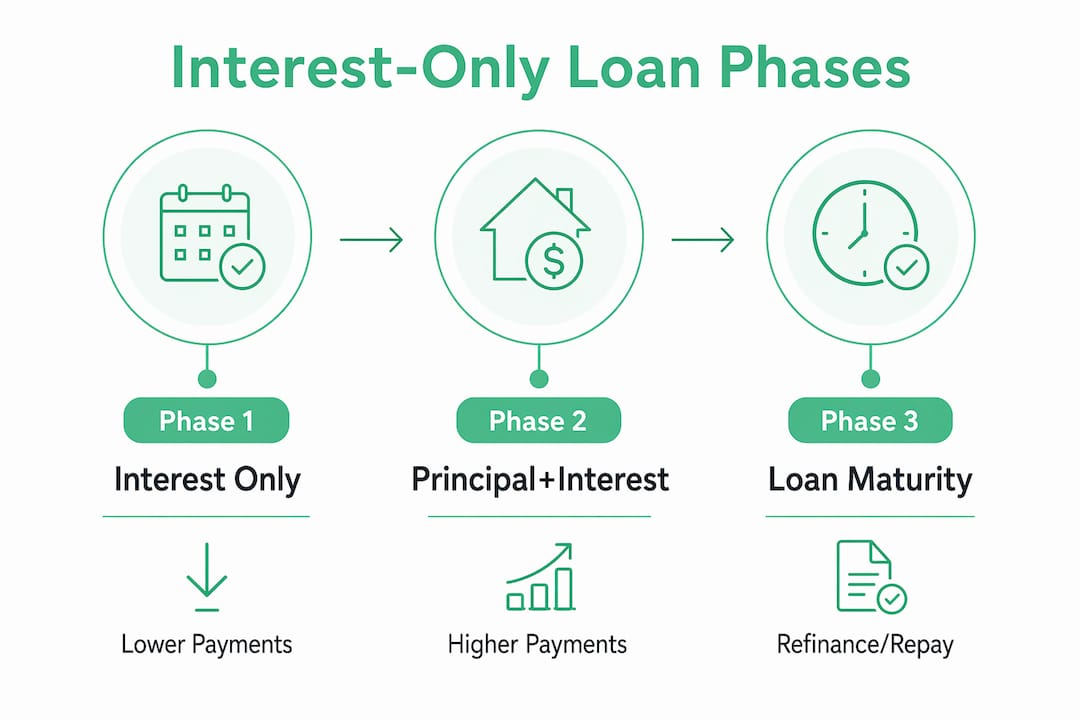
Here is how the loan lifecycle looks in plain terms:
Phase 1 (Interest-only period): You pay interest only each month. The principal balance is unchanged. Cash flow is lower.
Phase 2 (Amortisation): The loan converts to principal-and-interest repayments. Your monthly payment rises because you are now paying down the balance over the remaining term.
Phase 3 (End of term): Depending on the loan structure, you either complete full amortisation, refinance, or make a balloon payment to clear the outstanding principal.
Understanding this lifecycle is the foundation of every smart business loan payment strategy. The interest-only period is not a free pass; it is a deliberate timing tool.
Why interest-only repayment suits businesses: the core benefits

The practical case for interest-only loans for businesses comes down to one thing: timing. Revenue rarely arrives in a straight line, but loan repayments usually do. Interest-only terms let you bend the repayment schedule toward reality.
Cash flow and working capital:
- Lower monthly outgoings during the interest-only window free cash for payroll, stock, marketing, and capital expenditure
- For a business funding a fit-out or equipment purchase, the reduced early payments mean you are not draining reserves before the investment starts generating returns
- Liquidity ratios can improve in the short term, which matters if you are managing multiple financial obligations simultaneously
Aligning debt service with project timelines:
- A construction project or new location build-out typically generates no revenue until completion. Deferring principal repayment until the investment is generating returns means the loan structure matches the actual economic timeline of the project.
- Seasonal businesses, such as a coastal tourism operator or a retail business with a heavy Christmas trade, can schedule interest-only stretches during predictable slow months and build reserves during peak periods
Tax and balance-sheet effects:
- Interest payments on a business loan are generally tax-deductible in Australia, so the after-tax cost of an interest-only period is lower than the headline rate suggests
- The trade-off is slower equity build-up: because the principal does not reduce, your debt-to-equity ratio stays higher for longer, which some lenders will scrutinise at renewal
Use-case snapshots:
- Construction bridge: A builder draws down a commercial loan to fund materials and labour. Interest-only payments keep cash available until the first milestone payment arrives from the client.
- Seasonal retailer: A gift retailer uses interest-only terms through the first half of the year, then switches to principal-and-interest once Christmas trading revenue lands.
- Product launch: A manufacturer launching a new product line needs six months of runway before the product generates meaningful sales. Interest-only terms provide that breathing room without forcing asset sales or equity dilution.
Typical interest-only periods and loan types in Australia
Interest-only windows commonly last 5–10 years for some mortgage-style products, but for commercial bridge loans and short-term business finance the window is usually much shorter, often 3, 6, or 12 months. Some lenders offer up to 3–5 years for commercial property-backed loans.
The loan types most likely to include interest-only options in Australia are:
- Construction finance: Interest-only during the build phase is standard practice, with amortisation beginning once the property is complete and generating income
- Commercial bridging loans: Short-term finance designed to bridge a gap between a purchase and a sale or refinance. Exit plans are central to bridge loan structures because the interest-only window is finite and the balloon payment or refinance must be ready
- Commercial mortgages: Some lenders offer interest-only periods on owner-occupied or investment commercial property loans, particularly for established businesses with strong cash flow histories
- Business term loans: Certain lenders, including some mainstream Australian banks, offer interest-only periods on business term loans as a flexibility feature
How you negotiate the window matters. Interest-only terms written into the loan at origination are cleaner and cheaper than mid-term modifications, which can attract loan-modification fees and require fresh documentation. If you think you will need interest-only flexibility, raise it at the application stage, not after settlement.
Lenders may also load a small rate premium onto interest-only periods or impose stricter covenant tests during the window. Always ask for the full cost comparison before committing.

How interest-only repayments work: a worked example
Here is a straightforward comparison using a $500,000 business loan at a 7% annual interest rate over a 5-year term, with a 12-month interest-only period followed by full amortisation.
During the interest-only period (months 1–12):
Monthly interest is calculated as principal multiplied by the annual interest rate divided by 12, resulting in lower payments during the interest-only period.
After the interest-only period (months 13–60):
The full $500,000 principal now amortises over the remaining 48 months at 7%.
Monthly principal-and-interest payment after the interest-only period increases significantly as you start repaying principal along with interest.
That is a jump of roughly $3,000 per month when amortisation begins. This is the payment shock that catches businesses off guard when they have not planned for it.
Quick comparison bullets:
- Total interest paid over the life of the loan is higher with an interest-only structure because the principal stays elevated for longer
- Equity in any underlying asset builds more slowly during the interest-only window
- The cash saved during the interest-only period ($2,917 × 12 = $35,004 in this example) is only worthwhile if it is deployed productively or held as a reserve against the higher payments ahead
Use the interest-only mortgage calculator at Zenrgfinance to run your own numbers before you commit to a structure.
Pro Tip: Always stress-test your model against a 1–2% rate rise and a three-month delay in your projected revenue event. If the numbers still work under those conditions, the interest-only structure is probably sound. If they do not, you need a larger contingency reserve or a shorter interest-only window.
Key disadvantages and risks you must plan for
Interest-only terms are a tool, not a safety net. Used without a clear exit plan, they shift financial stress forward rather than removing it.
Payment shock is the most common failure point for businesses using interest-only loans. When the interest-only period ends, monthly repayments can jump by 50–100% or more depending on the loan term and remaining balance. Businesses that have not built reserves or secured a refinancing path often face a sudden cash crisis at exactly the moment their loan converts to full amortisation. Always model the post-IO payment before you sign.
Higher lifetime interest cost: Because the principal does not reduce during the interest-only window, interest accrues on a larger balance for longer. Over a five-year term, this can add meaningfully to the total cost of borrowing compared with a fully amortising loan at the same rate.
Refinancing risk: If your plan depends on refinancing at the end of the interest-only period, you are exposed to credit market conditions at that future date. If rates have risen, your credit profile has weakened, or lenders have tightened their criteria, you may refinance at worse terms or not at all.
Covenant tightening: Lenders commonly charge higher rates, require stricter covenants, or impose larger fees for interest-only terms, increasing overall borrowing cost and oversight. A covenant breach during the interest-only period can trigger an early repayment demand.
Slower equity build-up: Your balance sheet retains a larger outstanding principal, which can reduce tangible net worth and make it harder to borrow again on favourable terms.
If your interest-only period is approaching its end, Zenrgfinance has a practical guide on what to do when your interest-only loan is about to end that covers your options in plain language.
When does interest-only actually make sense for your business?
The best-fit scenarios for interest-only financing share a common thread: there is a specific, credible event on the horizon that will either generate the cash to service principal repayments or allow refinancing on planned terms.
Scenarios where interest-only is a strong fit:
- Construction or fit-out projects: Revenue does not start until the project is complete. Interest-only during the build phase is logical and widely accepted by lenders.
- Seasonal businesses: A business with concentrated income windows, such as a ski resort, a summer tourism operator, or a tax-time accounting firm, can use interest-only during off-peak months and make accelerated principal payments when cash is strong.
- Contract-based or lumpy receipts: A business waiting on a large government or commercial contract payment can use interest-only to bridge the gap without drawing down reserves.
- Staged roll-outs and inventory ramp-ups: A retailer expanding into new locations or a manufacturer scaling production needs time before the new capacity generates returns.
Red flags that suggest interest-only is the wrong choice:
- Revenue is uncertain or declining, with no clear recovery timeline
- There is no credible refinancing path or asset sale event at the end of the interest-only window
- Cash reserves are already thin, leaving no buffer against the payment shock
- The business is taking on interest-only terms simply to afford the loan, rather than to align timing
Exit strategy examples tied to each scenario:
- Construction project: refinance to a long-term commercial mortgage once the property is tenanted and valued
- Seasonal business: use peak-season surplus to make lump-sum principal payments and reduce the amortising balance
- Contract-based business: earmark a portion of each contract receipt for principal reduction, documented in a cash flow forecast
Good cash flow management is what separates businesses that use interest-only terms successfully from those that get caught out.
What are the alternatives to a straight interest-only term?
Interest-only is not the only way to manage cash flow during a loan. Several structures can deliver similar short-term relief with different risk profiles.
| Structure | Cash flow benefit | Key trade-off | Best suited to |
|---|---|---|---|
| Principal-and-interest, longer amortisation | Lower monthly payments than a short-term P&I loan | More total interest over the life of the loan | Businesses wanting predictable payments without a balloon risk |
| Revolving line of credit | Draw and repay as needed; pay interest only on what you use | Variable rates; temptation to overborrow | Businesses with uneven, short-cycle cash needs |
| Step-up / step-down schedule | Payments start low and increase as revenue grows | Requires lender agreement and strong forecasts | Start-ups and businesses in a clear ramp-up phase |
| Sculpted principal repayments | Repayments aligned to actual cash flow cycles | More complex to negotiate; needs detailed forecasts | Businesses with quarterly or seasonal revenue patterns |
| Revenue-based repayment | Payments flex with revenue; lower in slow periods | Higher effective cost; factor-rate confusion common | Seasonal or variable-revenue businesses |
Amortisation schedule misalignment, not just interest rate, is a major driver of business cash stress. A sculpted repayment schedule that matches your actual revenue cycle can outperform a one-size-fits-all interest-only window if negotiated correctly. The right structure depends entirely on your cash flow pattern, your exit plan, and what your lender will agree to.
How do you decide? A checklist and questions to ask your lender
Before you commit to an interest-only structure, work through this decision checklist:
- Does the length of the interest-only window match the specific cash flow event you are planning for (project completion, contract receipt, seasonal peak)?
- Do you have a documented, credible exit strategy: refinance, asset sale, or revenue milestone?
- Have you stress-tested your cash flow against a rate rise of at least 1–2% and a three-month delay in your revenue event?
- Have you modelled the post-IO monthly payment and confirmed your business can service it?
- Do you understand the covenants that apply during the interest-only period and what triggers a breach?
- Have you calculated the total cost of the interest-only structure (including any rate premium and fees) versus a fully amortising loan?
Questions to ask your lender or broker:
- What is the maximum interest-only period available for this loan type?
- What is the exact amortisation schedule and monthly payment once the interest-only period ends?
- Is there a rate loading or fee premium for the interest-only feature?
- What covenant tests apply during the interest-only period, and how frequently are they reviewed?
- What are the prepayment terms if I want to start reducing principal early?
- What refinancing options are available at the end of the interest-only window, and what documentation will you require?
- Can the interest-only period be extended if my project runs over time, and what are the conditions and costs?
What to bring to the conversation:
Lenders respond well to preparation. Bring three to six months of bank statements, up-to-date profit-and-loss statements, a cash flow forecast covering the interest-only period and at least 12 months beyond it, and a written exit plan. A business that walks in with a documented repayment strategy is far more likely to secure favourable terms than one that simply asks for lower payments.
Use the loan repayment calculator at Zenrgfinance to model different scenarios before your lender meeting.
Zenrgfinance expert guidance: exit strategies and structuring tips
The most common mistake Zenrgfinance sees with interest-only business loans is not the structure itself; it is the absence of a written exit plan. Lenders are far more likely to approve an interest-only request, and on better terms, when you can show exactly how and when the principal will be repaid.
Actionable steps to structure your interest-only loan well:
- Write your exit plan down before you apply. It should name the specific event (project completion, contract receipt, refinance date) and the timeline.
- Build a contingency reserve during the interest-only period. Even setting aside a portion of the monthly saving creates a buffer against the payment shock.
- Negotiate step-up amortisation terms at origination so the transition from interest-only to full repayment is gradual rather than a cliff.
- Ask your lender how frequently covenant tests occur during the interest-only window and what you need to maintain to stay compliant.
A practical example: A Sydney-based hospitality business needed to fit out a new venue and expected the site to be trading within six months. By structuring a 12-month interest-only period on their commercial fit-out loan, they kept monthly cash obligations low during construction and the first few months of trading. By month nine, the venue was generating enough revenue to comfortably service principal-and-interest repayments. The key was a written cash flow forecast presented at application, which gave the lender confidence to approve the interest-only window without a rate premium.
Pro Tip: When requesting an interest-only modification mid-term, bring three to six months of bank statements and a forward cash flow forecast. Lenders prefer a performing loan with a modified schedule over a standard loan heading toward default. Presenting a credible plan significantly increases your approval odds.
Key takeaways
Interest-only terms suit business loans when there is a specific, time-bound cash flow event ahead and a documented plan for what happens when the interest-only period ends.
| Point | Details |
|---|---|
| Core purpose | Interest-only lowers near-term repayments by deferring principal, protecting working capital during ramp-up or seasonal gaps. |
| Payment shock is real | Monthly repayments can jump sharply when amortisation begins; model the post-IO payment before you sign. |
| Total cost is higher | Because principal stays elevated longer, total interest paid over the loan's life is greater than with a fully amortising structure. |
| Exit plan is non-negotiable | A documented refinance, sale, or revenue milestone is what separates a smart IO structure from a deferred cash crisis. |
| Zenrgfinance can help | Zenrgfinance models interest-only scenarios, negotiates terms with lenders, and builds exit strategies tailored to Australian SME cash flow realities. |
A word from Zenrgfinance on interest-only structures
At Zenrgfinance, we typically recommend interest-only structures when a business has a clear, time-bound reason for needing lower early payments and a credible plan for what comes next. It is not a product we suggest simply because it makes a loan look more affordable on paper. The businesses that benefit most are those with a specific project timeline, a seasonal revenue pattern, or a confirmed refinancing path, and the discipline to build reserves during the interest-only window.
Australian SMEs face real cash flow pressures, and the right loan structure can make a genuine difference to how a business weathers its growth phases. Our job is to match the structure to the reality of your cash flow, not the other way around.
Ready to model your interest-only options with Zenrgfinance?
Choosing the right loan structure for your business is one of the most consequential financial decisions you will make. Zenrgfinance works with Australian small and medium business owners to compare loan products across multiple lenders, model interest-only scenarios against fully amortising alternatives, and build exit strategies that hold up under pressure.

The difference between a well-structured interest-only loan and a poorly structured one often comes down to a single conversation with the right broker before you sign. Zenrgfinance's business finance team can walk you through your options, run the numbers on your specific situation, and help you present a compelling case to lenders.
Book a strategy session with a mortgage relationship manager at Zenrgfinance today and get a clear picture of what your repayments look like now, and after the interest-only period ends.
This article provides general information only and does not constitute financial advice. Please confirm the current rules and suitability for your own situation with a qualified financial professional or your lender.
Useful sources and further reading
| Source | Why it is useful |
|---|---|
| Moneysmart — Interest-only home loans | Official Australian government guidance on how interest-only repayments work and their cash flow implications |
| Business Funding Knight — Interest-only periods for small businesses | Practical risk and benefit analysis covering payment shock, covenants, and exit planning |
| Crestmont Capital — Business loan repayment structures | Detailed comparison of repayment structures including interest-only, revenue-based, and fully amortising options |
| NerdWallet — Interest-only business loan payments | Clear explainer on how interest-only payments work and what to ask lenders |
| Bernarsky Advisors — Aligning business loan amortisation and cash flow | Expert case for sculpted repayment schedules as an alternative to standard interest-only structures |
| Zenrgfinance — Is your interest-only loan about to end? | Practical guidance for Australian borrowers approaching the end of an interest-only period |
| Zenrgfinance — Interest-only mortgage calculator | Free tool to model your own interest-only repayment scenarios |