
The First Home Guarantee, now branded the Australian Government's 5% Deposit Scheme, lets eligible first-time buyers purchase a home with as little as a 5% deposit and skip Lenders Mortgage Insurance on that guaranteed portion. Housing Australia backs the loan, participating lenders assess and approve it, and property price caps apply based on location. You still cover every dollar of the purchase price and repayments yourself.
TL;DR:
- Lenders can reject applications if the property valuation exceeds the price cap for the area, especially when inclusions or unusual features raise value.
- Eligibility demands a clean credit history, proper documentation, and genuine savings, with internal lender policies sometimes stricter than scheme minimums.
- The entire process from pre-approval to settlement typically takes three to six months, depending on property search time and lender efficiency.
- Application success depends heavily on early preparation, including credit checks, savings evidence, and property valuation, to avoid delays or rejections.
- The scheme offers a chance to buy with only a 5% deposit, but buyers must still budget for other costs like stamp duty, legal fees, inspections, and ongoing homeownership expenses.
Table of Contents
- What the first home guarantee actually is
- Who is eligible and what documents you'll need to check first
- Which properties qualify and how price caps work
- Benefits and downsides: the financial trade-offs of buying with a 5% deposit
- How to apply: the practical steps a lender will take
- Costs you must still budget for beyond the deposit
- Allen from ZENRG Finance: practitioner tips to reduce risk
- How the guarantee affects your interest rate and loan terms
- The realistic timeline from application to settlement
- Common reasons applications get rejected
- Getting your finances in shape before you apply
- What happens after your loan is approved
- Why the "just use the guarantee" advice misses the point
- How ZENRG Finance helps you use the guarantee properly
- Sources
What the first home guarantee actually is
Confusion around this scheme usually starts with one wrong assumption: that the government hands you money. It doesn't. Housing Australia guarantees up to 15% of your property's value to the lender, which means your 5% deposit plus the 15% guarantee adds up to the 20% a lender normally wants before it drops LMI. You're still borrowing 95% of the purchase price and paying it back like anyone else.
The scheme runs through a few streams, and the differences matter:
- First Home Guarantee — the standard stream for eligible first-time buyers, minimum 5% deposit.
- Regional First Home Buyer Guarantee — same mechanics, aimed at buyers in regional areas.
- Family Home Guarantee — for eligible single parents or legal guardians, where the minimum deposit can be as low as 2%.
Treasury expanded the 5% Deposit Scheme on 1 October 2025, removing income caps that previously locked some buyers out and lifting the annual allocation beyond the earlier figure of a stated annual allocation of places for guarantees a year. That change opened the door to a much wider pool of applicants, including buyers who'd previously been assessed as earning too much.
Who is eligible and what documents you'll need to check first
Eligibility hinges on a few firm rules before you even look at a property. You need to be an Australian citizen or permanent resident, meet the age requirement (generally 18 or over), and not have owned property in Australia in the last 10 years, unless you qualify under one of the special streams.
Genuine savings expectations differ by stream: the standard First Home Guarantee wants a 5% deposit, while the Family Home Guarantee can accept 2%. Lenders will also want to see your Notice of Assessment from the Australian Taxation Office to confirm income.
Documents worth gathering early:
- Photo ID and proof of Australian residency or citizenship
- Notice of Assessment from your most recent tax return
- Home Buyer Declaration, a formal statement confirming your eligibility
- Evidence of genuine savings, such as bank statements
- Recent pay slips and employment confirmation
The First Home Guarantee FAQs list these requirements in detail, and it pays to check them before you start property hunting rather than after.
Which properties qualify and how price caps work
The scheme is for owner-occupiers only. Investment properties are explicitly excluded, no matter how good the deal looks. Eligible types include established houses, townhouses, units, house-and-land packages, and land plus a separate construction contract.
Price caps are set by location, and both your purchase price and the lender's assessed property value must sit under the relevant cap. This trips up more buyers than you'd expect. A recent cap increase has widened what qualifies in several regions, but caps still vary sharply between a capital city postcode and a regional one.
Here's the part people miss: a lender's valuation can come in higher than what you agreed to pay, especially once you factor in inclusions like solar panels, a pool, or subdivided land value. If that valuation pushes you over the cap, you can lose your place in the scheme. Ask your lender for an indicative valuation before you sign anything, not after.
Benefits and downsides: the financial trade-offs of buying with a 5% deposit
Buying sooner is the obvious upside. Waiting to save a 20% deposit on an average Australian property can take years, and property prices rarely sit still while you wait. Skipping LMI alone can save thousands, and the scheme stacks with other supports like the First Home Super Saver Scheme and state stamp duty concessions.
The trade-off is leverage. Legal commentators point out that low-deposit borrowers face greater exposure to negative equity if prices fall shortly after settlement, because there's so little equity cushion to begin with.
The interest difference over 30 years is often bigger than the LMI saving, so know what you're trading before you decide it's worth it.*
How to apply: the practical steps a lender will take
You can't apply to Housing Australia directly. Every application goes through a participating lender, who checks your eligibility, assesses your finances, and lodges the guarantee request on your behalf.
The typical sequence looks like this:
- Initial eligibility check — confirm you meet residency, age, and prior ownership rules.
- Pre-approval — the lender assesses income, savings, and credit history against its own lending criteria.
- Lender lodges with Housing Australia — the guarantee place is requested once you've found a property or are close to it.
- Confirmation of place — Housing Australia confirms the guarantee applies to your loan.
- Loan documentation and settlement — final paperwork, contract exchange, and settlement proceed as normal.
Here's the catch worth flagging early: participating lenders can and do apply stricter internal criteria than the scheme's bare minimums. One lender might want a cleaner credit file or higher genuine savings than another. Ask directly about a lender's internal policy before you commit to an application, because the scheme rules and the lender's rules aren't always the same thing.
Costs you must still budget for beyond the deposit
The guarantee reduces lender risk. It does nothing for your other upfront costs, and buyers who forget this often get an unpleasant surprise close to settlement.
Budget for:
- Stamp duty, which varies by state and territory and can run into tens of thousands of dollars
- Conveyancing or legal fees for contract review and settlement
- Building and pest inspections
- Lender application or valuation fees
- Moving costs and immediate setup expenses once you're in
Some of these can be reduced through state-based stamp duty concessions for first home buyers, so check what applies in your state before assuming you'll pay full freight. A sensible buffer beyond your deposit, several thousand dollars at minimum, keeps these costs from derailing settlement.
Allen from ZENRG Finance: practitioner tips to reduce risk
Treat the guarantee as a tool that lowers your barrier to entry, not a substitute for financial discipline. It doesn't hand you savings. You still need genuine savings, a clean credit file, and a buffer for the unexpected.
A mortgage broker earns their place here by comparing how different participating lenders treat the same scheme. One lender's internal deposit or credit requirements can be noticeably tighter than another's, and that difference decides whether your application sails through or stalls.
Pro Tip: Ask your broker to check the lender's valuation assumptions before you make an offer. A property valued below your contract price can wreck your price cap eligibility at the worst possible moment.
How the guarantee affects your interest rate and loan terms
The First Home Guarantee doesn't get you a discounted interest rate. Housing Australia's role is to guarantee part of the loan to the lender, not to subsidise the rate itself, so you'll generally pay whatever rate your lender applies to a comparable loan at that loan-to-value ratio.
Some lenders price their standard variable and fixed rates the same regardless of deposit size when the guarantee applies, but others still load a small margin onto higher LVR lending.
Loan terms themselves, length, repayment structure, offset account access, redraw facilities, aren't restricted by the scheme. You can still choose a 25 or 30 year term, a fixed or variable rate, or a split loan. The guarantee sits quietly in the background reducing the lender's risk exposure; everything else about the loan is negotiated the normal way.
This is exactly where comparing lenders pays off. A broker who compares options across the panel of participating lenders can find you a better rate for the same guaranteed loan, rather than settling for the first "yes" you get.
The realistic timeline from application to settlement
Most guarantee-backed purchases follow a similar rhythm, though timing shifts depending on how quickly you find a property and how busy your lender is.
Expect one to two weeks for initial eligibility screening and pre-approval once you've supplied your documents. This is the stage where your Notice of Assessment, savings evidence, and identification get checked against both scheme rules and the lender's own criteria.
Once you're pre-approved, property hunting can take anywhere from a few weeks to several months, depending on the market and how tight the price cap is in your area. This is often the longest and least predictable stage.
After you've made an offer and it's accepted, the lender formally lodges your guarantee request with Housing Australia. Confirmation of your place in the scheme typically comes back within days, assuming no issues with valuation or documentation. From there, standard settlement processes apply: contract exchange, cooling-off period where relevant, final loan documentation, and settlement itself, usually four to six weeks after contract exchange in most states.
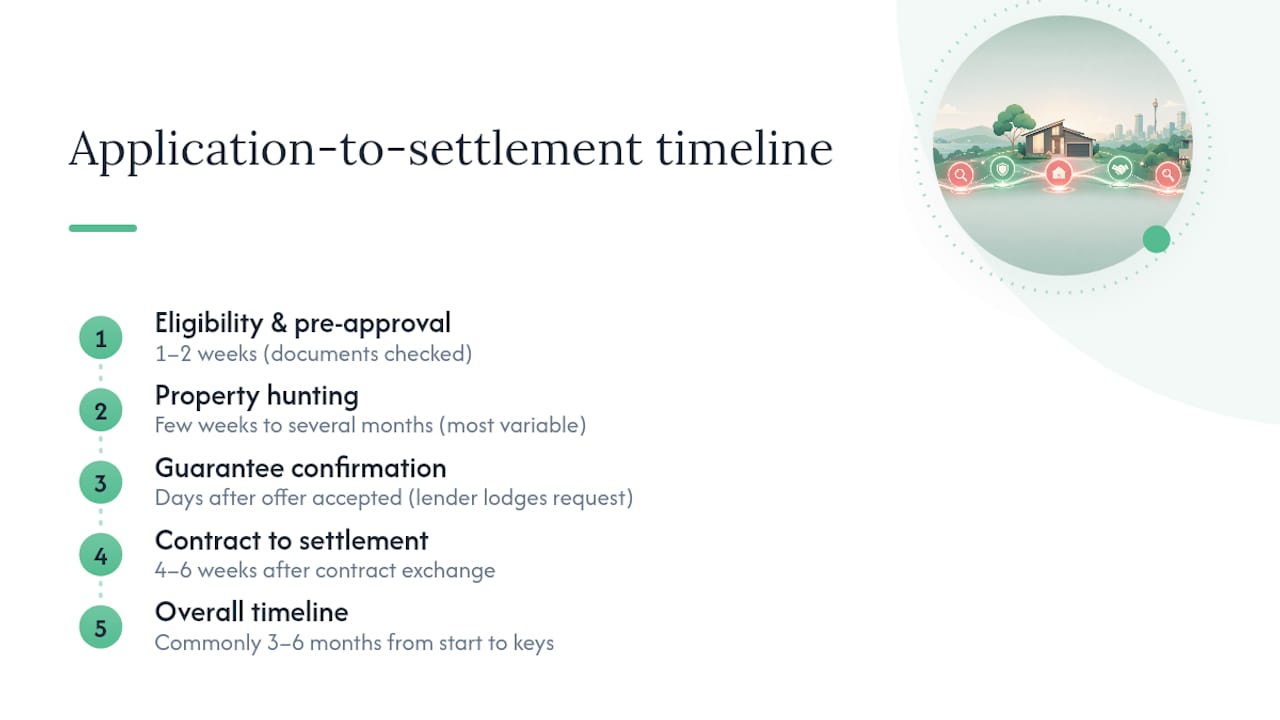
The whole process, from first lender conversation to keys in hand, commonly runs three to six months. Buyers who move fastest tend to have their documents sorted and pre-approval locked in before they start seriously inspecting properties, rather than after.
Common reasons applications get rejected
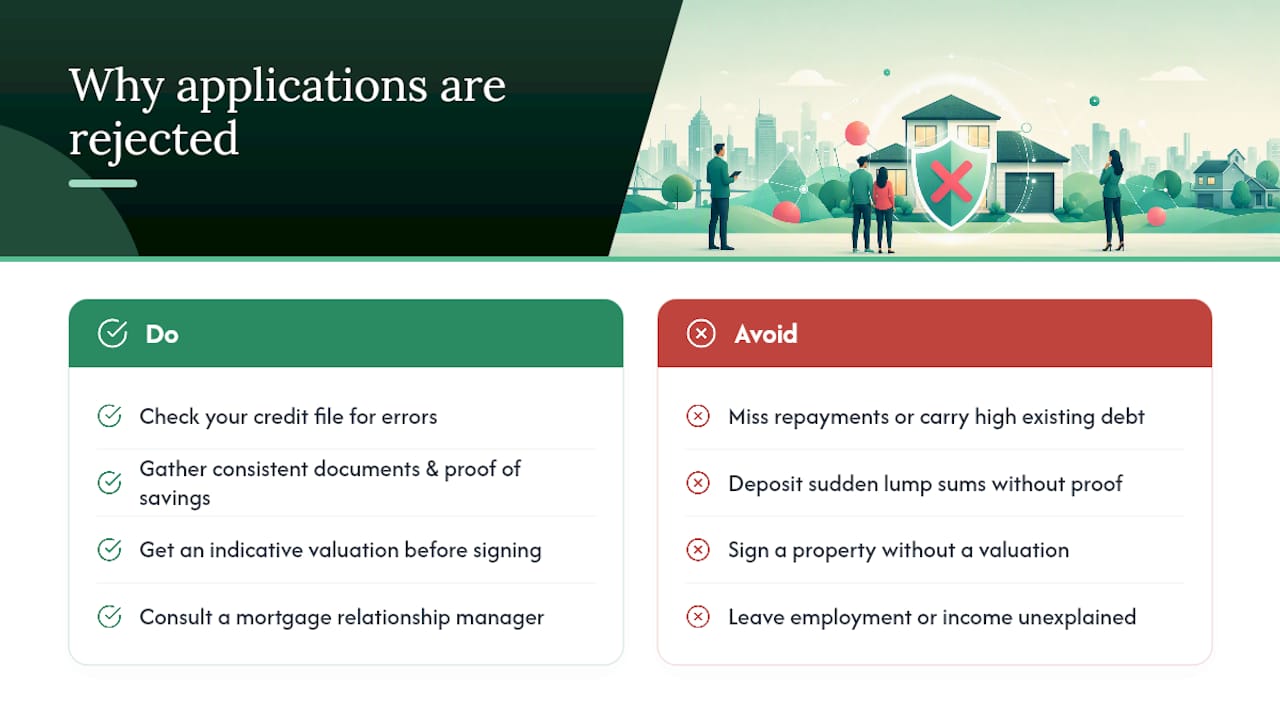
Most rejections trace back to a handful of avoidable issues rather than bad luck. Credit history problems top the list: missed repayments, high existing debt, or a poor credit score can see a lender decline an application even when scheme eligibility is otherwise met.
Insufficient genuine savings is another frequent cause. Lenders want to see savings held over time, not a lump sum that appeared in your account the week before you applied. A sudden deposit from a relative without proper documentation can raise questions rather than answer them.
Property value mismatches cause a specific type of rejection unique to this scheme. If the lender's assessed property value comes in above the price cap for your location, even though your contract price sits under it, your place in the scheme can fall through. This happens more often with properties that have unusual inclusions or sit right at the cap boundary.
Income or employment inconsistencies matter too. Gaps in employment history, recent job changes, or income that doesn't match your Notice of Assessment can all slow or sink an application.
Avoiding these traps starts with getting your documentation clean and consistent before you apply, checking your credit file for errors, and getting an indicative valuation on any property before signing a contract. A mortgage relationship manager can flag these issues before they become rejections rather than after.
Getting your finances in shape before you apply
Preparation makes the difference between a smooth application and a frustrating one. Start with your credit file: request a free copy from a credit reporting body, check for errors, and resolve any outstanding defaults well before you apply. Even small unpaid amounts on old accounts can flag as a problem.
Build your savings history early and keep it clean. Lenders want to see consistent saving patterns over several months, ideally longer, rather than an irregular pattern of deposits and withdrawals. Avoid large unexplained transactions in the months before you apply, since these invite extra scrutiny and can slow approval.
Reduce existing debt where you can. Credit card limits, personal loans, and buy-now-pay-later balances all factor into how much a lender will lend you, even if you don't use them regularly. Closing unused credit cards or reducing limits can improve your borrowing capacity.
Get your paperwork organised well ahead of time: recent pay slips, your latest Notice of Assessment, bank statements, and identification. Having these ready means you can move quickly once you find a property, which matters in a competitive market where other buyers won't have a guarantee slowing them down.
What happens after your loan is approved
Approval isn't the finish line. You take on the same ongoing obligations as any other borrower: making repayments on time, keeping the property insured, and maintaining it as your principal place of residence.
The owner-occupier requirement carries real weight here. If you move out and rent the property within the period specified by your loan terms, you may need to notify your lender, and doing so without informing them can breach your loan conditions. The scheme is built around owner-occupation, not investment, and lenders monitor this.
You're also responsible for keeping up with council rates, strata or body corporate fees where applicable, and general maintenance, all separate from your mortgage repayments. None of these costs are covered by the guarantee, and they don't disappear once you've settled.
If your circumstances change, job loss, income reduction, or unexpected expenses, contact your lender early rather than letting repayments lapse. Most lenders have hardship provisions, but they work far better when you raise concerns before you miss a payment rather than after.
Why the "just use the guarantee" advice misses the point
Most explainers on this scheme stop at eligibility and price caps. That's the easy part.
The scheme is a bridge, not a strategy. It gets you into a property years earlier than saving a full deposit would, and for most first-time buyers watching prices climb faster than their savings, that's worth real money. But the smart move is using that head start to build equity aggressively, extra repayments where you can afford them, avoiding further borrowing in the short term, rather than settling into the minimum repayment for the next decade.
Where conventional advice falls short is treating every participating lender as equivalent. They aren't. Internal policies on credit, savings, and valuation vary enough to change whether you get approved at all. Prioritise finding a lender whose criteria actually fit your situation before you fall in love with a particular property.
— Allen
How ZENRG Finance helps you use the guarantee properly
Comparing lender policies on your own means ringing around banks and hoping you ask the right questions. A mortgage broker can run your numbers across multiple participating lenders to find one whose internal criteria match your savings history, credit profile, and target property, rather than leaving you to discover a mismatch after you've applied.

That matters most at the two points where guarantee applications commonly stall: valuation risk against price caps, and lender-specific credit requirements that sit above the scheme minimums. A broker who works across the panel daily catches these before they cost you a property, not after.
If you're weighing up whether the 5% Deposit Scheme suits your situation, or you want your documents and savings history reviewed before you start inspecting properties, get in touch with a mortgage relationship manager at ZENRG Finance and find out where you actually stand.