
Stamp duty is a government transfer tax charged on property purchases, and for first home buyers in Australia, it represents one of the largest upfront costs you will face. The good news is that most states and territories now offer meaningful concessions or full exemptions specifically for first home buyers, potentially saving you tens of thousands of dollars. These savings depend on your state, the property value, and whether you meet residency and ownership requirements. Understanding how stamp duty concessions work before you sign a contract is the single most effective way to reduce your purchase costs in 2026.
What stamp duty exemptions are available for first home buyers in 2026?
Stamp duty exemptions for first home buyers vary significantly across Australia, and knowing your state's rules is non-negotiable before you buy. The thresholds, caps, and eligibility conditions differ enough that a property purchase in one state can cost you nothing in duty, while the same purchase price in another state attracts thousands of dollars.
Here is a state-by-state breakdown of the current rules:
| State/Territory | Full exemption threshold | Concession up to | Notes |
|---|---|---|---|
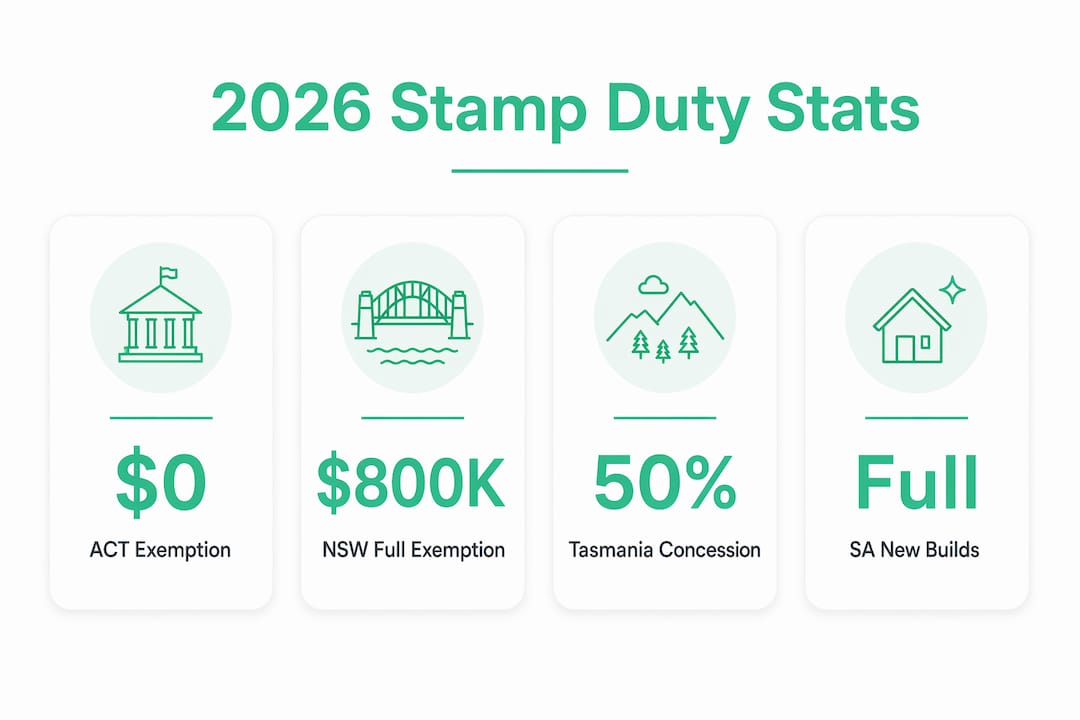
| NSW | $0 duty up to $800,000 | $1,000,000 | Applies to new and established homes |
| VIC | $0 duty up to $600,000 | $750,000 | New builds may attract additional benefits |
| QLD | $0 duty up to $700,000 | $800,000 | Must move in within 12 months |
| ACT | No stamp duty from 1 July 2026 | No cap | No income test or value cap applies |
| SA | New builds only, full exemption | No concession on established homes | Established homes pay full duty |
| TAS | 50% concession up to $600,000 | Expires 30 june 2026 | Temporary measure on established homes |
| WA | $0 duty up to $450,000 | $600,000 | Applies to established and new homes |
| NT | Concessions available | Varies | Contact Territory Revenue Office |
The ACT reform is the most significant change in 2026. From 1 july 2026, the ACT abolishes stamp duty entirely for all first home buyers, with no income test and no property value cap. That is a genuine policy shift that removes a barrier other states have not yet matched.

South Australia stands out for a different reason. New builds receive a full exemption, but buyers purchasing established homes pay full stamp duty with no concession at all. If you are buying in SA, the type of property you choose directly determines whether you pay anything.
Tasmania's 50% concession on established homes valued up to $600,000 is a temporary measure. It was due to expire on 30 june 2026, so buyers in Tasmania should confirm the current status with the State Revenue Office before proceeding.
Pro Tip: Use the Zenrgfinance stamp duty calculator to model your exact liability before you make an offer. A five-minute check can save you from a costly surprise at settlement.
What eligibility criteria must you meet to claim concessions?
Eligibility for first home buyer concessions is not open to everyone. Each state applies a set of conditions, and failing to meet even one of them means you pay full stamp duty.
The common requirements across most states include:
- Age: You must be at least 18 years old at the time of purchase.
- First home buyer status: You must never have owned residential property in Australia or overseas before. This includes properties received as gifts or through inheritance in some states.
- Residency obligation: You must move in within 12 months of settlement and use the property as your principal place of residence.
- Citizenship or permanent residency: Most states require you to be an Australian citizen or permanent resident, though rules vary.
- Property type: Some states restrict concessions to new builds, while others include established homes.
The residency rule is the one that catches buyers off guard most often. Queensland's rules are clear: residency must commence within 12 months of settlement, and the property must remain your principal place of residence. Renting out the property or granting exclusive possession to someone else during that first year triggers a reassessment. You could be required to repay the full concession amount plus penalties.
Leasing part or all of your property within the first year is one of the most common compliance failures. Any lease or exclusive possession granted within 12 months triggers reassessment and possible penalties across multiple states. This rule is strictly enforced, and ignorance is not accepted as a defence.
Pro Tip: If you are buying with a partner or co-buyer, both parties typically need to meet the first home buyer criteria. Check your state's rules on joint purchases before assuming you both qualify.
How do you apply for stamp duty concessions?
Applying for a stamp duty concession is not automatic. Concessions are not applied by default; you must proactively claim them using the correct forms, and the timing matters.
Follow these steps to make sure your application goes through without a hitch:
- Confirm your eligibility early. Check your state revenue office's website before you sign a contract. Eligibility rules can change, and you want certainty before you commit.
- Engage a conveyancer or solicitor. Your legal representative handles the stamp duty forms as part of the settlement process. Conveyancers must actively file for concessions on your behalf. Do not assume they will do this without being asked.
- Complete the correct declaration forms. Each state has its own forms. In Queensland, for example, you sign a transfer duty concession declaration. In NSW, the process is built into the online duties system.
- Submit before settlement. Missing the deadline means losing the concession. Confirm with your conveyancer that the application is lodged and accepted before settlement day.
- Use government calculators to verify your liability. Government self-assessment tools help you model costs accurately before you finalise the purchase. Do not rely on rough estimates.
- Keep records of your application. Store copies of all submitted forms and confirmation receipts. If a dispute arises later, documentation is your protection.
A common mistake is assuming your conveyancer will automatically claim the concession without a specific instruction. Always confirm this in writing at the start of the engagement.
What financial strategies help you manage stamp duty costs?
Even with concessions, stamp duty can still represent a significant cost. Smart planning before you buy makes the difference between a smooth settlement and a financial scramble.
The cliff effect is the most underappreciated risk in stamp duty planning. Paying just above a concession threshold can trigger full stamp duty liability, meaning a slightly cheaper property could actually leave you better off overall. For example, in a state where the full exemption ends at $700,000, a property priced at $705,000 may attract tens of thousands in duty that a $699,000 purchase would not. Always model both sides of a threshold before making an offer.
"The cliff effect creates a stark financial incentive for buyers to carefully evaluate property price brackets before purchase to maximise stamp duty savings." — Moneytools.com.au
Practical strategies to manage stamp duty costs include:
- Factor stamp duty into your savings target from day one. Many buyers save for a deposit but forget to account for stamp duty, conveyancing fees, and building inspections on top of that.
- Explore the First Home Owner Grant (FHOG). The FHOG is a one-off government payment available in most states for eligible first home buyers purchasing new builds. It does not replace stamp duty savings, but it can offset costs. Check your state's current grant amount and eligibility rules through the first home buyer government schemes guide.
- Consider the Home Guarantee Scheme. This federal programme lets eligible buyers purchase with as little as a 5% deposit without paying lenders mortgage insurance. Reducing your deposit requirement frees up cash for stamp duty and other upfront costs.
- Talk to a mortgage broker before you set your budget. A broker can show you how your borrowing capacity interacts with upfront costs. Zenrgfinance works with first home buyers to map out total purchase costs, not just the loan amount, so you go into the process with clear numbers.
- Ask about payment plans. In some states, buyers who cannot pay stamp duty upfront may be able to arrange a payment plan with the state revenue office. This is not widely advertised, but it is worth asking about if cash flow is tight.
Choosing a property just below a concession threshold is one of the most direct ways to reduce your stamp duty bill. It is not about settling for less. It is about understanding the numbers and making a deliberate decision.
Key takeaways
Stamp duty concessions for first home buyers can save you tens of thousands of dollars, but only if you understand your state's rules, meet the eligibility criteria, and actively apply before settlement.
| Point | Details |
|---|---|
| State rules vary significantly | NSW exempts up to $800,000; ACT abolishes stamp duty entirely from 1 July 2026. |
| Concessions are not automatic | Your conveyancer must actively file the correct forms before settlement to claim your concession. |
| Residency rules are strictly enforced | You must move in within 12 months and not lease the property during that period or face repayment. |
| The cliff effect is real | Buying just above a threshold can cost you more overall than buying just below it. |
| Use official calculators | Government self-assessment tools give you accurate cost modelling before you commit to a purchase. |
What I have learned helping first home buyers with stamp duty
The most common mistake I see is buyers treating stamp duty as an afterthought. They spend months researching suburbs and floor plans, then get to settlement week and realise they have not confirmed their concession application or checked whether their property price sits above a threshold.
The ACT reform from 1 july 2026 is genuinely exciting. No stamp duty, no income test, no value cap. That is the kind of policy that changes the maths of buying your first home entirely. If you are flexible on location, it is worth factoring into your decision.
The residency rule is the one I warn every buyer about. Leasing your property within the first year, even a single room, can trigger a full reassessment. I have seen buyers lose their entire concession because they rented out a spare room while travelling for work. The rule exists, it is enforced, and it applies even when the arrangement seems minor.
My honest advice is to start the stamp duty conversation before you start inspecting properties. Know your state's thresholds, confirm your eligibility, and brief your conveyancer on day one. The buyers who get this right are the ones who go in prepared, not the ones who figure it out at settlement.
The first home buyer resources at Zenrgfinance are a good starting point if you want a clear picture of what applies to your situation before you speak to anyone.
— Allen
How Zenrgfinance can help you plan your first home purchase
Buying your first home involves more moving parts than most people expect, and stamp duty is just one of them.

Zenrgfinance works with first home buyers across Australia to map out the full cost of purchasing, from deposit and stamp duty through to ongoing repayments. Our mortgage relationship managers take the time to understand your situation, explain which concessions apply to you, and structure your borrowing so upfront costs do not catch you short. Whether you are still saving or ready to make an offer, getting personalised advice early puts you in a much stronger position. Reach out to the Zenrgfinance team to get a clear picture of your numbers before you commit.
FAQ
What is the stamp duty exemption threshold for first home buyers in NSW?
NSW offers a full stamp duty exemption for first home buyers purchasing properties valued up to $800,000. A tapered concession applies for properties valued between $800,000 and $1,000,000.
Does the ACT still charge stamp duty for first home buyers in 2026?
No. From 1 july 2026, the ACT charges no stamp duty to any first home buyer, with no income test and no property value cap.
Is stamp duty automatically waived for first home buyers?
No. Concessions are not applied automatically. Your conveyancer or solicitor must actively submit the correct forms before settlement, or you lose the concession.
Can I rent out my property after buying it as a first home buyer?
Renting out your property or granting exclusive possession within the first 12 months of settlement triggers a reassessment of your stamp duty concession. You may be required to repay the full concession amount plus penalties.
How do I calculate my stamp duty as a first home buyer?
Use your state revenue office's online calculator or the Zenrgfinance stamp duty calculator to model your exact liability. Government self-assessment tools account for current thresholds and concession tapering so you get an accurate figure before you make an offer.