
Your commercial property loan hinges on one number more than any other: can the property's income sustainably cover its own debt repayments? Lenders call this debt service coverage ratio, or DSCR, and it usually matters more than your personal credit score. Alongside DSCR, you'll need adequate equity in the deal and enough liquid cash sitting in reserve after settlement.
Before you fill out an application, check these three things:
- Serviceability – Does the property's net income comfortably exceed the loan repayments?
- Equity – Do you have enough deposit or existing equity to meet typical loan-to-value ranges?
- Liquidity – Can you show cash reserves left over after settlement, not just enough to scrape through?
Pro Tip: Pull together 12 to 24 months of clean cash-flow figures and a liquidity statement before you approach any lender. It's the single fastest way to move from "maybe" to "approved".
Key Takeaways
Commercial property loan approval depends primarily on the property's DSCR, supported by sufficient equity at the right LVR and proven post-closing liquidity.
| Point | Details |
|---|---|
| DSCR is the core metric | Most lenders expect a minimum DSCR of around 1.25x before approving a loan. |
| LVR varies by property type | Standard commercial deals sit around 65%–80% LVR; special-use assets require more equity. |
| Documentation must be complete | Borrower, business and property documents should be assembled before you approach a lender. |
| Liquidity reserves matter | Lenders commonly want several months of debt service held in reserve after settlement. |
| Pre-packaging speeds approval | ZENRG Finance matches your file to lender appetite and negotiates covenants before submission. |
Table of Contents
- What lenders assess when you apply for a commercial property loan
- Deposit and loan-to-value ratios: how much can you actually borrow?
- Documents needed for your commercial loan application
- How to strengthen your commercial loan application
- Why a broker like ZENRG Finance makes your application stronger
- Application process, timeline and fees to budget for
- Types of commercial property loans and which one fits your deal
- Get your commercial loan application pre-packaged before you submit it
- Frequently asked questions
- Sources
What lenders assess when you apply for a commercial property loan
Commercial lenders underwrite in a fairly consistent order: capacity, capital, collateral, conditions and character, often shorthanded as the five Cs. Capacity, your cash flow, usually carries the most weight, because it answers the only question that really matters to a credit committee: will the repayments get made?
DSCR is where that question gets answered in numbers. Most lenders want net operating income to sit comfortably above the loan repayment, and minimum DSCR thresholds commonly fall within a typical range depending on the property type and loan program. A DSCR of 1.25x means the property generates 25% more income than it needs to cover the loan. That's the buffer lenders want to see before they'll commit.
Beyond the numbers, lenders check:
- Time trading and tax history for your business
- Personal guarantees from directors or principals
- Rent roll, lease lengths and tenant covenant strength
- Independent valuation and, in many cases, an environmental check
Tenant quality carries real weight here. A property leased to a single tenant on a short rolling lease looks very different to a lender than one anchored by a national retailer on a ten-year term, because lease length and tenant covenant strength directly drive both occupancy risk and DSCR.
Pro Tip: If your property is leased, present the rent roll as its own clean document, not buried in a spreadsheet. Lenders read it first.
Deposit and loan-to-value ratios: how much can you actually borrow?
Commercial loan-to-value ratios sit lower than home loans, and they move depending on what you're buying. Standard commercial real estate loans typically land between 65% and 80% LVR, with owner-occupied purchases and some government-backed programs stretching higher.
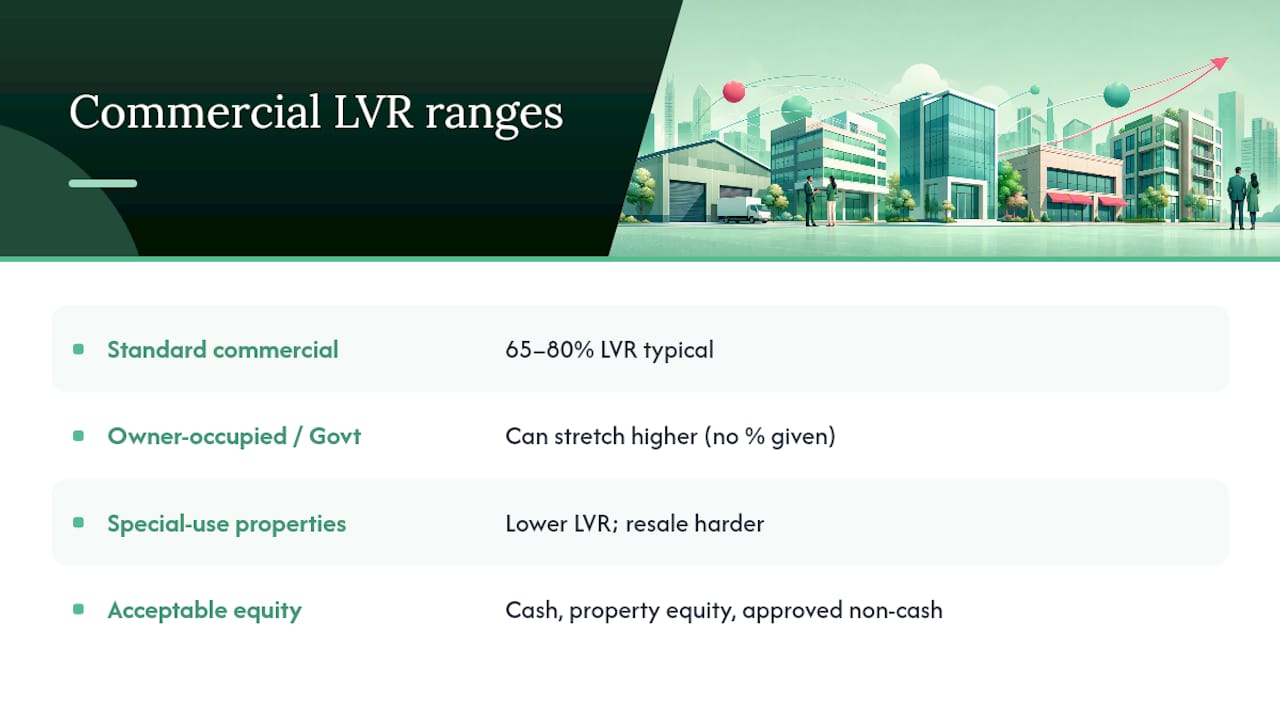
Special-use properties, think childcare centres, service stations, or gyms fitted for one purpose, attract lower LVRs because a limited pool of buyers makes resale harder if the loan ever needs to be recovered.
Acceptable equity sources include cash, equity in an existing property, or approved non-cash contributions. Deals commonly stall when the "equity" turns out to be unrealised paper gains a lender won't count, or a deposit sourced from undisclosed debt.
Documents needed for your commercial loan application
Getting your paperwork in order before you approach a lender speeds up everything downstream. Split your file into three piles.
Borrower documents: personal financial statements, two to three years of personal tax returns, identification, credit authorisation, and a short bio for each principal or director.
Business documents: two to three years of business tax returns, profit and loss statements, balance sheets, year-to-date interim financials, entity formation documents, and a debt schedule listing existing liabilities.
Property documents: the purchase contract, rent roll and copies of current leases, property operating statements, insurance certificates, the most recent council rates or tax notice, title documents, and appraisal instructions.
For larger or development deals, expect to also provide a Phase I environmental site assessment, a survey, construction budgets, or a short business plan explaining use of funds.
How to strengthen your commercial loan application
A few practical moves can shift a marginal file into an approved one, and most cost nothing but time.
- Pay down discretionary business debt before applying, it directly lifts your DSCR and investment returns
- Tighten rent collection processes and secure longer lease terms where you can
- Bring in a co-guarantor or offer additional real estate as collateral
- Prepare "spread" financials, reconciled bank statements, and a one-page executive summary of the deal
- Show 6 to 12 months of post-closing liquid reserves, since lenders frequently expect multiple months of debt service held in reserve as a buffer against vacancies
Pro Tip: Match your package to the lender's appetite before you submit. A file that fits one lender's risk profile perfectly might get rejected by another purely on property type or sector exposure, pre-screening saves weeks.
Why a broker like ZENRG Finance makes your application stronger
A broker's job during underwriting isn't just paperwork. It's matching your deal to lenders whose credit grids you'll actually clear, then packaging the file so it reads the way that lender wants to see it.
- Lender matching based on property type, sector and LVR band
- Pre-packaging documents into the format underwriters expect
- Preparing credit memos and negotiating covenants before formal submission
- Testing your deal against multiple lenders' appetite before you commit to one
ZENRG Finance runs this triage process for commercial and business finance clients, and readers weighing SMSF-held commercial property can also explore self managed super fund lending options through the same process.
Application process, timeline and fees to budget for
Commercial lending typically moves through five stages: pre-screen, full application and documentation, underwriting and credit analysis, credit committee, then conditions and closing.
Pre-screen usually takes a few days once your file is complete. Full underwriting can run two to six weeks, longer if the property needs a fresh valuation or an environmental report. Appraisals and Phase I assessments are standard on most commercial deals and are the most common source of delay.
Budget for:
- Valuation and appraisal fees
- Environmental report costs, where required
- Legal fees for contract review and settlement
- Lender application and administration fees
- Broker commission, typically paid by the lender on settlement
Build in at least a two-week contingency for title or legal issues that surface late.
Types of commercial property loans and which one fits your deal
Not every commercial loan is assessed the same way. Matching your deal to the right category before you apply saves time.
- Owner-occupied commercial mortgage – Approval leans on your business's own cash flow and trading history.
- Investment/commercial real estate loan – Approval leans on the property's rental income and tenant strength.
- Bridging finance – Short-term, higher-cost, used to cover settlement gaps; LVRs are usually tighter.
- Construction or development loans – Assessed on sponsor experience and project feasibility, not existing income.
- Equipment or commercial and industrial (C&I) loans – Assessed on business cash flow, with the asset as security.
- SMSF lending – Assessed against superannuation fund rules and the fund's own serviceability, not personal income.
Special-use properties and construction deals generally attract tighter LVRs than a standard tenanted retail or office asset, property type is one of the biggest swing factors in what a lender will approve.
What most applications get wrong
The weakest files I see share the same fault: they lead with the property's story instead of its numbers. Owners describe location and potential tenants before they've reconciled a single bank statement, and by the time DSCR gets calculated properly, the deal has already lost momentum with the lender. Fix the order. Get your cash-flow figures spread and verified first, then build the narrative around them. If you're not sure your file is underwriting-ready, get it checked before you submit it anywhere.

Get your commercial loan application pre-packaged before you submit it
Most rejections happen at pre-screen, not underwriting, usually because the file wasn't matched to the right lender in the first place. ZENRG Finance runs your deal against multiple lenders' credit grids before you submit anywhere, packages your financials the way underwriters expect, and negotiates covenants on your behalf rather than leaving you to accept whatever terms come back first.

That means fewer conditions attached to your approval and a much shorter path from application to settlement. If you're weighing up a commercial purchase, an investment property, or an SMSF-held asset, start with a conversation through the Mortgage Relationship Manager page and get your file assessed before you approach a lender directly.
Frequently asked questions
What credit score do I need for a commercial property loan? There's no fixed threshold across lenders, but most want a clean credit history from directors and guarantors alongside strong DSCR. Weak personal credit can be offset by strong property cash flow, though it rarely helps your case on its own.
How much deposit do I need for a commercial property loan?
Do I need a personal guarantee for a commercial loan? Most lenders require a personal guarantee from directors or principals, particularly for smaller businesses or newer entities without an extensive trading history.
How long does a commercial property loan take to settle? Once your file is complete, expect two to six weeks for underwriting and approval, longer if a fresh valuation or environmental report is needed.
Can I get a commercial property loan through my SMSF? Yes, though SMSF lending is assessed against the fund's own serviceability rules rather than your personal income. Specialist SMSF lending guidance can help you work out whether your fund qualifies.
This article is general information, not a substitute for advice from a qualified financial advisor. Consult a qualified financial professional about your own circumstances before acting on anything here.
Sources
- Commercial Real Estate Loan Requirements: Credit, DSCR, LTV & Documentation | CapitalXO
- Commercial lending process explained: From application to funding | Cactus
- Commercial Loan Underwriting Process, Step by Step - LenderAnalyzer