
Before you sign up with anyone, verify their licence on ASIC's professional registers and ask for a written fee disclosure upfront. A broker who hesitates on either front isn't the right fit. Beyond that, talk to at least two or three brokers before committing. It won't take long, and it's the single best way to compare service, panel access and cost side by side.
TL;DR:
- Verify your broker's license and ask for a written fee disclosure before proceeding to ensure transparency and compliance with regulations.
- A broker's panel access may not include direct-only lender deals, so confirm whether they truly offer whole-of-market service for the best options.
- Comparing multiple brokers' written quotes allows you to evaluate total costs, service quality, and panel breadth beyond just the advertised interest rate.
- Beware of brokers who pressure you to borrow more, refuse to put costs in writing, or only recommend a single lender without explanation.
- Long-term relationship quality depends on ongoing support and periodic loan reviews, not just the initial interest rate or quick approval.
Table of Contents
- How to choose a mortgage broker: what brokers actually do
- Where do you find a reliable mortgage broker?
- Credentials, panel access and fees: the checks that actually matter
- What should you ask a mortgage broker in the first meeting?
- How do you compare mortgage broker offers fairly?
- Red flags to watch for when choosing a broker
- What to expect: documents, timeline and ongoing service
- How ZENRG Finance approaches the broker relationship
- Potential conflicts of interest and how brokers manage them
- Understanding the different mortgage products a broker can access
- The role of a broker versus going direct to a lender
- How brokers assess your financial situation
- Choosing a broker for the long run
- How ZENRG Finance can help you take the next step
- Sources
- FAQ
How to choose a mortgage broker: what brokers actually do
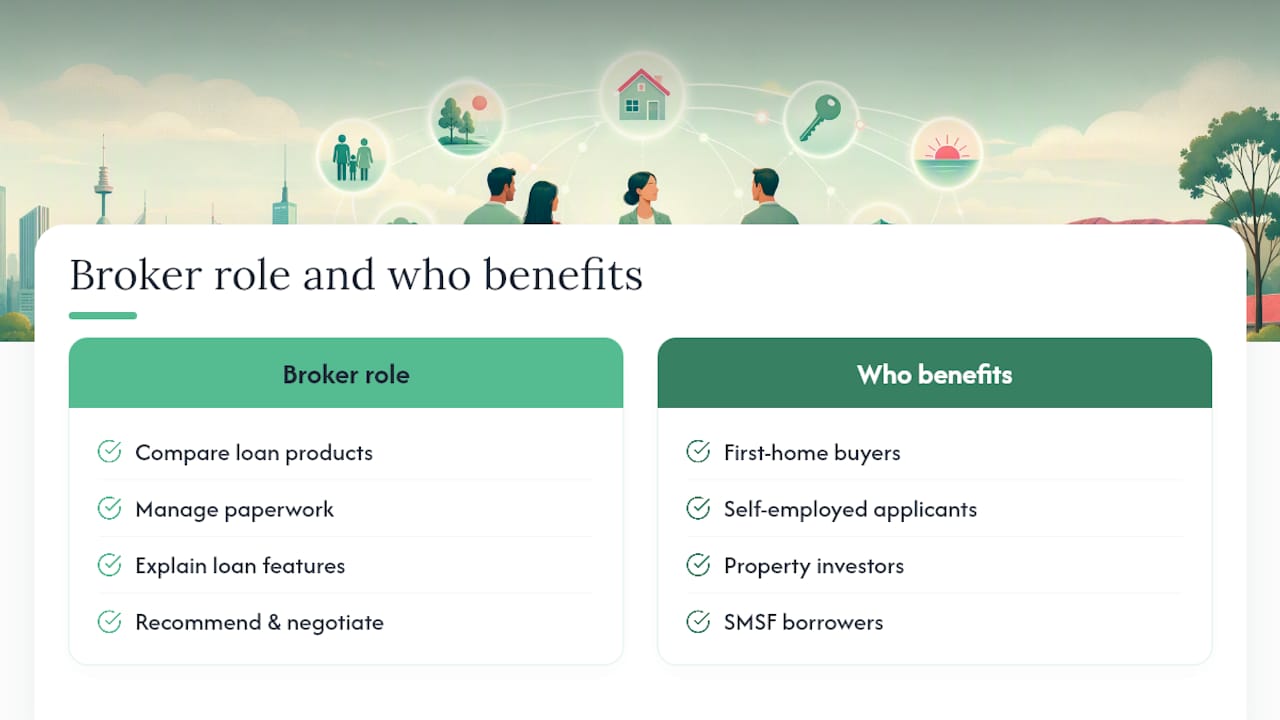
A mortgage broker's job is to sit between you and dozens of lenders, doing the legwork you'd otherwise have to do yourself. That means comparing loan products across multiple banks and non-bank lenders, managing the paperwork trail, and translating loan features (offset accounts, redraw limits, fixed versus variable splits) into plain language you can actually weigh up.
The value shows up most clearly for certain borrower profiles. First-home buyers benefit because brokers know which lenders play nicest with government schemes and low-deposit scenarios. Self-employed applicants benefit because brokers understand which lenders accept alternative income documentation without punishing you for it. Property investors and anyone setting up a Self-Managed Super Fund (SMSF) loan benefit because these structures involve lending rules most bank branch staff rarely handle. Complex refinances, where you're untangling multiple debts or restructuring for tax purposes, are another case where a broker's cross-lender view pays off.
There's a limit worth being upfront about: a broker can recommend, negotiate and package your application, but the lender makes the final credit decision. No broker can override a lender's assessment of your income, credit history or the property itself. What a good broker can do is steer you toward lenders where your profile is more likely to be approved on decent terms, which is a meaningfully different skill from simply filling in forms. If you're still working out whether a broker is the right move at all, it's worth reading through specific scenarios where brokers add real value before you start interviewing.
Where do you find a reliable mortgage broker?
Referrals are still the most reliable starting point, particularly from friends or family who've settled a loan in the last year or two (lending policy shifts often enough that a five-year-old recommendation isn't as useful as it sounds). Real estate agents and conveyancers also see brokers in action regularly and can point you toward ones with a track record of settling on time.
Beyond word of mouth, a handful of channels are worth working through systematically:
- Search the MFAA's accredited broker finder or the FBAA's equivalent tool for brokers accredited in your area.
- Cross-check any name against ASIC's professional registers to confirm an active credit licence or credit representative status.
- Read Google Reviews and Trustpilot patterns rather than star ratings alone. Look for recurring themes (communication speed, follow-through after settlement) rather than one glowing or scathing outlier.
- Check whether the broker's own website lists client resources, guides or explainer content, which usually signals they're used to educating clients rather than rushing them to sign.
Aim to build a shortlist of two to four candidates rather than settling on the first name that comes up. Comparing multiple brokers before making a decision is standard advice from consumer finance sites, and it's borne out by how differently brokers can respond to the same enquiry. Note how quickly each one replies to your first message and how much they ask before offering an opinion. A broker who wants to understand your full financial picture before suggesting a lender is behaving the way Moneysmart's guidance recommends; one who names a lender in the first five minutes is worth treating with caution.
Credentials, panel access and fees: the checks that actually matter
This is the part of the process most borrowers skip, and it's the part that protects you most. Three things need verifying before you go further with any broker: their licence, the real size of their lender panel, and exactly how they get paid.
Licence and Best Interests Duty. Licensed mortgage brokers in Australia operate under a Best Interests Duty, which legally requires them to recommend loans that suit your circumstances rather than whichever pays the best commission. You can check a broker's credit licence or credit representative status directly on ASIC's registers in a few minutes, and it costs nothing. If a broker can't tell you their licence number or credit representative number without checking, treat that as a warning sign rather than an oversight.
What "whole-of-market" really means. Plenty of brokers describe themselves as whole-of-market, but the term gets used loosely. Moneysmart points out that whole-of-market access often doesn't include direct-only lender deals, meaning a handful of cheaper products sold only through a lender's own branches or website simply aren't on the table through any broker. Ask directly: "Does your panel include every lender you deal with, and are there direct-only deals you can't access?" A broker who answers honestly, rather than deflecting, is one worth trusting further.
Fee transparency. Request a written breakdown before you commit to anything. That should cover:
- Commission the broker receives from the lender on settlement (upfront and trailing).
- Any client-facing fees charged directly to you.
- Incentives, bonuses or soft-dollar benefits tied to particular lenders.
Commission structures vary lender to lender, and brokers are required to disclose remuneration before you engage them, so there's no reasonable excuse for vagueness here. Our own breakdown of how broker fees and commissions work is worth a read if the terminology is new to you.
Accreditation and ongoing development. Look for MFAA or FBAA accreditation, which signals a broker has met industry education and conduct standards and keeps up continuing professional development. It's not a guarantee of quality, but it's a baseline most reputable brokers clear easily, and its absence deserves a question.
What should you ask a mortgage broker in the first meeting?
Treat the first meeting as an interview, not a sales pitch. Bring a version of this list and take notes on how each broker answers, not just what they say.
- Are you licensed, and can you give me your credit representative number? A broker should answer instantly, not look it up.
- How many lenders are on your panel, and does that include any direct-only products? This tests whether "whole-of-market" is real or marketing.
- Have you worked with clients in a situation similar to mine (self-employed, investor, SMSF, low deposit)? Specific experience matters more than general years in the industry.
- How are you paid, and can I get that in writing? Push for a written quote covering commission and any fees, not a verbal summary.
- Why this loan and not the alternatives? Canstar's guidance suggests asking a broker to justify their recommendation against at least one other option, which filters out brokers defaulting to the easiest sale.
- What's the expected timeline from application to settlement, and who's doing the legwork on documentation?
- What happens after settlement? Do you offer loan health checks or proactively flag refinance opportunities?
- Have you had any complaints lodged against you, and how were they resolved?
Pro Tip: Ask every broker on your shortlist the exact same eight questions, in the same order, and write down the answers side by side. The differences in how thoroughly they answer question 5 alone will usually tell you more than any online review.
Industry guidance consistently flags that a quality first meeting should feel like fact-finding, not selling. If a broker starts recommending a specific lender before asking about your income, deposit, or goals, that's backwards.
How do you compare mortgage broker offers fairly?
Once you've spoken to two or three brokers, line up their written quotes side by side rather than relying on memory or gut feel. The comparison needs to go beyond the headline interest rate.
- Total cost, not just the rate. Compare the comparison rate (which bundles in most fees), Lenders Mortgage Insurance where relevant, upfront fees and any ongoing account fees across the life of the loan.
- Service quality. Note response times, how clearly each broker explained loan features, and whether they answered your questions directly or vaguely.
- Panel breadth. A broker with 30 lenders on their panel and one with 8 aren't offering the same service, even if their fee structures look identical on paper.
- Perceived conflicts. If one broker keeps steering you toward a single lender without much justification, factor that into your score, not just their fee.
It doesn't need to be scientific, just consistent across every broker you're comparing.
It's also worth getting one direct-lender quote as a sanity check, particularly if a broker's chosen lender happens to be one with a well-known direct-only special. That single comparison can validate whether the broker's recommendation genuinely beats what you'd get walking in yourself.
Red flags to watch for when choosing a broker
Certain behaviours should make you pause, regardless of how friendly or confident a broker sounds on the phone.
- Pressure to borrow more than you're comfortable with, especially without a clear explanation of why a higher limit suits your situation.
- Reluctance to put costs in writing. Verbal reassurances about fees mean nothing if they won't confirm them on paper.
- A single lender recommendation with no comparison offered. Even when one lender genuinely is the best fit, a good broker will explain why it beat the alternatives, not just assert it.
- Recurring negative review themes, particularly around poor communication after the loan settles or unexplained fee surprises.
Borrowers make a few predictable mistakes on their end too. Trusting a single quote without a second opinion is the most common one. Fixating entirely on the headline interest rate while ignoring comparison rate and fees is another. And skipping the licence check because a broker "seems legitimate" is a mistake that takes two minutes to avoid and can save considerable grief later.
What to expect: documents, timeline and ongoing service
The path from first meeting to settlement follows a fairly predictable shape, even though timing varies by lender and complexity.
- Initial consultation and fact-find. The broker gathers your income, expenses, assets, debts and goals. Expect this to take longer than you'd think if it's being done properly.
- Pre-approval. Once your broker has matched you to suitable lenders, they'll submit for conditional approval. This typically takes anywhere from a few days to two weeks depending on the lender.
- Property search and formal approval. Once you've got a property under contract, the broker submits full documentation for unconditional approval.
- Settlement. Final paperwork is signed, funds are released, and the loan settles, usually four to six weeks after signing a contract of sale, though this varies by state and lender.
Documents commonly requested include photo ID, recent payslips or tax returns (especially for self-employed applicants), bank statements covering several months, and a full list of assets and liabilities. Having these ready before your first meeting speeds things up considerably.
The relationship shouldn't stop at settlement. Moneysmart recommends asking brokers about ongoing service, and proactive brokers offer periodic loan health checks to confirm your rate and structure are still competitive as circumstances or the market shifts. Asking about this upfront is a reasonable way to gauge whether a broker is thinking beyond the settlement date.
How ZENRG Finance approaches the broker relationship
A client-centred approach to brokering means going beyond finding a rate and moving on. ZENRG Finance's process starts with understanding your full financial picture, whether that's a first home buyer working out deposit options, an investor structuring a portfolio, or someone navigating SMSF lending, which is genuinely one of the more complex corners of Australian lending.
Every client is paired with a dedicated point of contact who manages the relationship from first conversation through settlement and beyond, rather than handing you off between different staff at each stage. That continuity matters more than most borrowers expect. A broker who understood your situation at application is far better placed to flag a refinance opportunity two years later than someone meeting you for the first time.
For readers who want to go deeper before booking a conversation, ZENRG's insights hub covers topics from interest rate movements to property investment strategy, and the podcast series walks through broker basics in more conversational detail if reading isn't your preferred format. There's also a dedicated conversation on SMSF lending with Francis Choo for anyone weighing up whether a self-managed super fund structure makes sense for their situation. None of this replaces a proper consultation, but it's a reasonable way to arrive at that first meeting with better questions.
Potential conflicts of interest and how brokers manage them
The most obvious conflict in broker lending is commission. Brokers are typically paid by the lender on settlement, not by you directly, which raises a fair question: does that create an incentive to push higher loan amounts or particular lenders?
The Best Interests Duty exists specifically to manage this. It legally obliges brokers to prioritise your interests over their own commission structure, and it's enforceable, not just a guideline. In practice, the way to manage this conflict as a borrower is transparency: ask directly how much commission a broker earns on the loan they're recommending, and whether that figure changes materially between lenders on their panel. A broker with nothing to hide will answer without hesitation.
Soft-dollar incentives (conference trips, bonus payments for volume with a particular lender) are a subtler version of the same issue. These don't have to be disclosed loan by loan, but a reputable broker will tell you plainly if asked whether such arrangements exist. If a broker seems to have a favourite lender that shows up suspiciously often across different client profiles, that's worth probing rather than ignoring.
Understanding the different mortgage products a broker can access
Brokers typically deal in a broader range of products than a single bank branch offers, and knowing the categories helps you ask sharper questions. Variable rate loans move with the market and generally offer more flexible features like offset accounts and unlimited extra repayments. Fixed rate loans lock in certainty for a set period, usually one to five years, but often restrict extra repayments and can carry break costs if you refinance early.
Split loans combine both, letting you fix a portion for certainty while keeping some flexibility on the rest. Interest-only loans, common with investors, reduce repayments temporarily but don't pay down principal during that period. Then there are specialist products: low-deposit loans supported by government guarantee schemes, SMSF loans structured specifically for retirement fund property purchases, and construction loans that release funds in stages as a build progresses.
A broker worth choosing should be able to explain which of these genuinely fits your situation, not just which one their preferred lender pushes hardest.
The role of a broker versus going direct to a lender
Going direct means dealing with one lender's own product range and one lender's own assessment criteria. A broker sits across many lenders at once, which matters most when your situation doesn't fit neatly into a standard box, self-employment, a complex income structure, or a property type some lenders avoid.
The trade-off is that direct-only deals exist precisely because some lenders want to skip paying broker commission, which occasionally means a marginally sharper rate for borrowers willing to shop it themselves. For most borrowers, though, the time saved and the wider comparison a broker provides outweighs chasing that marginal saving alone, particularly on a first purchase.
How brokers assess your financial situation
Before recommending anything, a broker works through your income (including how lenders view irregular or self-employed income), existing debts, living expenses, credit history and savings pattern. This fact-find stage is where a good broker earns their fee, because it determines which lenders will even consider your application, let alone offer competitive terms.
Expect detailed questions about spending habits, not just income. Lenders scrutinise bank statements closely, and a broker who understands this will flag things like frequent buy-now-pay-later use or irregular transfers before a lender does, giving you time to address them.
Choosing a broker for the long run
Picking the right broker matters more than the first interest rate suggests, because loan structure, ongoing service, and future reviews all compound over years, not just at settlement. Run through this before deciding: verify the licence, get fees in writing, compare at least two or three brokers, ask about post-settlement support, and trust your read on how thoroughly they listened before they recommended anything.
— Allen
How ZENRG Finance can help you take the next step
If you've worked through the checks above and want a broker who treats the relationship as ongoing rather than transactional, ZENRG Finance is worth a conversation. A client-centred approach means a dedicated point of contact managing your file from first chat to settlement and beyond, ensuring continuity throughout the process.

Every new client conversation starts with a straightforward fact-find and a written fee disclosure, so you know exactly how the broker is paid before you decide anything. First-home buyers can start with the First Home Buyer Loans page, investors can explore Property Investments, and anyone considering a self-managed super structure can look into SMSF Loans. If refinancing is the goal, the Home Refinancing page is the right starting point. Book an initial consult and get your fee disclosure in writing before you decide on anything.
This article is general information, not a substitute for advice from a qualified financial advisor. Consult a qualified financial professional about your own circumstances before acting on anything here.
Sources
- ASIC: ASIC publishes new regulatory guidance for mortgage brokers (media release)
- Moneysmart: Using a mortgage broker
- Canstar: Top 10 Questions to Ask a Mortgage Broker
- MFAA: Why choose a mortgage or finance broker?
FAQ
Is it cheaper to use a mortgage broker than going direct to a bank?
Usually, yes, because brokers are typically paid by the lender rather than by you, and they can compare rates across many lenders instead of just one. Occasionally a direct-only deal beats what's available through any broker, which is why it's worth asking your broker whether they can access those products too.
What salary do you need for a $500,000 home loan?
It depends heavily on your deposit, existing debts, living expenses and the lender's servicing calculator. A broker can run your specific numbers against several lenders' calculators rather than relying on a single estimate.
How much do you need to earn for a $700,000 mortgage?
As with smaller loans, this varies by lender, deposit size and your other financial commitments. A broker comparing multiple lenders' servicing calculators can give you a more accurate idea for your specific situation.
How much is a $600,000 mortgage monthly?
Monthly repayments depend on the interest rate and loan term, so there's no single fixed figure. Getting a personalised figure from a broker or lender calculator is far more reliable than any general estimate.
How many mortgage brokers should I talk to before deciding?
Speaking with two to three brokers gives you enough basis for comparison without dragging the process out unnecessarily. It's enough to spot meaningful differences in panel access, fees and communication style.
Does ZENRG Finance charge upfront fees?
Fee structures depend on your loan type and circumstances, so ZENRG Finance provides a written fee disclosure before any engagement begins, and current details are available directly on its site.