
Your credit score is one of the first things an Australian lender looks at when you apply for a home loan. It tells them, in a single number, how reliably you've managed debt in the past and how likely you are to keep up with repayments. A strong score opens doors to lower interest rates, more loan options, and better features like offset accounts. A weaker score can push you toward specialist lenders who charge higher fees to offset their risk.
Here's what your credit score actually influences when you apply:
- Loan approval: Lenders use credit reports from Equifax, Experian, and Illion to assess risk and decide whether to approve your application at all.
- Interest rate: Higher scores unlock lower rate tiers. Moving from a "good" score to a "very good" score can save you over $8,000 on a standard 30-year loan.
- Loan features: Access to offset accounts, redraw facilities, and flexible repayment options often depends on meeting a lender's credit threshold.
- Fees and charges: Lower scores funnel borrowers toward products with higher establishment fees and ongoing costs.
- Loan-to-value ratio (LVR): Lenders may require a larger deposit from borrowers with lower scores, reducing how much they'll lend relative to the property value.
Understanding why credit score affects home loan outcomes puts you in a much stronger position before you ever walk into a lender's office.
What is a credit score and how is it calculated in Australia?
A credit score is a number, typically ranging from 0 to 1,200 depending on the bureau, that summarises your credit risk based on the information in your credit report. The three major Australian credit bureaus, Illion, Experian, and Equifax, each calculate scores using their own models, so your number can vary slightly between them.
The main factors that shape your score include:
- Repayment history: Whether you've paid bills, loans, and credit cards on time. This carries the most weight.
- Credit utilisation: How much of your available revolving credit you're actually using. Lower is better.
- Credit age: Older accounts generally help your score because they show a longer track record.
- Account mix: Having a variety of credit types, such as a car loan alongside a credit card, can work in your favour.
- New credit enquiries: Each time you apply for credit, a "hard enquiry" is recorded, which can temporarily lower your score.
Your score isn't static. It shifts as your financial behaviour changes, which means consistent good habits build it over time, and a run of missed payments can drag it down quickly.
What credit score do you need for a home loan in Australia?

There's no single universal minimum, but most Australian lenders want to see a score above 600–620 before they'll consider approving a standard home loan. That gets you through the door. Getting a genuinely competitive rate is a different matter.
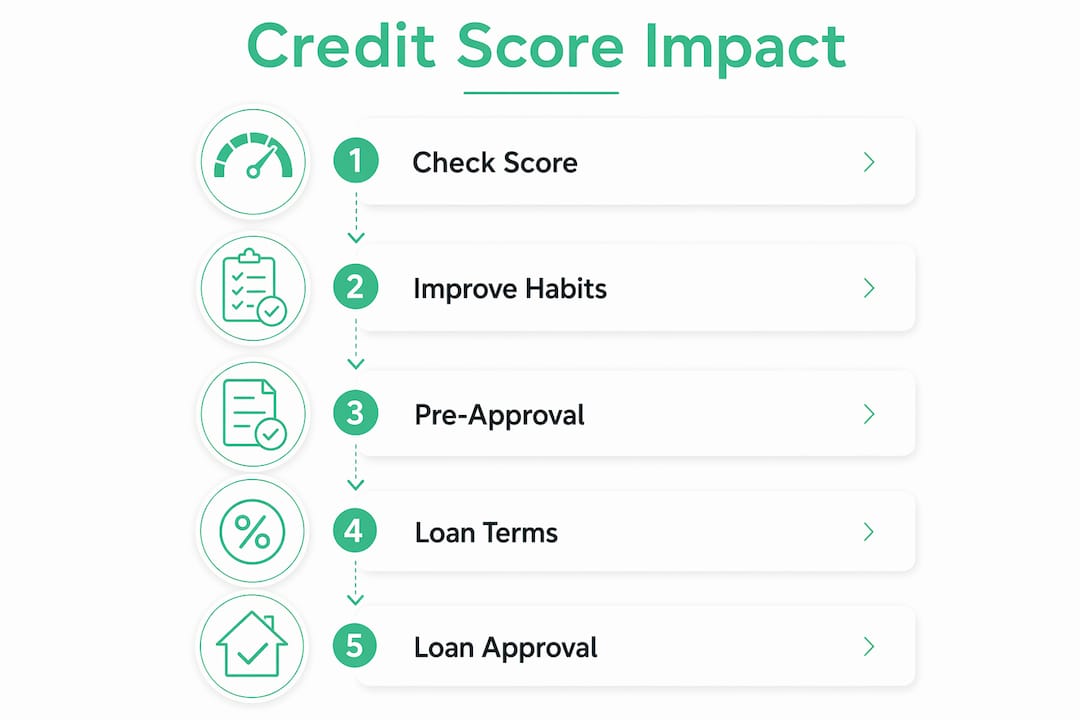
To access the best interest rates, you generally need to be in the "very good" range, which starts around 740–760. Borrowers with higher scores secured notably lower mortgage rates than those with lower scores, translating to substantial savings over the life of a typical loan. The most meaningful jump comes from moving from a "good" score to "very good," resulting in meaningful rate discounts and thousands saved on a standard 30-year loan.
Beyond 760, the gains diminish. Chasing a perfect score past that point delivers little additional rate improvement. The practical goal for most Australians is crossing that 720–740 threshold, not perfection.
Your score also interacts with other factors lenders weigh heavily. A strong credit score alongside a high debt-to-income ratio or a small deposit can still result in a less favourable outcome. Lenders look at the full picture.
How to check and understand your credit score in Australia
Checking your own credit score does not affect it. You can request a free copy of your credit report from each of the three major bureaus: Illion, Experian, and Equifax. Each bureau holds slightly different information, so it pays to check all three rather than relying on just one.
A few things to keep in mind when reviewing your report:
- Look beyond the number: Check for errors in account details, incorrect defaults, or listings that don't belong to you. Errors on your credit report can reduce your score unfairly.
- Don't rely solely on free apps: Credit score app results can differ from the scores mortgage brokers pull, since brokers typically access aggregated data from multiple bureaus.
- Check 6–12 months before applying: Giving yourself this window allows time to dispute errors and gradually improve your position before a lender sees your file.
- Review recent activity: Look for any enquiries you didn't authorise, which could indicate identity theft or an error worth disputing.
Pro Tip: Request your reports from all three bureaus at the same time, then compare them side by side. Discrepancies between bureaus are more common than most people expect, and catching them early can save your application.
Tips to improve your credit score before applying for a home loan
The good news is that your credit score responds to deliberate, consistent action. You don't need to overhaul your finances overnight. Small, targeted moves made months before your application can shift your score meaningfully.
- Pay down revolving balances: Reducing your credit card balances lowers your credit utilisation rate, one of the fastest ways to lift your score. Aim to keep balances below 30% of your available limit, and lower if possible.
- Avoid new credit applications: Applying for multiple new credit products in a short period triggers hard enquiries that reduce your score and may lower your borrowing power right before your mortgage application.
- Fix errors on your credit report: Dispute any inaccuracies with the relevant bureau promptly. An incorrect default listing can cost you points you've legitimately earned.
- Make every payment on time: Payment history carries the most weight in your score calculation. Even one missed payment can set you back significantly.
- Keep older accounts open: Closing a long-standing credit card reduces your average credit age and available credit limit, both of which can nudge your score downward.
- Build a stronger credit file gradually: Consistent behaviour over 12–24 months is more persuasive to lenders than a rapid short-term score jump.
Pro Tip: If you've recently paid down debt or corrected an error, ask your lender or broker about a "rapid rescore." This process can update your credit file with bureaus in days rather than the usual month or two, which is useful if your application timeline is tight.
Expert insights on credit scoring and home loans from Zenrgfinance
The team at Zenrgfinance works with first-home buyers and experienced investors every day, and one pattern comes up repeatedly: borrowers who focus on credit consistency over time get better outcomes than those who try to game their score in the weeks before applying.
Australia's comprehensive credit reporting system means lenders now see far more than a single number. They review your repayment history across all active loans for the past 24 months. A score that climbed quickly after years of patchy behaviour tells a different story to one that's been steadily strong.
Key insights from Zenrgfinance's experience working with Australian borrowers in 2026:
- Lender interpretation varies: Not every lender weights your score the same way. Some prioritise repayment history; others focus heavily on credit utilisation or recent enquiries.
- Your report tells a story: A lender reading your file sees the narrative behind the number, including what caused any dips and whether your behaviour has improved.
- Market conditions in 2026 make preparation more important: With lenders applying tighter serviceability assessments, a strong credit profile gives your application more room to breathe.
- Brokers add value here: A broker who accesses your aggregated credit data across bureaus can identify issues you might miss on a single free report.
The home loan approval process rewards preparation. Starting that preparation 12 months out, not 12 days out, is the single most consistent piece of advice Zenrgfinance offers.
How different lenders interpret credit scores in Australia
Not all lenders read your credit score the same way, and this is one of the most misunderstood aspects of the home loan process. Major banks typically apply stricter internal credit score thresholds and automated assessment models. Non-bank lenders and credit unions often take a more manual approach, weighing your full financial picture alongside the score.

Specialist lenders exist specifically for borrowers with lower scores or complex credit histories. They'll approve applications that mainstream lenders decline, but they price for that risk with higher interest rates and fees. For some borrowers, this is a short-term solution while they rebuild their credit profile. For others, it's a more permanent arrangement worth understanding upfront.
Mortgage brokers have access to multiple lenders and can match your credit profile to the lender most likely to view it favourably. This matters because different credit bureaus report varying information, and brokers use aggregated scores to find the best fit rather than sending your application to a lender whose threshold you narrowly miss.
What your credit report reveals beyond the score itself
Your credit score is a summary. Your credit report is the full story, and lenders read both. Under Australia's comprehensive credit reporting framework, lenders can access your repayment history across all active credit accounts for the past 24 months, not just whether you've defaulted. They see whether you paid on time, how often you were late, and by how much.
This means a borrower with a moderate score but a clean 24-month repayment history can sometimes present better than one with a higher score built on older positive data and recent inconsistency. The report also shows:
- Credit enquiries: Every application for credit in the past five years, including those that were declined.
- Default listings: Overdue debts of $150 or more that were referred to a collection agency.
- Court judgements: Any legal action taken against you for unpaid debts.
- Bankruptcy or insolvency: These stay on your report for several years and significantly affect approval chances.
Checking your report for accuracy is not just about finding errors. It's about understanding what a lender will see when they pull your file.
How recent credit issues affect your home loan approval chances
A default, missed payment, or court judgement from the past year or two will attract far more lender scrutiny than something from five years ago. Recency matters. Lenders interpret recent credit problems as a signal about your current financial habits, not just a historical blip.
Defaults stay on your credit report for five years in Australia. A paid default is viewed more favourably than an unpaid one, but it still shows up. If you have a default on your file, being upfront with your broker or lender about the circumstances, and demonstrating a clear pattern of improved behaviour since, can make a meaningful difference to how your application is assessed.
Missed payments are a softer signal but still count. Lenders assess repayment patterns over 24 months, so a cluster of late payments in the past year will raise questions even if your score hasn't collapsed. The practical advice is straightforward: if you know you're planning to apply for a home loan, treat every bill and repayment as non-negotiable for at least the 12 months leading up to it.
How your credit score affects home loan pre-approval
Pre-approval is where your credit score first meets a lender's formal assessment process. Most lenders run a credit check as part of pre-approval, which means a hard enquiry is recorded on your file. If you're shopping around and applying for pre-approval with multiple lenders in quick succession, those enquiries add up and can lower your score before your actual application is assessed.
A strong credit score going into pre-approval gives you a clearer picture of what you can borrow and at what rate. It also puts you in a stronger negotiating position, particularly in competitive property markets where sellers favour buyers with confirmed finance. Pre-approval with a weaker score is still possible, but the conditional terms may be less favourable, and some lenders may attach conditions around the deposit size or property type.
Working with a broker before seeking pre-approval means your credit profile is assessed once, across multiple lenders, rather than triggering multiple hard enquiries. That's a practical advantage worth knowing about before you start the process.
Common misconceptions about credit scores and home loans in Australia
A few persistent myths trip up Australian borrowers every year. Getting these straight can save you from making decisions based on outdated or simply wrong information.
"Checking my own credit score will hurt it." It won't. Requesting your own report is a "soft enquiry" and has no effect on your score. Only applications for credit trigger hard enquiries.
"A perfect score is the goal." Past 760, the rate improvements become marginal. Chasing 850 when you're already at 780 is unlikely to change your loan offer in any meaningful way.
"My score is the same across all bureaus." Illion, Experian, and Equifax each use different models and may hold different information. Your score can vary between them, sometimes by a noticeable margin.
"Closing old credit cards improves my score." Closing accounts reduces your available credit and shortens your average credit age, both of which can lower your score. Keeping old accounts open, even if you rarely use them, generally helps.
"A low score means I can't get a home loan." It means your options are narrower and likely more expensive. Specialist lenders exist for borrowers with imperfect credit histories, and a broker can help you find the right fit while you work on improving your profile.
"My income will compensate for a low score." Income affects serviceability, not your credit score assessment. A high income with a poor credit history still raises red flags for lenders evaluating repayment reliability. The credit score impact on your application is assessed separately from your earning capacity.
Ready to talk through your credit profile?

Whether you're six months from applying or just starting to think about buying, Zenrgfinance can help you understand where your credit profile stands and what steps will make the biggest difference. The team works with first-home buyers, upgraders, and property investors across Australia, matching each client to the lender and loan structure that fits their situation.
Talk to a mortgage relationship manager at Zenrgfinance today and get a clear picture of your home loan options.
Key takeaways
Your credit score directly shapes your home loan interest rate, approval chances, and access to loan features, making it one of the most controllable factors in your mortgage application.
| Point | Details |
|---|---|
| Score thresholds matter | Most lenders want a score above 600–620 for approval; 740+ unlocks the most competitive rates. |
| Rate savings are real | Moving from the "good" to "very good" score range can save over $8,000 on a standard 30-year loan. |
| Check all three bureaus | Illion, Experian, and Equifax each hold different data; review all three at least 6–12 months before applying. |
| Recent behaviour counts most | Lenders review 24 months of repayment history under comprehensive credit reporting, not just your score. |
| Consistency beats perfection | Stable, reliable credit habits over time are more persuasive to lenders than a rapid short-term score improvement. |