
A property syndicate loan is a financing arrangement where multiple investors pool their capital to collectively acquire real estate assets too large for any single buyer to fund alone. This structure, more formally known as real estate syndication, sits at the intersection of collective investment and property finance. General partners contribute 5–10% equity and manage the deal, while limited partners supply the remaining 90–95% as passive investors. That split is what makes syndication accessible. You do not need millions in the bank to own a slice of a commercial building or a large residential development. You simply need to understand how the structure works before you commit.
What is a property syndicate loan and how does it work?
A property syndicate loan describes the financing layer that sits beneath a syndicated real estate deal. The syndicate itself is the group of investors. The loan is the debt facility the syndicate uses to fund the acquisition alongside pooled equity.
Real estate syndication follows a five-step lifecycle: deal origination, due diligence, capital raising, acquisition and management, and finally the exit phase. Each stage has a distinct role in shaping how the loan is structured and what investors can expect.
- Deal origination. The general partner (sponsor) identifies a target property and assesses its viability. This is where the financing strategy takes shape, including which loan type suits the deal.
- Due diligence. Due diligence typically runs 30–90 days before acquisition. During this window, the sponsor reviews title, zoning, tenancy, and financial projections. Lenders also conduct their own assessments before committing funds.
- Capital raising. The sponsor presents the deal to prospective limited partners via an offering memorandum. Investors commit equity, and the sponsor secures debt financing to cover the balance of the purchase price.
- Acquisition and management. Settlement occurs, the loan is drawn down, and the property enters its management phase. The sponsor oversees day-to-day operations, services the debt, and distributes income to investors.
- Exit. The property is sold or refinanced, the loan is repaid, and remaining proceeds are distributed to investors according to the agreed waterfall structure.
Pro Tip: Read the operating agreement and offering memorandum before signing anything. These documents define your rights, the fee structure, and how profits are split. Skipping this step is the most common mistake new syndicate investors make.
The legal structure typically uses a limited liability company or unit trust, which caps each investor's exposure to their contributed capital. You cannot lose more than you put in.

How do property syndicate loans differ from bank syndicated loans?
Loan syndication in banking is fundamentally different from a property syndicate loan. Confusing the two leads to real misunderstandings about risk, liquidity, and your role as a participant.
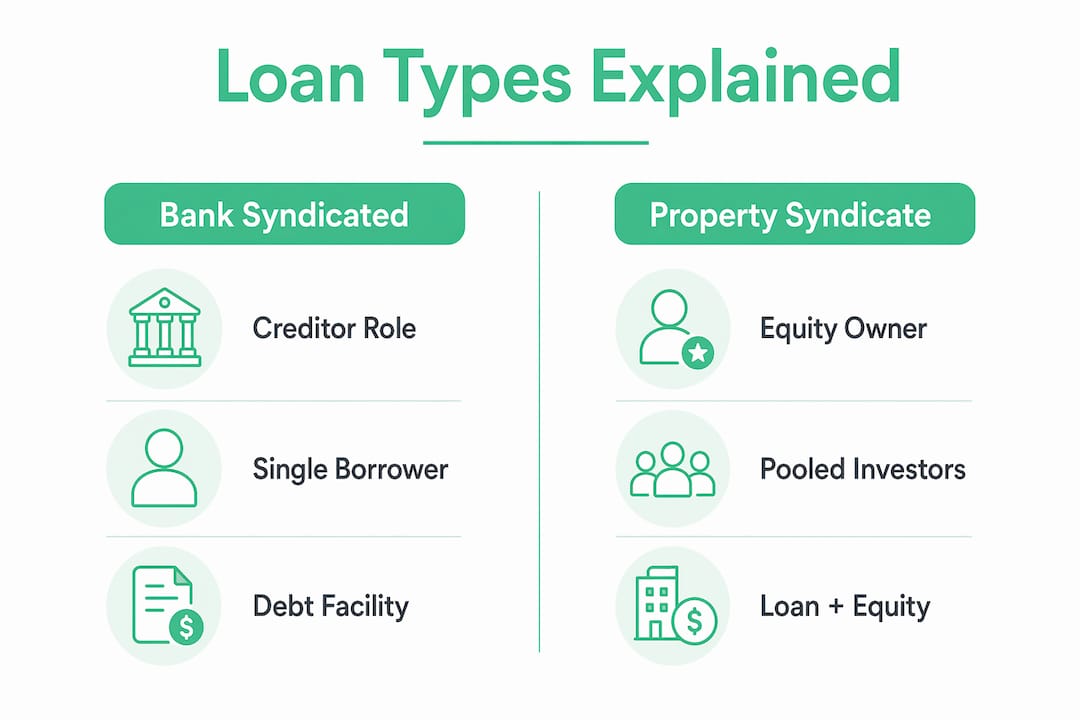
In a bank syndicated loan, multiple lenders share a single large loan to one borrower. Each lender acts as a creditor, earns interest, and holds security over the borrower's assets. The lenders do not own the property. They are owed money.
In a property syndicate, investors are owners, not lenders. You hold an equity interest in the asset. Your returns come from rental income and capital growth, not from interest payments. Debt investors have capped returns; equity investors share both upside and downside. That distinction matters enormously when assessing what you stand to gain or lose.
| Feature | Bank syndicated loan | Property syndicate loan |
|---|---|---|
| Investor role | Lender (creditor) | Owner (equity holder) |
| Return type | Fixed interest | Income distributions and capital gain |
| Return cap | Yes, capped at agreed rate | No cap on upside |
| Risk exposure | Limited to credit default | Full operational and market risk |
| Liquidity | Loan can be traded on secondary market | Generally illiquid until exit |
| Security | Secured against borrower's assets | Equity stake in the property |
Some syndicates do blend debt and equity features through instruments like preferred equity or mezzanine debt, which sit between pure lending and pure ownership. These hybrid structures carry elements of both columns above.
What loan types are used in property syndicates?
Different loan types in syndication serve different purposes in the capital stack. Understanding each one helps you assess how a deal is funded and where your equity sits in the priority order.
- Senior debt. This is the primary secured loan, usually from a bank or non-bank lender. It sits at the top of the repayment priority list. If the deal goes wrong, senior lenders are paid first. Because of this security, senior debt carries the lowest interest rate.
- Mezzanine debt. This fills the gap between senior debt and equity. It is unsecured or subordinated, meaning it gets repaid after the senior lender. Mezzanine lenders charge higher interest to compensate for the added risk. Sponsors use mezzanine debt when senior lending alone does not cover the full acquisition cost.
- Bridge loans. These are short-term facilities used during construction, renovation, or the period before a property stabilises its tenancy. Bridge loans are more expensive than senior debt but give the syndicate time to add value before refinancing into a longer-term facility.
- Preferred equity. This is a hybrid instrument that sits above common equity but below debt in the capital stack. Preferred equity investors receive priority distributions before common equity holders, but they do not hold a mortgage over the property. It behaves like debt in its priority but like equity in its legal form.
Pro Tip: Ask the sponsor exactly where your capital sits in the capital stack. The higher up you are (closer to senior debt), the safer your position. The lower you sit (closer to common equity), the higher your potential return but also your risk.
Understanding the role of debt in syndication structures is not just academic. It directly determines the order in which you get paid and how much you receive if the deal underperforms.
What are the benefits and risks of property syndicate investing?
Property syndication gives individual investors access to larger real estate assets that would otherwise require institutional capital. That accessibility is the primary draw. A $5 million commercial property becomes reachable when 20 investors each contribute $100,000 alongside debt financing.
Key benefits include:
- Access to institutional-grade assets without institutional-grade capital
- Risk sharing across multiple investors rather than one owner carrying the full load
- Passive income from rental distributions without the burden of property management
- Preferred returns of 6–8% annually paid to investors before sponsors take their share of profits
- Portfolio diversification across property types, locations, and deal structures
- Potential for capital growth on exit, distributed according to the waterfall structure
The waterfall structure defines the legal priority of profit payouts. Preferred returns go to investors first. Only after that threshold is met do sponsors receive their profit share. If the deal performs poorly, sponsors may receive little or nothing. That alignment of interests is one of the most investor-friendly features of a well-structured syndicate.
Risks you must understand before investing:
- Illiquidity. Your capital is locked in until the property is sold or refinanced, which can take years.
- Sponsor risk. The deal's success depends heavily on the general partner's competence and integrity.
- Market risk. Property values and rental income can fall, reducing or eliminating returns.
- Operational risk. Vacancies, cost overruns, and interest rate increases all affect performance.
"The risk profile of syndicate deals varies significantly by asset class. Core assets carry low risk with stable returns. Value-add deals carry medium risk as the sponsor works to improve the property. Opportunistic deals carry high risk but offer the highest potential returns. Investors must review the offering memorandum carefully to understand exactly which category their deal falls into."
Protecting yourself also means understanding the legal structure. A well-drafted operating agreement limits your liability to your invested capital. It also defines how disputes are resolved, how the sponsor is compensated, and under what conditions the property can be sold. You can explore property investment financing options to see how syndicate loans compare to other investment loan structures available in Australia.
For investors considering syndicates through a self-managed super fund, the SMSF property lending rules add another layer of complexity worth understanding before you commit.
Life insurance also plays a role in protecting your estate if you hold illiquid syndicate investments. Understanding how life insurance fits into family protection is worth considering alongside any long-term property investment.
Key takeaways
A property syndicate loan is the debt facility that, combined with pooled investor equity, funds a collective real estate acquisition, with investor returns determined by the capital stack position, the waterfall structure, and the sponsor's ability to execute.
| Point | Details |
|---|---|
| Syndicate structure | General partners manage the deal; limited partners contribute 90–95% of equity passively. |
| Loan types matter | Senior debt, mezzanine, bridge loans, and preferred equity each carry different risk and return profiles. |
| Preferred returns | Investors typically receive 6–8% annually before sponsors share in profits. |
| Key risk: illiquidity | Capital is locked in until exit, which can span several years. |
| Due diligence is critical | Review the offering memorandum and operating agreement before committing any capital. |
My honest view on property syndicate loans
I have seen a lot of investors come to syndicates with the wrong expectations. They hear "passive income" and assume it means zero risk. It does not. Passive refers to your operational role, not your financial exposure.
The deals that go wrong almost always share one common thread: investors did not read the documents. The offering memorandum is not a formality. It tells you the asset class, the risk profile, the fee structure, and how the sponsor gets paid. If you skip it, you are flying blind.
The sponsor is everything in a syndicate. A great property in the hands of a poor operator will underperform. A mediocre property managed by an experienced, aligned sponsor can deliver solid returns. I always tell people to spend as much time researching the sponsor as the property itself. Look at their track record, their communication style, and how they handled deals that did not go to plan.
The waterfall structure is your friend when it is set up correctly. Preferred returns to investors first, then profit splits, means the sponsor only wins when you win. That alignment is what separates a well-structured syndicate from one that quietly extracts fees regardless of performance.
My advice: start with a smaller commitment in your first syndicate. Learn how the reporting works, how distributions are paid, and how the sponsor communicates. Then scale up once you have confidence in the structure and the people running it. Listening to practical conversations like the Zenrgfinance investing in property podcast can also help you build your knowledge before you commit.
— Allen
Property syndicate financing: how Zenrgfinance can help
Zenrgfinance works with property investors at every stage of their investment journey, from understanding loan structures to securing the right finance for a syndicate deal.

Whether you are exploring your first syndicate or looking to expand an existing portfolio, Zenrgfinance's mortgage relationship management service connects you with financing options tailored to your situation. The team understands the nuances of investment property loans, including how debt layers within a syndicate affect your overall position. You can also explore the full range of property investment solutions available through Zenrgfinance to find the right fit for your goals. Reach out to Zenrgfinance for personalised guidance on your next property investment move.
FAQ
What is a property syndicate loan in simple terms?
A property syndicate loan is a debt facility used by a group of investors who have pooled their capital to collectively purchase a property. The loan, combined with investor equity, funds the acquisition.
How do investors make money in a property syndicate?
Investors earn returns through rental income distributions and capital growth on exit. Preferred returns of 6–8% annually are typically paid to investors before sponsors receive their profit share.
What is the difference between a syndicated bank loan and a property syndicate loan?
A bank syndicated loan involves multiple lenders sharing a single debt to one borrower. A property syndicate loan involves multiple investors pooling equity to own a property together. One makes you a lender; the other makes you an owner.
How long is capital locked up in a property syndicate?
Hold periods vary by deal type, but most syndicates run for several years from acquisition to exit. Investors should treat syndicate capital as illiquid for the duration of the hold period.
What should I check before joining a property syndicate?
Review the offering memorandum, the operating agreement, and the sponsor's track record. Understanding the risk profile of the specific asset class (core, value-add, or opportunistic) is the most important step before committing capital.