
A cooling-off period is a short, state-governed window that lets you rescind a residential property contract after signing, without losing your full deposit. In Australia, this right is created by state and territory law and applies to most private treaty residential sales. It does not generally extend to mortgage or loan contracts. — once you sign a home loan agreement, you are bound by it.
Here is what you need to know right now:
- Who it covers: Buyers of residential property purchased by private treaty (not auction).
- Typical duration: 3–5 business days depending on your state or territory.
- Penalty to exit: A small percentage of the purchase price or a fixed amount depending on the state.
- Immediate action: If you want to withdraw, serve written notice to the vendor or their agent before 5:00pm on the final business day of the period.
- Loans: No equivalent statutory cooling-off right applies to standard mortgage contracts in Australia.
Table of Contents
- What does a cooling-off period actually cover?
- How long is a cooling-off period in each state?
- What does it cost to exit during the cooling-off window?
- Does a cooling-off period apply to your mortgage or loan?
- How do you actually rescind within the cooling-off window?
- Common mistakes that can cost you the deposit
- What to do before signing so you never need to rely on cooling-off
- Key takeaways
- A broker's honest take on cooling-off periods
- Useful sources and next steps
What does a cooling-off period actually cover?
A cooling-off period is a legal right, created by state and territory conveyancing law, that allows a buyer to walk away from a signed residential property contract within a defined window. The penalty is small compared to losing a full deposit. Think of it as a short pause, not a safety net for sorting out your finances.
Scope is narrower than most buyers expect. The right applies to:
- Residential property sold by private treaty
- Individual purchasers (some states exclude corporations)
- Contracts where no waiver has been signed
It does not apply to:
- Properties purchased at auction (buyers are unconditionally bound once the hammer falls)
- Many commercial property contracts
- Some off-the-plan or tendered sales
- Contracts where the buyer has signed a waiver, such as a section 66W certificate in NSW
In South Australia, the vendor must serve a Form 1 vendor's statement before the cooling-off clock starts. In NSW, the equivalent is a section 66W waiver or a Form 1 attached to the contract. These documents define when your window opens and closes.
Pro Tip: Don't treat the cooling-off period as time to arrange finance. Getting pre-approval before you sign is the only reliable way to protect yourself from a finance shortfall.
How long is a cooling-off period in each state?
Durations and rules vary significantly across Australia. "Business days" excludes weekends and public holidays, and deadlines commonly fall at 5:00pm on the final business day.

| State/Territory | Statutory period | Typical penalty | Auctions excluded? |
|---|---|---|---|
| NSW | 5 business days | 0.25% of purchase price | Yes |
| QLD | 5 business days | 0.25% of purchase price | Yes |
| ACT | 5 business days | 0.25% of purchase price | Yes |
| VIC | 3 business days | $100 or 0.2% (whichever is greater) | Yes |
| SA | 2 business days | No specific statutory penalty | Yes |
| NT | 4 business days | No specific statutory penalty | Yes |
| WA | None | N/A | N/A |
| TAS | None | N/A | N/A |
A few important timing details:
- In NSW, the period starts when contracts are exchanged.
- In QLD, it commonly begins when the buyer receives the signed contract.
- In SA, the clock starts after the Form 1 is served, and expires at the end of the second clear business day.
- WA and TAS have no statutory cooling-off period for residential property — buyers there rely entirely on contract conditions.
Always check the contract schedule or Form 1 for the precise start event in your state. The wording in the document controls the deadline, not a general assumption.
What does it cost to exit during the cooling-off window?
Rescinding during the cooling-off period is not free. The penalty is deducted from your deposit, and the remainder is returned to you.
The 0.25% rule: In NSW, QLD and ACT, the standard penalty for exercising your cooling-off right is 0.25% of the purchase price. On a $750,000 property, that is $1,875 — a relatively small cost compared to proceeding with a purchase you cannot fund.
Here is how the numbers typically work:
- Purchase price: $750,000
- Deposit paid: $37,500 (5%)
- Penalty (NSW/QLD/ACT at 0.25%): $1,875
- Deposit returned to buyer: $35,625
In Victoria, the penalty is a fixed amount or a small percentage of the purchase price, whichever is greater. South Australia and the Northern Territory do not impose a specific statutory penalty, though your contract may include other terms.
One edge case to watch: if your deposit is less than the penalty amount, the vendor may be entitled to pursue the shortfall. Always check the contract terms with a conveyancer before assuming the penalty is your only exposure.
Does a cooling-off period apply to your mortgage or loan?
This is one of the most common points of confusion, and the answer is clear: mortgage and home loan contracts in Australia generally do not carry a statutory cooling-off right equivalent to the one that protects property sale contracts.
Once you sign a loan contract with a lender, you are bound by it. There is no state law that gives you a few business days to change your mind the way property law does for a sale contract.
Some lenders or brokers may include a voluntary withdrawal clause or a pre-contract disclosure period, but these are contractual arrangements, not statutory rights. They vary by lender and product.
Practical implications for you:
- Finalise unconditional finance approval before signing the property contract wherever possible.
- Do not sign a loan contract until you are certain about the terms — review it carefully with your broker or conveyancer first.
- If you are refinancing, note that the US has a federal "right of rescission" for refinances, but Australia has no equivalent statutory right for standard home loan refinances.
Pro Tip: Work with a mortgage broker to get your loan application in order before exchange. That way, the cooling-off period on the property contract is a formality, not a lifeline.
How do you actually rescind within the cooling-off window?
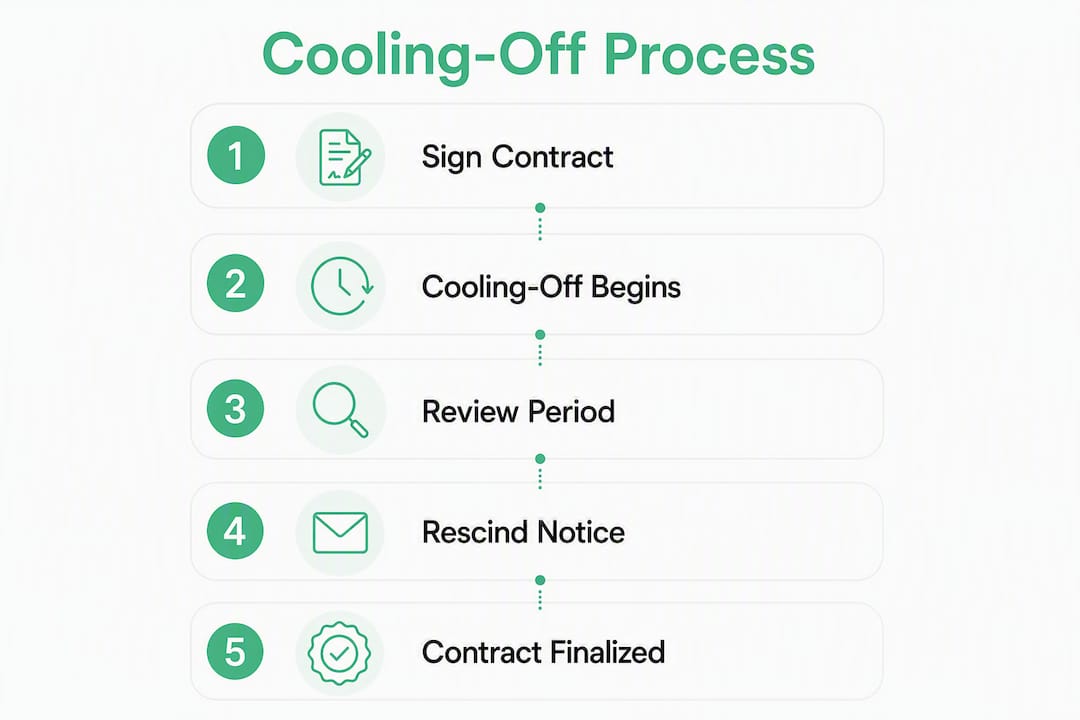
If you decide to withdraw, the process needs to be done correctly. A late or incorrectly served notice is usually treated as no notice at all.
- Check your deadline. Confirm the exact start date from the contract or Form 1, count the business days, and note the 5:00pm cut-off on the final day.
- Prepare written notice. The notice must be in writing and clearly state that you are rescinding the contract. Your conveyancer or solicitor should draft this.
- Serve it correctly. Acceptable methods include in-person delivery to the vendor's agent, registered post, or (where permitted by state law) fax. SA law sets out specific timing rules for when posted or faxed notice is taken to have been given.
- Keep proof of service. Retain a receipt, delivery confirmation, or witnessed copy.
- Wait for deposit refund. The statutory penalty is deducted and the balance returned to you. The contract is rescinded.
The vendor cannot force you to proceed once valid notice is served within the window. However, if your notice is late or defective, the contract may remain on foot and you could forfeit your deposit.
Pro Tip: Always use a licensed conveyancer or solicitor to prepare and serve the rescission notice. A procedural error can cost you far more than the conveyancer's fee.
Common mistakes that can cost you the deposit
The cooling-off period looks like a safety net, but it has real gaps. Here are the traps buyers fall into most often:
- Treating it as finance time. The window is too short to arrange unconditional finance. It is designed for inspections and calm consideration, not loan approvals.
- Signing a waiver without realising it. A section 66W certificate in NSW (or equivalent waivers in other states) removes your cooling-off right entirely. Once signed, the contract is immediately unconditional.
- Bidding at auction. There is no cooling-off period for properties purchased at auction. The moment the hammer falls, you are bound. No exceptions.
- Missing the 5:00pm deadline. Even being an hour late can invalidate your rescission. Courts have upheld forfeiture of deposits where notice was served after the deadline.
- Assuming commercial property is covered. Commercial contracts and some off-the-plan purchases are commonly excluded.
In competitive markets, vendors sometimes pressure buyers to waive cooling-off to make their offer more attractive. The ACT Law Society warns that signing a waiver without completing inspections and confirming finance is a significant risk.
What to do before signing so you never need to rely on cooling-off
The best use of a cooling-off period is not needing it. Here is a practical pre-signing checklist:
Before you sign:
- Obtain lender pre-approval — pre-approval gives you negotiating strength and confirms your borrowing capacity before you commit.
- Commission building and pest inspections before exchange, not during cooling-off.
- Have a conveyancer review the contract and vendor disclosures (Form 1) before you sign.
- Confirm the property is not being sold at auction, which removes cooling-off rights entirely.
Conditional clauses — your real protection:
A "subject to finance" clause gives you a defined period (commonly 14–21 days) to obtain unconditional finance approval. That is far longer than any state's cooling-off window and is specifically designed for loan approval. Understanding the due diligence process in property transactions helps you see why these clauses matter so much.
Sequencing matters:
- Lock in pre-approval with your broker before you start making offers.
- Order building and pest inspections as soon as you identify a property.
- Instruct a conveyancer to review the contract before exchange.
- Negotiate conditional clauses into the contract before signing.
- Only exchange contracts once finance is confirmed or the condition period is in place.
Pro Tip: Zenrgfinance can coordinate your pre-approval and help you understand conditional contract wording before you sign. Reach out via the mortgage relationship manager to get started.
Key takeaways
A cooling-off period protects residential property buyers for a short, state-determined window — it does not apply to mortgage contracts, and relying on it for finance is one of the costliest mistakes a buyer can make.
| Point | Details |
|---|---|
| Applies to property, not loans | Cooling-off covers residential sale contracts; mortgage agreements are generally binding once signed. |
| Durations differ by state | NSW, QLD and ACT allow 5 business days; VIC 3; SA 2; NT 4; WA and TAS have none. |
| Penalty for exiting | Commonly 0.25% of purchase price in NSW, QLD and ACT; $100 or 0.2% in VIC. |
| Auctions have no cooling-off | Buying at auction binds you immediately — no right to rescind after the hammer falls. |
| Pre-approval is the real safety net | Unconditional finance approval before signing removes the need to rely on the cooling-off window. |
A broker's honest take on cooling-off periods
Most buyers come to us thinking the cooling-off period is their backup plan. It is not — and that misunderstanding is where things go wrong.
The window is genuinely useful for a final contract review or a last-minute inspection, but it was never designed to replace proper preparation. Five business days is not enough time to get unconditional finance approval from a lender. If you are relying on cooling-off to sort out your loan, you are already in a difficult position.
What actually protects buyers is doing the work before exchange: pre-approval locked in, a conveyancer engaged, inspections completed, and conditional clauses negotiated into the contract where needed. That sequence gives you real options. Cooling-off just gives you a short window to confirm what you should already know.
At Zenrgfinance, we work with first-home buyers, investors, and business owners to get finance structured correctly before contracts are signed. That includes property investment lending and SMSF lending strategies where the stakes of a misstep are even higher. The cooling-off period is a legal right worth understanding, but the goal is always to not need it.
Useful sources and next steps
For the most accurate and current information on cooling-off rights in your state, go directly to the primary sources:
- Queensland: Queensland Government — buying process and cooling-off — covers duration, penalty and timing rules.
- NSW: NSW Government — buying at auction — confirms auction exemptions and contract obligations.
- SA: Law Handbook SA — cooling-off period — detailed guidance on Form 1 timing and notice methods.
- ACT: ACT Law Society — contract for sale guidance — practical legal advice on waivers and contract terms.
- NSW legislation: Conveyancing regulation — cooling-off provisions — the statutory basis for section 66W waivers and Form 1 requirements.
When you review your contract, check three things: the Form 1 or vendor statement, the clause that defines when the cooling-off period starts, and whether any waiver certificate has been attached.
Pro Tip: If you are unsure about any contract term or deadline, contact a licensed conveyancer in your state before signing — not after. The cost of advice upfront is always less than the cost of a mistake.
This article is general information only and does not constitute legal, financial, or conveyancing advice. Cooling-off rules differ by state and individual circumstances vary — confirm the rules that apply to your contract with a qualified conveyancer or solicitor.