
Refinance settlement is the formal process where your new lender pays out your existing mortgage and registers a new loan in its place, completing the switch. Understanding what does refinance settlement involve helps you avoid surprises around timing, costs, and paperwork. The process includes document preparation, a signing appointment, a mandatory rescission period for primary residences, and final loan funding and registration. It is simpler than a property purchase settlement because no seller is involved, making it a more straightforward transaction for you as the homeowner.
What does refinance settlement involve step by step?
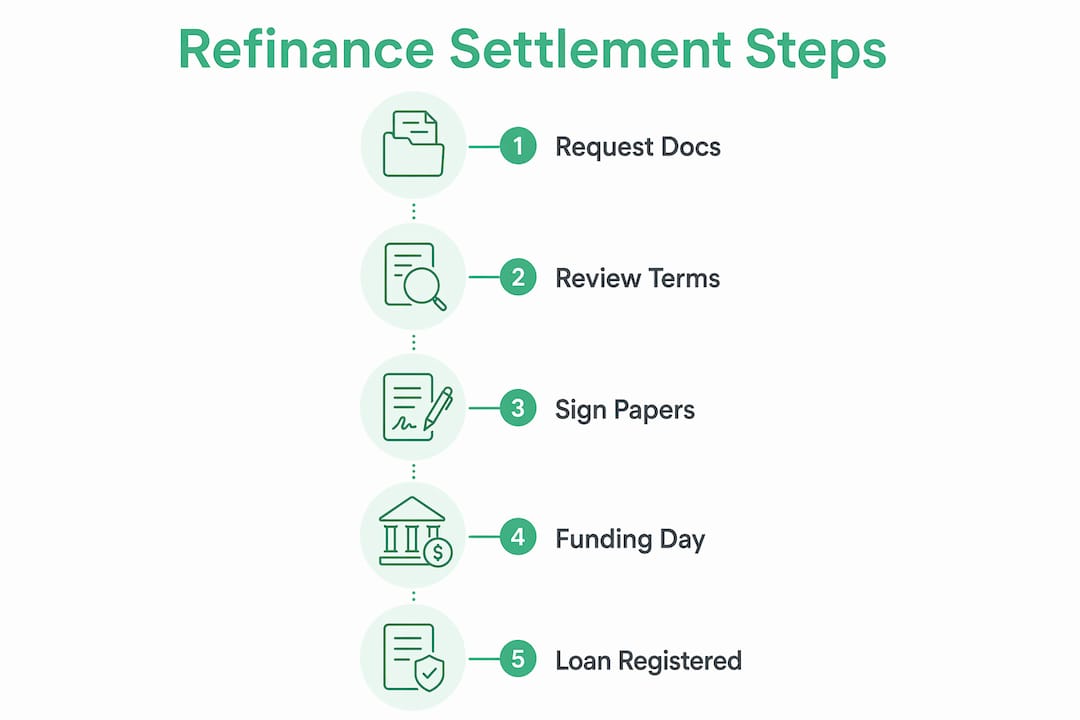
Refinance settlement follows a clear sequence of events, and knowing each step removes the guesswork from the process.
-
Document preparation. Your new lender prepares the loan documents and a settlement statement. These include the Closing Disclosure, the promissory note, the mortgage deed, and a right of rescission notice. You receive these before your signing appointment so you have time to review them.
-
Signing appointment. You attend a signing appointment that typically takes 30–60 minutes. You sign the promissory note, the mortgage deed, and other required documents. You also present government-issued ID and proof of home insurance.
-
Three-business-day rescission period. Federal law in Australia and equivalent consumer protection rules give you a cooling-off window after signing. Federal law mandates a three-business-day rescission period for primary residences, during which you can cancel the refinance for any reason. This period protects you from making a rushed decision.
-
Loan funding. Once the rescission period ends without cancellation, your new lender releases the funds. The settlement agent uses those funds to pay out your old mortgage in full.
-
Mortgage registration. The settlement agent manages the payout and registers the new mortgage with the relevant state land titles office. Your old mortgage is discharged, and the new one is recorded on title.
-
Cash-out disbursement (if applicable). If you refinanced to access equity, any cash-out funds are released to you after the old mortgage is paid off.
Pro Tip: Request your loan documents at least two days before your signing appointment. Reading them in advance means you can ask questions before you sit down to sign, not during.
The distinction between signing day and funding day catches many homeowners off guard. You sign documents on one day, but your loan does not actually fund until after the rescission period. Your old lender does not receive the payoff until funding day, not signing day.

How does the refinance settlement period affect your timeline?
The refinance settlement period is the window between signing your new loan documents and the moment your new loan is fully funded and your old mortgage is discharged. Understanding this period helps you plan your cash flow and avoid confusion about your final payoff amount.
Key things to know about the settlement period:
- The rescission window adds days to your timeline. The three-business-day rescission period means your loan cannot fund on the same day you sign. Plan for at least four to five calendar days between signing and funding when weekends are involved.
- Interest accrues daily on your old loan. Interest accrues daily and is paid in arrears, so the exact funding date directly affects your final payoff amount. A settlement that funds on the 20th of the month costs more in accrued interest than one that funds on the 10th.
- An 'interest gap' can surprise you. Many homeowners find their final payoff amount is higher than their remaining principal balance. The difference is the daily interest that has built up between your last repayment and the funding date.
- Your first new repayment date may feel delayed. Because interest is prepaid at settlement, your first repayment on the new loan is often 30–45 days after funding. This can feel like a payment holiday, but the interest is already accounted for.
- Monthly payment scheduling shifts. The settlement date is organised by your new lender in coordination with your old lender. The timing of that date affects when your first new repayment falls and when your old direct debit should be cancelled.
Pro Tip: Use the split loan calculator at Zenrgfinance to model different funding dates and see how daily interest affects your payoff amount. Even a week's difference can change the figure by hundreds of dollars.
Understanding the settlement period also helps you manage your budget. You may need to cover your old loan's final interest charges and any upfront costs on the new loan at the same time. Planning for this overlap prevents a cash flow pinch.
What documents and parties are involved in refinance settlement?
Refinance settlement is a coordinated effort between several parties, each with a defined role. Knowing who does what helps you stay on top of the process.
Key documents you will sign
- Closing Disclosure. This outlines the final terms of your new loan, including the interest rate, monthly repayment, and all fees. You should receive it at least three business days before signing.
- Promissory note. This is your legal promise to repay the loan under the agreed terms. It is the most binding document you sign.
- Mortgage deed. This gives the new lender a security interest over your property as collateral for the loan.
- Right of rescission notice. This confirms your legal right to cancel the refinance within three business days of signing.
Parties involved in the process
The refinance settlement process involves multiple parties, and coordination among all of them is the key to a smooth, timely outcome.
- Your new lender prepares the loan documents, sets the settlement date, and releases funds after the rescission period.
- Your old lender provides a final payoff figure and discharges the existing mortgage once funds are received.
- The settlement agent or conveyancer manages the exchange of funds, coordinates with both lenders, and lodges the new mortgage with the state land titles office.
- You, the borrower, sign all documents, provide ID and proof of insurance, and arrange any funds due at settlement.
Your solicitor or conveyancer reviews the documents on your behalf before you sign. They check that the loan terms match what was agreed and that no unexpected conditions have been added. Bringing a bank cheque or arranging a wire transfer for any cash due at closing is your responsibility, so confirm the exact amount with your settlement agent the day before.
What are the costs and financial implications at settlement?
Refinance settlement comes with costs beyond your new loan's interest rate. Knowing what to expect prevents last-minute surprises.
| Cost item | What to expect |
|---|---|
| Lender fees and closing costs | Application, valuation, and legal fees; often rolled into the new loan balance |
| Discharge fee (old lender) | A fee charged by your old lender to close the existing mortgage |
| Prepaid daily interest | Interest on the new loan from funding date to month end, paid upfront at settlement |
| New escrow account funding | If applicable, an initial deposit to cover rates and insurance in advance |
| Old escrow refund | Escrow refunds from your old lender typically arrive 2–6 weeks after payoff |
The cash due at settlement is variable. Many homeowners roll closing costs into the new loan rather than paying them upfront, which increases the loan balance but reduces the cash needed on the day. If you choose to pay costs upfront, prepare a cashier's cheque or wire transfer for the exact amount confirmed by your settlement agent.
The timing of your old escrow refund matters. You may need to fund a new escrow account at settlement while waiting weeks for your old one to be returned. This temporary cash outlay is worth factoring into your budget before you commit to a settlement date. Reviewing how refinancing improves cash flow can help you model this overlap and decide whether to roll costs in or pay them separately.
Key takeaways
Refinance settlement replaces your old mortgage with a new one through a structured process involving document signing, a mandatory rescission period, loan funding, and title registration.
| Point | Details |
|---|---|
| Settlement replaces your mortgage | Your new lender pays out the old loan and registers a new mortgage on your title. |
| Rescission period adds time | A three-business-day cooling-off window applies after signing before funds are released. |
| Daily interest affects payoff | Interest accrues on your old loan up to the exact funding date, raising your final payoff figure. |
| Multiple parties coordinate | Your new lender, old lender, settlement agent, and conveyancer all play defined roles. |
| Costs can be rolled in | Closing costs and fees can be added to the new loan balance to reduce cash needed at settlement. |
What I have learned from watching homeowners go through settlement
The single biggest source of stress I see during refinance settlement is not the paperwork. It is the gap between what homeowners expect and what actually happens on funding day.
Most people assume their old loan is paid off the moment they sign. It is not. The three-business-day rescission period means your old mortgage keeps accruing interest for days after you have put pen to paper. When the final payoff figure arrives and it is higher than the principal balance on their statement, homeowners feel blindsided. That figure is not an error. It is the cost of daily interest between their last repayment and the funding date.
The other thing I see consistently is homeowners cancelling their old direct debit too early. They sign, feel like it is done, and stop the automatic repayment. Then the old lender charges a missed payment fee because the loan has not actually been paid off yet. Cancel the direct debit only after you receive written confirmation that your old mortgage has been discharged.
Planning for the interest gap is the most practical thing you can do before settlement. Ask your settlement agent for the projected payoff figure at two or three different funding dates. That comparison tells you exactly how much the timing costs and lets you choose a date that suits your budget. A good mortgage broker walks you through this calculation before you ever sit down to sign.
— Allen
Zenrgfinance is here to guide you through settlement
Refinance settlement has moving parts, and the timing decisions you make can affect your costs and cash flow more than most homeowners realise.

Zenrgfinance pairs you with a dedicated mortgage relationship manager who coordinates with your old and new lenders, explains every document before you sign, and helps you choose a settlement date that works for your budget. From calculating your final payoff figure to managing the discharge of your old mortgage, Zenrgfinance handles the detail so you can focus on what comes next. Use the loan comparison calculator to compare your current loan against refinancing options, then book a personalised consultation to get the process moving.
FAQ
What does the refinance settlement period mean?
The refinance settlement period is the time between signing your new loan documents and the date your new loan is funded and your old mortgage is discharged. It includes the mandatory three-business-day rescission period for primary residences.
How long does refinance settlement take?
The signing appointment takes 30–60 minutes, but the full settlement period from signing to funding takes at least three business days due to the rescission window. Total time from loan approval to settlement is typically two to four weeks.
What documents do I sign at refinance settlement?
You sign the Closing Disclosure, promissory note, mortgage deed, and right of rescission notice. You also provide government-issued ID and current proof of home insurance.
Why is my final payoff amount higher than my loan balance?
Interest accrues daily on your old loan and is paid in arrears. The payoff figure includes all interest that has built up from your last repayment to the exact funding date, which is why it exceeds your principal balance.
Can I cancel a refinance after signing?
Yes. Federal consumer protection rules give you three business days after signing to cancel the refinance for any reason without penalty. After that window closes, the loan funds and the cancellation right expires.