
The bigger story for 2026 is regulatory, not just financial: from 10 August 2026, new limited recourse borrowing arrangements for residential property are off the table unless the property meets the business real property test. Beyond the deposit itself, you'll need cash for stamp duty, legal costs and a liquidity buffer, so budget for more than the headline percentage suggests.
TL;DR:
- Borrowing arrangements for residential property through SMSFs will be prohibited from August 10, 2026, unless the property qualifies as business real property.
- Lenders typically require a deposit of 20–30% for residential properties, 25–35% for commercial properties, and often set more conservative LVRs for regional or less liquid assets.
- Trustees must prepare detailed documentation, including audited financial statements and cash flow projections, and allow 6 to 12 weeks for approval and set-up processes.
- Costs beyond the deposit, such as stamp duty, legal fees, valuation charges, and ongoing property expenses, can significantly add to the initial cash needed.
- The size of the deposit impacts fund risk management, liquidity buffers, and diversification, requiring careful planning based on the fund’s total assets, age, and investment strategy.
Table of Contents
- What deposit and LVR can an SMSF expect?
- How do lenders assess SMSF deposits and loan applications?
- What upfront and ongoing costs sit on top of the deposit?
- What's the settlement checklist trustees should work through?
- What compliance risks and lender restrictions should trustees watch?
- How can trustees source and build the SMSF deposit?
- What tax implications apply to funding the deposit?
- How does deposit size shape the fund's investment strategy?
- What does ZENRG Finance see trustees get wrong most often?
- How ZENRG Finance can help with SMSF lending
- Sources
What deposit and LVR can an SMSF expect?
Lenders price SMSF property loans differently depending on whether the fund is buying a house, a unit, or a commercial premises, and the gap between the two is wider than most first-time trustees expect.
- Residential property: typically 70–80% LVR, meaning a deposit of 20–30%. On a $700,000 property, that's a deposit of $140,000 to $210,000 before you account for costs.
- Regional or less liquid property: lenders often drop the LVR further, pushing the deposit closer to 30–35%, because resale risk under a limited recourse arrangement sits with the lender.
These are bands, not promises. Every SMSF gets underwritten on its own merits, and the LVR a lender quotes on its website is rarely the LVR it offers once it has seen your fund's balance, cash flow and structure. Treat the top of each range as the number to budget for, and any lower deposit as a pleasant surprise rather than an expectation.
How do lenders assess SMSF deposits and loan applications?
A lender assessing an SMSF loan isn't assessing you personally. It's assessing the fund: its balance, its income streams, its liquidity, and whether it can service the loan without leaning on member guarantees it isn't legally allowed to rely on. That shift in focus catches a lot of trustees off guard.
Expect to provide:
- Audited financial statements, usually the last one to two years
- Cash flow projections showing rental income and contribution flow
- Evidence of existing liquid assets held inside the fund
- The trust deed and any bare trust or holding trust documentation
- Details of the corporate trustee structure, where one is used
Lenders are pricing in more caution. Serviceability buffers of 1.5–2.0% above the offered rate are now common, and SMSF loans typically carry an interest premium of 0.75–1.50% over an equivalent loan held in a personal name.
Loan terms and minimum loan sizes also shape what deposit you'll need. Shorter terms increase repayments and can force a lender to demand a bigger deposit to keep serviceability within its buffer. A fund with a corporate trustee and clean, well-documented accounts tends to get closer to the advertised LVR than one running an individual trustee structure with patchy records.
What upfront and ongoing costs sit on top of the deposit?
The deposit is rarely the only cash the SMSF needs at settlement. Trustees who forget this end up scrambling in the final weeks before completion.
- Stamp duty, which varies by state and typically runs 3–5.5% of the purchase price. Get a state-specific estimate early, because duty is often the single largest non-deposit cash requirement.
- Legal fees, generally $2,000 to $5,000 for reviewing contracts and setting up the borrowing arrangement correctly.
- Bare trust (holding trust) establishment, usually $500 to $1,500, plus the ongoing cost of maintaining that structure.
- Valuation fees, charged by the lender or an independent valuer before approval is finalised.
- Ongoing costs including annual audit, accounting, council rates, landlord insurance and property management, all of which must be paid from fund assets, not personal accounts.
On top of all that, keep a liquidity buffer.
What's the settlement checklist trustees should work through?
Getting from "I want to buy through my SMSF" to a settled property takes longer than most trustees expect, mostly because the paperwork chain has several dependencies.
- Check the trust deed for explicit borrowing powers, and amend it if the wording is outdated or silent on limited recourse borrowing.
- Confirm deposit and acquisition funds sit in the SMSF's own bank account. Using a related-party loan to plug the deposit is possible but needs careful structuring to avoid compliance issues.
- Assemble audited financials and cash flow projections that demonstrate serviceability to a lender's satisfaction.
- Instruct a solicitor and order a valuation early, and get the bare trust deed drafted in parallel rather than after finding a property.
- Allow 6 to 12 weeks for the LRBA setup and lender approval process to run its course.
Pro Tip: Start the bare trust paperwork the same week you start property hunting, not after you've signed a contract. Trustees who begin the document chain 8 to 12 weeks out from expected settlement rarely need bridging finance to cover a documentation gap.
Zenrgfinance coordinates this timeline for SMSF trustees so the lender, solicitor and adviser workstreams run at the same pace instead of stalling one another.
What compliance risks and lender restrictions should trustees watch?
Two rules trip up more trustees than any other part of SMSF borrowing. The sole purpose test requires every investment decision to serve the fund's retirement purpose, not a member's personal benefit, and any hint of non-arm's-length pricing or terms can trigger non-arm's-length income (NALI) consequences that are taxed punitively. The "no major alterations" rule under a limited recourse borrowing arrangement also means you generally can't change the character of the asset, through development or subdivision, while the loan remains outstanding.
New limited recourse borrowing arrangements for residential property are not permitted from 10 August 2026 unless the property meets the business real property test. Existing arrangements that were compliant before the change remain unaffected.
This is the single biggest shift trustees need to plan around this year. If you were counting on an LRBA to fund a residential purchase and haven't locked in terms before the cutoff, a business real property structure or a commercial purchase becomes the realistic path forward. Keep meticulous records, use arm's-length contracts for every transaction, and get advice before signing anything unusual. Related reading on ZENRG Finance's analysis of the restriction walks through the practical fallout in more detail.
How can trustees source and build the SMSF deposit?
Most SMSF deposits come from a combination of three sources, and getting the mix right takes planning well before you start looking at properties.
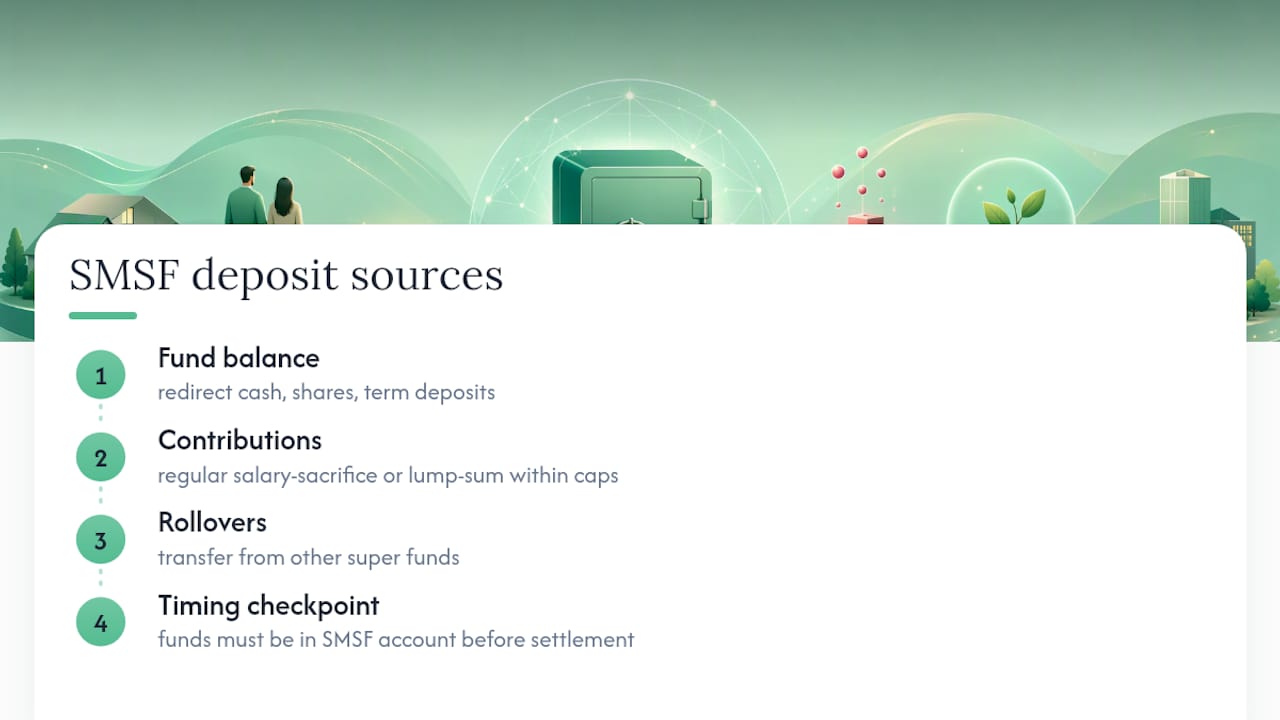
Existing fund balance is the obvious starting point. If the SMSF already holds cash or liquid assets like shares or term deposits, those can be redirected toward the deposit, provided the fund still keeps enough liquidity for ongoing costs and its investment strategy.
Concessional and non-concessional contributions build the deposit over time. Regular salary sacrifice or personal deductible contributions, within the contribution caps, steadily grow the fund's cash position ahead of a purchase. Some trustees time a lump sum non-concessional contribution, such as proceeds from selling a personal asset, to bring the deposit together faster, though this needs to respect cap limits and bring-forward rules.
Rollovers from other superannuation funds are another common lever, particularly for trustees consolidating multiple accounts into the SMSF before a purchase. This can meaningfully boost the fund balance without touching personal cash flow at all.
Whichever combination you use, the money must land in the SMSF's own bank account before settlement, not sit in a member's personal account and get transferred at the last minute. Lenders and auditors both want to see a clean paper trail showing the deposit built up through legitimate, timed contributions or asset sales, not a scramble in the final fortnight.
What tax implications apply to funding the deposit?
Building a deposit through contributions has real tax consequences that trustees often overlook until it's too late to fix them.
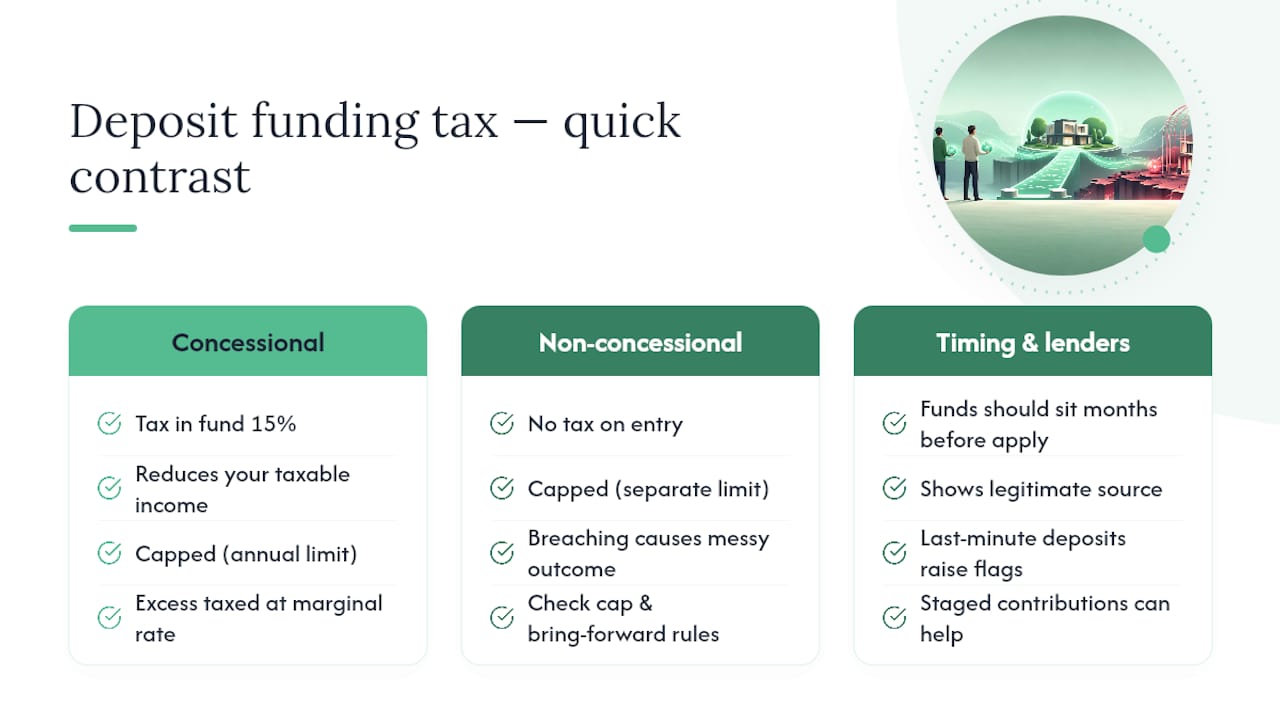
Concessional contributions, including salary sacrifice and personal deductible contributions, are taxed at 15% inside the fund but reduce your personal taxable income. Exceeding the concessional cap means the excess gets added to your assessable income at your marginal rate, with an additional charge, so timing large contributions across financial years can matter if you're close to the limit.
Non-concessional contributions aren't taxed going in, but they're capped too, and breaching that cap creates a genuinely messy tax outcome that's far easier to avoid than to unwind. If you're planning to use a lump sum, non-concessional contribution to fund part of the deposit, check the cap and any bring-forward provisions before the money moves, not after.
Timing also affects your loan application. Lenders typically want to see deposit funds settled in the SMSF account for a reasonable period before applying, both to demonstrate the source is legitimate and to avoid any appearance the contribution was engineered purely to satisfy a lender's checklist at the last minute. A deposit that lands in the account the week before you apply raises more questions than one that's been sitting there for a few months.
How does deposit size shape the fund's investment strategy?
The size of the deposit you put down does more than determine whether a lender says yes. It reshapes how much risk the rest of the fund carries.
That leaves more headroom for the liquidity buffer and reduces the risk that a vacancy or a rate rise forces an unplanned asset sale, highlighting key property investment risks trustees should consider. It also means less of the fund's total balance is tied up in a single, illiquid property relative to the SMSF's other investments, which matters for diversification under the fund's investment strategy.
A smaller deposit preserves more cash inside the fund for other purposes, but it increases loan repayments, tightens the liquidity buffer, and concentrates more of the fund's overall risk in one property purchased with borrowed money. If that property underperforms or a tenant defaults, a highly geared SMSF has far less room to absorb the hit than one carrying a bigger equity stake from day one.
There's no universally correct deposit size. The right figure depends on the fund's total balance, the member's age and time horizon, and how much of the SMSF's assets you're comfortable concentrating in property. A fund with a $1.2 million balance putting $300,000 into a $750,000 property is in a very different risk position to a fund with a $500,000 balance doing the same deal.
What does ZENRG Finance see trustees get wrong most often?
The mistakes we see repeating aren't exotic. Trustees underestimate liquidity buffers, assume an old trust deed already permits borrowing, and budget for the deposit while forgetting stamp duty and legal costs sitting on top of it. Each one is avoidable with earlier preparation.
The bigger value in working with a broker isn't finding a lender, it's coordinating the lender, the solicitor and the adviser so nobody's timeline stalls someone else's. That coordination is where settlement risk actually gets managed down, and it's the difference between a smooth 8 to 12 week process and a stressful scramble against a contract deadline.
— Allen
How ZENRG Finance can help with SMSF lending
Getting an SMSF loan deposit right takes more than knowing the percentages. It means having your trust deed checked, your accounts audit ready, and a lender lined up who actually understands SMSF structures rather than treating your application like a standard investment loan. That's the gap this service can help close.

A SMSF lending strategy session gives you a clear read on how much deposit your fund can realistically put together, which lenders are likely to say yes, and what documentation gaps need fixing before you make an offer on a property. From there, Zenrgfinance coordinates the loan broking, liaises with your solicitor on the bare trust paperwork, and keeps the lender's timeline moving so that a 10 to 12 week settlement window doesn't turn into a 20 week ordeal. If commercial property is more your fund's fit than residential, the same team can also walk you through commercial property loan requirements and how they differ. Book a strategy session and find out where your fund actually stands before you sign anything.
This article is general information, not a substitute for advice from a qualified financial advisor. Consult a qualified financial professional about your own circumstances before acting on anything here.
Sources
- Moneysmart — SMSFs and property
- SMSF property borrowing market update (Salfbase)
- WealthWorks — SMSF LRBA guide 2026