
Yes, your SMSF can still get a property loan, but the rules shifted hard on 10 August 2026. New limited recourse borrowing arrangements can now only fund business real property, not residential homes or apartments. If your fund already had an LRBA running, or you exchanged contracts before that date, you're grandfathered and can generally still refinance. Everyone else needs a different playbook, which this guide sets out.
TL;DR:
- New LRBA rules after August 10, 2026, restrict SMSF borrowing to business real property, excluding residential homes unless contracts were exchanged beforehand.
- Existing arrangements and contracts exchanged before the cutoff can generally be refinanced, but trustees must verify dates and seek specialist advice first.
- To qualify as business real property, assets must be used solely and continuously for a legitimate business, with strong evidence required for borderline cases.
- Lenders for SMSF property loans typically require lower loan-to-value ratios and cash buffers, with interest-only periods up to five years, but market options are now more limited.
- Trustees should prioritize property classification and documentation over financing, and consult specialists to navigate the shrinking pool of lenders actively servicing SMSF property loans.
Table of Contents
- What changed on 10 August 2026: the ATO's LRBA rule change and who it affects
- What counts as business real property?
- How does an SMSF property loan actually work?
- What do lenders look for in an SMSF loan application?
- What will an SMSF property loan cost you?
- What are the biggest risks with SMSF property lending?
- Where does ZENRG Finance fit into your SMSF lending journey?
- Where can you check the official rules yourself?
- Why the 10 August 2026 change is the detail everyone's missing
- Get your SMSF lending sorted with ZENRG Finance
- Sources
What changed on 10 August 2026: the ATO's LRBA rule change and who it affects
The Australian Taxation Office's rule change is specific: any new limited recourse borrowing arrangement used to acquire real property, entered into on or after 10 August 2026, must be for business real property. Residential investment properties are off the table for new LRBAs from that date forward.
If your fund's LRBA was already in place, or you'd exchanged contracts before 10 August 2026, you're grandfathered. That means the existing arrangement can continue, and refinancing is generally possible, though the ATO advises getting tailored advice before you touch the structure.
For trustees who'd been eyeing a residential property purchase through their fund, this closes that door for anything not already locked in. What you can still do:
- Buy business real property (commercial premises, warehouses, farms used in a business) through a new LRBA
- Refinance a pre existing residential LRBA if the contract predates 10 August 2026
- Purchase residential property in the SMSF outright with fund cash, without borrowing
- Check your exact contract exchange date against the cutoff before assuming either way
The first practical step for anyone still weighing this up is simple: check your paperwork dates and talk to an SMSF specialist before signing anything.
What counts as business real property?
The ATO's test is "wholly and exclusively" used in one or more businesses, and that status has to be maintained for the entire life of the loan. Slip out of business use at any point, even years into the arrangement, and you risk breaching the conditions attached to the arrangement.
Typical qualifying assets include:
- Warehouses, factories and industrial sheds
- Commercial office suites and retail shopfronts
- Farms and rural land used for a genuine primary production business
- Medical, dental or allied health practice premises
Related-party leasing is allowed, but only at market rent, properly documented. A dentist leasing their own surgery from their SMSF at a mate's-rates figure is exactly the sort of thing that draws ATO attention.
Borderline cases cause the most grief. A residential looking cottage used as a bed and breakfast, or a converted house used purely as consulting rooms, can qualify, but you need evidence: lease agreements, business registration, floor plans showing commercial fit out, and a paper trail proving the use is genuine and continuous.
Pro Tip: Get an independent valuation and written confirmation of business use before you exchange, not after. Lenders and the ATO will both want to see it, and unwinding a deal that fails the test is far messier than checking upfront.
How does an SMSF property loan actually work?
An LRBA isn't a simple mortgage. The fund can't hold legal title directly while the loan is outstanding, so the structure runs through a separate holding trust, commonly called a bare trust.
- The SMSF sets up a bare trust with its own corporate trustee, distinct from the fund's own trustee structure.
- The bare trust holds legal title to the property, while the SMSF holds beneficial ownership and enjoys the rental income and any capital growth.
- The lender's security is limited to the property itself. If the loan defaults, the lender can't chase other SMSF assets, which is the "limited recourse" part of LRBA.
- Once the loan is fully repaid, legal title can transfer from the bare trust into the SMSF's name.
You'll need a compliant SMSF trust deed, a correctly drafted bare trust deed, corporate trustee constitutions for both entities, and an investment strategy that specifically references the borrowing and the property. Get any of these wrong, and you're looking at in-house asset breaches or non-arm's-length income problems, the kind of error that's expensive to fix retrospectively and sometimes impossible to undo cleanly.
What do lenders look for in an SMSF loan application?
SMSF lenders assess your fund differently to a standard mortgage applicant, and they're more conservative across the board. Expect loan-to-value ratios generally lower than for personal borrowing, often in the range where lenders want 20 to 30% deposits, with commercial and specialised assets attracting even lower LVR caps than standard retail or office property.
Liquidity is the other big hurdle. Lenders typically want the fund holding a cash buffer after settlement, commonly around 5% of the loan amount, to cover unexpected vacancies, repairs or rate rises without the fund scrambling.
Serviceability checks tend to include:
- Two years of SMSF tax returns showing contribution history and existing income
- Realistic rental projections, often independently verified rather than agent estimates
- Trustee guarantees in some cases, depending on the lender and structure
- Interest only periods of up to five years on many SMSF products, with principal and interest terms following
The market has also thinned out. Several major banks have exited SMSF lending entirely, leaving specialist and non-bank lenders to fill the gap, which is part of why a broker who tracks which lenders are still active matters more here than in mainstream home lending.
What will an SMSF property loan cost you?
Budget for more than a standard purchase. Upfront, you're covering legal fees for the bare trust deed, an independent valuation, stamp duty on the transfer, and lender application fees on top of the usual conveyancing costs.
Ongoing, the fund carries its normal accounting, audit and ASIC and ATO fees, plus whatever the lender charges for account keeping across the life of the loan. These stack on top of your existing SMSF administration costs, so the fund needs enough scale to absorb them without eating disproportionately into returns.
On tax, capital gains inside an SMSF are taxed concessionally, and if the fund is in pension phase when the property sells, the gain can be exempt altogether. Timing a sale around pension phase transitions is worth modelling with your accountant well ahead of any disposal.
- Legal and bare trust setup: a fixed cost regardless of property value
- Valuation and stamp duty: scale with purchase price and state
- Ongoing SMSF admin, audit and lender fees: recurring annually
- Refinancing pre 10 August 2026 LRBAs: generally permitted but seek advice before restructuring
What are the biggest risks with SMSF property lending?
Cashflow pressure sits at the top of the list. A vacant property, a rate rise, or an unexpected repair bill can force the fund into a tight spot if you haven't planned conservatively.
- Stress-test rental income against a vacancy period of several months, not the optimistic case an agent gives you.
- Keep leases at documented market rates, especially with related parties, and preserve the sole purpose test by ruling out any personal use of the asset.
- Avoid over concentration in a single property relative to total fund assets, and run a scenario where rates rise or rent drops before you commit.
- Update the fund's investment strategy to reference the property specifically, arrange an independent valuation, and schedule regular reviews rather than a set and forget approach.
Pro Tip: Review your investment strategy document annually, not just when the ATO asks. A strategy that hasn't been touched since the loan settled is one of the first things an auditor will flag.
Where does ZENRG Finance fit into your SMSF lending journey?
Getting an SMSF loan across the line since 10 August 2026 means working with lenders who actually understand business real property lending, not generic mortgage products retrofitted for super funds. ZENRG Finance's SMSF lending service helps trustees check eligibility, match against lenders still active in this space, and pull together the documentation lenders expect the first time round.
Working with Francis Choo on SMSF lending gives you a strategy session that covers your fund's specific structure before you approach a lender, rather than after an application stalls.
- Eligibility checks against your fund's liquidity and existing structure
- Lender matching across the shrinking pool of active SMSF lenders
- Documentation support for bare trust deeds, investment strategy updates and valuations

Where can you check the official rules yourself?
- ATO: changes to LRBAs — the primary source on the 10 August 2026 change and grandfathering.
- Moneysmart: SMSFs and property — plain-English guidance on costs, structure and risk.
Confirm your contract dates against these pages before signing anything complex.
Why the 10 August 2026 change is the detail everyone's missing
Most commentary on this rule change treats it as a technical tweak. It isn't. It's a structural shift in what SMSF gearing is for, and trustees who keep assuming they can borrow into a residential rental the way they did in 2024 are going to hit a wall at contract stage.
The conventional advice, "get a deposit together and talk to a broker", undersells how much the lending landscape itself has thinned out. With major banks gone from this market, the practical bottleneck isn't just the deposit or the property type. It's finding a lender who still writes SMSF loans at all, and who understands the difference between a genuine business real property purchase and one that won't survive an ATO review.
If you take one thing from this, prioritise the property test before you prioritise the loan. A perfect finance package is worthless if the asset fails "wholly and exclusively" six months after settlement. Get the property classification locked down with real evidence first, then let a specialist broker sort the lending.
— Allen
Get your SMSF lending sorted with ZENRG Finance
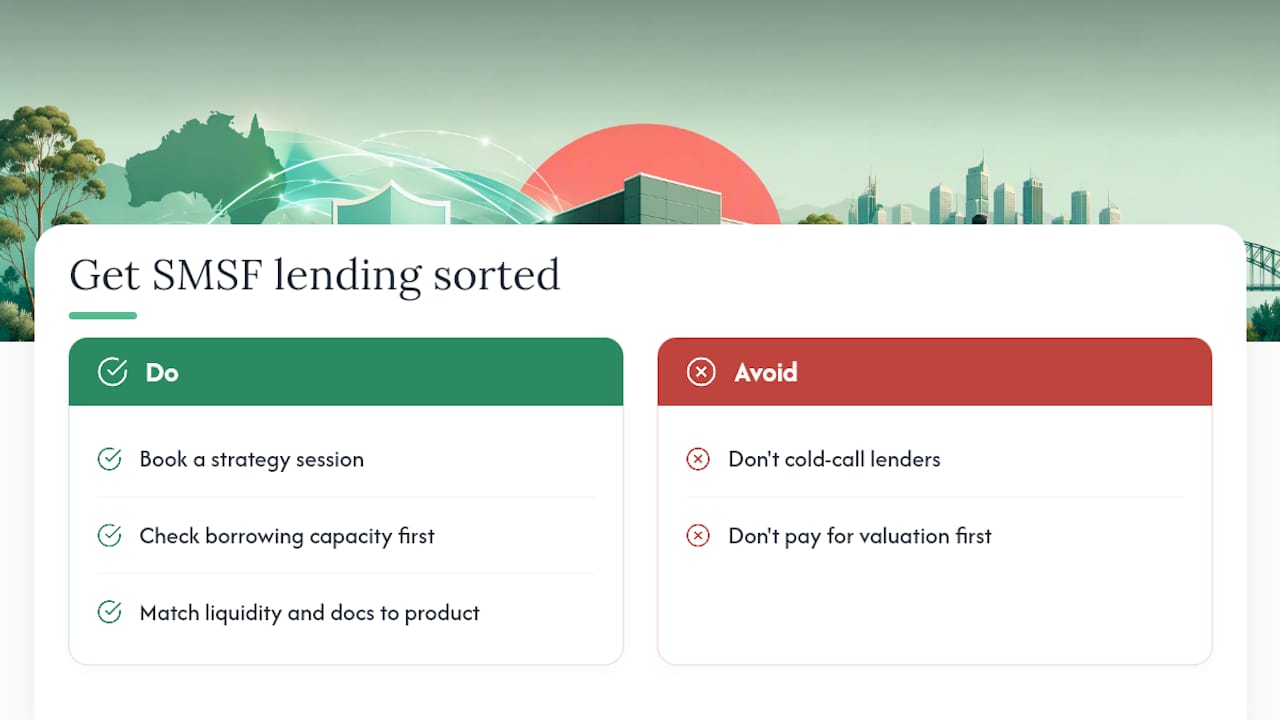
Comparison sites can tell you the rules changed. What they can't do is tell you which of the remaining SMSF lenders will actually approve your fund's specific structure, and that gap is where most trustees lose months. Zenrgfinance works directly with the specialist and non-bank lenders still active in SMSF property lending, matching your fund's liquidity position and documentation against the right product instead of you cold-calling a shrinking list.
Whether you're refinancing a grandfathered residential LRBA or structuring a new business real property purchase, a strategy session walks through your fund's numbers before you approach any lender, so you're not finding out about a serviceability gap after you've paid for a valuation. Book a session and get your fund's borrowing capacity checked properly before you make an offer on anything.
This article is general information, not a substitute for advice from a qualified financial advisor. Consult a qualified financial professional about your own circumstances before acting on anything here.
Sources
- Changes to limited recourse borrowing arrangements | Australian Taxation Office
- Moneysmart
- SMSF borrowing and property investing | SuperGuide
- SMSF home loans 2026 | Finder