
Refinancing to consolidate debt can genuinely save you money and simplify your finances, but only when the new loan's total cost (including all fees) is lower than what you would pay across your existing debts over a similar term. That is the single condition that determines whether this strategy works in your favour.
Quick checklist to decide if it is worth reading on:
- Compare your weighted average rate. Add up what you currently pay in interest across all debts and work out the blended rate. If the new loan rate is meaningfully lower, there may be a saving.
- Add up every fee. Break costs, establishment fees, valuation, legal costs and any ongoing fees all reduce your net saving. The headline rate alone tells you very little.
- Check what you are securing. Rolling unsecured credit card debt into a mortgage means your home backs that debt. That is a material change in risk, not just a paperwork exercise.
If all three checks point in the right direction, keep reading. If any one of them raises a red flag, the alternatives section below may suit you better.
Table of Contents
- How refinancing to consolidate debt actually works
- What are the real benefits of consolidating through refinancing?
- Key risks and downsides to watch for
- The exact costs you must compare before you refinance
- Worked example: does this refinance actually save you money?
- Alternatives to refinancing you should consider first
- How to check providers and avoid dodgy debt consolidation offers
- Practical next steps and a realistic timeline
- Where to get free or paid help with debt consolidation
- Key takeaways
- The thing most people get wrong about debt consolidation
- Zenrgfinance helps you compare refinancing options with confidence
- Useful Australian sources to read next
How refinancing to consolidate debt actually works
When you consolidate debt through refinancing, you take out a new loan large enough to pay off multiple existing debts, then repay just that one loan going forward. MoneySmart notes that this process can simplify repayments but can also increase total costs if fees are higher or the loan term is extended.
There are several product routes available to Australian borrowers:
- Cash-out refinance. You refinance your existing home loan for a larger amount, take the difference as cash, and use it to pay off other debts. Your mortgage balance increases, but you are left with one repayment at the mortgage rate.
- Home equity loan. A separate loan secured against the equity in your property, used to pay out other debts. Fixed rate, lump sum, repaid alongside your main mortgage.
- HELOC (home equity line of credit). A revolving credit facility secured against your home. Flexible drawdowns, but variable rates and the temptation to redraw can be a problem.
- Personal consolidation loan. An unsecured loan that pays out credit cards and other debts. No property risk, but rates are higher than mortgage rates.
- Balance transfer card. Moves credit card balances to a new card, often at a low or 0% introductory rate. No security required, but limited to card balances.
The secured versus unsecured distinction matters enormously here. Moving credit card debt into a mortgage converts what was personal liability into a debt backed by your home. If you default, the lender can sell your property to recover the balance. That shift in risk profile deserves serious thought before you sign anything.
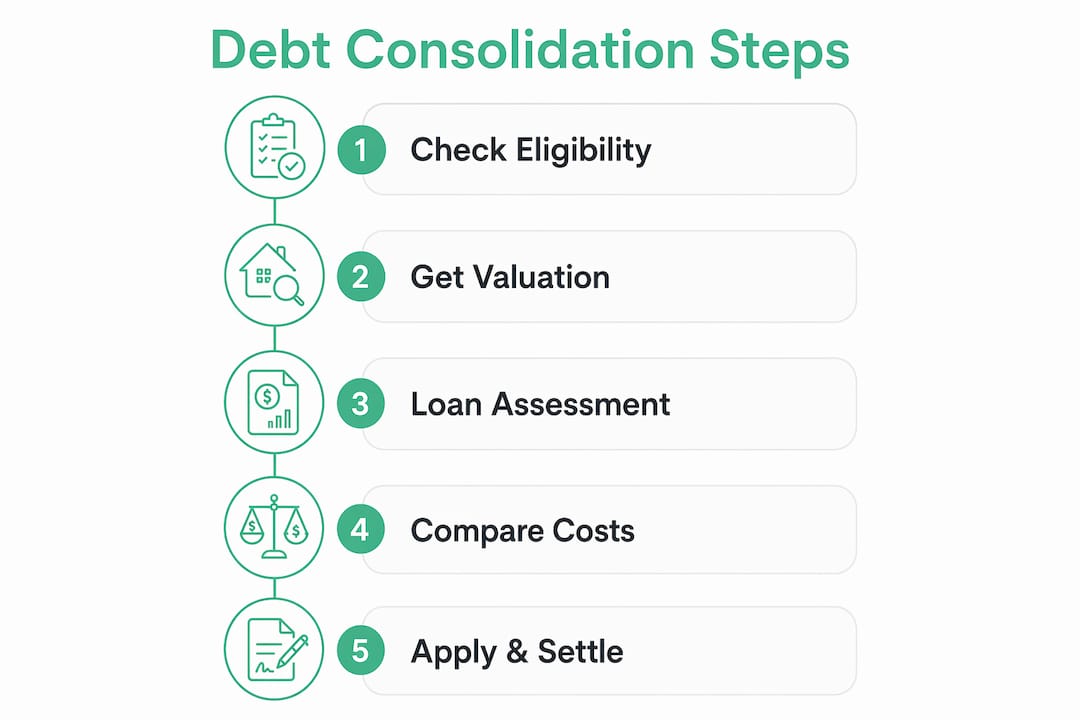
The typical process runs like this: you check your eligibility and get a property valuation, the lender assesses your borrowing capacity and LVR (loan-to-value ratio), fees are disclosed in writing, existing creditors are paid out from the new loan proceeds, and you start a single repayment schedule on the new loan.

Pro Tip: Ask your lender for a written comparison showing the total amount repayable over the full loan term, not just the new monthly repayment. That single number tells you more than any rate comparison.
What are the real benefits of consolidating through refinancing?
The practical upsides are real, provided the numbers stack up. Consolidating multiple debts into one loan can lower your monthly outgoings, cut the number of accounts you manage, and give you a fixed payoff date.
Common benefits include:
- Lower monthly repayment. Spreading debt across a longer term or securing a lower rate reduces what you pay each month, freeing up cash flow for other expenses.
- One payment instead of many. Managing a single direct debit is simpler than juggling four or five due dates with different lenders.
- Potential interest saving. Moving high-rate credit card debt (often 18–22% per annum) into a home loan rate can produce a significant interest reduction, provided the term is not extended unnecessarily.
- Fixed payoff date. A personal consolidation loan with a set term gives you a clear end date, which a revolving credit card balance never does.
- Improved cash flow. Lower monthly repayments can reduce financial stress and create room in your budget for savings or an emergency fund.
A typical scenario: you have a balance across several credit cards at a high average rate and a minimum combined monthly payment. Rolling that into a personal loan at a lower rate over a few years drops the monthly payment and cuts total interest paid substantially. The saving is real, but only if you do not run the cards back up afterwards. You can explore refinancing benefits for homeowners in more detail if you want to see how the mortgage-specific version of this plays out.
Key risks and downsides to watch for
The biggest danger is paying more overall, not less, because you extended the loan term or added fees that outweigh the rate saving. This is more common than most people expect.
Extending your loan term is the hidden cost of consolidation. A lower monthly repayment that comes from a 25-year mortgage replacing a 3-year personal loan is not a saving. You are paying less each month but far more in total interest over the life of the loan. Always compare total cost, not just the monthly figure.
Other downsides to weigh up:
- Secured debt risk. Converting unsecured debt to mortgage debt means your home is at risk if you default. This is a fundamental change in your financial position.
- Break fees and exit costs. Fixed-rate loans often carry early repayment penalties. These can run into thousands of dollars and must be factored into your calculation.
- Establishment, valuation and legal fees. MoneySmart confirms that refinancing can involve legal fees, valuation fees and stamp duty, all of which reduce your net saving.
- Higher LVR. Adding debt to your mortgage increases your loan-to-value ratio, which can affect your interest rate tier and borrowing capacity for future loans.
- Behavioural risk. Clearing credit cards through a refinance and then spending on them again is one of the most common ways people end up worse off. Debt consolidation is a tool, not a cure for overspending.
A simple example of how things go wrong: you roll a substantial amount in personal loans into your mortgage at a lower rate, but you extend the mortgage term by several years. The lower rate saves you some interest, but the extended term costs you more. Net result: you may end up worse off. Understanding why refinancing resets your loan term is one of the most practical things you can do before committing.
The exact costs you must compare before you refinance
The only number that matters is total cost to repay, not the monthly repayment. MoneySmart emphasises comparing total interest and fees rather than monthly repayments alone.
Calculation checklist:
- Weighted average interest rate across all current debts
- New loan interest rate (comparison rate, not just the headline rate)
- Break fees or early repayment penalties on existing loans
- Establishment or application fee on the new loan
- Valuation fee (typically required for mortgage refinancing)
- Legal and conveyancing fees
- Ongoing monthly or annual fees on the new loan
- Effect of any change in loan term on total interest paid
| Comparison dimension | What to look at |
|---|---|
| Interest rate | Compare the new rate against your weighted average current rate, using comparison rates |
| Fees and break costs | Add all upfront and exit fees; subtract from headline saving |
| Loan term | Shorter or similar term preserves savings; longer term can erase them |
| Secured vs unsecured | Secured loans risk your home; unsecured loans carry higher rates |
| Monthly repayment vs lifetime cost | A lower monthly payment from a longer term often costs more overall |
| Eligibility and LVR | Higher LVR may trigger lender's mortgage insurance or a higher rate tier |
Pro Tip: Use the Zenrgfinance loan comparison calculator to enter your current debts and the proposed new loan side by side. The total interest figure over the full term is the number to focus on, not the monthly saving.
Worked example: does this refinance actually save you money?
The maths here shows clearly when consolidating through refinancing helps and when it quietly costs you more.
Scenario: You have several debts and are considering a personal consolidation loan.
| Debt | Balance | Rate | Monthly payment | Remaining term |
|---|---|---|---|---|
| Credit card A | a moderate balance | a high rate | a moderate monthly payment | Revolving |
| Credit card B | a moderate balance | a high rate | a moderate monthly payment | Revolving |
| Personal loan | a moderate balance | a moderate rate | a moderate monthly payment | fixed term |
| Total | a significant amount | blended high rate | substantial monthly payment | mixed terms |
Proposed consolidation loan: an amount equal to total debts at a lower rate over several years, plus an establishment fee.
Step-by-step calculation:
- New monthly repayment: significantly lower than current payments.
- Total repaid on new loan: total monthly payment times loan term plus fees.
- Total repaid on current debts (if paid off at current rates over similar term): higher total repayment.
- Net saving: consolidation loan may save money if term is similar and rate is lower.
Now change one variable: extend the term to reduce monthly payment.
- New monthly repayment: lower but over a longer period.
- Total repaid: higher overall cost due to longer loan term.
- Net saving versus current debts over original term: comparison may be misleading due to extended repayment period.
The longer term erases most of the saving and you are still in debt two years longer. That is the gotcha most people miss.
Common calculation errors to avoid:
- Forgetting to include the establishment fee in the total cost
- Comparing the new loan's 7-year total against the current debts' 5-year total (apples and oranges)
- Ignoring break fees on the personal loan if it has a fixed rate
- Treating a 0% balance transfer as free (transfer fees of 3%–5% apply and the introductory period is limited)
Alternatives to refinancing you should consider first
Before you secure any unsecured debt against your home, check whether a lower-risk option gets you to the same place. MoneySmart advises considering alternatives such as negotiating with credit providers, balance transfers, or speaking with a hardship team.
Balance transfer credit card. Works well for credit card balances you can realistically clear within 12–24 months. Transfer fees of 3%–5% apply, and the standard rate kicks in at the end of the introductory period. Not suitable for large balances or borrowers who struggle with discipline.
Personal consolidation loan. Unsecured, so no property risk. Rates are higher than mortgage rates but lower than credit cards. Best for borrowers with good credit and manageable balances under $50,000 who do not want to touch their mortgage.
Negotiating directly with creditors. Many lenders will reduce interest rates, waive fees or restructure repayments if you ask. This costs nothing and carries no risk. Worth a phone call before anything else.
Hardship assistance. Your current mortgage provider's hardship team can restructure repayments, pause payments, or extend your term without the upfront cost of a full refinance. This is often the fastest and cheapest option for short-term cash flow pressure.
Debt management plan through a financial counsellor. A free financial counsellor can negotiate with creditors on your behalf and set up a structured repayment plan. No fees, no new loan, no risk to your home.
| Borrower profile | Best-fit option |
|---|---|
| Small card balances, can clear in 12–24 months | Balance transfer card |
| Multiple high-rate debts, good credit, no equity | Personal consolidation loan |
| Short-term cash flow problem, existing mortgage | Hardship variation with current lender |
| Significant equity, high-rate debts, disciplined budget | Mortgage refinance (cash-out or home equity loan) |
| Overwhelmed, creditors not cooperating | Free financial counsellor or debt management plan |
For practical budgeting discipline after consolidation, simplifying your personal finances is worth reading before you commit to any strategy.
How to check providers and avoid dodgy debt consolidation offers
Always verify a lender's or adviser's licence and get written itemised costs before you commit to anything. This is non-negotiable.
Licence check steps:
- Go to ASIC's Professional Registers at connectonline.asic.gov.au
- Search for the company or individual under "credit licensee" or "credit representative"
- Confirm the licence is current and covers the service being offered
- If they are not on the register, do not proceed
Questions to ask before signing:
- What is the total amount repayable over the full loan term?
- What fees apply upfront, ongoing, and on early repayment?
- Is the loan secured against my property?
- Who pays your fee — me or the lender?
- Can I get all costs in writing before I sign?
Red flags to watch for:
- Promises of guaranteed approval regardless of credit history
- Pressure to sign documents before you have read them, or blank forms
- No written disclosure of fees and interest rate before signing
- Requests to transfer money or pay fees before paperwork is completed
- The company does not appear on ASIC's register
ASIC's guidance on switching home loans covers the specific disclosures you should receive from any lender before you commit. If a firm cannot or will not provide written costs upfront, that alone is sufficient reason to walk away.
Practical next steps and a realistic timeline
Your first three actions right now: gather your current loan statements, call your existing lenders to ask about hardship options, and get a written cost disclosure from any new lender you are considering.
Documents to collect:
- Last two payslips (or last two years' tax returns if self-employed)
- Three months of bank statements for all accounts
- Current statements for every debt you want to consolidate (balance, rate, remaining term)
- Credit card statements showing current limits and balances
- Most recent property valuation or council rates notice
- Photo ID
- Evidence of regular expenses (utilities, insurance, subscriptions)
Typical timeline for a mortgage refinance:
- Week 1–2: Pre-approval application, credit check, initial document review
- Week 2–3: Property valuation ordered and completed
- Week 3–4: Formal approval, loan documents issued
- Week 4–6: Legal checks, discharge of existing mortgage, settlement
- At settlement: Existing creditors paid out, new repayment schedule begins
Fees can apply at valuation, at application, and at settlement. Ask for a written schedule of when each fee is charged so there are no surprises.
Before you apply anywhere new, talk to your current mortgage provider's hardship team. Many lenders can restructure your repayments or consolidate debts within your existing loan without the full cost of a new application. It takes one phone call and costs nothing to ask.
Where to get free or paid help with debt consolidation
The right kind of help depends on your situation. If you are in immediate financial hardship, a free financial counsellor is the right first call. If you have equity, good credit, and want to compare refinancing options across multiple lenders, an independent mortgage broker is the better fit.
Your options:
- National Debt Helpline (1800 007 007). Free financial counselling, available Monday to Friday. Counsellors can negotiate with creditors, explain your options, and help set up a repayment plan at no cost to you.
- MoneySmart (moneysmart.gov.au). ASIC's consumer finance website with calculators, guides, and a mortgage switching calculator to compare your current loan against a new one.
- Independent mortgage broker. A licensed broker compares products across multiple lenders, handles the paperwork, and is paid by the lender (not you, in most cases). Check their ASIC licence and ask for written disclosure of any fees before you engage.
- Accredited financial adviser. For complex situations involving tax implications, investment properties, or SMSF structures, a financial adviser can model the full picture. Fees apply; ask for a written quote.
- Community legal centres. For extreme cases involving creditor disputes or debt agreements, community legal centres provide free legal advice.
When choosing a mortgage broker, check their credit licence on ASIC's register, ask whether they receive commissions from lenders, and confirm you will receive a written credit proposal before any loan is submitted. MoneySmart's guide to using a mortgage broker explains exactly what a broker should disclose to you and when.
Key takeaways
Refinancing to consolidate debt works best when the total cost of the new loan (including all fees) is lower than the combined cost of your existing debts over a similar term.
| Point | Details |
|---|---|
| Compare total cost, not monthly repayment | A lower monthly payment from a longer term often costs more overall in interest. |
| Secured debt carries real risk | Rolling unsecured debt into a mortgage puts your home on the line if you default. |
| Verify every provider on ASIC's register | Search for "credit licensee" or "credit representative" before signing anything. |
| Explore alternatives first | Balance transfers, hardship variations, and free counselling may solve the problem without a new loan. |
| Zenrgfinance can compare options for you | A Zenrgfinance mortgage broker compares lenders, handles paperwork, and helps you run the numbers before you commit. |
The thing most people get wrong about debt consolidation
Consolidation gets sold as a simplification story, and it genuinely can be one. But the version most people encounter in the wild is a monthly-repayment story, and those two things are not the same.
The monthly repayment drops. That feels like a win. What does not get shown on the same page is the total interest over the new term, the fees deducted from the proceeds, and the five or seven extra years of debt you just signed up for. The maths is not hidden, exactly. It is just never presented in a way that makes the full cost obvious.
The other thing worth saying plainly: clearing your credit cards through a refinance and then spending on them again is not a debt problem. It is a spending problem, and no loan structure fixes that. The most effective thing you can do alongside any consolidation is close or reduce the limits on the accounts you just paid out. That one step removes the temptation entirely.
From a brokerage perspective, the clients who benefit most from consolidation are the ones who come in with a clear picture of what they owe, a realistic budget, and a genuine plan to not re-borrow. The loan structure is almost secondary. The discipline is the variable that determines the outcome.
Zenrgfinance helps you compare refinancing options with confidence
Sorting through lenders, comparison rates, break fees, and loan terms on your own takes time, and a single miscalculation can cost you thousands. Zenrgfinance's mortgage brokers do the comparison work for you, across multiple lenders, so you can see the real numbers before you commit to anything.

Working with a Zenrgfinance broker means you get a clear picture of your options, written cost disclosure before any application is submitted, and support through the full process from pre-approval to settlement. The service is built around your situation, not a one-size-fits-all product.
- Compare refinancing and consolidation options across multiple lenders
- Receive written disclosure of all rates, fees, and total costs upfront
- Get support with documents, valuation coordination, and lender negotiation
- Understand the impact on your LVR, borrowing capacity, and loan term before you sign
Ready to see whether the numbers actually work in your favour? Book a session with a Zenrgfinance mortgage relationship manager and get a clear, personalised comparison with no obligation.
This article is general information only and does not constitute financial, legal, or credit advice. Your situation is unique. Confirm current rates, fees, and eligibility with your lender or a licensed financial professional before making any decisions.
Useful Australian sources to read next
- MoneySmart: Debt consolidation and refinancing — ASIC's consumer guide covering definitions, risks, costs, and alternatives. The most authoritative starting point for any Australian borrower.
- MoneySmart: Mortgage switching calculator — Free tool to compare your current home loan against a new one, including fees and break costs.
- MoneySmart: Using a mortgage broker — Explains what a broker must disclose, how they are paid, and what to check before you engage one.
- ASIC Professional Registers — Search for any lender, broker, or debt adviser to confirm their licence is current before you sign anything.
- Services Australia: Managing debt — Government guidance on dealing with debt, including hardship options and financial assistance programmes.
- Zenrgfinance: Home refinancing — Zenrgfinance's refinancing service page for borrowers ready to explore their options with a broker.
- Zenrgfinance: Loan comparison calculator — Run your own numbers to compare your current debts against a proposed consolidation loan.