
For most Australian SMEs, an authorised overdraft is your fastest short-term buffer, and a line of credit (revolving credit facility) suits ongoing or predictable working capital better. Both charge interest only on the funds you draw, but the way each facility is structured, reviewed, and priced differs enormously.
Here's the practical split:
- Use an overdraft for reactive, temporary gaps: a late-paying customer, an awkward payroll timing clash, a one-off supplier bill.
- Use a line of credit for seasonal stock builds, staged projects, or working capital needs you can see coming.
- Know the risk either way: Australian banks review facilities periodically, and uncommitted facilities can be reduced without much warning.
Before you sign anything, run through the checklist further down this guide.
Key Takeaways
Choosing between an overdraft and a line of credit comes down to matching how often you draw funds to how much certainty you need over the facility's term.
| Point | Details |
|---|---|
| Match facility to pattern | Use an overdraft for occasional gaps and a line of credit for recurring or seasonal draws. |
| Compare total cost | Weigh interest plus establishment, renewal, and unused-limit fees, not just the headline rate. |
| Watch stability risk | Uncommitted overdrafts can be reduced on review; documented lines of credit offer more certainty. |
| Prepare documentation early | Trading history, forecasts, and clean bookkeeping speed up approval on either facility. |
| Ask about notice periods | Confirm review cycles and reduction triggers with your lender before signing. |
Table of Contents
- Line of credit vs overdraft: how a business overdraft actually works
- What is a business line of credit in Australia?
- Overdraft vs revolving credit: the differences that matter for your cash flow
- Costs, fees and the pricing traps SMEs miss
- Eligibility and what lenders will ask for
- Five real cash-flow scenarios and the right facility for each
- What can change without warning, and how to protect against it
- How to choose: your checklist before you talk to a bank or broker
- Where to check the current facts
- Sources
Line of credit vs overdraft: how a business overdraft actually works
A business overdraft sits on top of your existing transaction account, letting your balance dip below zero up to an agreed limit. It's the most familiar facility for Australian business owners because it feels like an extension of the account you already bank with.
Overdrafts come in two flavours. An authorised overdraft is pre-approved by your bank with a set limit and agreed pricing. An unauthorised overdraft happens when you go negative without approval, or exceed your approved limit, and it almost always triggers steep penalty fees and a much higher interest rate.
Once approved, an overdraft kicks in automatically:
- Card payments, direct debits, and supplier transfers simply draw against the negative balance.
- There's no separate application each time you dip into it, which is what makes it feel so convenient.
- CommBank frames overdrafts as reactive, short-term buffers rather than structured funding tools.
- Most Australian banks review overdraft facilities annually, and can adjust or withdraw the limit at that point.
That review cycle is the catch. Fast access comes paired with a facility your bank can reshape on its own schedule.
What is a business line of credit in Australia?
A line of credit, sometimes called a revolving credit facility, is a standalone finance product with its own formal agreement, separate from your day-to-day transaction account. You draw funds as needed, repay them, and redraw again within an agreed limit and term, similar in spirit to a business credit card but usually with far larger limits and lower rates.
The mechanics are straightforward once set up:
- You draw down against the approved limit whenever cash flow requires it.
- Repayments free up the limit again, so you can redraw without reapplying.
- Interest applies only to the amount actually drawn, not the full approved limit.
- Facilities are commonly documented for fixed terms of one to three years, after which the lender reviews and renews.
Major banks, second-tier lenders, and specialist non-bank lenders all offer lines of credit in Australia, though eligibility criteria vary. Banks generally want an established trading history and clean financials; non-bank lenders sometimes move faster and accept thinner trading histories, often at a higher rate. A line of credit tends to suit businesses with predictable or recurring draws because the fixed-term documentation gives more certainty than a facility the bank can adjust at its own discretion.
Overdraft vs revolving credit: the differences that matter for your cash flow
Cost, speed, and stability rarely move in the same direction, and that's the trade-off you're really weighing.
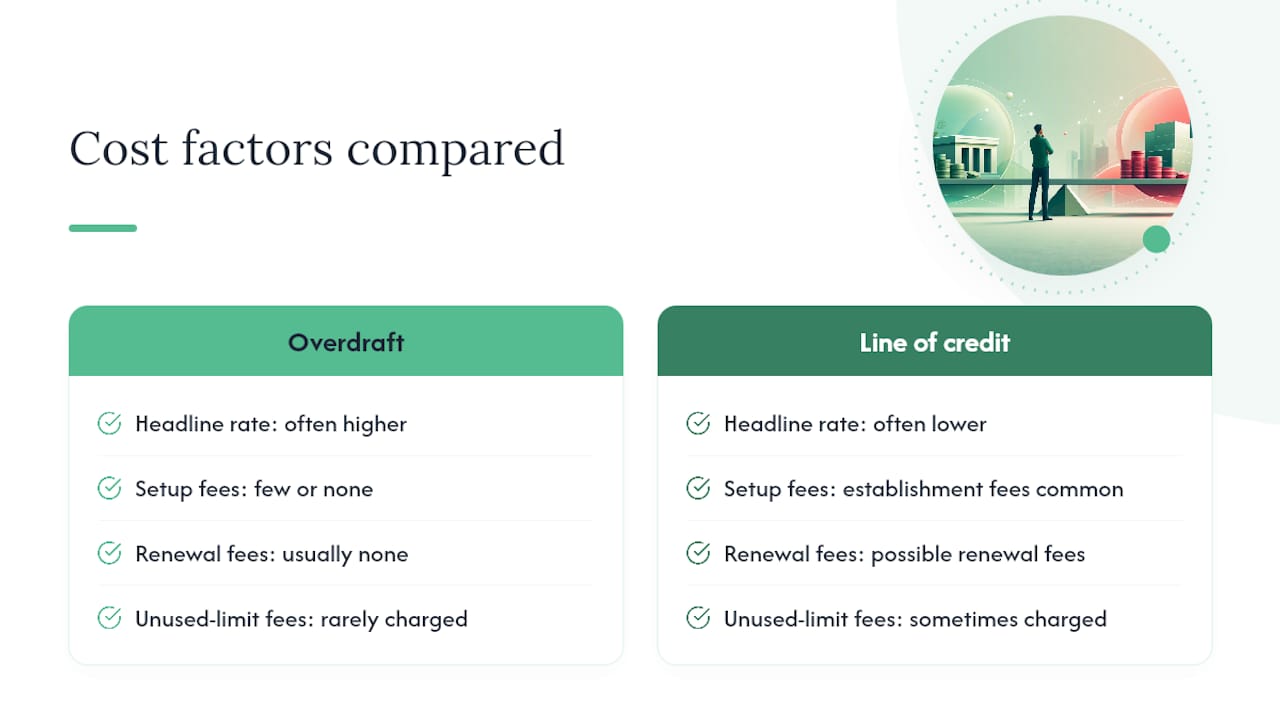
Cost. Overdrafts often carry a higher headline interest rate but fewer set-up fees, since they piggyback on an account you already hold. Lines of credit can have a lower rate but add establishment, renewal, and sometimes unused-limit fees. Finder's comparison notes the effective cost depends on total fees, not just the advertised rate.
Speed of access. Nothing beats an overdraft for instant access once it's approved, since it's already wired into your everyday banking. A line of credit takes longer to set up, given the standalone documentation, but drawdowns afterwards are just as fast.
Limit size. Overdrafts tend to be smaller, calibrated to smooth short gaps. Lines of credit often support larger limits, which matters if you're funding a bigger seasonal stock order or a multi-stage project.
Stability. This is where the two genuinely diverge. Many overdrafts are uncommitted and technically repayable on demand, meaning the bank can reduce or withdraw the facility with little notice. A documented line of credit gives more contractual certainty for its agreed term.
Eligibility. Overdrafts are easier to get if you already bank with the lender. Lines of credit usually demand a fuller financial picture, including forecasts and sometimes security.
Costs, fees and the pricing traps SMEs miss
Interest applies only to what you've drawn on both facilities, which sounds simple until you factor in everything sitting alongside that headline rate.
Variable rates on both overdrafts and lines of credit move with the market. Reserve Bank of Australia cash rate decisions flow through to business lending pricing, so a facility that felt cheap eighteen months ago may cost noticeably more today, and vice versa.
Pro Tip: Ask your lender for the total annual cost, not just the interest rate. A facility with a lower rate but a hefty unused-limit fee can end up more expensive than one with a slightly higher rate and no extra charges.
Watch for:
- Establishment and renewal fees on lines of credit, charged when the facility is set up or reviewed.
- Commitment or unused-limit fees, charged on the portion of your limit you're not drawing.
- Unauthorised overdraft penalties, which can include a much higher interest rate plus a flat fee for exceeding your limit.
One insight worth acting on: if you're regularly sitting in overdraft, track the annualised cost of interest plus fees and compare it against a line of credit. Businesses that use overdraft as a permanent crutch frequently discover the line of credit would have been cheaper.
Eligibility and what lenders will ask for
Lenders want evidence you can service the facility, and the paperwork differs by product.
- Trading history. Most banks want at least twelve months of trading, often longer for a line of credit.
- Management accounts and cashflow forecasts. A 12-month forecast with best, expected, and worst-case scenarios is routinely requested and materially improves lender confidence.
- Director guarantees or security. Larger limits, especially on a line of credit, often require a personal guarantee or an asset as security.
- Existing banking relationship. An overdraft with your existing bank moves faster than a fresh application; a line of credit usually takes longer regardless of who you bank with.
Pro Tip: Tidy bookkeeping and a clear forecast will shave weeks off approval, and a broker can flag which lender is likely to say yes before you burn time on the wrong application. Our guide on improving your business borrowing capacity covers the detail.
Five real cash-flow scenarios and the right facility for each
- A customer's invoice is 30 days late and payroll is due Friday. An overdraft covers this cleanly. It's short, temporary, and resolves itself once the invoice clears.
- You're building stock ahead of Christmas trade. A line of credit fits better, since the draw is planned and likely to recur next season.
- A piece of equipment fails and repairs cost a big lump sum. A modest overdraft can bridge it, but for a larger amount, compare against a short-term business loan instead.
- You're onboarding new contracts and need recurring working capital as you scale. A line of credit suits growth-related draws that repeat month after month.
- You want both flexibility and a safety net. Many established SMEs run a small overdraft for genuine emergencies alongside a line of credit for planned funding, giving you both a buffer and structured capital.
What can change without warning, and how to protect against it
Facility stability is the risk most business owners underestimate until it bites.
Uncommitted overdrafts are typically repayable on demand, which means the bank can reduce or withdraw the limit with limited notice. Revolving credit facilities, backed by formal documentation, generally offer more contractual certainty over their agreed term.
Lenders act when they see warning signs: deteriorating financial accounts, covenant breaches, or a broader tightening in credit policy across the bank. ASIC's insolvency data underscores why sudden facility withdrawal is a genuine operational risk, not a theoretical one, for SMEs already under pressure.
Protect yourself by:
- Keeping a liquidity buffer beyond what you rely on from any single facility.
- Contacting your lender early if trading conditions soften, rather than waiting for them to notice first.
- Having a contingency plan for at least one alternative funding source.
How to choose: your checklist before you talk to a bank or broker
Walk into any lender conversation with these answered:
- How will you actually use it? Occasional buffer or recurring draws changes which facility fits.
- What limit do you need, based on your worst realistic cash-flow month, not your average one?
- What fees are acceptable? Decide your ceiling on establishment, renewal, and unused-limit charges before you're quoted one.
- What's the review and renewal cycle, and what happens if the lender wants to reduce your limit?
- What security or guarantees are you comfortable offering?
Ask lenders directly: how often is this facility reviewed, what triggers a reduction, are there unused-limit fees, and how much notice will you get before any change takes effect.
Pro Tip: If a lender can't give you a straight answer on notice periods, treat that as a red flag. That's exactly the point a broker earns their fee, negotiating clearer terms before you sign.
How ZENRG Finance can help Australian SMEs
Choosing between an overdraft and a line of credit gets easier with someone comparing lenders on your behalf. Zenrgfinance works with business owners to compare facility options, assist with the documentation lenders ask for, and negotiate terms like renewal notice periods and fee structures.
- Model your options with the Loan Comparison Calculator before you approach a lender.
- Check what you can realistically borrow with the Borrowing Power Calculator.
- Get a broker's read on which lenders suit your trading history and industry.
Stability for growth, convenience for emergencies
If you're drawing on a facility most months, that's a line of credit conversation, not an overdraft habit. Reserve the overdraft for genuine one-off gaps. Lean on it constantly and you're paying convenience pricing for what is really ongoing working capital, and exposing yourself to a facility your bank can reduce on review.
— Allen
Where to check the current facts
For up-to-date rates and product terms, go straight to the source. CommBank's business overdraft page and Westpac's overdraft comparison outline current product mechanics. The RBA's cash rate page tracks the rate movements that flow through to your facility pricing, and ASIC's insolvency statistics show why contingency planning around facility withdrawal genuinely matters.
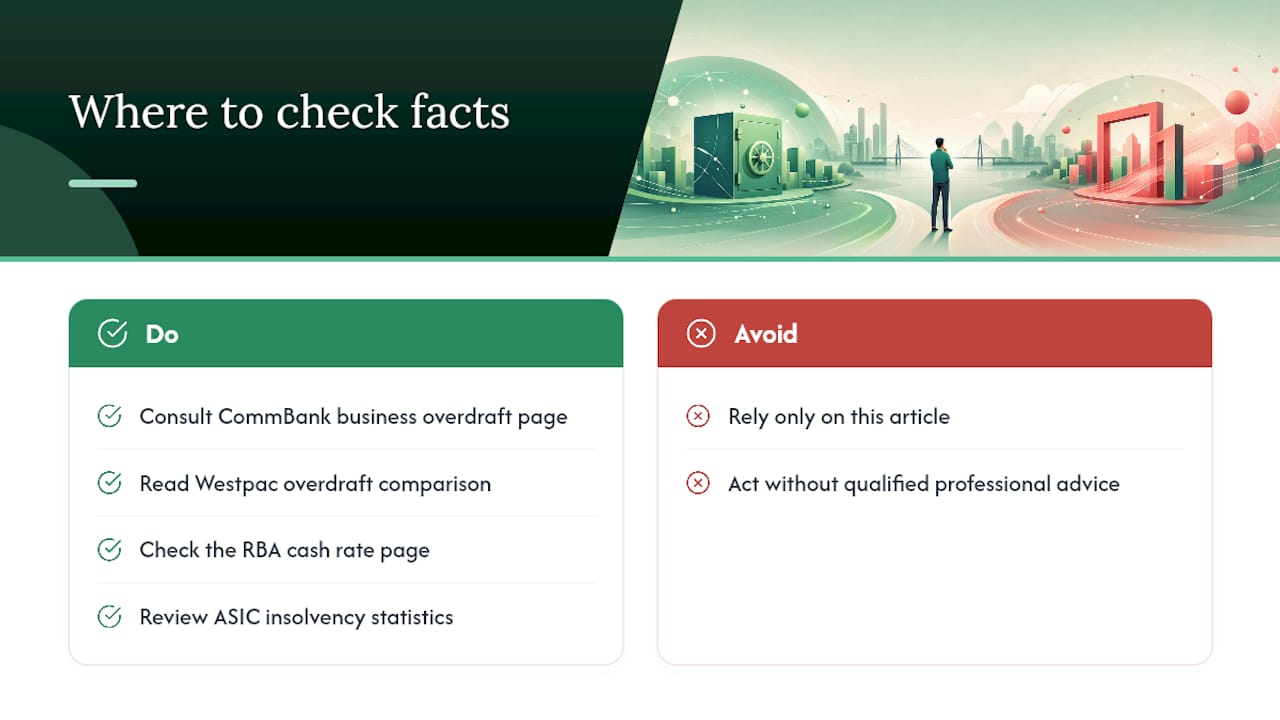
This article is general information, not a substitute for advice from a qualified financial advisor. Consult a qualified financial professional about your own circumstances before acting on anything here.
Sources
- Cash rate — Reserve Bank of Australia
- Insolvency statistics — ASIC
- Overdrafts, term loans and revolving credit facilities — LexisNexis