
The fastest way to improve your business borrowing capacity is to increase your documented net cash flow and reduce your monthly debt service, then put lender-ready documents in front of the right lender. The most common lender metric is your Debt Service Coverage Ratio (DSCR), and most Australian lenders require a minimum DSCR of 1.25—some use higher thresholds, such as 1.30–1.50, for better rates and higher limits. You can start this week.
Here is what to do right now:
- Speed up receivables. Shorten invoice payment terms to 14 days and offer direct debit to clients.
- Trim variable expenses. Pull three months of bank statements and cut any recurring costs that do not directly generate revenue.
- Pause non-essential owner draws. Even a 60-day pause lifts your average monthly net, which lenders read directly.
- Close unused personal credit limits. Open limits count as potential liability even when the balance is zero.
- Prepare your documents. Gather 3–12 months of business bank statements, your most recent Business Activity Statements (BAS), and your last two years of tax returns.
A broker like Zenrgfinance can audit your file before you approach any lender, which often makes the difference between a conditional approval and a flat decline. The borrowing power calculator on the Zenrgfinance website lets you model the impact of these changes before you sit down with anyone.
Key takeaways
Improving your business borrowing capacity comes down to three things: raising documented net cash flow, reducing monthly debt service, and presenting a clean, complete file to the right lender.
| Point | Details |
|---|---|
| DSCR is the primary lever | Most Australian lenders require a minimum DSCR of 1.25; improving cash flow or reducing debt service moves this ratio directly. |
| Document preparation speeds approvals | Lender-ready files (12 months of bank statements, BAS, tax returns, P&L) reduce underwriter uncertainty and improve offers. |
| Secured products unlock higher limits | Offering property or assets as collateral typically increases the total amount a lender will approve. |
| Timing your application matters | Applying after 3–6 months of improved monthly receipts gives lenders a verifiable trend, not a single good month. |
| Zenrgfinance matches you to the right lender | A strategy session with Zenrgfinance covers file preparation, lender matching, and product structuring at no upfront cost. |
Table of Contents
- What do lenders actually assess when calculating your borrowing capacity?
- Step-by-step actions that genuinely increase your borrowing capacity
- How do loan types and security choices change what lenders will offer you?
- How to estimate the impact of your changes with a worked example
- How long do improvements take, and what do they cost?
- How can a broker like Zenrgfinance increase your borrowing capacity?
- A practical note from a mortgage specialist
- Zenrgfinance can help you prepare and apply with confidence
- Sources
What do lenders actually assess when calculating your borrowing capacity?
Lenders primarily measure your ability to service additional debt, a concept called serviceability. The key metric most Australian lenders use is the Debt Service Coverage Ratio (DSCR): your net operating income divided by your total annual debt payments. A DSCR of 1.25 is a common minimum threshold, meaning your business generates $1.25 for every $1.00 of debt repayment. Ratios of 1.30–1.50 typically unlock better rates and higher limits.
Statistic: A DSCR below 1.0 means your business cannot cover its debt from operating income alone. Most Australian lenders will not approve new lending at that level without additional security or a co-borrower.
Banks also use EBITDA-based coverage ratios, sometimes called the Fixed Charge Coverage Ratio (FCCR). BDC notes that lenders commonly look for an FCCR around 1.25 to consider repayments affordable, and a simple spreadsheet can help you "audition" different loan amounts before you apply.
Beyond the numbers, lenders weigh both quantitative and qualitative factors: revenue consistency, credit scores, industry stability, and time in business all feed the final decision. A café open for 18 months with volatile monthly deposits will face a harder assessment than a trade business with two years of steady BAS lodgements, even if their average revenue is similar.
The five C's of creditworthiness
U.S. Bank's creditworthiness framework describes five factors lenders assess: capacity (can you repay?), capital (what assets do you hold?), collateral (what security can you offer?), character (your credit history and track record), and conditions (industry and economic environment). Australian lenders apply the same logic, though the terminology varies by institution.
Document checklist lenders expect
| Document | What lenders look for |
|---|---|
| Business bank statements (3–12 months) | Consistent deposits, average monthly balance, no unexplained large withdrawals |
| Business Activity Statements (BAS) | Declared turnover matching bank deposits; regular lodgement history |
| Profit and loss statement | Net operating income trend over 3–12 months |
| Tax returns (last 2 years) | Taxable income, depreciation add-backs, director drawings |
| Accounts receivable ageing | Quality of debtors; concentration risk |
| Asset register | Equipment, vehicles, property owned by the business |
| Existing loan statements | Current balances, monthly repayments, remaining terms |
Personal credit files matter too. For most small business loans in Australia, lenders run a director credit check and may require a personal guarantee. A single default or missed payment on a personal card can trigger a more conservative assessment of the whole business file.
Step-by-step actions that genuinely increase your borrowing capacity
These are ordered by speed-to-impact. Work through them in sequence rather than trying everything at once.
-
Improve net cash flow (30–90 days). Contact your three largest clients and move them to 14-day payment terms with direct debit. Review your last 90 days of expenses and cancel any subscription or service that does not directly produce revenue. Even a $2,000 lift in average monthly net operating income can materially shift your DSCR.
-
Reduce or refinance high-cost short-term debt (30–90 days). Credit card balances and merchant cash advances carry the highest monthly repayment obligations relative to their balance. Paying down a $10,000 credit card at 20% interest removes roughly $200 per month from your debt service, which feeds directly into a better DSCR calculation.
-
Fix credit report errors (30–90 days). Request your business and personal credit reports from Equifax, Experian, and illion. Dispute any listing that is incorrect or outdated. Lenders in Australia use these files to assess character and capacity, and a single erroneous default can cost you access to an entire tier of lenders.
-
Separate business and personal accounts (immediate). If you are still running business income through a personal account, open a dedicated business transaction account this week. Lenders reward clean, consistent business bank deposits and penalise files where personal and business transactions are mixed, because underwriters cannot reliably verify your actual business income.
-
Document irregular income correctly (1–3 months). If you receive project-based or seasonal income, prepare a one-page summary showing the source, frequency, and contract or invoice evidence for each payment. Lenders discount income they cannot verify, so presenting a clear pattern turns what looks like volatility into a credible revenue stream.
Pro Tip: Timing matters as much as the changes themselves. Applying after a 3–6 month run of improved monthly receipts, rather than immediately after making changes, gives lenders a verifiable trend instead of a single good month. Patience here can unlock a materially better offer.
Before you meet a broker or lender, have these ready:
- Last 12 months of business bank statements
- Last 4 BAS lodgements
- Profit and loss for the current and prior financial year
- Last 2 years of business and personal tax returns
- A list of all existing loans with current balances and monthly repayments
- Any lease or hire-purchase agreements
How do loan types and security choices change what lenders will offer you?
Secured products generally unlock higher limits because collateral reduces the lender's risk exposure. That relationship between security and loan size is consistent across Australian lenders: the more certainty a lender has about recovering their money, the more they are willing to lend.
Here is how common product categories compare in terms of their effect on borrowing capacity:
| Product type | How it affects capacity | Best suited for |
|---|---|---|
| Secured term loan | Highest limits; property or business assets as security | Established businesses with owned property |
| Equipment finance | Asset-backed; the equipment itself is security | Purchasing specific machinery or vehicles |
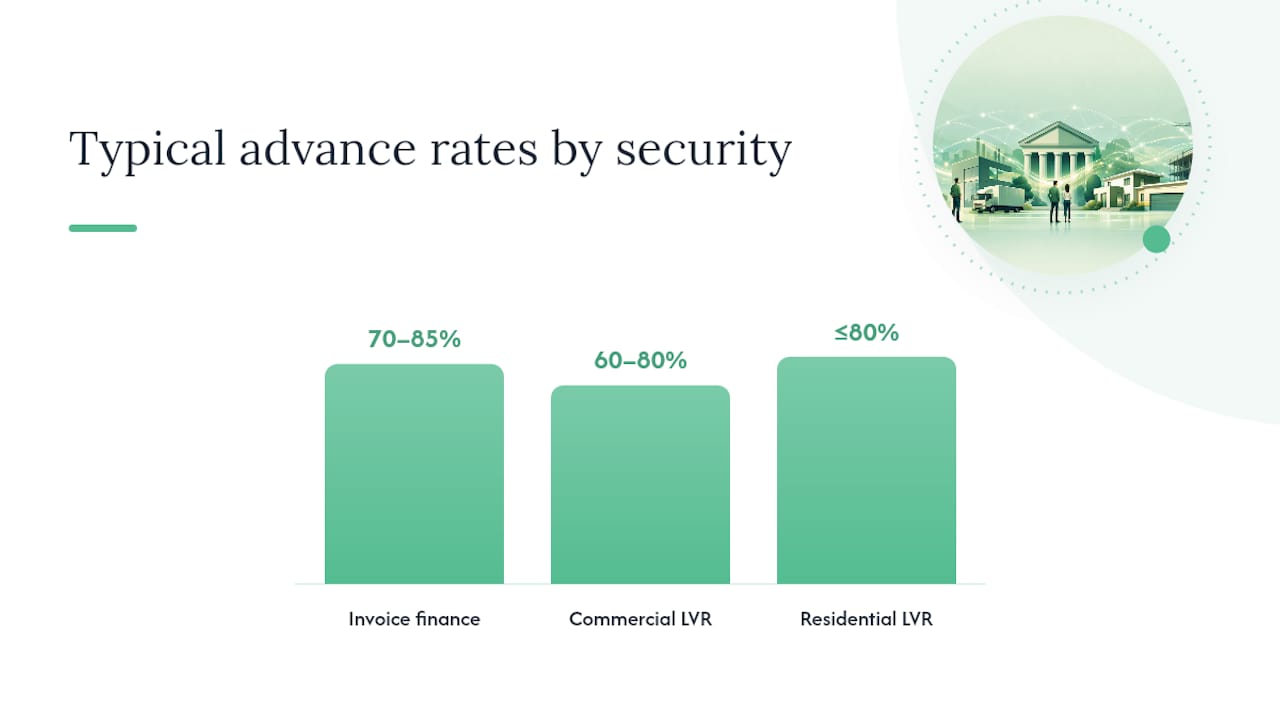
| Invoice finance | Advance on outstanding invoices (typically 70–85%) | Businesses with strong debtors but slow payment cycles |
| Line of credit / overdraft | Flexible; limit set by cash flow and security | Managing working capital gaps |
| Unsecured term loan | Lower limits; higher rates; faster approval | Short-term needs where speed matters |
Equipment finance is worth considering when you need capital for a specific asset purchase. Because the equipment itself acts as security, lenders assess the asset's value separately from your general business cash flow. A trade business buying a $150,000 vehicle or piece of plant can often access that amount through equipment finance even when its unsecured borrowing limit is much lower.
Invoice finance works differently again. If your business has $200,000 in outstanding invoices from creditworthy clients, a lender may advance 70–85% of that value within days. The capacity is tied to your debtor book, not your historical cash flow, which makes it a practical route for businesses in growth phases.
Offering property as security changes the lender's assessment significantly. Australian lenders typically apply a Loan-to-Value Ratio (LVR) of 60–80% against commercial property and up to 80% against residential property used as security. A director offering their home as a guarantee can substantially lift the total amount available, though this carries personal risk that deserves careful consideration. Property investments held in your own name or through a trust can also be used as collateral in some structures.
How to estimate the impact of your changes with a worked example
Small, measurable improvements to monthly net operating income often produce a bigger short-term lift to borrowing capacity than credit score improvements alone, because lenders prioritise serviceability above most other factors.
Here is a simple worked example using realistic Australian assumptions:
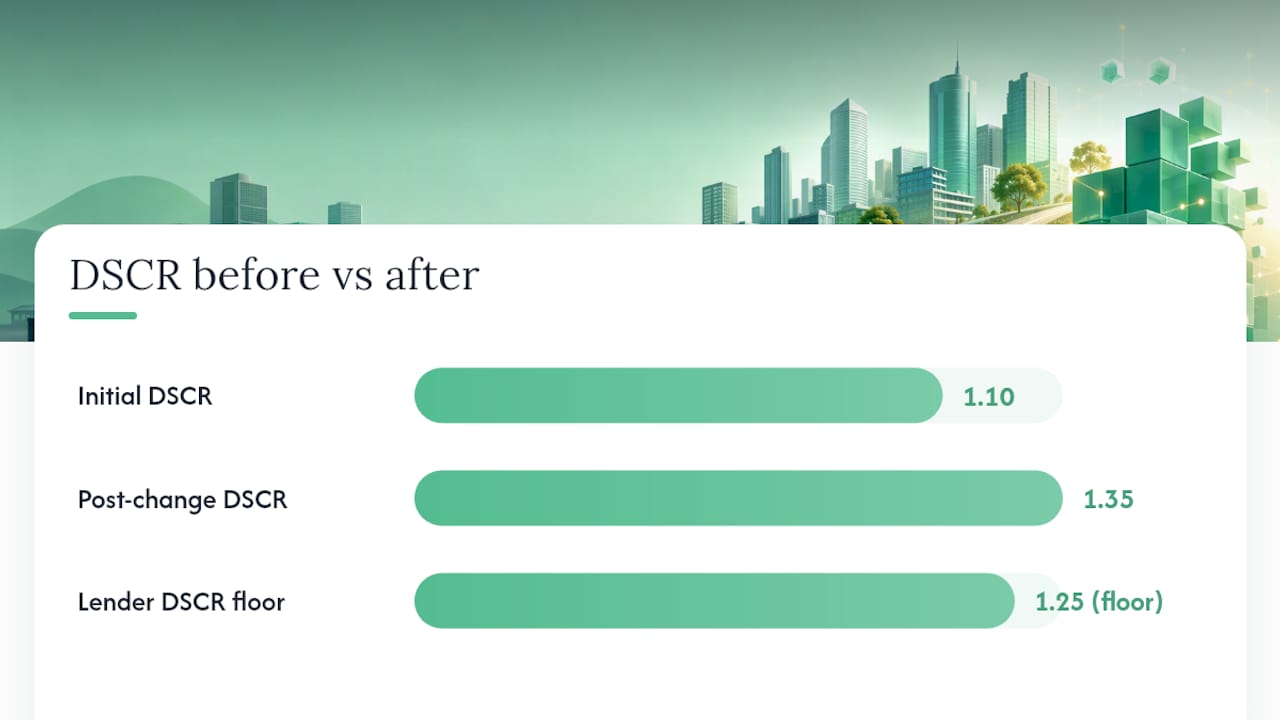
Assumptions: 5-year term loan, 8.5% interest rate, lender requires a minimum DSCR of 1.25, monthly repayment capped at 30% of average monthly net revenue.
A moderate lift in monthly net revenue combined with paying down existing high-cost credit card debt can significantly increase the available loan amount under these assumptions. The DSCR moves from approximately 1.10 to 1.35, crossing the common 1.25 threshold that many lenders require.
Key assumptions to adjust for your situation:
- Interest rate: varies by lender, product, and security offered (8.5% is a mid-range estimate for an unsecured SME loan in 2026)
- Loan term: longer terms reduce monthly repayments and can increase the total amount available
- DSCR floor: some lenders use 1.20, others 1.35; ask your broker which lenders apply which threshold
- Revenue cap: not all lenders cap at 30%; some use DSCR alone
Use the Zenrgfinance borrowing power calculator to plug in your own numbers. Test the interest rate sensitivity first, then adjust the loan term, and finally model the impact of reducing your existing debt service. Those three levers typically move the result the most.
How long do improvements take, and what do they cost?
Some changes show up in a lender's assessment within 30–90 days. Others require 6–18 months of consistent behaviour before they register. Tighter serviceability tests in the current Australian lending environment mean that timing your application well is more important than it was a few years ago.
| Action | Typical time-to-impact | Notes |
|---|---|---|
| Pay down credit card / short-term debt | 30–60 days | Reflects in next lender statement cycle |
| Improve average bank balance | 60–90 days | Lenders average 3 months of statements |
| Fix credit report errors | 30–90 days | Depends on bureau processing time |
| Offer property as security | Immediate (at application) | Requires valuation; adds 1–2 weeks to approval |
| Build 12-month trading history | 6–12 months | Unlocks more lender options and better rates |
| Raise business credit profile | 12–18 months | Consistent lodgements, no defaults, low utilisation |
Costs and trade-offs to plan for
Refinancing existing debt to lower your monthly repayments can improve your DSCR, but it comes with costs. Break fees on fixed-rate loans can be substantial, and legal fees for property-secured loans typically run $1,500–$3,000 depending on complexity. Valuation fees for commercial property are usually $1,000–$3,000. Application fees vary by lender and product.
Zenrgfinance operates on a commission-based model, paid by the lender on settlement, so there is no upfront broker fee for most business lending engagements. Confirm the fee structure at your first conversation.
The main trade-offs to weigh:
- Using property as security increases your capacity but puts a personal asset at risk if the business cannot service the debt.
- Extending a loan term reduces monthly repayments (improving DSCR) but increases total interest paid over the life of the loan.
- Consolidating short-term debts into a longer-term facility lowers monthly obligations but may reduce your flexibility to pay down early without penalty.
How can a broker like Zenrgfinance increase your borrowing capacity?
An experienced broker can often increase your practical borrowing capacity by matching you to lenders who weight cash flow and collateral favourably, and by improving how your file is presented before it reaches an underwriter. Zenrgfinance's business finance services are built around exactly this kind of tailored preparation and lender matching.
Here is what that looks like in practice:
- File audit. A broker reviews your bank statements, BAS, and tax returns before submission to identify anything that could trigger a conservative assessment.
- Lender matching. Not every lender weights DSCR, collateral, and industry risk the same way. A broker with access to multiple lenders can direct your application to the one whose credit policy suits your profile.
- Product structuring. Choosing between a secured term loan, equipment finance, and invoice finance is not just about rate. The right product can lift your total accessible capital significantly.
- Scenario modelling. Presenting multiple amortisation and LVR scenarios to an underwriter gives them a range of repayment outcomes to assess, which can shift a conservative initial position.
- Submission and negotiation. A well-structured credit proposal, with supporting commentary on any revenue irregularities, reduces underwriter uncertainty and speeds approval.
- Settlement support. Zenrgfinance stays with you through to settlement, not just approval.
Before a strategy session, prepare: 12 months of business bank statements, your last 4 BAS, two years of tax returns, a current profit and loss, and a list of all existing debts with balances and monthly repayments. The more complete your file, the more accurately a broker can model your options.
Pro Tip: If your business has seasonal revenue, bring 12 months of management accounts and show a rolling cash buffer. Seasonality is often treated as a risk unless there is clear evidence of financial planning to manage it. A reserve account with 2–3 months of average expenses sitting in it tells a very different story than a volatile bank balance.
To book a strategy session, speak with the team at Zenrgfinance's mortgage relationship manager page.
A practical note from a mortgage specialist
Cash flow documentation is the single lever most small business owners underestimate. Before worrying about your credit score or the right loan product, reconcile your last three months of bank statements and highlight every recurring deposit. That exercise alone often reveals income patterns that lenders will reward, and gaps that are worth addressing before you apply.
The right product matters almost as much as the numbers. A business with strong debtors but thin cash flow is a better candidate for invoice finance than an unsecured term loan, and a broker who knows that distinction will get you a materially better outcome than applying directly.
Zenrgfinance can help you prepare and apply with confidence
Getting your borrowing capacity right before you apply is where Zenrgfinance adds the most value. A tailored strategy session covers your current financial position, which lenders suit your profile, and which product structure gives you the highest accessible amount at the lowest cost.

What a session includes: a review of your bank statements, BAS, and tax returns; a borrowing capacity estimate using realistic lender assumptions; a lender shortlist matched to your industry, trading history, and security position; and a clear action plan for the next 30–90 days.
What to bring: 12 months of business bank statements, your last 4 BAS lodgements, two years of tax returns, a current profit and loss, and a list of existing debts. The more complete your documents, the more specific the advice.
Zenrgfinance is commission-based, paid on settlement by the lender, so the strategy session costs you nothing upfront. To get started, visit the business finance page or book directly through the mortgage relationship manager.
Sources
- Factors That Impact Loan Size: What Determines How Much You Can Borrow
- How much can I borrow for my business?
- How Much Can You Borrow? Factors for Business Loans
- What is creditworthiness? | U.S. Bank
This article is general information, not a substitute for advice from a qualified financial advisor. Consult a qualified financial professional about your own circumstances before acting on anything here.