
Most Australian lenders will not let you attach a genuine offset account to a fixed-rate home loan. A small number of second-tier banks and non-bank lenders make exceptions,, usually charging a rate premium for the privilege. The common workaround is a split loan, where part of your borrowing stays fixed and the rest sits on a variable rate with a full offset attached, and that is what most brokers recommend once the numbers are run.
TL;DR:
- Most Australian lenders do not offer genuine offset accounts on fixed-rate loans, except through higher rate premiums or split loan arrangements.
- Fixed-rate loans usually exclude offset features because daily changing balances disrupt lenders' ability to lock in predictable funding costs.
- Borrowers with fixed loans should thoroughly check whether offsets are full or partial, as many include caps or reduced benefit clauses in the PDS.
- Split loans are the common workaround, allowing a fixed portion for certainty and a variable portion with a full offset for flexibility, tailored to cash flow.
- Running detailed calculations based on your average offset balance and fixed rate premium helps determine if a fixed offset or split loan yields real savings.
Table of Contents
- How fixed-rate loans and offset accounts actually work in Australia
- Exceptions: when lenders offer offset on fixed rates and the trade-offs
- Split loans explained: certainty on one side, offset on the other
- Is a fixed-rate with offset premium worth paying?
- Checklist: questions and PDS checks before you sign
- Tax implications of using an offset account with a fixed rate loan
- How loan term and loan amount changes affect your offset benefit
- Real savings across different fixed terms
- ZENRG Finance perspective: testing the trade-off properly
- Get help from ZENRG Finance: calculators, comparisons and a strategy session
- Sources
- FAQ
How fixed-rate loans and offset accounts actually work in Australia
Lenders price fixed loans on the assumption they know exactly how much interest they'll collect over the term. An offset account throws a spanner in that: your balance moves daily, so the bank can't lock in predictable funding costs the same way. That's the core reason most fixed products in Australia skip offset entirely, even though the same lender happily offers it on a variable loan.
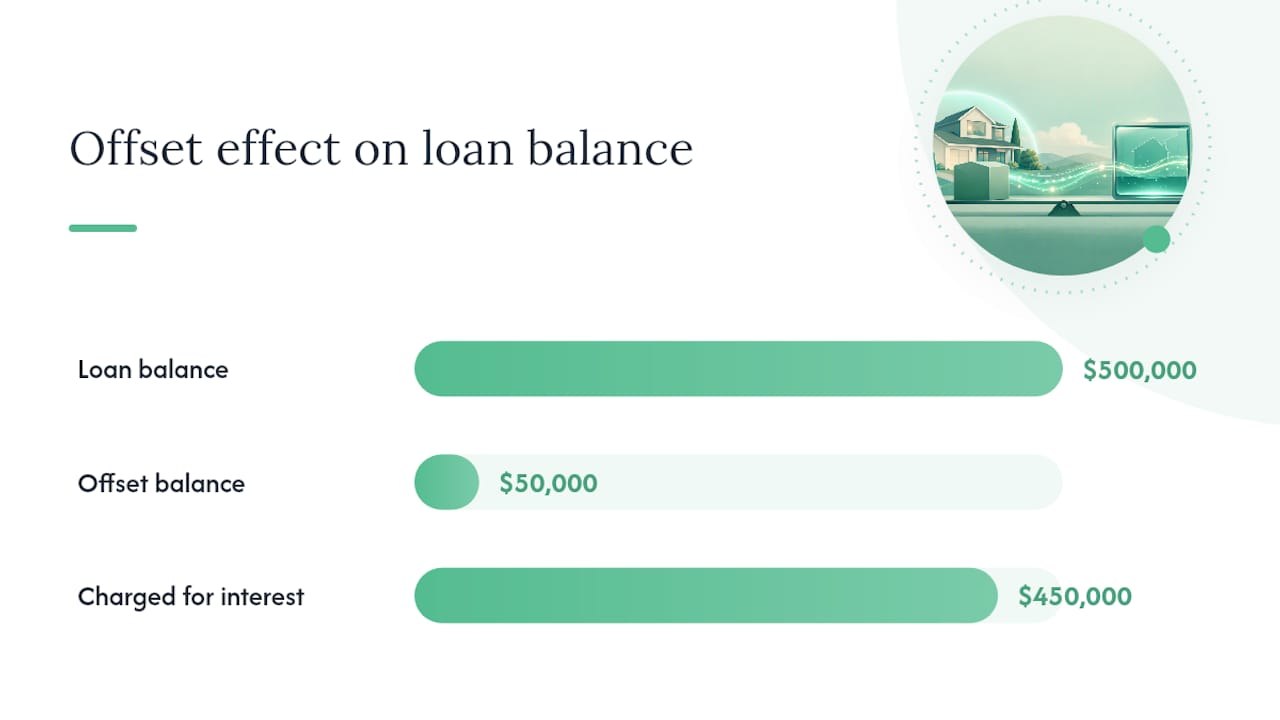
On a variable loan, offset works by reducing the interest you're charged based on how much sits in a linked transaction account. If you owe $500,000 and hold $50,000 in the offset, you're only charged interest on $450,000, and the calculation resets every day.
Redraw is a different animal. It lets you access extra repayments you've already made, but those funds usually go back into the loan account itself rather than sitting separately, and some fixed loans cap how much you can redraw or charge for the privilege.
There are two flavours of offset worth knowing before you compare products:
- Full offset: 100% of your balance reduces the interest-bearing loan amount, dollar for dollar.
- Partial offset: only a portion of your balance counts, or the bank applies a reduced rate to the offset amount rather than removing it from the loan balance entirely.
That distinction matters more on fixed products, where lenders are more likely to offer the partial version to manage their own risk.
Exceptions: when lenders offer offset on fixed rates and the trade-offs
A handful of regional banks, mutuals, and non-bank lenders in Australia do offer offset facilities on fixed-rate loans. Bendigo Bank and Australian Mutual Bank are examples of lenders that have marketed offset alongside fixed terms, though the exact mechanics vary between full and partial models depending on the specific product.
Quick fact: Broker guides consistently flag that most Australian lenders exclude offset from fixed loans altogether, and the ones that don't typically charge for it through a higher fixed rate.
The trade-offs tend to follow a pattern:
- A fixed rate that sits above the standard fixed rate for the same term, sometimes by a meaningful margin.
- Capped extra repayments during the fixed period, often $10,000 to $20,000 a year before break costs kick in.
- Package fees that bundle the offset feature with other products, whether you use them or not.
- Reduced or partial offset calculation rather than a full dollar-for-dollar reduction.
Before you sign anything, get the product disclosure statement and read the clause defining how offset applies. ASIC has flagged that some borrowers have lost interest savings because the offset feature didn't behave the way marketing materials implied. Ask the lender directly whether the offset is full or partial, and get the answer in writing.
Split loans explained: certainty on one side, offset on the other

A split loan divides your borrowing into two (or more) portions, each with its own rate type. One portion is fixed, giving you repayment certainty. The other stays variable, and that's the portion you attach a full offset account to. It's the workaround brokers reach for most often when a client wants both stability and flexibility, because most fixed products simply don't support offset directly.
Splits aren't one-size-fits-all. Here are three common structures and who they tend to suit:
- 70% fixed / 30% variable with offset — suits borrowers who want maximum rate certainty but still hold a decent cash buffer they want working for them.
- 50/50 split — a middle ground for households expecting some savings growth over the fixed term, without betting everything on rate stability.
- 30% fixed / 70% variable with offset — fits borrowers who expect a large offset balance (an inheritance, sale proceeds, bonus income) and only want a small slice locked in for peace of mind.
Operationally, each portion behaves independently. You can usually make unlimited extra repayments and redraws on the variable side, while the fixed side keeps its usual caps and break-cost exposure. Read more on how split loans work before deciding on a ratio.
Pro Tip: Match your split ratio to your cash flow, not your gut feeling. If your offset balance genuinely fluctuates by $30,000 or more across a year, put more of the loan on the variable side so that swing actually earns its keep.
Is a fixed-rate with offset premium worth paying?
Run the maths before you pay for the privilege. You need four numbers: the loan amount, the fixed term, your realistic average offset balance, and the size of the rate premium the offset-enabled fixed loan charges over a standard fixed rate.
Here's a worked example on a $500,000 loan over a three-year fixed term, assuming an average offset balance of $40,000:
| Scenario | Rate | Effective loan balance | Annual interest (approx.) |
|---|---|---|---|
| Standard fixed, no offset | 5.8% | $500,000 | $29,000 |
| Fixed with offset (rate premium) | 6.1% | $460,000 | $28,060 |
In this example, the offset-enabled fixed rate still comes out roughly $940 a year cheaper once the offset balance is factored in, but that gap narrows fast if your balance drops or the premium is higher. The break-even point depends entirely on:
- how consistently large your offset balance stays across the fixed term
- whether the premium is a flat percentage or scales with loan size
- how many years remain on the fixed term (a longer term amplifies both the savings and the premium cost)
Test your own numbers with ZENRG's Home Loan Offset Calculator before committing, plugging in a conservative average balance rather than your peak balance.
Checklist: questions and PDS checks before you sign
Bring this list to any lender or broker conversation:
- Is the offset full or partial, and how is that defined in the PDS?
- What's the exact rate premium compared to the same lender's standard fixed rate?
- Are extra repayments capped, and what happens if you exceed the cap?
- Are there package fees attached, and do they apply regardless of offset use?
- What are the break costs if you need to exit the fixed term early?
Read the PDS clause on offset calculation frequency. Some products apply offset daily, others monthly, and that difference alone can shift your annual savings noticeably.
Pro Tip: If a lender's marketing calls a feature "full offset" but the PDS defines a cap or a reduced rate on the offset portion, that's a mismatch worth querying in writing before you proceed.
Tax implications of using an offset account with a fixed rate loan
Offset accounts don't generate assessable income themselves, because the "return" comes as reduced interest rather than earned interest. That's a meaningful difference from a regular savings account, where interest earned is taxable.
For owner-occupied properties, this doesn't change anything about deductibility, since owner-occupier loan interest generally isn't deductible regardless of whether you offset it. The picture shifts for investment properties. If your loan is for an investment property and you're using an offset account, the interest you're charged (after offsetting) is typically what remains deductible, since offset reduces the interest itself rather than counting as a separate repayment against the loan principal. That's different from putting extra funds directly into the loan via redraw, which can complicate deductibility if you later redraw those funds for a private purpose.
This is exactly the kind of detail worth checking with a tax adviser or accountant before you decide how to structure a split loan between fixed and variable portions, particularly if part of the borrowing relates to an investment property and part relates to your own home. The offset mechanics themselves don't change under a fixed-rate structure. What changes is your ability to access one at all, and that's a structuring decision, not a tax one.
How loan term and loan amount changes affect your offset benefit
A longer fixed term magnifies both sides of the equation. Lock in five years instead of two, and a rate premium compounds for longer, but so does any consistent offset balance you're carrying. This is why the break-even calculation from earlier matters more as the term stretches out. A small annual saving becomes meaningful money over five years; a small annual cost does too.
Loan amount changes the dollar impact of the same percentage move. The same premium on a $700,000 loan costs around $2,100 a year, so the same offset balance needs to work harder in percentage terms to justify the premium as your loan size grows.
Paying down the loan also matters. As your loan balance shrinks over the fixed term, the dollar value of any given offset balance represents a larger share of the outstanding debt. That's one reason a shorter fixed term paired with a decent offset balance can sometimes outperform a longer fixed term with the same balance, even before rate premiums are considered.
Real savings across different fixed terms
Consider three borrowers with the same $500,000 loan and the same $50,000 average offset balance, differing only in fixed term length.
Over two years, that's close to a wash. Not much upside there.
A borrower on a five-year fixed term with the same balance and premium sees the maths shift, because their offset balance tends to grow as they get further into their savings habits, and the fixed rate they locked in becomes more valuable if rates rise over that period. Brokers who've modelled this consistently point to split loans outperforming pure fixed-with-offset products for exactly this reason: the certainty and flexibility combination usually beats a single-product compromise.
A third borrower, refinancing mid-term into a split structure after starting on a standard fixed loan with no offset, effectively captures offset savings from the day they switch onto the variable portion, without ever needing a fixed product with offset attached at all. This is the most common real-world pattern brokers see: borrowers start fixed, then split at refinance time once their savings habits and cash flow become clearer.
ZENRG Finance perspective: testing the trade-off properly
Most borrowers approach this backwards. They ask "can I get offset on my fixed loan?" when the better question is "what does my average offset balance look like over the next few years, and does a premium or a split actually pay off?"
Some brokers run break-even scenarios against real client cash flow patterns rather than assumptions. One recent scenario involved a client refinancing a loan who assumed they needed a fixed-with-offset product to keep their savings working. Modelling their actual balance history showed a 60/40 split, fixed on the larger portion, delivered a better outcome than any fixed-offset product on the market at the time, once the premium was factored in, according to the modelling.
There's value in testing multiple lender PDS terms side by side rather than accepting the first marketing claim you read. Numbers change with rate movements, so it's worth re-running the offset calculator whenever your savings pattern shifts materially.
— Allen
Get help from ZENRG Finance: calculators, comparisons and a strategy session
Working out whether a fixed rate with offset premium, a split loan, or a straight variable structure suits you best usually comes down to your own numbers, not a generic rule. Mortgage brokers compare loan products across multiple lenders, model split-loan scenarios against actual savings patterns, and check PDS terms so you're not relying on marketing copy to make a five-figure decision.

Start by running your own figures through the Home Loan Offset Calculator to see whether a premium or a split makes more sense for your loan amount and expected balance. Then book a session with a mortgage relationship manager to walk through lender options and get a structure recommendation tailored to your situation, not a one-size-fits-all product pitch.
This article is general information, not a substitute for advice from a qualified financial advisor. Consult a qualified financial professional about your own circumstances before acting on anything here.
Sources
- Mortgage offset accounts - Moneysmart
- ASIC media release — hidden mortgage offset failures (2026)
- Offset account | Bendigo Bank
FAQ
Can I have an offset account with a fixed rate loan?
Generally no, most Australian lenders don't allow a genuine offset account on a fixed-rate loan, though a small number of lenders offer it at a rate premium. The common workaround is a split loan, keeping part of your borrowing variable with offset attached.
What is a fixed-rate offset mortgage?
It's a home loan where part or all of the balance is charged a fixed interest rate while still allowing an offset account to reduce the interest calculation, a feature only some Australian lenders provide and usually at a higher rate than a standard fixed loan.
How much interest will I save with an offset account?
Savings depend on your average balance and loan size.
What salary do you need for a $500,000 loan?
It varies by lender, existing debts, and living expenses, so a broker can model your exact borrowing capacity against your specific income and expenses.