
A split home loan divides your mortgage into two or more separate portions, typically one on a fixed interest rate and one on a variable rate, so you get some repayment certainty without giving up all your flexibility. Lenders like CommBank, Westpac, and NAB all offer this structure, and it is one of the more popular choices for Australian owner-occupiers and investors who want to hedge against rate movements.
Quick snapshot before you read on:
- Pros: Partial rate certainty, protection if rates rise, flexibility to make extra repayments on the variable portion, and access to offset accounts on that same portion.
- Cons: Break costs if you exit the fixed portion early, reduced flexibility on the fixed side, and slightly more admin than a single-rate loan.
- Who uses it: First-home buyers wanting budget predictability, families managing tight cash flow, and property investors who need flexibility for extra repayments while locking in part of their cost base.
Worth noting: in financial markets, "split loan" can also refer to securitisation tranches where assets are divided to create different investor risk profiles. That is a completely different concept to the retail home loan product covered here.
Key takeaways
A split home loan gives Australian borrowers partial rate certainty and repayment flexibility by dividing a single mortgage into fixed and variable portions, each with its own features and costs.
| Point | Details |
|---|---|
| What a split loan is | One mortgage divided into fixed and variable portions, each with separate rates and features. |
| Key benefit | Partial rate certainty on the fixed side, extra repayment flexibility and offset access on the variable side. |
| Main risk to watch | Break costs on the fixed portion can be significant if you exit or refinance before the fixed term ends. |
| Choosing your split ratio | Model 30/70, 50/50, and 70/30 scenarios using a calculator and stress-test each with a 2% variable rate rise. |
| Zenrgfinance | Zenrgfinance brokers compare lender rules, model tailored stress tests, and help you structure the right split for your goals. |
Table of Contents
- How does a split home loan work in practice?
- What are the benefits and drawbacks of a split loan?
- How do you decide how much to fix vs leave variable?
- A worked example: $500,000 loan split 50/50
- How do you set up a split loan or refinance into one?
- What tools can you use to model split scenarios?
- How can a mortgage broker help you structure a split loan?
- Who actually benefits most from a split loan?
- Zenrgfinance can help you find the right split
- Sources
How does a split home loan work in practice?
When you set up a split loan, your lender creates two separate account numbers under the one mortgage. Each portion has its own interest rate, its own repayment schedule, and its own set of features. You make repayments to each account, though many lenders let you set up a single direct debit that allocates funds across both.
Interest calculation works independently for each portion. The fixed portion is locked at the agreed rate for the fixed term, so your repayment on that side does not change regardless of what the Reserve Bank of Australia does. The variable portion reprices whenever your lender moves its standard variable rate, which means your repayment on that side can go up or down.
Features are where the split structure gets interesting:
- Variable portion: Typically allows unlimited extra repayments, access to a redraw facility, and an offset account that reduces the interest you pay on that balance.
- Fixed portion: Usually caps or prohibits extra repayments (some lenders allow a small annual threshold, often around $10,000), and offset accounts generally do not apply to fixed portions.
- Redraw on fixed: Rarely available; check your lender's terms before assuming it is included.
A split home loan lets you divide a loan into separate portions, with the lender allocating repayments across those portions and features such as offset or redraw sometimes applying only to the variable portion. Understanding exactly which features attach to which account is the single most important question to ask before you sign.
Pro Tip: Ask your lender specifically whether your offset account balance reduces interest on the variable portion only, or whether any offset benefit flows across to the fixed portion. Most lenders apply offset exclusively to the variable side, which affects how much you should park in that account.
What are the benefits and drawbacks of a split loan?
The appeal of a split loan comes down to one core idea: you do not have to bet everything on one rate type. If rates rise sharply, your fixed portion shields part of your repayments. If rates fall, your variable portion lets you benefit from lower costs and make extra repayments to pay down the loan faster.
Benefits worth knowing
- Partial rate certainty: The fixed portion locks in a known repayment, which makes budgeting easier, especially for households with tight monthly cash flow.
- Upside if rates fall: The variable portion reprices downward, so you are not entirely locked out of a rate-cut cycle.
- Extra repayment flexibility: Parking surplus cash into the variable portion reduces interest and builds equity faster, without triggering break costs.
- Feature mix: You can use an offset account on the variable side while still enjoying the certainty of a fixed rate on the other.
Drawbacks to weigh up
- Break costs on the fixed portion: Exiting or refinancing the fixed portion before its term ends can be expensive, sometimes thousands of dollars depending on how far rates have moved.
- Reduced flexibility on the fixed side: Extra repayments are usually capped, and you cannot redraw freely.
- Slightly more complex to manage: Two accounts mean two sets of statements and two repayment lines to track.
For property investors scaling a portfolio, the variable portion's flexibility is often the deciding factor. For owner-occupiers who simply want to sleep soundly knowing at least half their mortgage repayment will not change, the fixed portion does that job well. You can read more about investor financing strategies if that side of the equation applies to you.
Split loan dimensions at a glance
| Dimension | Fixed portion | Variable portion |
|---|---|---|
| Interest type | Fixed for agreed term | Moves with lender's variable rate |
| Extra repayments | Usually capped or restricted | Typically unlimited |
| Offset account | Generally not available | Usually available |
| Redraw facility | Rarely available | Commonly available |
| Break cost risk | Yes, if exited early | None |
| Typical use case | Certainty-focused owner-occupiers | Investors, extra-repayment strategies |
How do you decide how much to fix vs leave variable?
There is no universal right answer, but there is a useful set of questions to work through before you pick a split ratio.
Ask yourself:
- How tight is my monthly cash flow? If a rate rise of 1–2% would genuinely stress your budget, a larger fixed portion gives you a buffer.
- Do I expect to make significant extra repayments in the next 1–3 years? If yes, keep a larger variable portion so those payments reduce your balance without penalty.
- Am I planning to sell, refinance, or access equity within the fixed term? If so, a smaller fixed portion limits your break-cost exposure.
- What is my view on the rate cycle? If rates look likely to fall, a smaller fixed portion lets you benefit more from those cuts.
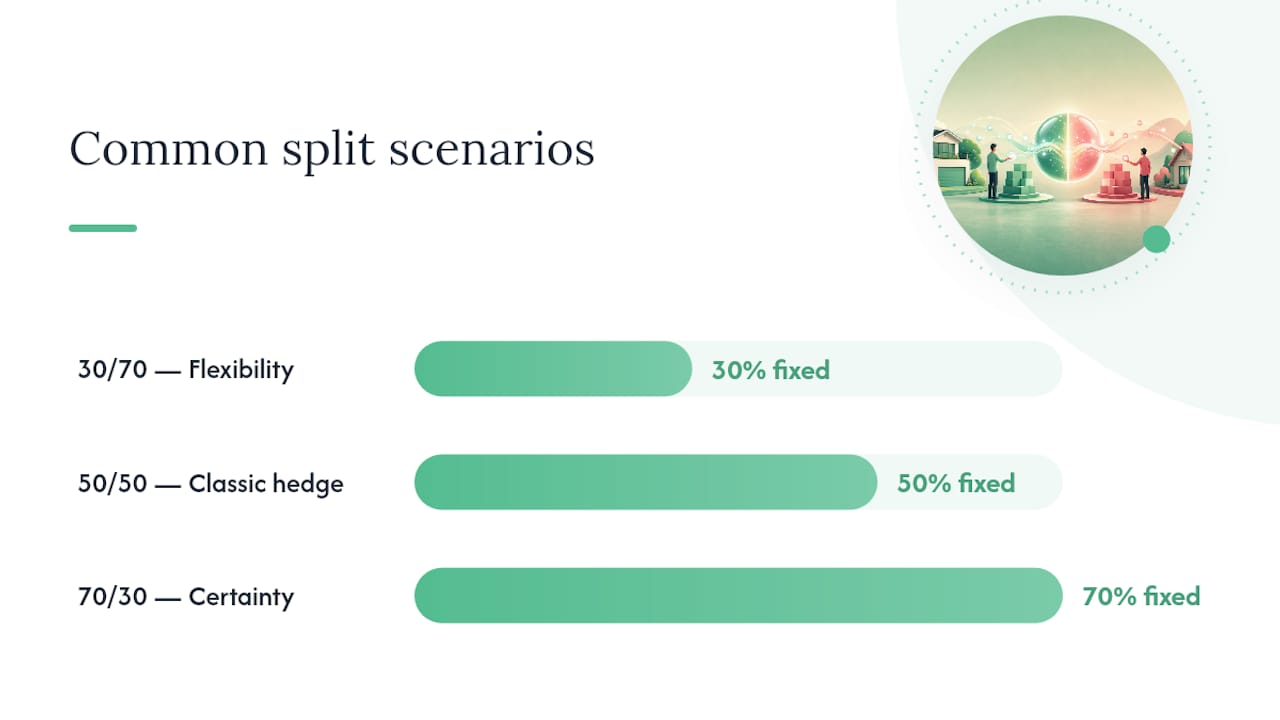
Common split scenarios and who they suit:
- 30% fixed / 70% variable: Works well for borrowers who want a small certainty buffer but prioritise flexibility and extra repayments. Common among investors and borrowers with variable income.
- 50% fixed / 50% variable: The classic hedge. Suits owner-occupiers who want balanced exposure, neither fully locked in nor fully exposed to rate movements.
- 70% fixed / 30% variable: Favours certainty. Suits households on fixed incomes or those who have stretched their borrowing capacity and need predictable repayments.
Stress-test steps before you commit:
- Use a split loan calculator to model your chosen ratio at current rates.
- Increase the variable rate by 1% and recalculate. Can you comfortably cover the higher repayment?
- Increase it by 2% and repeat. If the answer is no, shift more of the loan to the fixed portion.
- Check the fixed term length. A two-year fix gives you a shorter commitment than a five-year fix, which matters if your circumstances might change.
A worked example: $500,000 loan split 50/50
Assumptions: $500,000 loan, 30-year term, 50/50 split. Fixed portion rate: 5.99% p.a. Variable portion rate: 6.25% p.a. These rates are illustrative only. Use live rates from your lender or the Zenrgfinance repayment calculator for accurate figures.
Rate sensitivity: If the variable rate rises by 1% to 7.25%, the variable portion repayment increases from $1,539 to approximately $1,706 per month, adding roughly $167 to your combined monthly repayment. A 1% fall to 5.25% reduces it by a similar margin.
These figures assume interest-only periods do not apply and that no extra repayments are made. In practice, directing surplus cash into the variable portion would reduce the total interest paid meaningfully over the loan term.
Disclaimer: The rates and figures above are illustrative examples only and do not represent current market rates. Always check live rates with your lender or broker before making any decisions.
How do you set up a split loan or refinance into one?
You can split a home loan at settlement when you first take out the mortgage, or you can restructure an existing loan into a split at any point during the loan term. Both paths are straightforward, though the costs and timing differ slightly.
Steps to set up a split at settlement:
- Decide your split ratio and fixed term length before you apply.
- Tell your lender or broker the split structure you want when submitting your application.
- The lender sets up two separate account numbers at settlement, each with its own rate and features.
- Confirm in writing which features (offset, redraw, extra repayments) attach to which portion.
Steps to split an existing loan:
- Contact your lender and request a loan restructure. Many lenders process this without an establishment fee, but check first.
- Confirm the break-cost position on any existing fixed portion before making changes.
- Provide updated income and liability documents if the lender requires a credit reassessment.
- Sign the new loan schedule and allow 5–10 business days for the split to take effect.
Refinancing into a split loan with a new lender follows the same process as any refinance, but you must factor in break costs on your current fixed portion and any discharge fees from your existing lender. As Compare the Market notes, refinancing a split loan is generally possible like any other refinance, but borrowing capacity and lender-specific costs need careful consideration.
Costs to watch:
- Break costs: Can be significant if you exit a fixed portion when market rates have fallen since you fixed. Always request a break-cost quote in writing before proceeding.
- Establishment or package fees: Some lenders charge a fee to set up the split structure; others include it in a packaged loan fee.
- Comparison rate: The comparison rate on a split loan reflects fees and charges across the combined loan, so compare it carefully rather than just the headline rates.
Questions to ask your lender before signing:
- What is the break cost if I exit the fixed portion in year one, two, or three?
- Does my offset account reduce interest on the variable portion only?
- Are extra repayments on the fixed portion capped, and if so, at what annual amount?
- Is there a fee to change the split ratio later?
What tools can you use to model split scenarios?
Running the numbers before you commit is the single best thing you can do. These tools make it straightforward:
- Loan comparison calculator: Compare a split structure against a full fixed or full variable loan side by side to see the overall cost difference.
- Repayment calculator: Run per-portion repayment checks if you want to see each account in isolation.
- Home loan offset calculator: Model how parking savings in an offset account on the variable portion reduces your interest bill over time.
- Lender tools: Canstar's split home loan comparison lets you compare split loan products across lenders and check which features each product includes.
Pro Tip: Set up three side-by-side scenarios in the split calculator: 30/70, 50/50, and 70/30. Then apply a 2% variable rate rise to each. The scenario where the rate-rise repayment still fits your budget comfortably is your starting point for the conversation with your broker.
How can a mortgage broker help you structure a split loan?
Choosing a split ratio is one thing. Knowing which lenders allow offset on the variable portion, which cap extra repayments at $10,000 per year on the fixed side, and which have the lowest break-cost methodology is another. That is where a broker earns their value.
A broker working on your split loan can:
- Compare lender rules on offset accounts, redraw, and extra repayment caps across multiple products.
- Request a break-cost estimate from your current lender before you commit to any restructure.
- Model tailored stress tests using your actual income, expenses, and future plans, not just generic rate scenarios.
- Negotiate loan structure and features on your behalf, including whether a package fee covers both portions.
- Identify whether a home loan comparison checklist approach reveals a better-value product at another lender.
Zenrgfinance's split loan calculator is available to use directly, and a Zenrgfinance broker can run a personalised stress test using your numbers rather than illustrative ones. For investors specifically, understanding how a split structure interacts with your tax position and borrowing capacity across multiple properties adds another layer that a broker is well placed to map out. See the scaling a rental portfolio guide for context on how split structures fit into broader investment strategies.
This section provides general information only. Personal financial advice requires a licensed adviser who understands your full financial situation.
Who actually benefits most from a split loan?
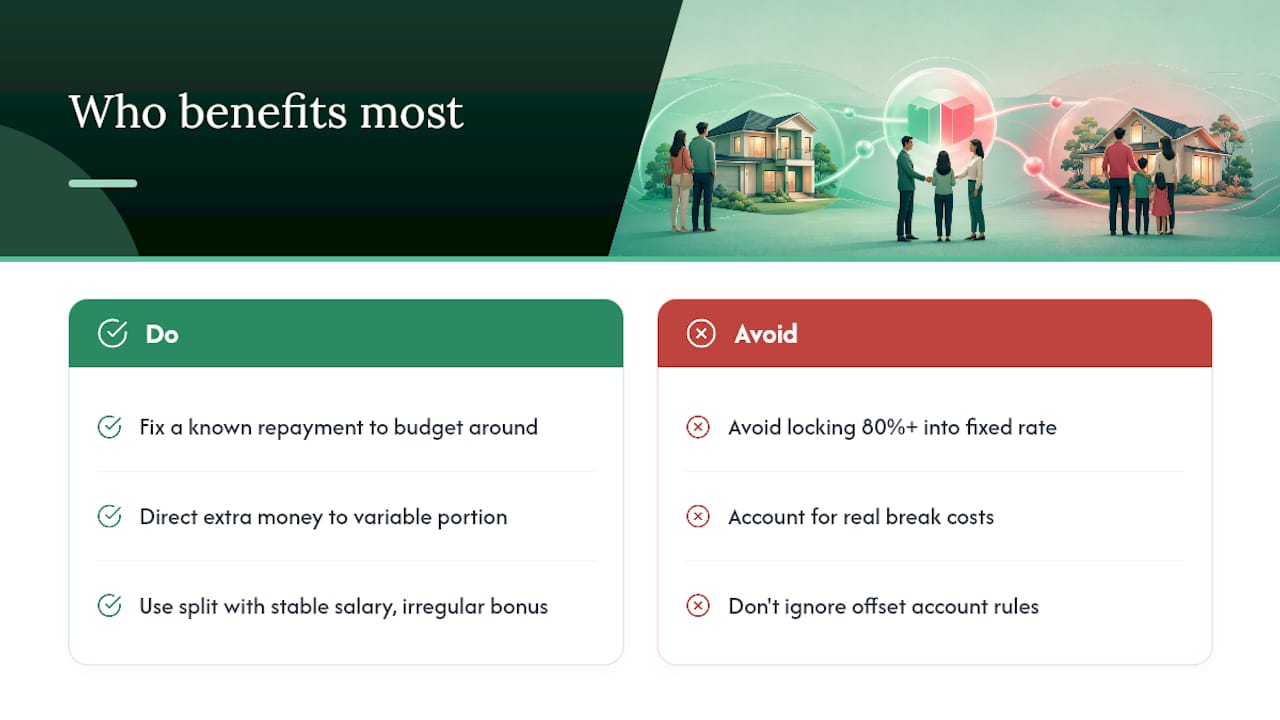
The borrowers who get the most from a split structure are those who genuinely need both things at once: a known repayment they can budget around, and the freedom to throw extra money at the loan when cash flow allows. That combination is more common than people realise. A family with a stable salary but an irregular bonus, for example, can fix the base repayment and direct the bonus straight into the variable portion without penalty.
Where split loans tend to disappoint is when borrowers over-fix. Locking 80% or more of a large loan into a fixed rate and then watching rates fall, or needing to refinance before the term ends, can wipe out any saving the fixed rate provided. The break cost is not a theoretical risk; it is a real dollar figure that can run into several thousand dollars on a large loan. The other common mistake is ignoring the offset account rules and parking savings in the wrong account, effectively paying interest on a balance that could have been offset.
Zenrgfinance can help you find the right split
Deciding between a 30/70 or 50/50 split, choosing the right fixed term, and making sure your offset account is attached to the right portion are all decisions that look simple on paper but have real dollar consequences. Zenrgfinance takes the guesswork out of that process by pairing you with a mortgage relationship manager who compares products across multiple lenders, models your specific scenario, and helps you structure a loan that fits your life, not just the current rate environment.

Whether you are buying your first home, refinancing an existing loan, or building an investment portfolio, Zenrgfinance's team can run a tailored split loan analysis using live rates and your actual numbers. Book a free strategy session with a mortgage relationship manager today and walk away knowing exactly what structure suits you.
General information only. Speak with a licensed mortgage broker or financial adviser before making decisions based on your personal circumstances.
Sources
These official lender pages and tools are the best places to verify split loan details and access live rates:
- How split home loans work - NAB
- What is a split home loan? | Westpac
- What is a split home loan? — CommBank
- Split Home Loans Explained | Simples! - Compare the Market
- Compare split home loans
- split-loan — Securitisation glossary
This article is general information, not a substitute for advice from a qualified financial advisor. Consult a qualified financial professional about your own circumstances before acting on anything here.