
Debt recycling converts non-deductible home loan debt into tax-deductible investment debt, using the equity you already have to build wealth while chipping away at your mortgage faster. It suits homeowners with a long time horizon, stable income and a higher marginal tax rate. The catch is real: you're taking on more leverage, and it only works if your loans are structured strictly to Australian Taxation Office rules.
TL;DR:
- Debt recycling is most effective for homeowners with long-term investment horizons, stable income, and a high marginal tax rate, as it relies on deducting interest on investment debt.
- The strategy hinges on strict loan structuring, including splitting the mortgage into separate personal and investment accounts, and ensuring redraws are used immediately for investments.
- The ATO requires a direct link between borrowed funds and income production, making dedicated investment loans and clear record-keeping essential to avoid losing deductions.
- Assets that generate regular income, such as dividend-paying shares or ETFs, are preferred, while growth-only assets like property or crypto pose higher audit risks for deduction claims.
- Effective debt recycling demands discipline, proper structure, and buffers; impulsive selling or poor planning can negate the tax benefits and increase financial vulnerability.
Table of Contents
- What is debt recycling and how does it work?
- How do I set up a debt recycling strategy?
- What are the ATO tax rules for debt recycling?
- What should you invest in when debt recycling?
- What are the risks of debt recycling?
- What does a debt recycling example look like?
- What should you ask before starting debt recycling?
- How a mortgage broker helps you implement debt recycling safely
- The real gap in most debt recycling advice
- Ready to structure your debt recycling strategy the right way?
- Sources
- FAQ
What is debt recycling and how does it work?
Debt recycling is a cycle, not a one-off trade. You're gradually swapping the "bad debt" (your home loan, which earns you no tax deduction) for "good debt" (an investment loan, which can). The mechanism relies on a straightforward principle: interest on money borrowed to earn assessable income is deductible under section 8-1 of the Income Tax Assessment Act 1997, while interest on your own home is not.
Here's the sequence most homeowners follow:
- Make extra principal repayments on your home loan to build usable equity.
- Split the loan into separate sub-accounts, keeping personal and investment portions strictly apart.
- Redraw the newly available equity from the investment sub-account only.
- Invest that amount immediately into an income-producing asset, such as dividend shares or an ETF.
- Claim the interest on the investment portion as a tax deduction, then direct the tax saving and any distributions back onto your home loan.
Repeat the cycle and, over years, more of your total debt shifts from non-deductible to deductible. Timing matters here: the ATO expects funds to be invested straight after the redraw, not left sitting in an everyday account, because that gap can break the connection between the borrowing and the income it was meant to produce.
How do I set up a debt recycling strategy?
Before you touch your loan, check whether you actually fit the profile. Debt recycling generally suits people with a long horizon (think seven to 10 years or more), secure income, a solid emergency buffer and a tax bracket where deductions carry real weight.
Once you've confirmed that, the setup itself comes down to loan structure and discipline:
- Split your mortgage into a home portion and a dedicated investment sub-account, rather than relying on one blended loan.
- Use redraw on the investment portion only. Never route those funds through an offset account tied to your personal spending.
- Confirm with your lender exactly how redraw timing works, and ask about fees or break costs tied to splitting an existing loan (our guide to refinance comparisons for fixed, variable and split loans covers this in detail).
- Ask whether the lender's offset feature can accidentally mix with the investment ledger. Some products blur this line more than others.
- Invest the redrawn amount the same day or as close to it as practical, and keep every transaction record.
Pro Tip: Keep a simple spreadsheet logging every redraw date, the amount, and the investment it funded. If the ATO ever asks questions, that paper trail is worth more than any explanation you could give after the fact.
What are the ATO tax rules for debt recycling?
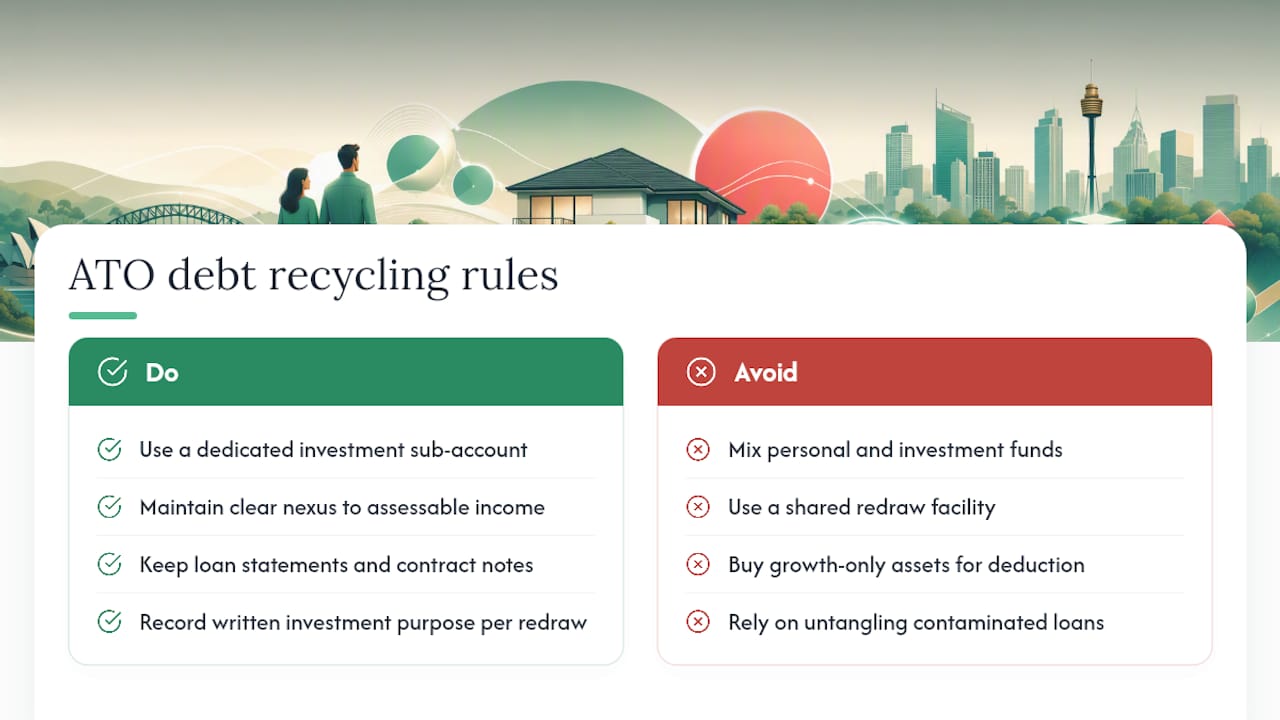
Section 8-1 is the backbone of the whole strategy: interest is deductible when the borrowed money is used to produce assessable income, and that link between borrowing and income, often called the nexus, has to hold up under scrutiny.
Loan contamination, where personal and investment funds mix in the same account, is widely flagged as the single technical error most likely to void your entire interest deduction, according to the ATO.
This is why a dedicated investment loan sub-account rather than a shared redraw facility isn't optional. Once investment and personal funds mix, untangling them for the tax office is difficult and often not worth attempting.
Not every asset defends itself equally well either. Growth-only holdings that pay no distributions, certain crypto assets or bullion bought purely for capital growth, are hard to justify as income-producing for a deduction claim under ATO guidance on investment income deductions. Keep loan statements, contract notes, and a written investment purpose for every dollar redrawn. That's your audit file if the ATO ever comes asking.
What should you invest in when debt recycling?
The ATO's own guidance favours assets that pay you something back regularly, since that income is what supports the deduction. Growth-only bets are a much shakier fit.
- Diversified ETFs that distribute income are the most commonly recommended starting point.
- Dividend-paying shares, particularly from established companies, suit the same purpose.
- Listed investment companies (LICs) offer similar income characteristics with a different fee structure.
- Managed funds with regular distributions work too, though fees vary widely between providers.
Direct property is sometimes floated as an alternative, but it's harder to slice into the small, regular tranches that a debt recycling cycle relies on, and it lacks the liquidity to sell down quickly if your circumstances change. A diversified share or ETF portfolio also spreads risk across dozens or hundreds of companies rather than betting the strategy on one asset.
What are the risks of debt recycling?
The biggest misunderstanding about debt recycling is that it's a low-risk tax trick. It isn't. You're borrowing to invest, and leverage cuts both ways.
- Market risk comes first: if your investments fall in value, your loan balance doesn't shrink with them. You still owe the full amount.
- Interest rate risk follows closely. A jump in rates lifts your investment loan repayments, and if your investment returns don't keep pace after tax, the strategy can add financial stress rather than remove it, a point ATO-aligned guidance makes clear.
- Behavioural risk is the one most people underestimate. Selling in a downturn locks in losses and can permanently derail the whole cycle.
Before starting, run through a simple suitability check: do you have a long enough horizon to ride out a downturn, a cash buffer to cover repayments if income drops, and the temperament to hold a diversified portfolio through volatility rather than panic sell?
Pro Tip: Write down, before you invest a single dollar, exactly what would make you sell. If your answer is "the market dropped," that's a sign you need a bigger buffer before you start, not a smaller one.
What does a debt recycling example look like?
The Australian Taxation Office's own modelling gives a useful reference point. An investor on a 37% marginal tax rate who borrows $200,000 at 6.5% interest to invest saves roughly $4,810 a year in tax, bringing the effective after-tax cost of that borrowing down to about 4.1%.
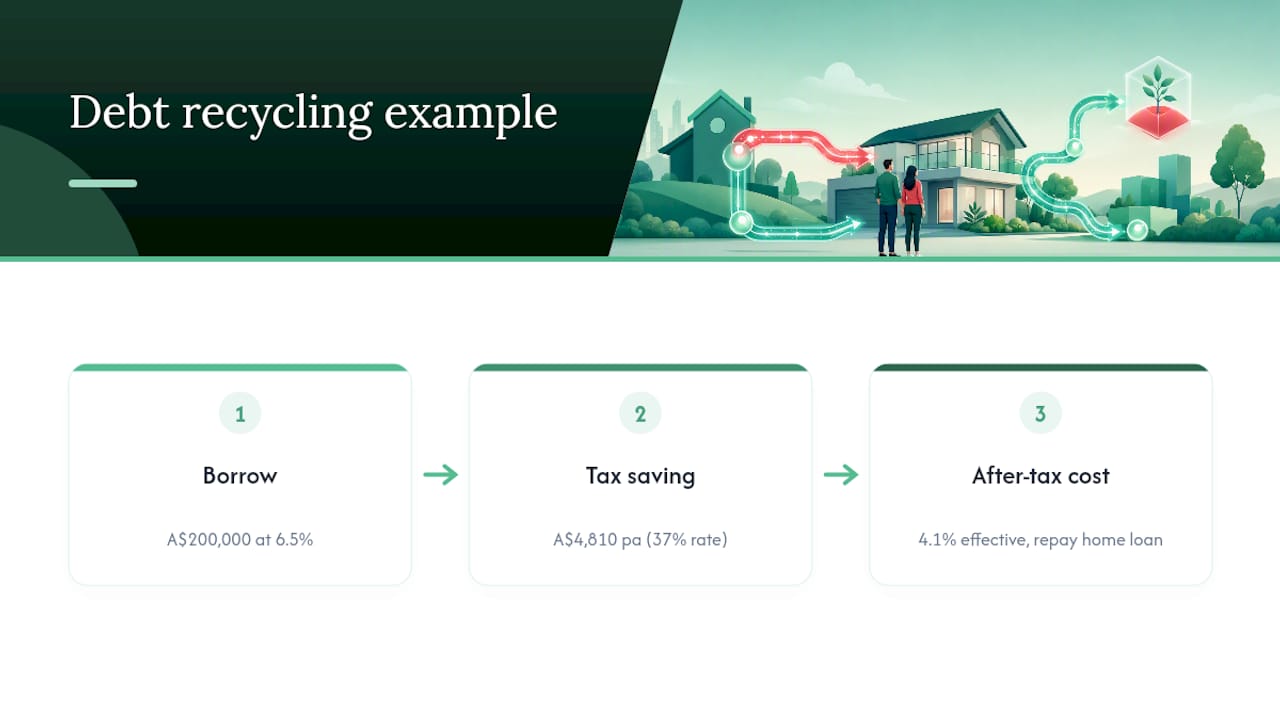
That tax saving, plus any distributions from the investment, can be funnelled straight onto the home loan, shaving years off it. The maths shifts with every variable: a higher marginal rate lifts the saving, a lower interest rate improves it further, and weaker investment returns can erode the whole advantage. A loan comparison calculator is the fastest way to test your own numbers before committing.
What should you ask before starting debt recycling?
Get these answers in writing before you sign anything.
- Ask your lender exactly how redraw requests are processed, and how long funds take to clear into an investable state.
- Confirm whether splitting your current loan into personal and investment portions triggers any fees or break costs.
- Ask your accountant to review your intended investment against ATO nexus requirements before you redraw a cent.
- Set a monitoring trigger in advance, for example, three consecutive quarters of cash-flow stress or a sustained gap between loan interest and investment returns, that tells you when to pause or unwind the strategy.
- Confirm your emergency buffer covers at least three to six months of combined home and investment loan repayments before you start.
How a mortgage broker helps you implement debt recycling safely
Getting the loan structure right is where most debt recycling strategies succeed or fail, long before tax time arrives. Mortgage brokers work through the practical side: structuring split loans correctly, comparing lender redraw and offset features, and matching you with products that keep your investment ledger clean from day one. For business owners and self-managed super fund trustees, that same structuring expertise extends to SMSF lending, where the compliance stakes are even higher. Tools like loan comparison calculators help model the numbers before you commit, and the process should be built around your specific income, buffer and timeline, not a generic template.
The real gap in most debt recycling advice
Most articles on this topic treat debt recycling as a maths problem: borrow at X, save Y in tax, done. That's the easy part. The harder truth, and the one the ATO's own framing keeps circling back to, is that the strategy lives or dies on discipline and structure, not on finding the cleverest investment.
The conventional advice oversells the tax saving and undersells the behavioural risk. That's the moment most people abandon the plan, sell at the worst time, and turn a sound tax strategy into a costly mistake.
If you take one thing from this guide, prioritise the buffer and the loan structure before the investment selection. A clean split loan with a genuine cash reserve behind it will outlast a clever stock pick every time. Get the plumbing right first. The tax deduction only matters if the structure holding it up doesn't collapse under the first bit of pressure.
— Allen
Ready to structure your debt recycling strategy the right way?
Debt recycling only pays off when the loan structure behind it is airtight, and that's exactly where a mortgage broker earns their keep. A discovery call with ZENRG Finance's mortgage relationship manager walks through your current loan, shortlists lenders whose redraw and split-loan features actually suit debt recycling, and maps out the next steps before you touch a dollar of equity.

There's no cost to have that conversation, and you won't be pushed into a structure that doesn't fit your income or your risk tolerance. If you're weighing up whether to renovate first and recycle later, our partner guide on granny flat approval in NSW is worth a read too. When you're ready, book a session and get your loan structure checked before you make your first extra repayment.
Sources
This guide draws on the Australian Taxation Office, the Stockspot debt recycling guide, and the Hudson Financial Planning calculator guide.
This article is general information, not a substitute for advice from a qualified financial advisor. Consult a qualified financial professional about your own circumstances before acting on anything here.
- Australian Taxation Office (ATO)
FAQ
Is debt recycling really worth it?
It's worth it for homeowners with a long investment horizon, stable income and a higher marginal tax rate, where the after-tax investment return can reasonably be expected to exceed the loan's after-tax cost. For those with short timeframes or thin cash buffers, the added leverage risk usually outweighs the tax benefit.
Which banks allow debt recycling?
Most major Australian lenders support the split loan and redraw features debt recycling needs, but the details vary. Ask specifically about redraw processing times, offset interactions and split loan fees before choosing a lender.
How long before debt is written off in Australia?
This depends on the type of debt and the write off policy of the individual lender, and it's unrelated to how debt recycling works. Debt recycling doesn't write off debt; it converts non-deductible mortgage debt into deductible investment debt over time.
Can I split my home loan to use it for debt recycling?
Yes. Splitting your home loan into a personal portion and a separate investment sub-account is the standard first step, and it's what keeps your investment borrowing traceable for ATO deductibility purposes. A split mortgage structured correctly from the outset avoids the loan contamination issues that can undo the whole strategy.