
Investment loan interest deductibility is defined as the ability to claim the interest paid on loans used to acquire income-producing assets as a tax deduction. For Australian property investors and homeowners, this deduction is one of the most valuable tools in the tax planning toolkit. The catch is that it comes with firm limits, specific procedural requirements, and common traps that cost investors real money each year. Understanding how the deduction works, where it stops, and how to get the most from it is the difference between a well-structured portfolio and one that quietly leaks tax dollars.
How does investment loan interest deductibility work?
Investment loan interest deductibility is governed by a straightforward principle: you can only deduct interest up to the amount of your net investment income for that year. Deduction limits and carryforward rules mean any excess interest does not disappear. It carries forward indefinitely to future tax years, which is genuinely useful for investors whose income builds slowly over time.
Net investment income is the figure that controls how much you can deduct. It includes gross portfolio income such as dividends, interest, and capital gains, minus allowable investment expenses. Passive rental real estate income is excluded from this calculation under standard rules. The Australian Tax Office requires you to keep clear records of each income stream so the figure is accurate and defensible.

The deduction only applies when you itemise your deductions rather than claiming a standard deduction. If itemised deductions don't exceed the standard deduction, the investment interest deduction delivers no immediate tax benefit that year. The disallowed interest still carries forward, but the timing matters for cash flow planning.
In the United States, the deduction is claimed on Form 4952 and reported on Schedule A. Australian investors work through equivalent ATO schedules and supplementary tax returns, but the underlying principle is identical: interest expense on income-producing loans is deductible against investment income, not against wages or other unrelated income.
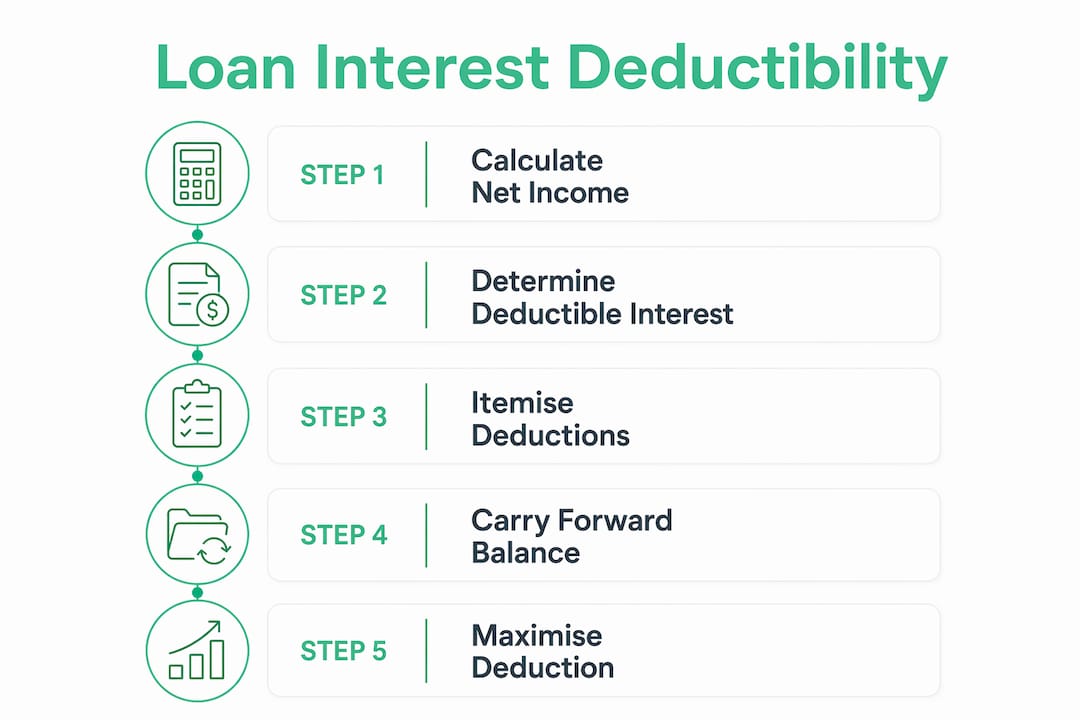
Here is a step-by-step view of how the deduction flows:
- Calculate your gross investment income for the year (dividends, interest, eligible capital gains).
- Subtract allowable investment expenses to arrive at net investment income.
- Total the investment loan interest you paid during the year.
- Deduct interest up to the net investment income figure.
- Carry any remaining interest forward to the next tax year.
Pro Tip: Keep a running carryforward balance in a simple spreadsheet updated each July. Knowing your accumulated balance helps you plan capital gain realisations in years when you want to unlock a larger deduction.
What are the common limits and exceptions to watch for?
Many investors assume all interest on investment loans is fully deductible each year. That assumption is wrong, and it is one of the most common and costly mistakes seen in practice. The deduction is capped at net investment income, and the rules around what qualifies are stricter than most people expect.
The key exclusions and nuances include:
- Personal interest is never deductible. Interest on loans used for private purposes, such as a holiday or a car for personal use, cannot be claimed regardless of how the loan is structured.
- Tracing rules are strict. Loan funds must be directly linked to the investment purchase within 15 days. Parking borrowed money in a general account for longer than that risks the ATO reclassifying the interest as personal and disallowing it entirely.
- Tax-exempt investments are excluded. Interest on loans used to buy tax-exempt securities is permanently disallowed and cannot be carried forward.
- Passive rental income is separate. Rental property losses and interest fall under the negative gearing rules in Australia, not the investment interest deduction framework. These are distinct calculations.
- Mixed-use loans require apportionment. If a loan funds both investment and personal use, only the investment portion of the interest is deductible. You need clear records showing the split.
- Business interest is different. Investment interest and business interest follow separate rules. Business interest is generally fully deductible against business income, while investment interest is capped at net investment income.
Pro Tip: Open a dedicated account for investment loan drawdowns and never mix personal transactions through it. This single habit makes tracing rules easy to satisfy and keeps your records audit-ready.
How can you calculate and maximise your allowable deduction?
Maximising your investment loan tax benefits requires both accurate calculation and deliberate planning. The calculation itself is not complicated, but the strategy around it takes thought.
Follow these steps to calculate your allowable deduction each year:
- Gather your income statements: interest income (from bank statements and term deposits), dividend statements, and any capital gains from investment sales.
- Total your allowable investment expenses, including management fees, adviser fees directly related to income-producing investments, and relevant subscriptions.
- Subtract expenses from gross income to get net investment income.
- Compare that figure to your total investment loan interest paid for the year.
- Claim the lower of the two figures as your deduction.
- Record the difference as a carryforward balance for next year.
The table below shows which interest costs qualify and which do not:
| Interest type | Deductible? | Notes |
|---|---|---|
| Margin loan on listed shares | Yes | Deductible up to net investment income |
| Loan to purchase investment property | Yes | Subject to ATO tracing and apportionment rules |
| Loan for tax-exempt securities | No | Permanently disallowed, no carryforward |
| Personal loan for private use | No | No deductibility regardless of structure |
| Mixed-use loan (partial investment) | Partial | Investment portion only, requires apportionment |
| Business loan for active income | Separate rules | Deductible against business income, not investment income |
The most effective strategy for increasing your deductible amount is to raise your net investment income. Realising capital gains strategically in a given year increases net investment income, which in turn unlocks more of your accumulated interest carryforward. This is not about selling assets you want to keep. It is about timing disposals you were already planning to coincide with years when you have a large carryforward balance.
Zenrgfinance works with property investors to structure loans in ways that support clean tracing, clear apportionment, and maximum deductibility. Reviewing your investment property loan types early in the financial year gives you time to act before income and expense positions are locked in.
Pro Tip: Ask your accountant to calculate your carryforward balance every year, even in years when you cannot use it. Investors who lose track of their carryforward often leave years of deductions unclaimed.
What special rules apply to vehicle loans and niche cases?
A specific and temporary deduction applies to qualified passenger vehicle loan interest for the 2025–2028 tax years. This rule is distinct from the general investment interest deduction framework and operates under its own conditions.
Key points about this deduction:
- A $10,000 cap applies per tax return on qualified passenger vehicle loan interest for 2025–2028.
- This deduction does not require itemising, unlike the general investment interest deduction. That makes it accessible to a broader group of taxpayers.
- The vehicle must be a qualified passenger vehicle under the relevant tax rules. Commercial vehicles and vehicles used primarily for business follow separate deduction paths.
- This deduction is temporary. It applies only for the four-year window and is subject to legislative review.
- The $10,000 cap is a hard ceiling. Interest paid above that amount on a qualifying vehicle loan is not deductible under this provision.
Pro Tip: Keep vehicle loan interest expenses in a separate ledger from investment loan interest. Mixing them creates confusion at tax time and risks misclassifying a deduction, which can trigger a review.
For investors with interest-only loans on investment properties, the general investment interest rules apply in full. Vehicle loan interest and investment property loan interest are calculated and reported separately, and each has its own ceiling and conditions.
Key takeaways
Investment loan interest is deductible only up to net investment income each year, with any excess carrying forward indefinitely, making early tax planning and accurate record-keeping the foundation of a sound deduction strategy.
| Point | Details |
|---|---|
| Deduction cap | Interest is deductible only up to net investment income; excess carries forward with no expiry. |
| Tracing rules matter | Loan funds must reach the investment account within 15 days to satisfy deductibility requirements. |
| Itemising is required | The general investment interest deduction only applies when you itemise, not when you take the standard deduction. |
| Vehicle loan exception | A $10,000 cap applies to qualified passenger vehicle loan interest for 2025–2028, with no itemising requirement. |
| Strategic gain timing | Realising capital gains in high-carryforward years raises net investment income and unlocks more deductions. |
What I have learned from watching investors get this wrong
After working with property investors across a wide range of portfolio sizes, the pattern I see most often is not ignorance of the deduction. It is overconfidence about how much of it applies right now. Investors see a large interest bill and assume it translates directly into a tax saving this year. When the net investment income cap bites, the disappointment is real.
The carryforward rule is genuinely powerful, but only if you track it. I have seen investors with years of accumulated carryforward who had no idea the balance existed. That is money sitting in a ledger, waiting to be used, and it gets missed because no one checked. The investment interest carryforward accumulates indefinitely, which means a patient investor with a long-horizon asset can build a significant deduction balance and deploy it strategically when income rises.
The other mistake I see regularly is poor loan structuring at the point of purchase. Mixing personal and investment drawdowns in the same account, or delaying the transfer of funds to the investment account beyond the 15-day window, turns a clean deduction into a contested one. Getting the structure right at the start costs almost nothing. Fixing it after the fact is expensive and sometimes impossible.
My honest advice: treat tax planning as a year-round activity, not a june scramble. Review your carryforward balance in july, model your expected net investment income in september, and make any capital gain timing decisions before december. That rhythm keeps you in control of the deduction rather than reacting to it.
— Allen
How Zenrgfinance helps you get the most from your investment loans
Structuring an investment loan correctly from the start is the single most effective way to protect your tax deductibility. Zenrgfinance works with property investors to design loan structures that satisfy tracing rules, support clean apportionment, and align with your broader tax strategy.

The Zenrgfinance Mortgage Relationship Manager service gives you access to an expert who understands both the lending and the tax implications of your investment finance decisions. Whether you are building a portfolio from scratch or restructuring existing loans to improve deductibility, the team at Zenrgfinance can walk you through your options clearly and without jargon. Book a strategy session and get a loan structure that works as hard as your investment does.
FAQ
Is investment loan interest always fully deductible?
No. Investment loan interest is deductible only up to your net investment income for the year. Any excess carries forward indefinitely to future years.
What happens to disallowed interest in the current year?
Disallowed interest carries forward with no expiry date. You can claim it in any future year when your net investment income is high enough to absorb it.
Does rental property interest fall under the investment interest deduction?
Passive rental property interest is excluded from the investment interest deduction calculation in Australia. It falls under the negative gearing rules and is reported separately.
How do tracing rules affect my deduction?
Loan funds must be transferred directly to the investment account within 15 days of drawdown. Holding borrowed funds in a general account beyond that window risks the ATO reclassifying the interest as personal and disallowing the deduction.
Can I deduct vehicle loan interest as an investment expense?
A specific deduction for qualified passenger vehicle loan interest applies for 2025–2028, capped at $10,000 per tax return. This is separate from the general investment interest deduction and does not require itemising.