
An equipment finance loan is a business loan where the purchased equipment itself acts as the primary security, meaning you typically own the asset from day one while spreading the cost over time. For small businesses, that single feature changes everything: you get the machinery, vehicle, or technology you need without draining your working capital in one hit.
A few things worth knowing upfront:
- Term lengths typically range from 24 to 84 months depending on the asset's useful life
- Who it suits: any small business buying tangible assets — trucks, fit-out equipment, medical devices, manufacturing machinery
- Main advantage: you preserve cashflow and build equity in the asset simultaneously
- ATO guidance governs how you claim depreciation and GST, so the structure you choose has real tax implications
- Zenrgfinance can compare lenders and structures on your behalf, which is especially useful when you are buying specialised equipment or need a tailored repayment arrangement
Table of Contents
- How does an equipment finance loan actually work?
- What are the main types of equipment finance?
- What are the benefits and drawbacks for small businesses?
- What do equipment finance loans typically cost?
- What do you need to apply, and how long does it take?
- How does equipment finance affect your tax and accounting?
- Should you use a broker or go direct to a bank?
- Key takeaways
- A broker's honest view on equipment finance
- Zenrgfinance can help you find the right equipment finance structure
- Useful sources and tools
How does an equipment finance loan actually work?
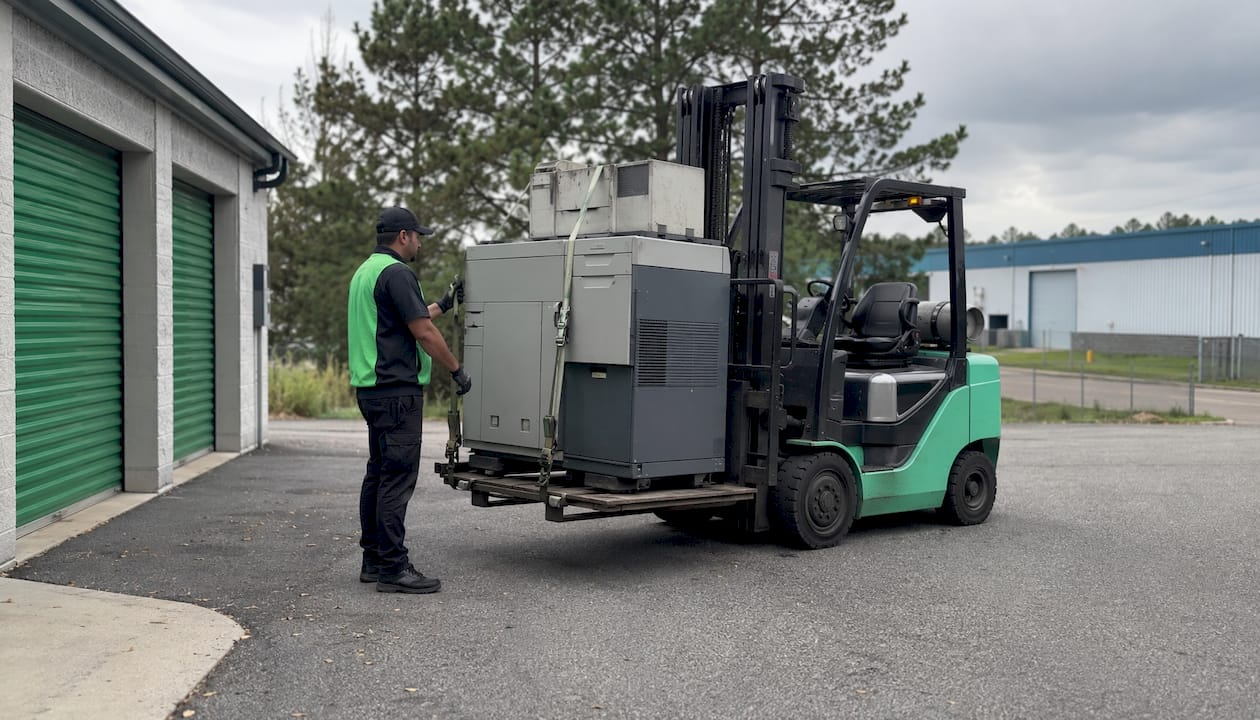
The lender provides capital to purchase a specific asset. That asset then secures the loan, and the lender registers a security interest on the Personal Property Securities Register (PPSR) until the debt is cleared. You own the equipment from settlement, but the lender holds a legal claim over it.
Repayments cover principal and interest, amortised across the loan term. Most lenders require a deposit of roughly 10–20% of the asset's value, though some lend up to 100% depending on the asset type and your credit profile. A balloon or residual payment at the end of the term reduces your monthly repayments but increases the total amount you repay overall.
If you default, the lender can repossess the equipment. Personal guarantees are common even when the asset secures the loan, so directors may remain personally liable. Confirm guarantee requirements early in any negotiation.
Pro Tip: Check the PPSR registration yourself after settlement. It should show your lender's interest, not an old one from a previous owner. An uncleared registration can complicate refinancing later.
What are the main types of equipment finance?
Buying versus leasing often comes down to how long you will use the asset and how you want to treat it for tax. The four main structures each handle ownership, accounting, and flexibility differently.
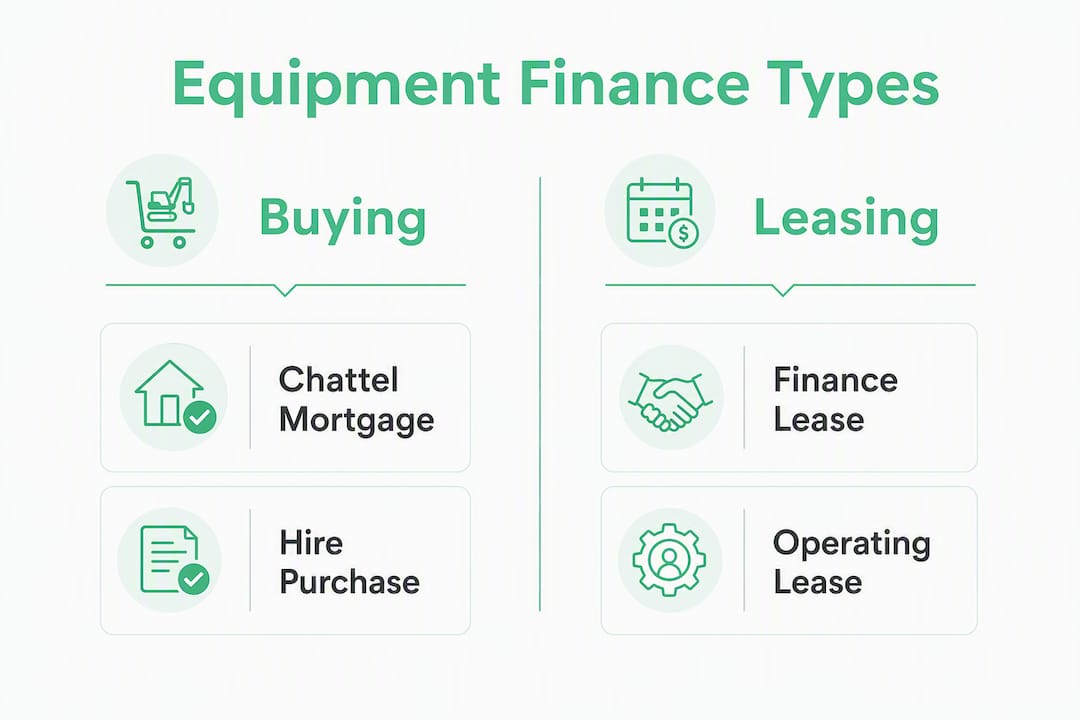
Chattel mortgage is the most common loan structure for business equipment. You own the asset from day one, claim depreciation, and can usually claim the GST upfront on your next BAS. The lender holds a mortgage over the asset until the loan is repaid.

Finance lease means the lender owns the asset during the term. You make regular payments and can purchase the asset at the end for a residual amount, return it, or refinance. GST applies to each repayment rather than the full purchase price upfront.
Hire purchase sits between the two: you use the asset immediately and ownership transfers automatically once the final payment is made. GST is payable on the full purchase price upfront.
Commercial loan secured by equipment is a conventional business loan where the equipment acts as collateral. Terms and structures vary more widely, and lenders assess the business's overall financial position rather than just the asset.
| Feature | Chattel mortgage | Finance lease | Hire purchase | Commercial loan |
|---|---|---|---|---|
| Ownership during term | You (borrower) | Lender | Lender (transfers at end) | You (borrower) |
| Ownership at term end | You | Purchase/return/renew | You (automatic) | You |
| Depreciation claim | Yes | No (lease payments deducted) | Yes (after transfer) | Yes |
| GST treatment | Claimed upfront on BAS | On each repayment | Upfront on full price | Varies |
| Typical term | 24–84 months | 24–60 months | 24–60 months | 24–84 months |
| Deposit required | Often 10–20% | Often nil or low | Often 10–20% | Varies |
| Repayment structure | Principal + interest, optional balloon | Fixed lease payments, residual | Fixed instalments | Principal + interest |
| Maintenance responsibility | Borrower | Borrower (finance lease) | Borrower | Borrower |
| Upgrade flexibility | Low (you own it) | High (return at end) | Low | Low |
- Chattel mortgage suits businesses that want ownership and the GST cashflow benefit upfront — common for vehicles and plant.
- Finance lease works well when you expect to upgrade equipment regularly, such as IT hardware or medical devices.
- Hire purchase is often chosen when ownership is the goal but an upfront GST claim is not critical.
- Commercial loan fits businesses with strong financials who want flexibility in how the loan is structured.
What are the benefits and drawbacks for small businesses?
Equipment finance gives small businesses access to assets they could not otherwise afford without touching their operating reserves. The collateral-backed structure also means lenders are generally more willing to approve these loans than unsecured business credit, and eligibility requirements tend to be more accessible.
Key benefits:
- Preserves working capital for wages, stock, and day-to-day costs
- Predictable fixed repayments make cashflow planning straightforward
- Easier approval than unsecured loans because the asset reduces lender risk
- Potential tax advantages through depreciation claims and, for chattel mortgages, upfront GST recovery
- Builds business credit history when repayments are made on time
Main drawbacks and risks:
- Repossession risk if repayments fall behind
- Personal guarantees may expose directors to personal liability
- Balloon payments reduce monthly costs but increase the total amount repaid
- Fees (establishment, ongoing, early exit) can significantly raise the effective cost
- Equipment may depreciate faster than the loan balance reduces, leaving you "underwater" on the asset
Pro Tip: Always ask for the total cost of capital, not just the monthly repayment. As Bluebridge Financial notes, fees, variable rates, and balloon payments shift the true cost considerably. Two loans with identical monthly figures can have very different total costs.
What do equipment finance loans typically cost?
Interest rates for equipment loans vary widely depending on your credit profile, the lender, and the asset type, with rates influenced by these factors.
| Cost element | Typical range |
|---|---|
| Loan term | Typically 24–84 months, depending on asset type |
| Interest rate (indicative) | Varies widely depending on credit and lender |
| Deposit | Typically some portion of asset value |
| Balloon/residual | May be required depending on loan terms |
| Establishment fee | Varies by lender |
| Ongoing fees | Monthly or annual, varies |
Worked example: A small business buys a $60,000 piece of manufacturing equipment. They pay a 10% deposit ($6,000), finance the remaining $54,000 over 48 months at an indicative rate of 8% per annum, with a 20% balloon ($12,000) at the end. Monthly repayments on the financed amount are lower because of the balloon, but the total repaid over the term — including the balloon and establishment fees — will exceed the original $60,000 purchase price. That gap is the cost of spreading the payment over time, and it is exactly why comparing total cost of capital matters.
- Calculate the full repayment amount including all fees and the balloon
- Compare that figure across at least three lenders using identical assumptions
- Factor in any tax deductions (depreciation, GST recovery) to get the net cost
- Use a loan amortisation calculator to model different balloon and term combinations
Pro Tip: Use the Zenrgfinance loan comparison calculator to run different scenarios side by side before you commit. Changing the balloon from 20% to 0% can look cheaper monthly but cost more overall.
What do you need to apply, and how long does it take?
Most lenders assess both the business and the asset. Getting your documents together before you approach a lender speeds things up considerably.
Eligibility checklist:
- Active ABN or ACN (most lenders want at least 12–24 months of trading history)
- Recent financial statements (profit and loss, balance sheet)
- Last two years of business and personal tax returns
- Quote or invoice for the equipment being purchased
- Director identification numbers (Director ID)
- Business and personal credit profile (check yours before applying)
- Bank statements, typically three to six months
Application steps and typical timeline:
- Get a vendor quote for the specific asset (day 1)
- Compare lenders or engage a broker to identify the best structure and rate (days 1–3)
- Submit application with supporting documents (day 3–5)
- Credit assessment by the lender, including PPSR checks (days 5–10)
- Approval and loan documents issued (days 7–14 for straightforward applications)
- PPSR security interest registered by the lender (at or before settlement)
- Funds released to vendor and asset delivered (days 10–21 typically)
Complex trust structures, missing documents, or unusual assets can add weeks to this timeline. A broker who knows which lenders are fastest for your asset type can cut that significantly.
How does equipment finance affect your tax and accounting?
Whether you depreciate, deduct lease payments, or claim an immediate write-off depends on the finance structure you choose and the current ATO rules for your business size and asset type.
- Chattel mortgage and hire purchase: you own the asset, so you claim depreciation over its effective life. For eligible assets, the ATO's instant asset write-off or temporary full expensing rules may allow an immediate deduction in the year of purchase. Check the ATO's current thresholds, as these change with each budget.
- Finance lease: you do not own the asset, so you cannot claim depreciation. Instead, lease payments are generally deductible as a business expense. GST applies to each repayment rather than the full purchase price upfront.
- GST timing: a chattel mortgage lets you claim the full GST on the purchase price in your next BAS, which can be a meaningful cashflow benefit for GST-registered businesses.
Whether you can claim an instant asset write-off depends on your aggregated annual turnover and the asset's cost — the ATO updates these thresholds regularly, so confirm the current rules before you structure your finance.
This is general information only. Speak with a registered accountant or BAS agent for advice tailored to your business’s situation.
Should you use a broker or go direct to a bank?
A broker's core advantage is access: they can compare multiple lenders, product structures, and fee arrangements in one conversation rather than you approaching each lender separately. For straightforward equipment purchases from a major bank you already use, going direct can be fine. But for anything more complex, a broker usually delivers better outcomes.
Scenarios where a broker adds the most value:
- Your credit profile is not straightforward (new business, prior defaults, or thin history)
- You need a tailored balloon or residual arrangement
- You are buying specialised equipment that not all lenders will fund
- You want to explore a sale-leaseback to unlock cash from equipment you already own
- You are comparing a chattel mortgage against a finance lease and want independent guidance on which suits your tax position
Zenrgfinance's business finance services include access to a lender panel, loan structuring support, and tools like the leasing calculator and loan comparison calculator. The team can also advise on how equipment finance fits alongside other business lending, including property-backed options — useful context if you are weighing equipment finance against a commercial loan against property.
Broker value checklist:
- Access to multiple lenders in one application process
- Negotiation on fees, rates, and balloon structures
- Guidance on which product type suits your tax position
- Time saved on paperwork and lender follow-up
- Independent comparison of total cost of capital across offers
Pro Tip: Before your broker meeting, bring the vendor quote, your last two tax returns, and a clear idea of how long you expect to use the asset. That 20-minute prep saves hours of back-and-forth.
Key takeaways
An equipment finance loan lets you own business-critical assets from day one while spreading the cost over a term of 24–84 months, depending on the asset's useful life. The structure you choose — chattel mortgage, finance lease, or hire purchase — determines your tax treatment, GST timing, and flexibility to upgrade.
| Point | Details |
|---|---|
| Definition | An equipment finance loan uses the purchased asset as security; you typically own it from settlement. |
| Match term to asset life | Align the loan term to how long you will use the equipment to avoid paying off a depreciated asset. |
| Watch personal guarantees | Lenders often require director guarantees even when the asset secures the loan; confirm this early. |
| Compare total cost | Monthly repayments are misleading; always compare the full cost including fees and balloon payments. |
| Zenrgfinance | Zenrgfinance can compare lenders and structures, and tools like the loan comparison calculator help you model scenarios before you commit. |
A broker's honest view on equipment finance
Most small business owners I speak with focus on the monthly repayment figure. It is the most visible number, and it fits neatly into a cashflow spreadsheet. But it is also the number most likely to mislead you.
Balloon payments at the end of a loan term can reduce monthly payments but increase total repayment cost over the full term. Add an establishment fee, an ongoing monthly fee, and a variable rate clause, and the gap between "what I thought I was paying" and "what I actually paid" can be thousands of dollars. That is not a lender trick — it is just how the maths works when you defer costs. The problem is that most comparison conversations happen at the monthly level, not the total-cost level.
The other thing owners underestimate is the personal guarantee. Equipment loans are secured, yes. But most lenders still want a director's guarantee, which means your personal assets are on the line if the business cannot service the debt. That is a reasonable risk for a well-structured loan on productive equipment. It is a much harder conversation when the equipment underperforms or the business hits a rough patch.
My honest advice: get at least three quotes with identical assumptions (same deposit, same term, same balloon), run them through a comparison tool, and ask each lender to confirm in writing whether a personal guarantee is required. Those two steps alone will put you in a far stronger position than most applicants.
Zenrgfinance can help you find the right equipment finance structure
Sorting through lender options, product structures, and fee schedules takes time most business owners do not have. Zenrgfinance works as your broker, comparing equipment finance options across a panel of lenders to find a structure that fits your cashflow, tax position, and asset type — without you having to approach each lender separately.

The team handles chattel mortgages, finance leases, hire purchase arrangements, and more complex structures like sale-leaseback. You also get access to practical tools including the leasing calculator and loan comparison calculator to model your scenarios before committing. There is no obligation to proceed after an initial conversation.
Ready to see what your repayments could look like? Book a free consultation with Zenrgfinance or visit the business finance page to get started.
Useful sources and tools
- ATO — income and deductions for business: current rules on depreciation, instant asset write-off, and GST treatment for equipment
- business.gov.au — leasing or buying vehicles and equipment: plain-English comparison of buy vs lease trade-offs
- Zenrgfinance business finance page: broker services, lender panel access, and equipment finance guidance
- Zenrgfinance loan comparison calculator: compare loan offers side by side on total cost
- Zenrgfinance leasing calculator: estimate lease vs buy costs for your asset
- Small Biz Finance Guide — equipment financing explained: overview of collateral mechanics and term ranges
- Corporate Finance Institute — equipment finance: lender perspective on LTV ratios and eligibility