
A joint venture property loan is a structured financing arrangement where two or more partners combine capital and expertise to fund a specific real estate project. Rather than one borrower carrying the full weight, the loan sits within a dedicated partnership structure, typically a special purpose vehicle (SPV), that keeps the project's liabilities separate from each partner's personal assets. Lenders assess these loans based on the property and project performance, not just individual incomes, which opens the door to developments that would be out of reach for a single investor.
The typical structure brings together senior development debt and partner equity within a single project entity. Common pairings include a landowner teaming up with a developer, or a developer partnering with a financial backer who contributes capital in exchange for a share of profits. The key elements that define a joint venture property loan include:
- Partner roles: Each party's responsibilities, decision-making authority, and financial obligations are defined upfront.
- Funding components: Senior debt from a lender sits above partner equity in the repayment hierarchy.
- Legal isolation: The SPV or equivalent entity ring-fences project risk from partners' personal balance sheets.
- Profit sharing: Returns are distributed according to agreed ratios after debt is repaid.
- Governance framework: A joint venture agreement (JVA) governs the entire arrangement and is reviewed by lenders as part of credit assessment.
Partnerships have become a significant component of investment properties, with lenders increasingly using debt service coverage ratio (DSCR) methods that focus on property income rather than individual borrower income. That shift reflects how mainstream collaborative property financing has become in Australia.
Why joint ventures make property investment more accessible
Joint ventures let you tackle projects that simply aren't possible on your own. A developer with skills but limited capital can partner with a financial backer who has funds but no construction expertise. Together, they can pursue a multi-unit development or a commercial site that neither could finance alone.
The advantages go beyond just pooling money:
- Risk sharing: Losses and cost overruns are distributed across partners, reducing individual exposure.
- Combined expertise: One partner may bring site knowledge, another brings construction contacts, and another brings finance experience.
- Improved credit profile: A well-structured JV with clear governance can present a stronger case to lenders than a solo application.
- Lower individual capital requirements: Each partner contributes a portion of the equity, preserving their own borrowing capacity for other projects.
- Access to larger deals: Pooled resources unlock commercial developments, land subdivisions, and multi-stage projects.
- Profit sharing upside: Partners share in the full project profit, not just a fixed return, which can outperform passive investment strategies.
Lenders respond well to JVs where governance is tight and roles are clearly documented. A project with a signed JVA, defined capital call schedules, and an agreed exit strategy signals to a lender that the partners have thought through the risks.
Pro Tip: Before approaching a lender, have your JVA reviewed by a solicitor experienced in property development finance. Lenders treat a comprehensive agreement as a credit positive, and a well-drafted document can meaningfully improve your funding terms.

What goes into a property joint venture agreement?
The joint venture agreement is the backbone of the entire financing structure. Lenders read it carefully, and gaps in the document translate directly into gaps in lender confidence. A solid JVA covers far more than just who owns what percentage.
The critical contents of a well-drafted JVA include:
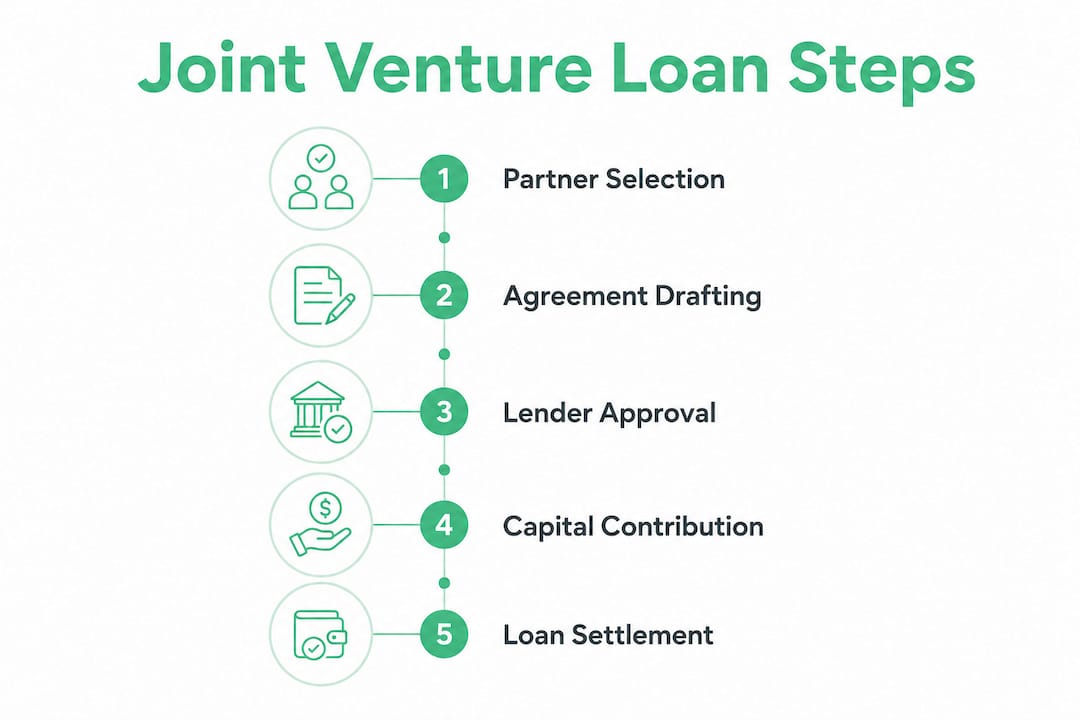
- Capital contribution timing: When each partner must contribute funds, and what happens if a partner fails to meet a call.
- Management control: Who makes day-to-day decisions, and which decisions require unanimous or majority consent.
- Roles and responsibilities: Construction oversight, sales management, finance liaison, and compliance obligations assigned to specific partners.
- Decision-making thresholds: Which expenditures or changes require a formal vote, and what the quorum rules are.
- Profit sharing mechanisms: The agreed split of net profits after senior debt repayment and any preferred returns.
- Exit strategies: How a partner can exit the JV, including buy-out rights, forced sale provisions, and dispute resolution pathways.
- Liability carve-outs: Provisions that limit each partner's exposure to the other's personal debts or external liabilities.
- Dispute resolution: Mediation or arbitration clauses that keep disagreements out of court and the project on track.
The JVA also functions as a financing framework. Lenders use it to assess whether the governance structure is sound enough to protect their security. A well-structured JVA with clear capital contribution timing, management control, and exit strategies is treated as a key credit positive by lenders. Australian best practice in 2026 means including specific provisions around GST treatment, stamp duty implications, and capital gains tax obligations, particularly for projects involving land transfers between partners.
How capital contributions and profit sharing work in practice
Getting the financial structure right is one of the most technically demanding parts of a property joint venture. The distinction between equity contributions and loans to the partnership matters enormously, both for tax purposes and for how lenders view the deal.
Here is how the financial layers typically stack:
- Equity contributions: Partners contribute capital that is treated as ownership. This is repaid only through profits, not on a fixed schedule.
- Partner loans: Some partners lend money to the JV entity rather than contributing equity. These carry repayment obligations and interest, and sit above equity in the repayment order.
- Senior development debt: The lender's loan sits at the top of the repayment hierarchy and is repaid first from project proceeds.
- Preferred returns: Some JVA structures give one partner a preferred return before profits are split, compensating for a higher capital contribution or greater risk.
- Profit splits: After senior debt and preferred returns are settled, remaining profits are distributed according to the agreed ratio.
Misclassifying partner funds as loans instead of equity can trigger legal disputes, denied tax deductions, and repayment priority conflicts. The Australian Taxation Office takes a close interest in how contributions are labelled, particularly when deductions are claimed on interest payments. Getting this classification right from the outset protects all partners and keeps the lender comfortable.
One practical consideration: signing a joint venture mortgage can significantly affect each partner's future borrowing capacity, since lenders may count the full loan against an individual's debt-to-income ratio despite shared ownership. That's worth factoring into your personal financial planning before you commit.
Which legal structures work best for property joint ventures in Australia?
The legal structure you choose shapes everything from tax exposure to lender comfort. There is no single right answer, but each option carries distinct trade-offs.
Special purpose vehicle (SPV) company
The SPV is the most common structure for property JVs in Australia. A new company is incorporated specifically for the project, and all partners hold shares. The SPV limits each partner's liability to their equity contribution, provides a clean governance framework, and gives lenders a straightforward security position over the company's assets. Most institutional and non-bank lenders prefer this structure because it is familiar and enforceable.
Unincorporated joint venture (UJV)
Unincorporated joint ventures are used to avoid triggering stamp duty or capital gains tax events that can arise when assets are transferred into a company. Each partner holds an undivided interest in the property directly. The trade-off is complexity: lenders cannot take a standard charge over a company's assets, so they require contractual substitute securities, which are more difficult to document and enforce. Experienced developers sometimes favour this structure for tax efficiency, but it demands more sophisticated legal drafting.
Contractual joint venture
A contractual JV operates through a detailed agreement without a separate legal entity. Partners remain individually liable and the arrangement is governed entirely by contract. This suits smaller, shorter-term projects where the tax and stamp duty savings from avoiding a corporate structure outweigh the governance risks.
Key considerations across all structures:
- Personal guarantees: Lenders typically require all partners to guarantee the full facility, regardless of equity share. The lowest credit score among guarantors often sets the interest rate for the entire loan.
- Stamp duty: In Victoria, for example, the State Revenue Office applies duty to economic entitlements in property, which can affect how JV interests are structured and transferred.
- GST treatment: The ATO has specific rules for GST and joint ventures, including the margin scheme for property sales, which can significantly affect project profitability.
For projects involving estate planning considerations or long-term asset holding, it is worth exploring how exit planning integrates with the JV structure from day one.
How Zenrgfinance approaches joint venture property financing
Zenrgfinance works with property investors and developers across Australia who are navigating the complexity of joint venture financing. The team understands that a JV loan is not just a mortgage. It is a layered arrangement where governance, legal structure, and lender relationships all have to align before a single dollar is drawn down.
One of the most consistent issues Zenrgfinance sees is the timing mismatch between senior development loans and equity capital. Equity and debt lines must be arranged in parallel, with signed heads of terms in place before either party commits. When these two streams fall out of sync, projects stall at the worst possible moment, often after significant legal and planning costs have already been incurred.
Lenders in 2026 treat the JVA as a governance document, not just a partnership formality. A comprehensive agreement with clear capital call schedules, defined management authority, and documented exit pathways gives lenders the confidence to approve and price the facility favourably. Zenrgfinance helps clients prepare this documentation to lender standard before the application goes in, which reduces back-and-forth and speeds up approval timelines.
Personal guarantees are another area where Zenrgfinance adds real value. Because guarantors may bear 100% liability regardless of their equity share, understanding the full impact on your borrowing capacity before you sign is critical. Zenrgfinance models this across all partners' balance sheets so there are no surprises after settlement.
Pro Tip: Engage a broker experienced in development finance before you finalise your JVA. Synchronising your equity commitments and senior debt arrangements from the start prevents the funding gaps that derail most JV projects before they get off the ground. Zenrgfinance can help you map this out.
For investors who want to explore property investment loan types beyond the standard JV structure, including options suited to SMSF borrowing and commercial development, Zenrgfinance offers tailored guidance across the full range of real estate financing products.
Ready to structure your joint venture property loan?

Joint venture property financing works best when you have the right broker in your corner from the very beginning. Zenrgfinance specialises in helping Australian property investors and developers structure JV loans that satisfy lender requirements, protect each partner's interests, and keep projects moving. Whether you are pairing up with a landowner, a financial backer, or a development partner, the team at Zenrgfinance can help you get the structure right before you approach a lender.
Talk to a mortgage relationship manager at Zenrgfinance today to explore your joint venture financing options and get a personalised strategy for your next property project.
Key takeaways
A joint venture property loan works best when the legal structure, governance documentation, and funding timelines are aligned before any lender conversation begins.
| Point | Details |
|---|---|
| JV loans focus on project performance | Lenders assess property income and project viability, not just individual borrower income. |
| The JVA is a credit document | Clear capital contribution timing, management control, and exit strategies are key credit positives for lenders. |
| Equity vs loan classification matters | Misclassifying partner funds as loans instead of equity can trigger tax disputes and repayment priority conflicts. |
| Personal guarantees carry full liability | Guarantors may bear 100% of the loan liability regardless of equity share, affecting future borrowing capacity. |
| Timing equity and debt in parallel is critical | Equity and debt lines must be arranged concurrently to prevent project collapse during initial funding. |