
A split home loan divides your mortgage into separate portions: one on a fixed rate, one on a variable rate. You lock in certainty on one slice while keeping flexibility, offset access, and the chance to benefit from rate drops on the other.
It suits borrowers who want some protection against rate rises but aren't ready to give up features like offset accounts and unlimited extra repayments entirely. If you're chasing full budgeting certainty, a fully fixed loan often makes more sense. If you're comfortable riding the market and want maximum flexibility, fully variable might suit you better. A split loan sits deliberately in the middle.
- Pro: Partial protection if rates climb, while keeping offset and redraw on the variable slice
- Pro: Easier budgeting for at least part of your repayments
- Con: You miss out on some savings if rates fall on the fixed portion
- Con: You may face two sets of fees and slightly more admin
- Con: Break costs can still apply to the fixed slice if your plans change
Key Takeaways
A split home loan works because it lets you match part of your mortgage to your need for certainty and part to your need for flexibility, without forcing an all-or-nothing rate decision.
| Point | Details |
|---|---|
| Split ratio drives the trade-off | Higher fixed proportions mean more certainty but less benefit if rates fall. |
| Features often differ by portion | Offset and unlimited extra repayments usually sit on the variable slice only. |
| Break costs are a real risk | They apply if you exit or restructure the fixed portion before the term ends. |
| Model before you fix | Test multiple ratios with a calculator rather than defaulting to 50/50. |
| Zenrgfinance can model your split | Use its split loan calculator and mortgage relationship manager to compare ratios and lender rules before applying. |
Table of Contents
- What is a split home loan and how does the terminology work?
- How do split loans work day-to-day?
- What are the pros and cons of splitting your mortgage?
- How do you calculate repayments on a split loan?
- What happens when the fixed portion's term ends?
- Which loan features apply to each portion of a split loan?
- What are the real costs and risks of a split loan?
- Who typically benefits from splitting their home loan?
- How do you actually apply for a split home loan?
- How does a mortgage broker help with the split-loan decision?
- How Zenrgfinance helps you set up a split home loan
- Sources
What is a split home loan and how does the terminology work?
A split home loan divides your total borrowing into a fixed portion and a variable portion, each governed by its own rate and rules. The lender doesn't blend the two into one hybrid rate. It genuinely treats them as separate sub-loans sitting under the same mortgage, each with its own repayment schedule and, in most cases, its own account number.
The fixed portion locks in an interest rate for a set term, usually one to five years. Repayments on this slice stay the same regardless of what the Reserve Bank does in the meantime. The variable portion moves with your lender's standard variable rate, which means your repayments on that slice can rise or fall depending on market conditions and the lender's own pricing decisions.
Split ratios are usually expressed as two numbers that add to 100, like 60/40 or 50/50. For example, a 60/40 split means part of the loan sits on the fixed rate and the rest on variable. According to Nestpath's fixed vs variable guide, 50/50, 60/40 and 40/60 are the most common configurations Australian borrowers choose, largely because they're easy to model and easy to explain to a partner or co-borrower.
A few terms worth knowing before you go further:
- Split ratio – the percentage breakdown between fixed and variable (e.g. 70/30)
- Fixed term – the length of time the fixed rate applies, typically 1 to 5 years
- Break costs – a fee charged if you exit or restructure the fixed portion early
- Offset account – a transaction account linked to your loan that reduces the interest charged on the linked portion
- Redraw – access to extra repayments you've already made, usually only on the variable slice
How do split loans work day-to-day?
Once your split loan settles, the lender manages each portion separately for interest calculation and feature eligibility, but you typically make one combined repayment that gets divided behind the scenes. NAB's explainer on split loans confirms this is standard practice: you pay once, the bank allocates the money across your fixed and variable sub-accounts according to the schedule set at settlement.
Here's roughly what happens each time a rate movement occurs:
- The variable portion's interest rate adjusts (up or down) in line with the lender's standard variable rate changes.
- Your repayment on the variable slice recalculates to reflect the new rate, while the fixed slice repayment stays exactly the same.
- Your total monthly repayment shifts by whatever the variable portion moved, not the full loan amount.
- Extra repayments or lump sums you make usually apply to the variable portion first, unless you've arranged otherwise.
- At the end of the fixed term, that portion reverts to a new rate (fixed or variable) as chosen by you.
Say rates rise by 0.5 percentage points. On a fully variable $600,000 loan, that increase hits the whole balance. On a 60/40 split, it only hits the $240,000 variable slice, so your repayment increase is proportionally smaller. That's the practical value of splitting: it dampens the impact of a rate move rather than eliminating it.
Borrowers commonly revisit their split when a fixed term ends, when they refinance, or when they've paid down enough principal that the original ratio no longer makes sense for their goals.
What are the pros and cons of splitting your mortgage?
Splitting isn't automatically better than going fully fixed or fully variable. It's a trade-off, and understanding both sides properly is what separates a good decision from a lucky one.
Advantages:
- Partial rate certainty without giving up all flexibility
- Offset and redraw features usually remain available on the variable portion
- Easier to budget for part of your repayments, which helps households on tight margins
- Staged exposure to rate movements rather than an all-or-nothing bet
Disadvantages:
- You lose some of the upside if rates drop, because the fixed slice doesn't benefit
- You may pay two sets of ongoing fees if the lender charges per sub-account
- Break costs can still apply to the fixed portion if you sell, refinance, or restructure early
- Slightly more complex to manage, since you're tracking two repayment streams instead of one
Pro Tip: A lot of borrowers assume splitting a loan fully hedges them against rate risk. It doesn't. As the research on split home loan risk trade-offs points out, splitting reduces your exposure rather than removing it. You still carry risk on the variable portion, and you still give up some flexibility on the fixed portion. The decision should be based on your own tolerance for rate movements, not a bet on where the market's headed next.
How do you calculate repayments on a split loan?
Numbers make this concrete. Take a $500,000 loan split 60/40, a common configuration for owner-occupiers wanting a meaningful fixed anchor while keeping decent flexibility.
Figures assume a 30-year loan term with principal and interest repayments, illustrative only, and will vary with your lender, rate, and repayment frequency.
To run your own numbers, follow this process:
- Decide your total loan amount and the split ratio you're testing (start with 50/50 as a baseline).
- Get a current fixed rate quote for your chosen term (1, 2, 3 or 5 years are typical) and a current variable rate.
- Calculate the repayment on each portion separately using standard principal and interest amortisation, based on the loan term.
- Add the two repayments together for your combined monthly figure.
- Repeat with a different ratio (say 70/30 or 40/60) to compare how sensitive your total repayment is to each configuration.
The inputs that matter most are the loan amount, the fixed rate and term, a realistic assumption for where the variable rate might move, the overall loan term, and how often you repay (weekly, fortnightly or monthly). Rather than running this by hand, Zenrgfinance's split loan calculator lets you test multiple ratios side by side and see the repayment outcomes instantly, which is far faster than manual amortisation tables when you're comparing three or four scenarios.
What happens when the fixed portion's term ends?
This is the moment a lot of borrowers forget to plan for, and it's often where the real cost of a split loan shows up if you're not paying attention.
When your fixed term expires, you generally have four choices:
- Refinance the fixed portion to a new lender if their rates or features suit you better
- Roll it onto a variable rate, often the lender's revert rate, which can be higher than advertised rates
- Re-fix for a new term at whatever rate is on offer at that time
- Repay the portion early, either in full or partially, if you've got the funds available
Break costs typically apply if you exit or restructure the fixed portion before the term ends, not at its natural expiry. The risk window is really the middle of the fixed term. Refinancing or selling in year two of a three-year fix is where break costs commonly get triggered, because the lender is recovering the difference between the rate they locked in for you and where wholesale rates have since moved.
Because the maths on refixing versus reverting to variable depends heavily on where rates sit at the time, it's worth modelling both outcomes rather than defaulting to whatever the lender proposes. A refinance comparison guide can help frame the decision, and this is exactly the point in the loan lifecycle where a conversation with a broker tends to pay for itself.
Which loan features apply to each portion of a split loan?
Feature compatibility is one of the most misunderstood parts of split lending, and it catches out a surprising number of borrowers who assume every feature applies across the whole loan.
Offset accounts and unlimited extra repayments are commonly tied to the variable portion only. Fixed portions usually come with capped extra repayments (often somewhere between $10,000 and $20,000 per year, depending on the lender) and limited or no redraw access. Some lenders now offer partial offset arrangements against fixed portions, but according to NAB's guide on fixed versus variable features, this remains the exception rather than the rule, and it's worth checking explicitly before you assume it's included.
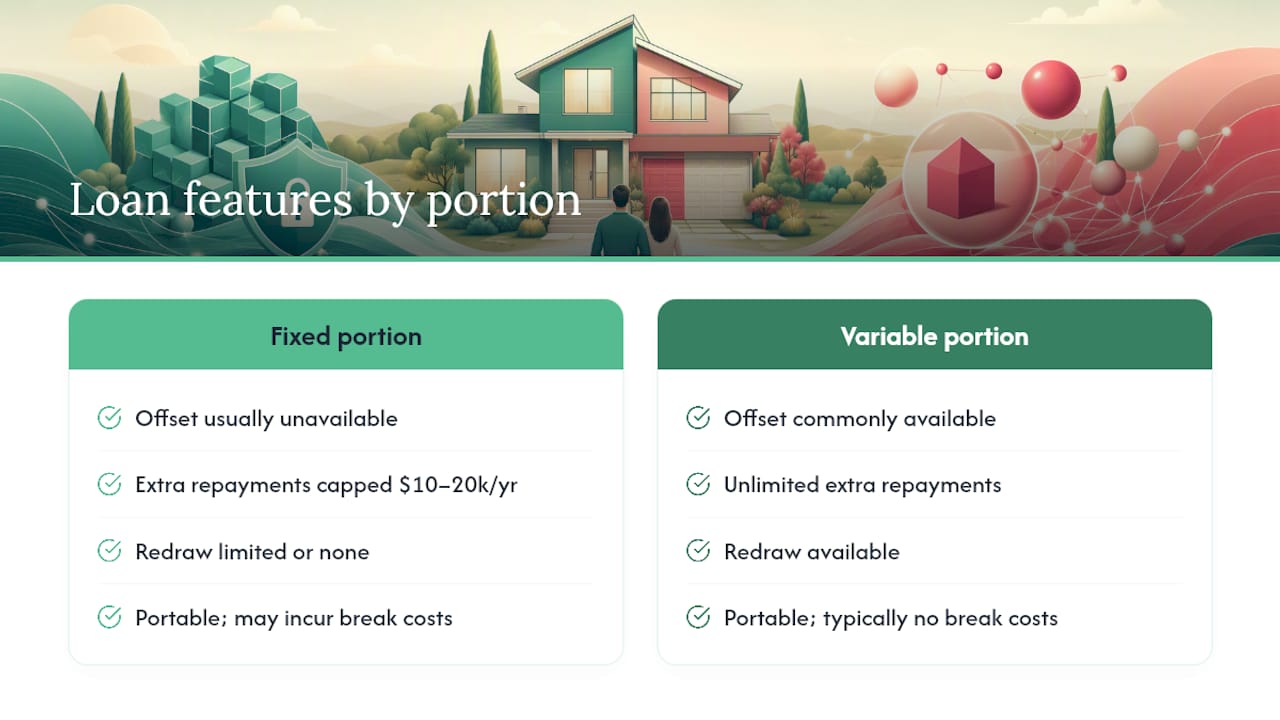
Portability, the ability to take your loan with you if you sell and buy another property, generally applies to both portions, but the fixed slice may still attract break costs if the timing doesn't line up neatly with settlement dates.
Pro Tip: If you're weighing up how to split your loan, put your offset account against the variable portion. That's usually where the offset feature lives anyway, and it means every dollar you park there directly reduces the interest charged on that slice, whereas parking savings against a fixed portion often does nothing at all.
What are the real costs and risks of a split loan?
Break costs are the cost borrowers underestimate most. They're triggered when you exit, refinance, or make large extra repayments against the fixed portion before the term ends, and they're calculated based on the difference between your locked rate and current wholesale rates, multiplied by the remaining term and balance. They can run into thousands of dollars on a larger loan if wholesale rates have fallen sharply since you fixed.

Ongoing fees are the second cost to watch. Some lenders charge a separate account-keeping fee for each portion of a split loan, which means you could be paying two fees where a single unsplit loan would only attract one. Comparison sites like Canstar flag this as one of the key differences between lender products worth checking line by line before you commit.
The lost-upside risk is the one that's easy to forget in a falling-rate environment. If rates drop while a portion of your loan is fixed, that slice doesn't benefit. You'll watch your variable portion's repayments fall while the fixed portion sits unchanged, which can feel frustrating even though it was the trade-off you signed up for.
A rough illustration of scale: on a $300,000 fixed portion locked with two years remaining, a rate gap of even 1 percentage point between your fixed rate and current wholesale pricing can translate into a break cost in the thousands of dollars, depending on the lender's calculation method. Always ask for a written estimate before assuming a number.
Who typically benefits from splitting their home loan?
Not every borrower needs a split loan, and matching your situation to the right structure matters more than following a trend.
- First-home buyers who want partial repayment certainty in their first year or two of ownership, while still building savings in an offset account, often gravitate toward a 50/50 or 60/40 split.
- Families managing tight household budgets benefit from knowing at least part of their repayment won't move, which makes cashflow planning simpler even if the household income fluctuates.
- Property investors juggling multiple loans sometimes split to keep offset flexibility on one portion for cashflow management while locking in certainty on another, particularly when comparing structures across an investment property loan types guide.
A fully fixed loan tends to suit borrowers who want total budgeting predictability and don't hold significant offset savings. A fully variable loan suits those comfortable with rate movement and who want to keep every feature, including unlimited extra repayments and full offset, available across their entire balance.
Quick scenario check: if your instinct is "I need budgeting certainty this year," lean toward a higher fixed proportion. If it's "I'll keep most of my savings in offset," lean toward a higher variable proportion. If you genuinely can't decide, 50/50 is a reasonable starting point to model from.
How do you actually apply for a split home loan?
Setting one up isn't dramatically different from applying for a standard mortgage, but specifying the split correctly matters, and the documentation load is broadly the same either way.
- Get pre-approval with your target split ratio specified upfront, so the lender assesses serviceability against both portions correctly.
- Gather your documents: proof of identity, recent payslips or income evidence, a statement of assets and liabilities, and evidence of your deposit or equity position.
- Compare lenders on features, not just headline rates, using a home loan comparison checklist to check offset availability, extra repayment caps, and break-cost policies side by side.
- Specify the exact split ratio in your application, along with your preferred fixed term (commonly 1 to 5 years).
- Ask direct questions about break-cost calculation methods, whether account-keeping fees apply per portion, and whether partial offset against the fixed slice is available.
- Review and sign loan documents, checking that the split ratio and fixed term match what you agreed to verbally.
- Settlement, after which your combined repayment begins and the lender manages the two portions as separate sub-accounts.
If you're dealing with a more complex structure, such as SMSF lending alongside a personal split loan, additional documentation like trust deeds and fund financials will be required, and this is where working with a broker experienced in both areas saves considerable back-and-forth.
How does a mortgage broker help with the split-loan decision?
A broker's job here isn't just paperwork, but also involves expert Mortgage Pipeline Management to model scenarios across multiple lenders effectively. It's modelling scenarios across multiple lenders, comparing how each one treats offset eligibility, extra repayment caps and break-cost calculations on the fixed slice, and negotiating rate discounts you might not access applying directly.
Zenrgfinance approaches split-loan structuring the same way: model first, apply second. Using the split loan calculator, you can test several ratios before committing to one, and see the repayment difference between, say, a 50/50 and a 70/30 structure on your actual numbers rather than a generic example.
Practical proof points that make this easier:
- A dedicated calculator for testing split ratios against real loan amounts and terms
- Personalised guidance that accounts for your offset savings, income stability, and risk tolerance, not a generic recommendation
- Support comparing lender-specific rules on break costs, fees, and feature access before you apply
- Experience with more complex structures, including SMSF lending, for borrowers who need it
If you're at the point of narrowing down a split ratio, the next practical step is usually a short discovery conversation, followed by a calculator session to stress-test a couple of scenarios before any application goes to a lender.
An adviser's perspective on choosing a split
The mistake I see most often isn't choosing the wrong ratio. It's not modelling the decision at all, and picking 50/50 because it sounds balanced rather than because it fits the borrower's actual cashflow and savings behaviour. Before fixing any portion, work through three things: how much you genuinely hold in offset savings right now, how stable your income looks over the fixed term you're considering, and what a 1 to 2 percentage point rate rise would do to your variable repayment if it happened tomorrow.
As a general rule, lock more of your loan when your income is less predictable or your offset balance is small, because certainty is worth more to you in that position. Keep more variable when you're carrying meaningful offset savings, since that's where the feature actually earns its keep. The ratio matters less than whether you've actually run the numbers before deciding.
How Zenrgfinance helps you set up a split home loan
There are other ways to research a split loan decision, comparison sites, lender calculators, forums, but none of them model your specific numbers against real lender rules the way a dedicated mortgage relationship manager can. Zenrgfinance's approach is to sit down with your actual figures, run them through the split loan calculator, and compare how different lenders treat offset access, break costs, and fees on each portion before you apply anywhere.

Zenrgfinance is paid a commission by the lender once your loan settles, not by you directly, so there's no upfront cost to get a split-loan scenario modelled properly. If you're ready to see what a 50/50, 60/40 or another ratio looks like against your own loan amount, book a session with a mortgage relationship manager and get a clear, numbers-based recommendation before you commit to anything.
Sources
- What is a split home loan? A complete guide
- Fixed vs Variable Home Loan: Australia 2026 Guide
- Compare split home loans
Rates, fees, and feature policies change regularly, so treat any figures here as a starting point and confirm current numbers directly with your lender or broker before making a decision.
This article is general information, not a substitute for advice from a qualified financial advisor. Consult a qualified financial professional about your own circumstances before acting on anything here.