
Saving for a first home deposit is achievable in Australia right now, and the target is far lower than most first-time buyers expect. Government schemes like the First Home Super Saver (FHSS), the 5% Deposit Scheme, and the Family Home Guarantee have fundamentally changed what you need to save. A realistic deposit target sits between $25,000 and $55,000 for most buyers, not the traditional 20% of a purchase price. The fastest path combines tax-effective saving through FHSS, a high-interest savings account, and disciplined budgeting. Zenrgfinance works with first-time buyers every day to map exactly this kind of plan.
What are the current deposit requirements and government schemes?
The standard deposit saving strategies have shifted dramatically since 2025. You no longer need 20% saved before a lender will talk to you seriously.
The 5% Deposit Scheme lets eligible buyers purchase with just a 5% deposit and no Lenders Mortgage Insurance (LMI). LMI is the insurance lenders charge when your deposit falls below 20%, and it typically costs between $10,000 and $40,000. The scheme removes that cost entirely, which is a significant saving on top of your deposit goal.

Since october 2025, the 5% Deposit Scheme carries no income caps or place limits and covers both new and established homes. Property price caps have also increased across major states: NSW sits at $1.5M, VIC at $950K, QLD at $1M, WA at $850K, SA at $900K, TAS at $700K, and ACT at $1M. That scope covers the vast majority of first home purchases in Australia.
The Family Home Guarantee goes further for eligible single parents. It requires only a 2% deposit with no LMI, making it one of the most accessible home deposit assistance options available. The FHSS scheme adds a tax-effective saving layer on top of these guarantees, with a lifetime cap of $50,000 and an annual contribution cap of $15,000.
| Deposit option | Minimum deposit | LMI required | Key benefit |
|---|---|---|---|
| Standard home loan | 20% | No | No LMI, full equity |
| 5% Deposit Scheme | 5% | No | Government guarantee covers gap |
| Family Home Guarantee | 2% | No | Single parents only, lowest deposit |
| FHSS scheme | Supplements above | N/A | Tax savings on contributions |
| Standard loan below 20% | 5–19% | Yes | No scheme needed, LMI applies |
Understanding which option fits your situation changes your savings target entirely. A buyer in Sydney aiming for a $700,000 property needs $35,000 under the 5% Deposit Scheme rather than $140,000 at 20%. That is a fundamentally different saving challenge.
How to set realistic savings goals and timelines
A first home savings plan works best when it starts with a clear number and a realistic timeframe. Vague goals produce vague results.
The typical savings target for Australian first-home buyers ranges from $25,000 to $55,000, with timelines spanning 18 to 36 months depending on income and household type. Higher income earners saving aggressively can reach their goal in 18–24 months. Dual-income couples without dependants typically land in the 24–30 month range. Buyers with dependants or high rent commitments often need 30–36 months.
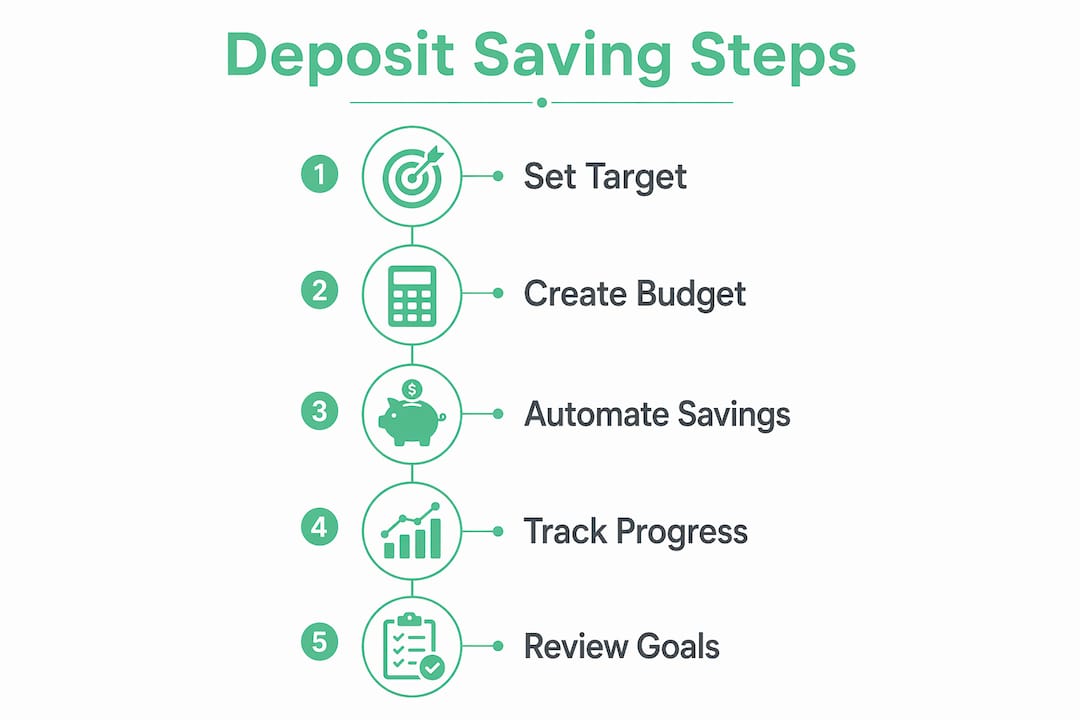
The 50/30/20 budgeting rule gives you a clear starting framework. Allocate 50% of your take-home pay to needs, 30% to wants, and 20% to savings. If your take-home pay is $5,000 per month, that 20% equals $1,000 per month saved, or $12,000 per year. Adjusting that ratio to 30% savings accelerates the timeline considerably.
| Monthly take-home pay | Savings rate | Monthly savings | Time to $40,000 |
|---|---|---|---|
| $4,000 | 20% | $800 | ~50 months |
| $5,000 | 25% | $1,250 | ~32 months |
| $6,000 | 30% | $1,800 | ~22 months |
| $8,000 (dual income) | 30% | $2,400 | ~17 months |
Pro Tip: Set your savings transfer to fire automatically on payday, before you see the money in your everyday account. Treating your deposit savings as a fixed bill is the single most effective behavioural shift first-time buyers can make.
The first-time buyer budget is not just about cutting costs. Income growth during the saving sprint period delivers more funds than expense reduction alone. A salary review, a promotion, or a side income stream can shave months off your timeline faster than cancelling subscriptions.
What practical deposit saving strategies actually work?
The most effective deposit saving strategies share one common feature: they remove willpower from the equation entirely.
Automating your savings on payday to a separate high-interest savings account is the foundation. Your everyday account never sees the money, so you never spend it. Pair this with a monthly budget review to catch spending drift before it compounds.
The biggest expense categories to review are rent, transport, and food. These three typically consume 60–70% of a household budget and offer the most room to move. Reducing rent by moving to a cheaper area or taking on a housemate can save $200–$500 per week, which translates to $10,000–$26,000 redirected to your deposit each year. That single change can cut your saving timeline by 12 months or more.
Here are the practical steps that consistently work for first-time buyers:
- Automate savings on payday to a dedicated high-interest savings account, separate from your everyday account.
- Run a subscription audit every three months. Cancel anything you have not used in the past 30 days.
- Meal plan weekly to reduce food waste and dining out costs, which are often the fastest-growing budget leak.
- Review transport costs and consider whether public transport, carpooling, or a cheaper vehicle reduces your monthly outgoings.
- Negotiate rent at renewal or consider a house share to cut your single largest expense.
- Pursue income growth through overtime, a salary review, freelance work, or retraining for a higher-paying role.
Pro Tip: Open two savings accounts: one for your FHSS contributions and one as a liquid high-interest savings account. This structure keeps your tax-effective savings separate from your accessible emergency buffer.
The compound effect of cutting one major expense and growing income simultaneously is powerful. A buyer who reduces rent by $300 per week and earns $200 more per week through a side income adds $500 per week, or $26,000 per year, directly to their deposit fund. That kind of combined approach is what separates buyers who save in 18 months from those who take four years.
How does the First Home Super Saver scheme accelerate your deposit?
The First Home Super Saver scheme is one of the least-used and most valuable tools available to Australian first-time buyers. Many buyers overlook it because it sits inside superannuation, which feels inaccessible. The reality is quite different.
FHSS works by letting you make voluntary contributions to your super fund, which are then taxed at 15% instead of your standard marginal tax rate. If you earn $80,000 per year, your marginal tax rate is 32.5%. Every dollar you salary-sacrifice into super for your deposit saves you 17.5 cents in tax compared to saving outside super. The tax saving can exceed $10,000 over a full saving period, depending on your income and contribution level.
- Check your eligibility. You must be a first-home buyer who has never owned property in Australia.
- Make voluntary contributions. Salary-sacrifice up to $15,000 per financial year into your super fund.
- Track your contributions. Keep records of all voluntary amounts, separate from your compulsory employer contributions.
- Apply to the ATO for a determination. Before withdrawing, the Australian Taxation Office calculates your eligible release amount.
- Request a release. Once approved, the ATO instructs your super fund to release the funds, minus applicable tax.
- Use the funds within 12 months. You must sign a contract to purchase or build within 12 months of the release.
The FHSS scheme is not a replacement for regular savings. It is an accelerator. The $50,000 lifetime cap means you still need other savings vehicles running in parallel. The best approach pairs FHSS contributions with a high-yield savings account for liquidity, giving you both tax efficiency and accessible funds for costs like stamp duty, conveyancing, and moving expenses.
Couples can each contribute up to $50,000 through FHSS, giving a combined potential of $100,000 in tax-effective savings. FHSS contributions taxed at 15% deliver meaningfully more net funds per dollar saved than standard after-tax savings for most income brackets. The trade-off is reduced liquidity, since super funds are not as immediately accessible as a bank account. That is why the blended approach, combining FHSS with a high-yield savings account, is the recommended structure for most buyers.
Key takeaways
Saving for a first home deposit in Australia is fastest when you combine the 5% Deposit Scheme, FHSS tax advantages, and automated savings discipline to reduce both your target amount and your timeline.
| Point | Details |
|---|---|
| Deposit target is lower than you think | Most buyers need $25,000–$55,000, not a 20% deposit, thanks to government schemes. |
| 5% Deposit Scheme removes LMI | Eligible buyers avoid $10,000–$40,000 in LMI costs with just a 5% deposit. |
| FHSS saves tax on contributions | Voluntary super contributions taxed at 15% can save over $10,000 compared to standard saving. |
| Automate savings on payday | Treating your deposit as a non-negotiable bill is the most effective behavioural strategy. |
| Income growth beats expense cuts | Pursuing salary reviews or side income during your saving sprint accelerates timelines faster than cutting costs alone. |
What I have learned about saving for a first home in Australia
The biggest mistake I see first-time buyers make is waiting. They believe they need a 20% deposit before they can act, and that belief costs them years. The misconception about needing 20% is genuinely one of the most expensive financial myths circulating in Australia right now.
Government schemes have shifted the goalposts. A buyer who qualifies for the 5% Deposit Scheme needs one-quarter of what they would have needed a decade ago. That is not a minor adjustment. It changes the entire saving timeline and makes homeownership realistic for people who assumed it was a decade away.
What I have also noticed is that income growth efforts during the saving period deliver far more than most buyers expect. Focusing on a salary review, upskilling, or a modest side income during the 18–24 month sprint period accumulates more funds than aggressive expense cutting alone. Cutting your coffee budget saves you $1,500 a year. A $10,000 salary increase saves you $10,000 a year. Both matter, but the proportions are worth understanding clearly.
The buyers I see succeed fastest treat their savings target as a project with a deadline, not a vague aspiration. They automate, they review monthly, and they combine FHSS with a liquid savings account so they are never caught short on settlement costs. Optimism backed by a structured plan is what gets people across the line.
— Allen
How Zenrgfinance can help you reach your deposit goal
Saving for a home deposit is one part of the picture. Knowing which loan structure, scheme, and lender suits your exact situation is where the real complexity begins.

Zenrgfinance works with first-time buyers to build a clear path from deposit goal to settlement. The Mortgage Relationship Manager service gives you personalised guidance on which government schemes you qualify for, how to structure your savings, and which lenders will work with your deposit size. You can also use the Zenrgfinance budget planner tool to map your income, expenses, and savings timeline in one place. Getting the right advice early means fewer surprises and a faster path to your first home.
FAQ
What is the average deposit for a first home in Australia?
The average deposit target for Australian first-home buyers ranges from $25,000 to $55,000, depending on location and which government scheme applies. Buyers using the 5% Deposit Scheme need significantly less than those saving toward a traditional 20% deposit.
How long does it take to save a first home deposit?
Timelines range from 18 to 36 months depending on income, household type, and saving discipline. Higher income earners or dual-income couples without dependants can often reach their target in 18–24 months.
What is the First Home Super Saver scheme?
The FHSS scheme lets first-home buyers make voluntary super contributions taxed at 15%, up to $15,000 per year and $50,000 total. The tax advantage over standard savings can exceed $10,000 over the full saving period.
Do I need a 20% deposit to buy my first home?
No. The 5% Deposit Scheme allows eligible buyers to purchase with just 5% and no LMI. Single parents may qualify for the Family Home Guarantee, which requires only a 2% deposit.
What is the fastest way to save for a house deposit?
The fastest approach combines FHSS tax savings with a high-interest savings account, automated transfers on payday, and active income growth during the saving period. Using a government guarantee to reduce your deposit target also shortens the timeline significantly.