
Rentvesting is renting where you actually want to live while owning an investment property somewhere more affordable. It suits Australians who value lifestyle now but still want to build property wealth, particularly first-home buyers priced out of their preferred suburb. The trade-off is real: you get flexibility and a foot on the ladder, but you're also carrying rent, a mortgage, and landlord responsibilities all at once.
TL;DR:
- Rentvesting allows for living in desirable areas while owning investment properties in more affordable locations, often requiring a larger financial commitment due to dual housing costs.
- A realistic serviceability assessment must account for rental income discounts, ongoing expenses, and the potential impact of policy changes, as many plans fail under these calculations.
- Success depends on selecting high-yield, low-vacancy suburbs with strong growth prospects, and aligning property choice with tenant needs and lender criteria rather than personal preferences.
- Investors should carefully stress-test cashflow models with buffers for vacancies and rate rises before committing, as thin margins or weak rental demand can lead to financial strain.
- Working with a mortgage broker to understand lending differences, optimize loan structuring, and assess long-term exit strategies improves the chances of a sustainable rentvesting plan.
Table of Contents
- What does rentvesting look like in practice in Australia?
- What are the pros and cons of rentvesting?
- What does rentvesting actually cost, and how does tax work?
- How does borrowing work for a rentvesting strategy?
- How do you choose the right investment location and property type?
- What's the practical checklist to start rentvesting?
- When is rentvesting the wrong choice?
- A mortgage broker's perspective on rentvesting
- How does rentvesting feel compared to traditional homeownership?
- What are the exit strategies for rentvesters?
- Where conventional rentvesting advice falls short
- How ZENRG Finance can help you plan a rentvesting move
- Sources
- FAQ
What does rentvesting look like in practice in Australia?
Strip away the jargon and rentvesting is a fairly simple split: you rent the home that suits your life right now, and you buy an investment property in a location chosen for its numbers, not its lifestyle appeal. Mozo describes it as separating the lifestyle decision from the financial one, which is really the whole point of the strategy.
In practice, this usually plays out in a set sequence:
- You keep renting in the suburb, city, or lifestyle setup you actually want, whether that's near work, family, or the beach.
- You save a deposit and buy an investment property in a location chosen for rental yield and growth potential, often interstate or in a cheaper part of your own city.
- A tenant moves in and pays rent, which contributes toward the mortgage repayments and ongoing costs.
- You manage the property (usually through a property manager) while living your own life elsewhere, unaffected by tenancy hassles.
Westpac's rentvesting analysis points to a common scenario: a young professional renting inner city for work and social life, while owning a house in a regional growth corridor two states away. The lifestyle stays put. The wealth building happens somewhere else entirely, which is exactly what makes rentvesting appealing to buyers who could see apartment living as a faster way into the market without sacrificing where they live day to day.
What are the pros and cons of rentvesting?
Rentvesting isn't a free lunch. It solves one problem (getting into the market while staying flexible) and creates others (running two sets of housing costs at once). Here's how the ledger typically breaks down.
- You keep living where you want. No compromising on commute, schools, or proximity to family just to afford a mortgage.
- You can often buy sooner. Cheaper investment-grade suburbs mean a smaller deposit and faster market entry than waiting to afford your dream suburb outright.
- Rental income offsets costs. Tenant rent contributes to mortgage repayments, and the ATO allows deductions for many ongoing expenses, including interest, property management fees, and repairs.
- Capital growth builds equity. If you choose well, the investment property appreciates while you're not living in it, working for you in the background.
- You carry two sets of housing costs. Rent plus mortgage repayments, rates, insurance, and maintenance can strain a single income if the numbers are tight.
- You take on landlord risk. Vacancies, problem tenants, and unexpected repairs are now your responsibility, not someone else's.
- You may lose owner-occupier concessions. Some state stamp duty concessions and the full capital gains tax exemption only apply to a principal place of residence, not an investment property.
Canstar's analysis frames this well: rentvesting is a genuine pathway to the market, but it stacks the costs and risks of renting on top of the costs and risks of owning an investment property. Weighing that combination honestly, before you sign anything, is the difference between a smart strategy and an overstretched one.
What does rentvesting actually cost, and how does tax work?
The sticker shock in rentvesting rarely comes from the purchase price. It comes from the pile of smaller costs that show up after settlement, month after month, whether or not you have a tenant.
Budget for these upfront and ongoing costs before you commit:
- Deposit, stamp duty, and loan establishment fees at purchase.
- Building and pest inspections, conveyancing, and lender's mortgage insurance if borrowing above 80% of the property's value.
- Council rates, water rates, landlord insurance, and body corporate or strata fees where applicable.
- Property management fees, typically a percentage of weekly rent, plus letting fees when a new tenant moves in.
- Repairs, maintenance, and a vacancy buffer for periods between tenants.
- Your own rent, which continues regardless of what's happening with the investment property.
On tax, the ATO treats a rental property as an income-producing asset. That distinction matters because it changes what you can claim and what you eventually owe. Interest on the investment loan, property management fees, council rates, and many repairs are commonly deductible against your rental income, based on ATO guidance on residential rental properties. Depreciation on fixtures and the building itself (where applicable) can add further deductions, depending on the property's age and construction date.
The catch is capital gains tax. Unlike a principal place of residence, which is generally exempt from CGT when you sell, an investment property doesn't get that concession. Sell it at a profit and you'll likely owe CGT on the gain, calculated against your marginal tax rate with a discount available if you've held the asset for more than 12 months. MoneySmart recommends stress-testing the full cashflow picture, tax included, before you buy, not after.
How does borrowing work for a rentvesting strategy?
Investment loans and owner-occupier loans are not the same product, even when they're secured against similar properties. Lenders price and assess them differently, and understanding that gap upfront avoids nasty surprises at approval time.
- Investment loans often carry a slightly higher interest rate than owner-occupier loans, reflecting the lender's view of higher risk.
- Loan-to-value ratio (LVR) requirements can be stricter, meaning you may need a larger deposit to avoid lender's mortgage insurance.
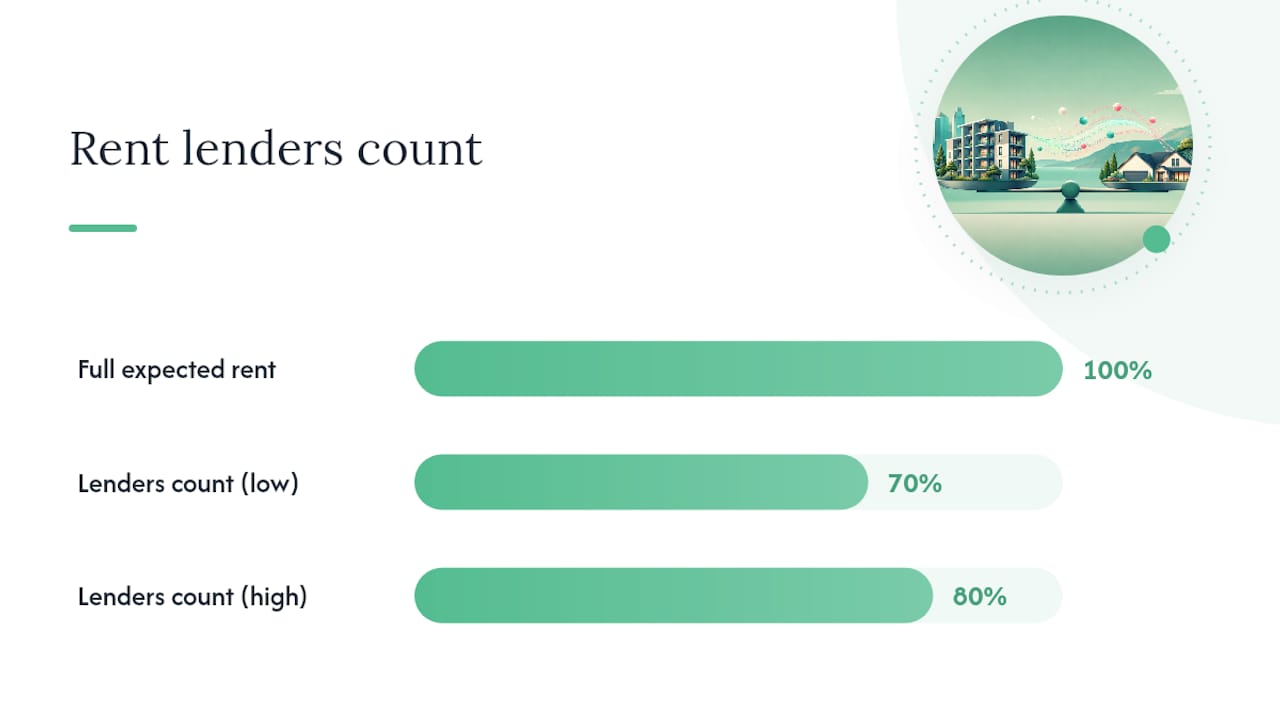
- Lenders typically only count a percentage of expected rental income (commonly around 70 to 80%) toward your serviceability, not the full amount, to allow for vacancies and costs.
- Your existing rent payments are factored into serviceability calculations too, since you're carrying that cost simultaneously with the new mortgage.
This is where a lot of rentvesting plans quietly fall apart. Applicants assume their expected rental income will comfortably cover the shortfall, only to find the lender's serviceability calculator discounts that income heavily and factors in their own rent as an ongoing liability. Getting a realistic read on mortgage serviceability before you start shopping for property saves a lot of wasted time on properties you were never going to be approved for.
A mortgage broker adds value here by packaging your application properly, choosing lenders whose serviceability rules suit your income structure, and presenting your numbers in the way that improves your approval chances.
How do you choose the right investment location and property type?
Buying an investment property with your heart instead of your head is the single most common rentvesting mistake. The property doesn't have to suit your taste. It has to suit a tenant's needs and a lender's confidence in future growth.
Filter potential locations using these criteria before you fall in love with a listing:
- Rental yield. Look for suburbs where rental income as a percentage of property value sits comfortably above your mortgage repayment obligations.
- Vacancy rates. Low vacancy rates signal strong tenant demand; consistently high ones are a warning sign of oversupply or weak local appeal.
- Employment and infrastructure. Suburbs near major employment hubs, transport upgrades, or planned infrastructure tend to hold value better over a decade.
- Population growth. Areas attracting new residents usually see steadier rental demand and stronger long-term capital growth.
New builds and established properties each carry a different risk profile. A new build can offer depreciation benefits and lower initial maintenance, but oversupply is a genuine risk when several similar developments complete in the same area at once, which can suppress rents and resale values. Established properties in proven locations carry less oversupply risk but usually come with higher maintenance costs and fewer depreciation deductions.
Before committing, pull a proper suburb report covering yield, vacancy, and growth history rather than relying on a real estate agent's pitch. Tools like SzopaLabs' sample property report illustrate the kind of granular local data worth reviewing, though Australian buyers should prioritise local, Australian-specific property data sources for anything you act on. A good property manager's local knowledge is worth just as much as the spreadsheet.
What's the practical checklist to start rentvesting?
Moving from "this sounds like a good idea" to actually settling on a property works best as a sequence, not a scramble.
- Budget and stress-test your cashflow. Model your rent, the investment mortgage, and all ongoing costs together, including a vacancy buffer of at least four weeks a year, as MoneySmart recommends.
- Get pre-approved and compare loan types. Talk to a mortgage broker about investment loan options across multiple lenders rather than accepting the first offer from your everyday bank.
- Research suburbs using real data. Compare yield, vacancy rates, and growth trends across a shortlist rather than one favourite location.
- Appoint a property manager before settlement. Line up management so there's no gap between purchase and your first tenant.
- Get tax advice specific to your situation. A quick session with an accountant or tax adviser before you buy avoids expensive mistakes on deductions and CGT.
Each step builds on the last. Skipping the stress test to chase a "hot" suburb is how otherwise sensible buyers end up overcommitted within a year.
When is rentvesting the wrong choice?
Rentvesting works best with a decent cash buffer and a clear margin between rent and mortgage costs. It works badly when that margin is razor-thin, because a single vacancy or rate rise can tip the whole plan into the red.
Watch for these warning signs before committing:
- A cash buffer that wouldn't cover more than one or two months of a vacant property.
- Rental income projections that barely cover the mortgage even under best-case assumptions.
- Weak rental demand in the target suburb, evidenced by high vacancy rates or a glut of similar listings.
- High strata or management fees eating into most of the rental return.
- A property manager with a patchy track record, or a suburb facing a wave of new-build completions that could flood the rental market.
Policy settings can shift the picture too. Ongoing government review of negative gearing and capital gains tax treatment, discussed in Treasury's tax policy work, means the tax efficiency of an investment property today isn't guaranteed to hold for the next decade. Model your plan with some room for policy change, not just current rules.
A mortgage broker's perspective on rentvesting
Serviceability calculations are where most rentvesting applications succeed or stall, and this is exactly where a broker earns their fee. A good mortgage broker takes a holistic approach, looking at your whole financial picture rather than just the property you want to buy, which matters when a lender's rental income discount and your own rent obligations are both working against your borrowing capacity.
Brokers commonly use a specific set of documents to strengthen a serviceability case:
- Recent payslips and tax returns to establish a clean income picture.
- A rental appraisal or comparable market rent evidence for the target property.
- Existing debt statements, including your current rental lease, to show accurate ongoing obligations.
- For SMSF lending, trust deeds and fund financials, since self-managed super fund loans involve additional structuring most lenders assess differently to standard investment loans.
Readers wanting to go deeper can work through ZENRG Finance's podcast on interest rate rises or the episode on investing in property for a broader look at how brokers and investors think through these decisions together.
How does rentvesting feel compared to traditional homeownership?
Owning the home you live in carries a psychological weight that rentvesting simply doesn't. There's a stability narrative attached to homeownership in Australia, the sense of "finally arriving," and rentvesters sometimes feel like they're missing that milestone even while building genuine wealth elsewhere.
That feeling cuts both ways. Renting your own home means you're not tied down. You can chase a job opportunity in another city, downsize or upsize as your life changes, or move closer to family without the friction of selling a home you actually live in. For many people that flexibility is worth more than the emotional certainty of "owning the front door," particularly earlier in a career or family stage.
The flip side is real too: some rentvesters describe a nagging sense of impermanence, especially if a landlord decides to sell the property they're renting, or if their own investment property demands more attention than expected. Managing a tenant relationship from a distance, dealing with repair requests, and absorbing the occasional vacancy can wear on people who imagined property investment as a passive, background activity.
The households who tend to do well with rentvesting are the ones who go in with clear eyes about that trade-off, rather than assuming lifestyle flexibility comes with zero emotional cost. Knowing which one matters more to you, stability or flexibility, is worth figuring out before you sign a lease and a mortgage in the same month.
What are the exit strategies for rentvesters?
Every rentvesting plan needs an endpoint, even if that endpoint changes over time. The three common exits are selling the investment property, converting it into your future home, or holding it long term while eventually buying a separate home to live in.
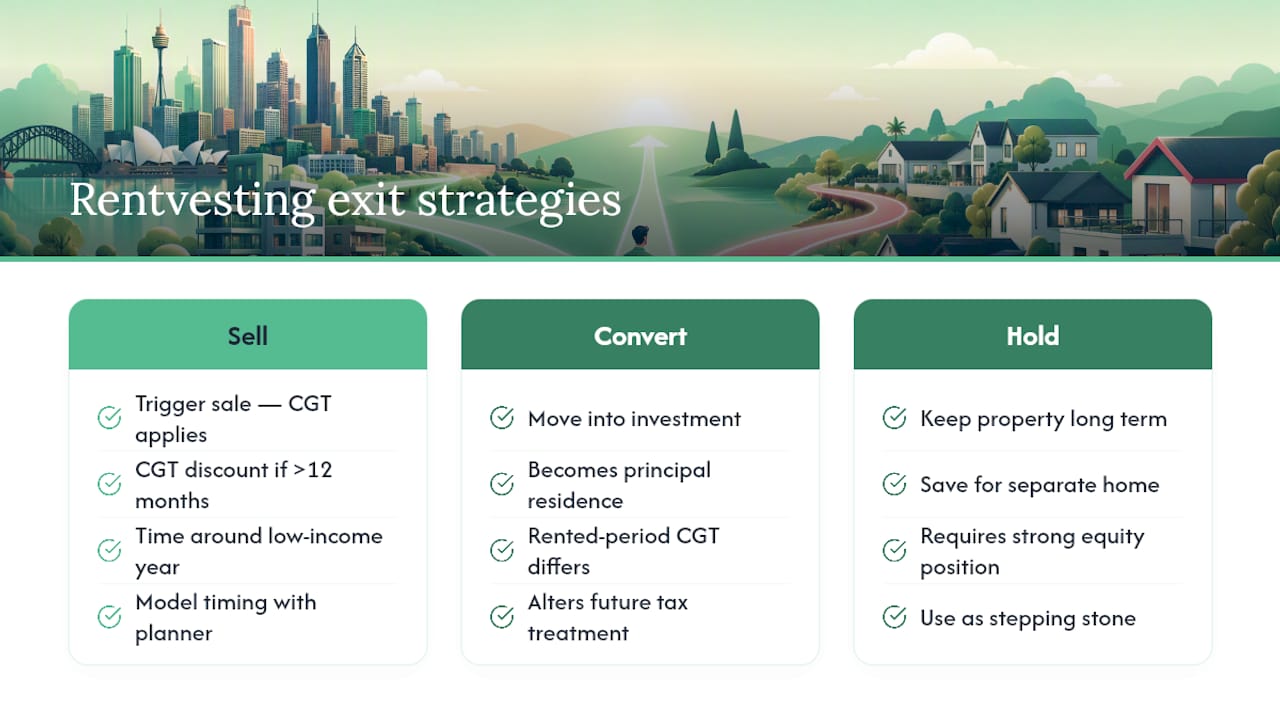
Selling triggers capital gains tax, calculated on the gain since purchase with a discount if you've held the asset over 12 months, based on ATO rules for residential rental properties. Timing a sale around a lower-income year, or after a market peak, can materially change how much tax you pay. Moving into the investment property yourself is another path some rentvesters take once their life circumstances settle, effectively converting the investment into a principal place of residence, though this changes both the tax treatment going forward and the CGT calculation for the period it was rented out.
The third option, holding long term while eventually saving for a separate owner-occupied purchase, is the classic "use the investment as a stepping stone" approach. It requires patience and a strong enough equity position in the investment property to help fund a deposit on the home you'll actually live in.
Whichever path you're leaning toward, model it years in advance rather than deciding reactively. A budget planner that lets you test different sale timings, rate scenarios, and income changes is worth far more than a rough guess done on the back of a napkin.
Where conventional rentvesting advice falls short
Most rentvesting content sells the upside: rent where you love, buy where it's cheap, watch the equity grow. That's not wrong, but it skips the part that actually determines success or failure, which is serviceability math done honestly rather than optimistically.
The research here points to a clear priority order. Get the cashflow stress test right first, including vacancy buffers and a genuine buffer for rate rises, before you fall in love with a suburb. Most rentvesting failures aren't caused by picking a bad property. They're caused by underestimating how thin the margin gets once a lender discounts your expected rental income and your own rent gets counted against your borrowing capacity.
The conventional advice also underplays how disorienting the lifestyle side can feel, even when the finances work perfectly. Nobody warns first-timers that owning an investment property you'll never live in can feel strangely abstract, more like a spreadsheet than an asset, until the first vacancy or repair bill lands.
If there's one thing worth prioritising above suburb selection or interest rate comparisons, it's getting your serviceability picture assessed properly before you start looking at listings. A property investment strategy built on a realistic borrowing capacity beats one built on hope every time.
— Allen
How ZENRG Finance can help you plan a rentvesting move
If the cashflow modelling and lender rules above have you thinking twice, that's the point of reading them before you buy, not after. ZENRG Finance takes a client-centric, holistic approach to exactly this kind of decision, tailoring loan structuring to your actual income, rent obligations, and goals rather than pushing a one-size-fits-all product.

For readers starting out, First Home Buyer Loans can help you understand your options if rentvesting is competing against a traditional first purchase in your planning. If you're ready to move on the investment side, Property Investments support covers comparing loan products across multiple lenders and structuring your application to present your numbers well. Investors using superannuation to fund a purchase can also explore SMSF Loans with guidance on the extra structuring these loans require.
A good next step is booking a strategy session and bringing your recent payslips, current rent details, and a rough shortlist of suburbs you're considering. You can also run your numbers through the Budget Planner beforehand to arrive with a clearer picture of what you can realistically afford.
Sources
This article is general information, not a substitute for advice from a qualified financial advisor. Consult a qualified financial professional about your own circumstances before acting on anything here.
FAQ
What are the downsides of rentvesting?
The main downsides are carrying rent and a mortgage simultaneously, taking on landlord responsibilities like repairs and vacancies, and potentially losing owner-occupier concessions such as the full capital gains tax exemption that applies to a principal place of residence. Canstar's analysis notes these combined costs and risks stack on top of each other rather than replacing one another.
What is the 2% rule for investment property?
The 2% rule is an informal guideline suggesting weekly rent should equal roughly 2% of the property's purchase price to indicate strong cashflow, though it's rarely achievable in most Australian capital city markets today. It's best treated as a rough screening tool rather than a hard target, alongside proper yield and vacancy data for the specific suburb.
What is the 30% rent rule in Australia?
The 30% rule suggests housing costs, rent or mortgage repayments, shouldn't exceed 30% of your gross household income to remain financially comfortable. For rentvestors, this needs applying to combined housing costs (your rent plus your investment mortgage shortfall), not just one or the other, which is where stress-testing cashflow becomes essential.
Is it better to rentvest or buy?
Neither option is universally better; it depends on whether you value living in your preferred location now more than owning the home you live in, and whether the numbers on an investment property stack up under a proper stress test. Buying your own home suits those wanting stability and full access to owner-occupier concessions, while rentvesting suits those prioritising lifestyle flexibility and earlier market entry. A conversation with a mortgage broker about your specific serviceability position is the fastest way to find out which path actually works for your numbers.