
Yes, you can use foreign income for an Australian home loan. Most major lenders and specialist brokers accept it, but they convert your earnings to AUD and typically use only a portion for serviceability. Approval depends on your residency or visa status, currency, employment stability and how well you document everything. The smart first move is a broker-led borrowing estimate, followed by certified, translated paperwork before you apply.
TL;DR:
- Eligibility varies by residency, visa status, and currency, with Australian citizens and permanent residents abroad facing the least restrictions and non-residents subjected to stricter conditions.
- Different income types like PAYG salaries, self-employment, pensions, and rental income are assessed differently, often requiring extensive documentation and translation for foreign payslips and tax returns.
- Converting and shading foreign income involves conservative currency rates and discounts, which can significantly lower assessed income; some lenders shade more conservatively than others, affecting borrowing power.
- Using a specialist broker helps identify lenders with favorable shading policies, prepares organized documentation packages, and improves approval odds while optimizing borrowing capacity.
Table of Contents
- Key considerations for borrowers with foreign income
- Who is eligible for a foreign income or expat home loan in Australia?
- What foreign income counts and how lenders treat different income types
- Documents lenders require when assessing foreign income
- How Australian lenders convert and 'shade' foreign income
- How foreign income affects borrowing power, LVR and costs to expect
- Application steps and timeline for using foreign income in an Australian home loan
- Practical tips to improve approval odds and maximise borrowing capacity
- Why work with a specialist broker for foreign income lending
- Common pitfalls I see with foreign‑income applications
- ZENRG Finance as a practical next step for foreign income borrowers
- Sources
Key considerations for borrowers with foreign income
Australian lenders don't treat foreign income the same way they treat a local payslip; for example, their policies vary widely as shown by Foreign Income Mortgage Approval Examples for Alberta. They see more risk in it, so they check more boxes before they say yes.
Residency and visa status sit at the top of that checklist. A citizen earning income in Singapore gets assessed differently to a temporary visa holder earning the same amount, and your local address (or lack of one) shapes which lenders will even look at your file. Employment type matters just as much. A PAYG employee with a stable employer letter clears the bar faster than a self-employed contractor juggling multiple currencies and irregular invoices.
Beyond that, expect lenders to weigh:
- Currency risk — not every foreign currency is treated equally, and some lenders won't touch certain currencies at all.
- Documentation and translation burdens — foreign payslips and tax returns usually need certified translation before they're even considered.
- Existing debt and deposit location — money sitting overseas raises questions about how and when it'll land in Australia.
- Income consistency — a two-year track record carries far more weight than a six-month contract.
Get these factors wrong on your application and you risk a rejection that a bit of preparation would have avoided.
Who is eligible for a foreign income or expat home loan in Australia?
Eligibility hinges on three things: who you are, where you live, and what currency pays you.
Most lenders happily consider Australian citizens and permanent residents living and working overseas, since your legal right to buy property here isn't in question. Some temporary visa holders can also qualify, though the pool of willing lenders shrinks and conditions tighten. Non-residents (foreign nationals with no Australian citizenship or permanent residency) face the strictest scrutiny and the smallest lender pool.
Here's how eligibility typically breaks down:
- Australian citizens/permanent residents abroad — widest lender access, most flexible LVR terms.
- Temporary visa holders — accepted by a narrower set of lenders, often with a higher deposit requirement.
- Non-residents — limited lender options, higher deposits, and closer compliance checks.
Deposit expectations climb accordingly. Expat-friendly lenders often cap borrowing at LVRs up to around 80% depending on your currency, income type and documentation strength, which usually means a 20% deposit at minimum, and often more for non-standard applicants.
If you're a non-resident (not a citizen or permanent resident) buying residential property in Australia, you'll generally need Foreign Investment Review Board approval before settlement. Citizens and permanent residents earning overseas income are exempt from this requirement, which is one reason the distinction between "expat" and "non-resident" matters so much in this space. Canstar's non-resident lending guide is worth a read if you're unsure which category you fall into.
What foreign income counts and how lenders treat different income types
Not all foreign income is assessed equally, and the type of income you earn changes how much paperwork you'll need to produce.
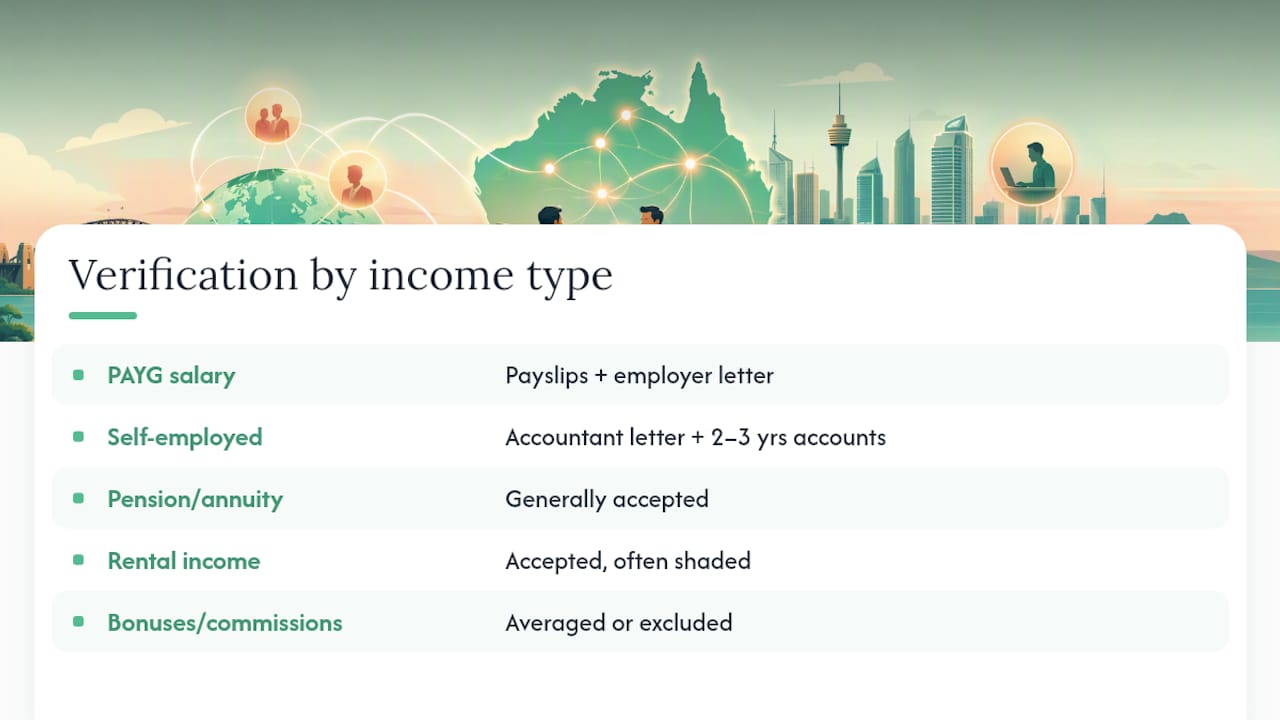
PAYG salary is the easiest to verify. Recent payslips, an employer letter confirming role and salary, and a couple of months of bank statements usually satisfy most lenders.
Self-employed income demands more. Lenders want accountant letters and often two to three years of financial statements, since a single strong year doesn't prove ongoing capacity to repay.
Pensions, annuities and rental income from overseas are generally accepted, though rental income often gets shaded harder than salary because vacancy risk and currency exposure compound each other.
Bonuses and commissions rarely count at full value. Most lenders average them over one to two years, or exclude them entirely if they're inconsistent.
Documents lenders require when assessing foreign income
A messy application slows everything down. A clean, complete pack does the opposite, and it's genuinely within your control to build one properly.
Here's the core documentation set most lenders expect:
- Recent payslips — usually the last two to three pay cycles, showing gross and net pay clearly.
- Tax returns — typically the last one to two years, translated if not issued in English.
- Bank statements — three to six months, showing salary deposits and general account behaviour.
- Employer letter — confirming your role, salary, employment start date and contract status.
- Passport and visa documentation — proving your identity and current residency or visa status.
If you're self-employed, add accountant-prepared financial statements and a signed accountant's letter verifying income, since lenders lean heavily on that third-party confirmation when payslips don't exist.
Translation is where a lot of applications stall. Lender guidelines typically require foreign documents to be translated by a NAATI-certified or registered translation service, not a casual translation from a friend or an online tool. An overseas credit report can also help, particularly if you've spent limited time building an Australian credit history.
Pro Tip: Package every document into a single, clearly labelled PDF bundle before submission — payslips first, then tax returns, then bank statements, then letters. Lenders process organised files faster, and it cuts down the back-and-forth email chain that delays so many expat applications.
Self-employed applicants should also read up on how to structure a home loan application when you run your own business, since the evidence bar sits noticeably higher than for PAYG employees.
How Australian lenders convert and 'shade' foreign income
This is the part that catches most expat borrowers off guard. Lenders don't just convert your salary to AUD at today's exchange rate and call it done. They convert it, then discount it, and that discount is where a lot of borrowing power quietly disappears.
Conversion itself usually happens using a conservative rate, not the day's spot rate, to build in a buffer against currency swings. Once converted, lenders apply a "shading" percentage that reflects how much they trust that income stream. Macquarie's broker credit guidelines state that foreign income is converted to AUD and lenders commonly use around 80% of that converted figure for serviceability, applying to Tier 1 currencies including GBP, EUR, HKD, NZD, SGD, USD, CAD, JPY and CHF.
Currency tiering in practice: a borrower earning a stable salary in a widely accepted currency such as USD or SGD might see 80% of their converted income counted. A borrower earning in a less commonly accepted currency, or paid through irregular commission structures, can see that figure shaded further, sometimes well below 70%.
Variable pay compounds the discount. Bonuses, commissions and short income histories often get an additional haircut on top of the currency shading, because lenders want proof the income is reliable before they lend against it.
Here's a worked example. Say you earn USD $120,000 a year in Singapore. Converted to AUD at a conservative rate, that might land around AUD $180,000. That $36,000 gap is the difference between qualifying for your target property and falling short.

This is exactly why lender selection matters more than the raw salary figure. Some lenders shade more conservatively than others, and the wrong choice can cost you tens of thousands in borrowing capacity for identical income.
How foreign income affects borrowing power, LVR and costs to expect
Once shading and haircuts are applied, the practical effect is a smaller assessed income and, by extension, a smaller loan.
Real-world scenarios show currency tiering and income shading can reduce an expat borrower's assessed borrowing capacity by roughly AUD $150,000 to $250,000 compared with an equivalent domestic-income applicant. That's not a small margin, and it's exactly why deposit planning needs to account for the shaded figure, not your actual take-home pay.
LVR caps for expat applicants commonly sit around 80%, meaning a 20% deposit minimum, though some lenders push this lower for non-standard currencies or thin documentation histories. Minimum loan sizes can also apply, ruling out smaller purchases for some overseas-income borrowers.
Budget for extra costs too: certified translation fees, overseas document retrieval charges, FIRB application fees where relevant, and in some cases a modest rate or fee premium reflecting the lender's added risk assessment. Timing your currency conversion for deposit transfers matters as well. A weak exchange rate on transfer day can quietly erode the AUD value of your deposit before it even reaches settlement.
Application steps and timeline for using foreign income in an Australian home loan
The process runs longer than a standard domestic application, mostly because of document verification and translation lead times.
- Pre-application — gather payslips, tax returns and bank statements, get a preliminary borrowing estimate from a broker, and check whether FIRB approval applies to your situation.
- Formal application — submit your full document pack; expect assessment and query turnaround to take longer than a standard application due to translation checks and overseas verification.
- Document submission — arrange NAATI-certified translations in advance rather than scrambling once a lender requests them, since this is the single biggest cause of delay.
- Settlement — plan your FX transfer timing for the deposit, and set up how you'll manage repayments if you're still being paid in a foreign currency.
Delays most often happen at the translation and verification stage, so starting that process early is the single most useful thing you can do for your timeline.
Practical tips to improve approval odds and maximise borrowing capacity
A few deliberate moves can meaningfully shift your outcome, and most of them cost nothing but time.
- Work with a specialist expat mortgage broker who understands which lenders shade which currencies favourably, since the right lender choice can materially lift your borrowing capacity for identical income.
- Provide multi-year income evidence rather than a single recent payslip, and get every document translated and certified before submission.
- Tidy up existing debts and credit reports before applying. Read through common money habits that raise lenders' eyebrows so you're not caught out by something avoidable.
- Consider a local co-borrower or an Australian deposit account, both of which can strengthen a file that otherwise relies entirely on overseas evidence.
Pro Tip: Time your FX transfer deliberately rather than moving your deposit the moment you decide to buy. A poorly timed transfer can erode your deposit's AUD value right when you need every dollar for settlement.
Why work with a specialist broker for foreign income lending
Foreign income lending isn't a one-size-fits-all product, it's a matching exercise between your income profile and the right lender's policy. Zenrgfinance takes a client-centric approach built around exactly this problem, comparing loan products across multiple lenders rather than pushing you toward a single option.

That matters because, as covered above, currency shading varies significantly between lenders. Zenrgfinance's broker relationships and lending knowledge help identify which lenders treat your specific currency and employment type most favourably, and its checklists and calculators let you model realistic repayment scenarios before you commit. Browse the latest lending insights for more context on how policy shifts affect foreign income borrowers month to month.
Common pitfalls I see with foreign‑income applications
Each one adds weeks to a timeline that didn't need to be long.
DIY applications tend to falter at the lender-selection step, where borrowers apply with the first bank they know rather than the lender best suited to their currency. Clients who switch to a lender with more favourable shading policies routinely qualify for materially more than their first quote suggested, sometimes tens of thousands more, simply from better matching.
— Allen
ZENRG Finance as a practical next step for foreign income borrowers
Zenrgfinance's approach gives foreign income borrowers a genuine head start over the traditional bank-branch experience, where a single teller's grasp of currency shading policy is often the ceiling on what you'll get offered. Rather than applying blind to one lender, you get a comparison across multiple lenders' currency and documentation policies before you commit to anything.

An initial consult with a mortgage relationship manager typically covers a realistic borrowing estimate based on your actual currency and employment type, a tailored document checklist so you're not guessing what to translate and certify, and a shortlist of lenders whose policies suit your specific income profile. Bring your recent payslips, tax returns and a rough idea of your target property price, and you'll walk away with a clear picture of what's achievable. Book a session through the mortgage relationship manager page to get your borrowing estimate underway.
Sources
For readers who want to verify lender credentials or check the rules directly, these official references are worth bookmarking:
- How Australian Lenders Assess Foreign Income | Expat Home Loan Guide - Expat Mortgage Broker
- Foreign Investment Review Board
- Non-resident home loans - Canstar
This article is general information, not a substitute for advice from a qualified financial advisor. Consult a qualified financial professional about your own circumstances before acting on anything here.