
Most home loan pre-approvals in Australia last between 60 and 90 days, with some major banks setting the mark at 90 days flat. If yours is close to lapsing or already has, call your lender or broker today. Renewal is usually quick and straightforward if your income, job and debts haven't changed.
TL;DR:
- Pre-approval validity in Australia typically ranges from 60 to 90 days, with some lenders offering as short as 30 days or as long as 120 days, depending on documentation and risk factors.
- The expiry mostly applies to the pre-approval letter, not the underlying loan assessment or file, which remains on record and can be quickly renewed.
- Updating a pre-approval involves providing recent payslips, bank statements, and confirming no material changes, with renewal usually faster than a fresh application.
- Timing renewals before the expiry date is crucial, especially in competitive markets, to prevent delays that could harm offer acceptance or cause contract issues.
- Using a broker with access to multiple lenders can significantly reduce renewal times and help manage deadlines during property negotiations.
Table of Contents
- How long does pre-approval last and why does it vary?
- What actually expires: the letter or your file?
- What happens once your pre-approval lapses?
- How do you renew a pre-approval? A step-by-step checklist
- How can you avoid letting pre-approval lapse in the first place?
- How does expiry affect offers, finance clauses and settlement?
- How ZENRG Finance helps when your pre-approval expires
- Why the standard advice on pre-approval expiry misses the point
- Ready to renew? Here's how ZENRG Finance can help
- Sources
How long does pre-approval last and why does it vary?
There's no single national rule on pre-approval validity, and that catches a lot of buyers out. Most Australian lenders issue conditional approval for somewhere between 60 and 90 days, and several major banks, including NAB, publish 90 days as their standard window for conditional home loan approval. Broader consumer guidance backs this up, noting most pre-approvals sit in the 60 to 90 day range regardless of lender.
Australian-focused finance guides tend to describe the range a little more loosely, putting it at around two to three months, which lines up with what brokers see day to day. The gap between lenders isn't random. It comes down to a few things:
- How the letter was issued. A quick digital pre-approval based on self-reported figures often carries a shorter shelf life than one backed by full document verification.
- The lender's own risk settings. Some lenders review pricing, credit policy or interest rate assumptions on a rolling basis and prefer shorter windows so those numbers don't go stale.
- The loan product. Investment loans and complex structures, including SMSF lending, sometimes carry tighter timeframes because the underlying serviceability calculations are more sensitive to change.
A handful of lenders will issue a 30 day letter for fast-moving buyers, while others stretch to 120 days for a well-documented file. That's a four-fold difference between the shortest and longest options on the market, which is exactly why you shouldn't assume your last pre-approval, or your mate's, tells you anything about this one. Check the expiry date printed on your own letter the day you receive it, not when you're about to make an offer.
What actually expires: the letter or your file?
Two different things are going on when people talk about pre-approval expiry, and mixing them up causes a lot of unnecessary panic. The pre-approval letter is the document you'd show an agent or attach to an offer. It states an approved amount, conditions and an expiry date. The underwriting file is the lender's internal record: your submitted payslips, bank statements, credit check results and the assessor's notes on how they arrived at that figure.
When the letter expires, the assessment behind it doesn't vanish. The file typically stays on record, which is why renewing a pre-approval is usually faster than starting fresh, since the lender isn't rebuilding your profile from zero, just refreshing the pieces that go stale fastest.
Some parts of your file age faster than others:
- Payslips and bank statements are the first things to expire in a lender's eyes, often needing to be dated within 30 to 60 days of any new assessment.
- Employment confirmation can shift quickly too, particularly if you're on probation, contract, or recently changed roles. If a job change is on the cards, it's worth reading how switching jobs can affect a mortgage application before you do.
- Identity documents and credit history tend to have longer shelf lives, though a fresh credit check is still standard practice at renewal.
- Savings history and deposit evidence need re-checking if any time has passed, since lenders want to see the funds are still there and genuinely saved.
Lenders re-verify before settlement, not just before offering you a letter, because a lot can change between pre-approval and the day the loan actually funds. That's the whole point of the exercise: the letter is a snapshot, and lenders want confidence the snapshot still reflects reality.
What happens once your pre-approval lapses?
An expired letter doesn't erase your borrowing capacity, but it does change how sellers, agents and lenders treat your offer. Real estate agents deal with pre-approval letters constantly, and a document that's clearly out of date raises a flag, especially in a competitive campaign where multiple offers are on the table.
Here's what typically follows an expiry:
- Agents may ask for an updated letter before presenting your offer to the vendor, particularly at auction or in a multiple-offer scenario.
- Lenders will often re-run a credit check as part of renewal, since the previous check has aged out of their comfort window.
- Updated documents get requested again, even if nothing in your financial life has changed, simply because the paperwork itself has a shelf life.
- Tight finance clauses become risky. If your contract's finance condition period is shorter than the time it takes to refresh your approval, you could be racing the clock on two fronts at once.
A mortgage-related hard credit inquiry can cause a small, temporary dip in your credit score, but the impact is usually limited and recovers over the following months.
The real risk of an expired pre-approval isn't the paperwork itself. It's timing. If you find the right property while your letter is lapsed, and the vendor wants a fast, clean settlement, a delay of even a few days for renewal can be the difference between your offer landing and losing out to a buyer with current approval in hand.
How do you renew a pre-approval? A step-by-step checklist
Renewing is rarely as painful as buyers expect, provided you start early and know what's coming. Here's the process most Australian lenders and brokers follow:
- Contact your broker or lender one to two weeks before expiry. Don't wait until the letter has lapsed. Setting a reminder ahead of the deadline gives the lender time to process a refresh without you losing momentum mid-search.
- Gather your updated documents. Most lenders want your most recent payslips (usually the last two), 30 days of bank statements, and written confirmation of current employment.
- Confirm nothing material has changed. New debts, a change of job, a new car loan, or a dip in savings can all affect the reassessment, so be upfront about anything that's shifted.
- Expect a fresh credit check. This is standard for most renewals and, per Experian's guidance, the effect on your score is usually small and short-lived.
- Wait for reissue. Because your underwriting file is often already on record, renewal is typically quicker than a brand-new application, sometimes turned around within a few business days rather than the one to two weeks a first-time application can take.
Pro Tip: Ask your lender directly whether they can reissue based on a "document refresh" rather than treating it as a brand-new file. Some lenders have an internal fast-track for this, but they won't always offer it unless you ask.
The key difference between renewal and a new application is scope. A new application starts from scratch, including a full reassessment of your borrowing capacity, credit profile and product fit. A renewal usually just checks whether the picture painted by your original file still holds true. If you're curious about what a first application actually involves, the step-by-step home loan application guide covers the full process for comparison.
How can you avoid letting pre-approval lapse in the first place?
The best fix for expiry is never needing to deal with it, and that comes down to timing your pre-approval to your actual search, not the other way around. Applying for pre-approval too early, before you're seriously inspecting properties, is one of the most common reasons buyers end up scrambling to renew.
A few habits make a real difference:
- Get pre-approved once you're genuinely ready to shop, not six months out from browsing listings out of curiosity. Consumer guidance from the US backs this pattern too: timing pre-approval to active house hunting cuts down on wasted paperwork.
- Set a calendar reminder at the two-thirds mark of your approval window, not the final week, so you have breathing room if the renewal takes longer than expected.
- Ask upfront whether a longer validity period is available. Some lenders will extend to 120 days for well-documented files if you simply request it.
- Loop in a broker if your search is dragging on. Brokers can often negotiate extensions directly with the lender's assessment team, and they know how to time your finance condition period against your pre-approval expiry so the two don't collide.
Pro Tip: If you're not sure how much runway you have left in a hot market, read up on how long you typically have to secure a property once you find one you want, then work backwards from your pre-approval expiry date.
How does expiry affect offers, finance clauses and settlement?
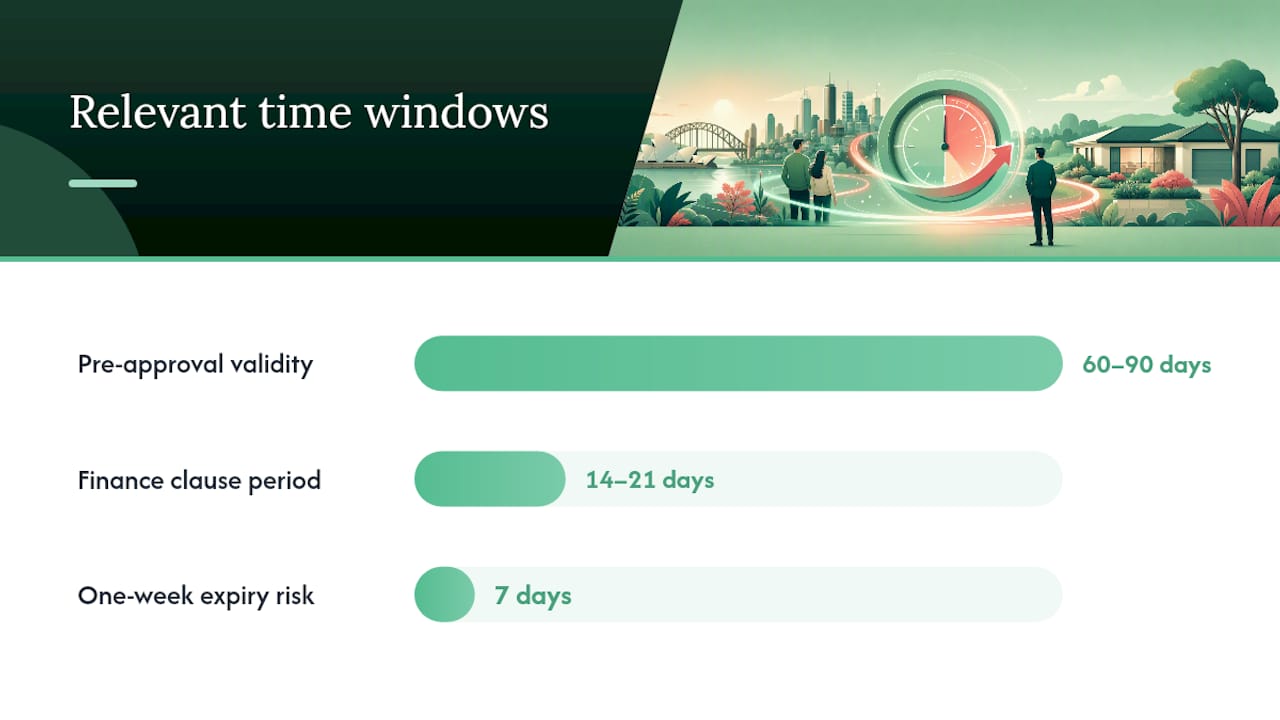
Agents and vendors read a current pre-approval letter as a signal you're a serious, ready buyer. An expired one, even if it's only a week out of date, can quietly weaken your position in a multiple-offer situation, because the agent has no easy way to know if you'd still qualify for the same amount today.
The bigger practical risk sits in your contract's finance clause. Most Australian contracts include a finance condition period, commonly somewhere between 14 and 21 days, during which you need to secure unconditional approval.
- Line up your pre-approval expiry with your likely settlement date, not just the day you sign the contract, so you're not renewing mid-negotiation.
- Factor in valuation timing. The lender's valuer needs to inspect the property before unconditional approval, and that step alone can take several business days.
- Build a buffer into your finance clause if your pre-approval is close to expiring when you make the offer, rather than assuming everything will move on schedule.
- Tell your broker the moment you're under contract so they can prioritise your file and avoid a last-minute scramble against the finance deadline.
None of this is about panic. It's about sequencing, and getting the order of operations right so your pre-approval, your finance clause and your valuation all land in the same window instead of working against each other.
How ZENRG Finance helps when your pre-approval expires
Renewing pre-approval yourself is doable, but a broker changes the maths on speed. ZENRG Finance works across multiple lenders, which means when one lender's turnaround stalls, there's often another route to keep your file moving instead of just waiting in a queue.
Brokers who work with a panel of lenders day in, day out tend to know which credit teams will accept a straightforward document refresh instead of demanding a full resubmission, and that knowledge alone can shave days off a renewal. ZENRG Finance applies that same relationship-driven approach across its client base, from first home buyers refreshing a straightforward letter to investors and business owners managing more layered files, including SMSF lending, where document requirements are more involved.
If your letter is close to lapsing, the practical next step is simple: get your updated payslips and bank statements ready, flag any changes to your income or debts, and get in touch before the deadline rather than after it.
Why the standard advice on pre-approval expiry misses the point
Most guidance on this topic treats expiry as a paperwork problem: your letter lapsed, so go get another one. That's technically true, but it skips the part that actually costs buyers deals, which is sequencing. The real issue isn't whether your pre-approval expires. It's whether it expires at the exact moment you need it most, mid-negotiation, days before a finance clause deadline, or right as a vendor is comparing offers.
Conventional advice also underplays how much variance exists between lenders. Telling someone "pre-approval lasts about 90 days" and leaving it there ignores the buyers sitting on a 30 day letter who don't realise it until it's already lapsed. The fix isn't complicated, but it does require discipline: check your expiry date the day you get the letter, not the day you need it, and treat renewal as a routine admin task rather than an emergency. Buyers who build that habit rarely lose a property over expired paperwork. The ones who don't are the ones calling their broker in a panic on a Friday afternoon before a Monday settlement.
— Allen
Ready to renew? Here's how ZENRG Finance can help
Waiting on a lender's general call centre to refresh your file can cost you days you don't have when a property's on the line. ZENRG Finance works across a panel of lenders, so if one lender's renewal process is slow, there's usually another practical route to keep your finance moving without starting from scratch.

The team can talk you through exactly which documents your specific lender will want for a refresh, help you time your renewal against your offer or finance clause deadline, and step in early if your situation includes anything more complex, like SMSF lending, that needs a closer look before resubmission. If your pre-approval is close to lapsing or already has, the next move is straightforward: get in touch with a Mortgage Relationship Manager at ZENRG Finance and get your renewal started before it becomes a deadline problem instead of a paperwork one.
Sources
- How long does a mortgage preapproval last? — Experian
- How long does home loan pre approval take? — Canstar
- How long does preapproval last? — Opendoor
- Get a preapproval letter — Consumer Financial Protection Bureau