
A lease doc commercial loan is assessed primarily on the rental income your commercial property earns, not on your personal tax returns or business financials. That single distinction makes it one of the most practical commercial financing options for investors who hold well-leased assets but have complex income structures. As CommBank explains, the loan is underwritten on verified lease income, which means the strength of your tenant and lease terms carries more weight than your personal serviceability.
This product suits you if:
- Your property is tenanted under an arms-length, executed commercial lease with a credible tenant
- The net rental income comfortably covers loan repayments at the lender's assessed interest coverage ratio (ICR)
- Your ownership structure is acceptable to lenders (a non-trading SPV, company, or trust typically qualifies)
If those three boxes are ticked, a lease doc pathway is worth exploring. Book an eligibility review with a broker or speak with the team at Zenrgfinance to confirm your position before you start assembling documents.
Key takeaways
A lease doc commercial loan is assessed on verified rental income, making it the most practical pathway for investors with strong tenancies and complex personal income structures.
| Point | Details |
|---|---|
| Lease strength is everything | Lenders adjust gross rent for outgoings, incentives, and vacancy; the net figure must cover repayments at the required ICR. |
| Minimum lease term matters | Most lenders require at least 12 months of remaining lease term; longer terms improve approval prospects. |
| LVR ranges from 65–70% | Standard commercial property typically attracts LVRs up to 65–70%, depending on lender and property type. |
| Tenant covenant is assessed | Lender credit teams review tenant quality and payment history, not just the rent figure on the lease. |
| Zenrgfinance can help | Zenrgfinance matches investors to the right lease doc lenders and manages the application from pack preparation to settlement. |
Use the Zenrgfinance loan comparison calculator to model repayments, or book a strategy session to confirm your eligibility.
Table of Contents
- What is a lease doc commercial loan and how does it work?
- Who qualifies and what documents do lenders want?
- What are the benefits and risks of lease doc lending?
- What loan terms should you expect?
- Which lease clauses do lenders actually inspect?
- How do you apply, and how long does it take?
- Lease doc versus traditional commercial loans: which suits your situation?
- How a specialist broker helps you get lease doc approval
- What the front line actually teaches you about lease doc applications
- Zenrgfinance: your lease doc lending partner
- Sources
What is a lease doc commercial loan and how does it work?
The term "lease doc" is shorthand for lease-documentation lending, a product category where the commercial lease itself serves as the primary underwriting evidence. Rather than submitting two years of personal tax returns or business profit-and-loss statements, you provide the executed lease, a rent ledger, and a current property valuation. The lender then models whether the rental income alone can service the debt.
The underwriting flow works like this: the lender receives your lease and verifies the rent, adjusts it for outgoings, vacancy risk, and any incentive periods, then stress-tests the adjusted figure against the proposed loan repayments. A valuation confirms the security value and the LVR. The tenant's covenant (their financial standing and lease history) is assessed alongside the remaining lease term. If the numbers stack up, the lender issues a conditional approval.
This differs from a full-doc commercial loan, where the borrower's trading history, tax returns, and personal income are the primary repayment source. It also differs from an alt-doc loan, which typically accepts accountant declarations or BAS statements as income evidence. Lease doc sits in its own category: the property's cash flow is the repayment source, and the borrower's income is largely set aside. That makes it particularly useful for property investors who hold assets in trusts or companies with limited trading history, or who have recently changed employment.
Who qualifies and what documents do lenders want?
Eligibility checklist
Lenders apply a consistent set of filters before they even look at your numbers. You generally need to meet all of the following:
- Active, arms-length tenancy. The lease must be current and signed by an unrelated third party. Related-party tenancies (where the tenant is connected to the borrower) are a common rejection trigger.
- Acceptable ownership structure. Non-trading SPVs, companies, and trusts are typically accepted. Owner-occupied properties usually fall outside lease doc criteria.
- Minimum remaining lease term. Brighten's product guidelines indicate lenders commonly require around 12 months of remaining lease term at a minimum, though many prefer longer.
- Sufficient ICR. The net rental income must cover loan repayments at a lender-assessed interest coverage ratio.
- Clean ATO position. Outstanding ATO liabilities or payment arrangements can delay or block approval.
Document checklist
Prepare these before you approach a lender or broker:
- Executed current lease and any registered variations or options to renew
- Rent ledger or payment history (typically 12 months)
- Tenancy schedule showing rent, outgoings, and review dates
- Current ATO tax portal reports for all entities in the ownership structure
- Registered valuation (lender-instructed, not a desktop estimate)
- Contract of sale (for purchases) or existing loan statements (for refinances)
- Entity documents: trust deed, company constitution, ASIC extracts, and certified ID for all directors and beneficial owners
BankSA's lease doc checklist is a useful reference for the documentation standard major lenders expect.
Common rejection triggers
Short leases with no confirmed renewal, related-party tenants, significant rent arrears, and incomplete entity documents are the four most common reasons applications stall. Lenders also flag leases with extensive rent-free periods or abatement clauses, since these reduce the assessable income figure.
Pro Tip: Organise your lease pack into clearly named folders before you approach a lender: executed-lease.pdf, rent-ledger-12m.xlsx, tenancy-schedule.pdf, valuation.pdf, ato-portal-report.pdf. A clean, labelled pack signals professionalism and often shaves days off the assessment process.
What are the benefits and risks of lease doc lending?
Benefits
The clearest advantage is speed. Because the lender is not waiting on personal tax returns, accountant letters, or business financials, the documentation phase is shorter. Investors with complex income structures (multiple trusts, overseas income, or recent business changes) often find lease doc is the only pathway that works for them without months of preparation.
Lease doc also lets the property's own cash flow do the heavy lifting. If you have a well-leased office, retail strip, or industrial unit generating strong net rent, that income can support a loan that your personal income alone might not.
Risks and limitations
The flip side is that the loan lives and dies with the lease. If your tenant vacates, defaults, or negotiates a rent reduction, the income supporting your loan disappears. Lenders know this, and they price the risk accordingly, sometimes through a lower maximum LVR, a higher interest rate, or tighter covenant requirements.
Lease expiry is a specific pressure point. Some lenders will reassess the loan at lease renewal, which can create refinancing risk if the property is vacant at that time. Rent incentives, abatement clauses, and outgoings that are not fully recoverable from the tenant all reduce the net income figure lenders will accept.
A short scenario: an investor holds a suburban medical centre with a five-year lease and a strong tenant. Lease doc approval is straightforward, the LVR is comfortable, and settlement is fast. The same investor with a six-month lease and a start-up tenant faces a very different conversation, regardless of how strong the property is.
What loan terms should you expect?
Indicative figures vary by lender, property type, and loan size. The numbers below are market examples only; always obtain specific quotes.
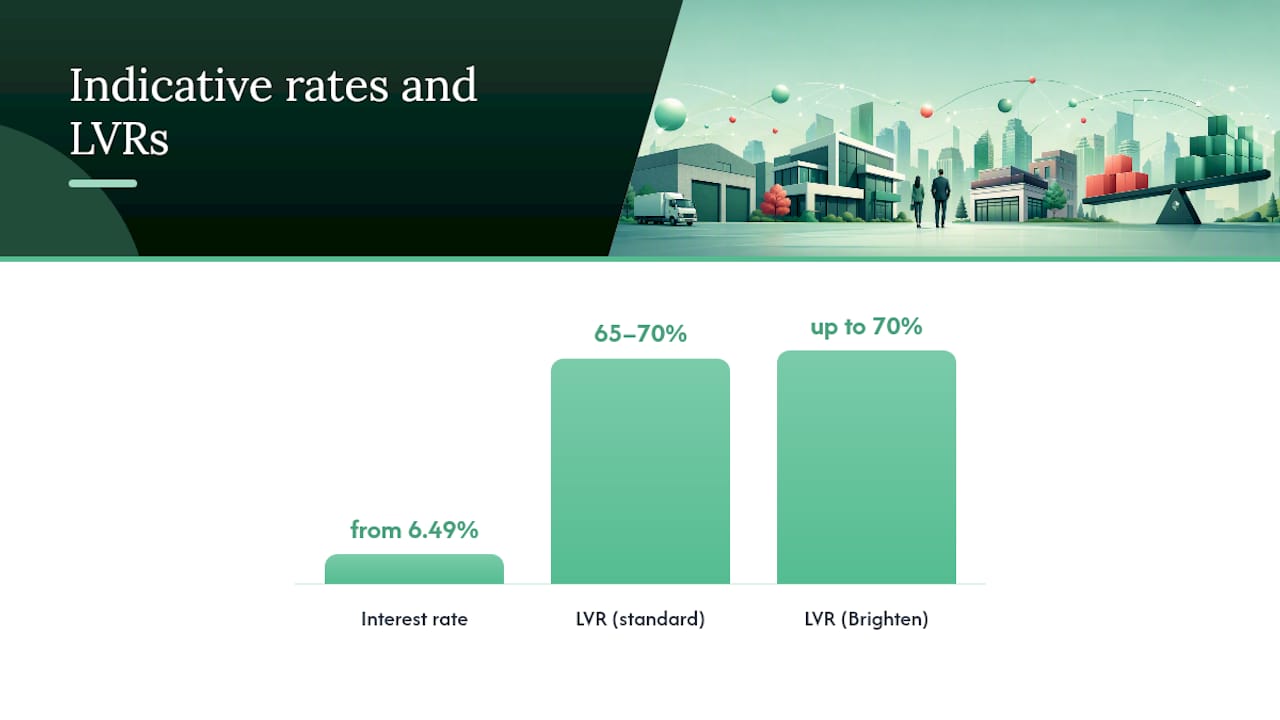
| Feature | Indicative range |
|---|---|
| Interest rate | From around 6.49% for eligible loans over $1m (advertised; rates vary by lender and loan size) |
| LVR (standard commercial) | Up to 65–70% depending on lender and property type |
| LVR (specialised property) | Typically lower; lender-specific |
| Maximum loan size | Commonly capped in the multi-million dollar range with major bank lenders; non-bank lender caps vary |
| Minimum loan size | Available from smaller thresholds with some non-bank lenders |
| Loan term | Typically aligned to or shorter than the remaining lease term |
BOQ's lease doc product and BankSA both publish loan caps up to $5m with LVRs up to 65–70% for standard commercial property. Brighten accepts loan amounts from $100k upward with LVRs commonly up to 70%, which illustrates the range available across bank and non-bank lenders.
Interest rate movements affect these figures. The May 2025 RBA rate decision influenced lender pricing and valuation outcomes across commercial property finance, so advertised rates at any point in time reflect current market conditions rather than a fixed benchmark.
Security requirements typically include a first registered mortgage over the commercial property, a general security agreement over the borrowing entity, and director's guarantees where the borrower is a company or trustee. Lenders operating under an Australian Credit Licence (ACL) or Australian Financial Services Licence (AFSL) are required to comply with responsible lending and disclosure obligations; confirm your lender's licensing status before proceeding.
Which lease clauses do lenders actually inspect?
Lenders do not just glance at the rent figure. They read the lease. Here is what they look for and what raises flags:
Documents and clauses reviewed
- Executed lease and all registered variations
- Options to renew and the mechanism for exercising them
- Rent schedule and review dates (CPI, fixed percentage, or market review)
- Outgoings schedule: what is recoverable from the tenant and what is not
- Rent-free periods, abatement clauses, or incentive arrangements
- Tenant guarantees or bank guarantees (if any)
- Break clauses or early termination rights
Red flags lenders flag
- Remaining term under 12 months with no confirmed renewal
- Extensive rent-free periods that reduce the assessable income in the near term
- Break clauses that allow the tenant to exit without penalty
- Related-party tenancy (tenant connected to the borrower)
- Complex outgoings structures where the landlord bears significant unrecoverable costs
- Arrears or payment history showing irregular rent payments
As broker guidance consistently notes, lenders adjust gross rent for outgoings, incentives, and vacancy risk before arriving at the assessable income figure. The headline rent on the lease is rarely the number the lender uses.
For newly built or pre-leased assets, lenders typically require an executed lease (not just a heads of agreement) and may apply a more conservative income figure until the tenant has a payment history. A valuation that reflects the pre-lease or as-if-complete value will also be required.
Pro Tip: When preparing your lender pack, use consistent file naming across every document: executed-lease.pdf, rent-ledger.xlsx, valuation.pdf, ato-portal-report.pdf. Lenders and brokers process dozens of applications; a clean, labelled pack moves faster through credit.
How do you apply, and how long does it take?
Step-by-step process
- Initial enquiry. Contact a broker or lender to confirm the property and lease structure are eligible. This takes one to two business days.
- Document pack assembly. Gather the lease, rent ledger, entity documents, ATO portal reports, and any existing loan statements. Allow three to five business days if documents are ready.
- Valuation instruction. The lender or broker instructs a registered valuer. Valuation turnaround is typically five to ten business days for metropolitan commercial property; longer for regional assets.
- Formal application lodgement. The complete pack is submitted to the lender's credit team.
- Conditional approval. Credit assesses the lease income, tenant covenant, LVR, and security. Conditional approval typically arrives within five to ten business days of a complete submission.
- Satisfaction of conditions. Any outstanding conditions (additional entity documents, ATO clearance, insurance confirmation) are resolved.
- Unconditional approval and settlement. Loan documents are issued, signed, and settlement is booked.
Realistic timelines
A well-prepared application with a clean lease and no ATO issues can reach conditional approval in two to three weeks. Add valuation time and you are looking at four to six weeks from first enquiry to settlement in a straightforward case. Complex structures, incomplete documents, or ATO liabilities can push that to eight to twelve weeks.
The most common delay points are: waiting on a valuation, resolving ATO portal discrepancies, and chasing entity documents from accountants or solicitors. Clearing these before you lodge saves the most time.
A pre-application due diligence checklist from Consumer Victoria is a practical starting point for confirming your property and entity searches are in order before you approach a lender.
Pro Tip: Ask your broker to instruct the valuation at the same time as lodging the application, not after conditional approval. Running both in parallel can cut two weeks off your timeline.
Lease doc versus traditional commercial loans: which suits your situation?
| Feature | Lease doc pathway | Full doc commercial loan |
|---|---|---|
| Primary income evidence | Executed lease and rent ledger | Personal/business tax returns, financials |
| Borrower income required | Not the primary assessment factor | Central to serviceability |
| Documentation burden | Lower (lease-focused) | Higher (full financial history) |
| Typical LVR | Up to 65–70% | Up to 70% for strong borrowers |
| Best suited to | Investors with tenanted assets, complex income structures | Owner-occupiers, trading businesses with clear financials |
| Lease requirement | Active arms-length lease required | Not required |
| Speed to approval | Generally faster | Depends on financial complexity |
When lease doc is the right call
Lease doc suits you when the property is tenanted, the lease is strong, and your personal or business income is complex, limited, or simply not the right lens for the deal. Investors holding assets in trusts or companies with multiple income streams often find lease doc removes the friction of full-doc assessment.
When to use full doc instead
If you occupy the property yourself, if the tenant is related to you, or if the lease has less than 12 months remaining with no confirmed renewal, full doc is usually the more appropriate pathway. Lenders will not accept lease doc for owner-occupied commercial property, and a weak or short lease undermines the entire underwriting basis.
For a broader look at commercial loan types and how they compare, the Zenrgfinance blog covers the full range of options available to Australian investors.
How a specialist broker helps you get lease doc approval
Lease doc applications look simple on the surface, but the detail work is where most deals succeed or stall. A specialist broker adds value at every stage:
- Lender matching. Not every lender offers lease doc, and those that do have different LVR caps, minimum lease term requirements, and acceptable property types. A broker narrows the field quickly.
- Tenant covenant analysis. Brokers assess whether your tenant's profile will satisfy lender requirements before lodgement, avoiding a rejection that damages your credit file.
- Pack preparation. A broker structures your document pack to match the lender's credit template, reducing back-and-forth during assessment.
- Valuation coordination. Brokers with lender relationships can instruct valuations directly, often faster than a borrower acting alone.
- Condition management. Post-conditional approval, brokers track outstanding conditions and liaise with solicitors, accountants, and lenders to keep settlement on track.
A practical example: an investor approached a lender directly with a lease that included a 12-month rent-free period at the start of the term. The lender's credit team assessed the income as zero for the first year and declined the application. A broker reviewed the same lease, identified that the rent-free period had already passed and the full rent was now payable, restructured the evidence pack to show the current rent ledger clearly, and resubmitted to a different lender. Conditional approval followed within a week.
Zenrgfinance works with commercial property investors across Australia to prepare lease doc applications, match deals to the right lenders, and manage the process from initial enquiry through to settlement. To discuss your property and lease structure, reach out to the team for an eligibility review.
What the front line actually teaches you about lease doc applications
Most investors who struggle with lease doc applications are not underprepared on the property side. They are underprepared on the lease side. The lease is the loan. If the lease has problems, the loan has problems, and no amount of strong personal financials will fix that.

Three things I see make a real difference in practice. First, packaging your lease evidence as if the credit assessor has never seen a commercial lease before. Label every document, include a one-page cover note summarising the tenant, the rent, the remaining term, and the ICR calculation. Credit teams process volume; a clear pack gets read first and read properly.
Second, fix minor covenant issues before you lodge. If your tenant has one month of arrears that was subsequently cleared, get a statutory declaration or a letter from the tenant explaining it. If there is a rent review that has not been formally documented, get a variation executed before submission. These are small things that become big things inside a credit assessment.
Third, on valuations: brief your valuer on the lease terms before they inspect. A valuer who understands the lease structure, the tenant covenant, and the rent review mechanism will produce a report that supports your application rather than one that raises more questions than it answers.
One deal that sticks with me involved a warehouse with a strong national tenant but a lease that had a market rent review clause worded in an unusual way. The first valuer flagged it as a potential downward risk and the lender's credit team queried the assessable income. We briefed a second valuer with the rent review history and the tenant's payment record, and the revised report addressed the clause directly. The application proceeded without further queries.
Credentials and certifications relevant to this article will appear in the published version.
Zenrgfinance: your lease doc lending partner
Getting a lease doc application right the first time saves weeks and protects your credit file. Zenrgfinance works with commercial property investors across Australia to do exactly that: match your deal to the right lender, prepare a credit-ready documentation pack, and manage the process from first enquiry through to settlement.

Where a direct lender application can stall on a single document gap or a misread lease clause, a brokered approach through Zenrgfinance means those issues are caught and resolved before lodgement. The team reviews your lease structure, assesses tenant covenant, coordinates valuations, and handles lender correspondence so you are not chasing paperwork across three different parties.
To get started, book a strategy session with a mortgage relationship manager at Zenrgfinance. Bring your lease, your entity documents, and your ATO portal status, and the team will give you a clear picture of your eligibility and the best lender options for your deal.
This article is general information only and does not constitute financial, legal, or tax advice. Loan approval is not guaranteed. Speak with a qualified adviser and confirm current lender requirements before making any financing decisions.
This article is general information, not a substitute for advice from a qualified financial advisor. Consult a qualified financial professional about your own circumstances before acting on anything here.
Sources
- Lease Doc loan - CommBank
- BSA_LeaseDoc_280723
- Lease Doc Commercial Loans | Brighten
- Lease Doc Business Loan | BOQ
- Lease Doc Commercial Investment Loans from 6.49% for ...