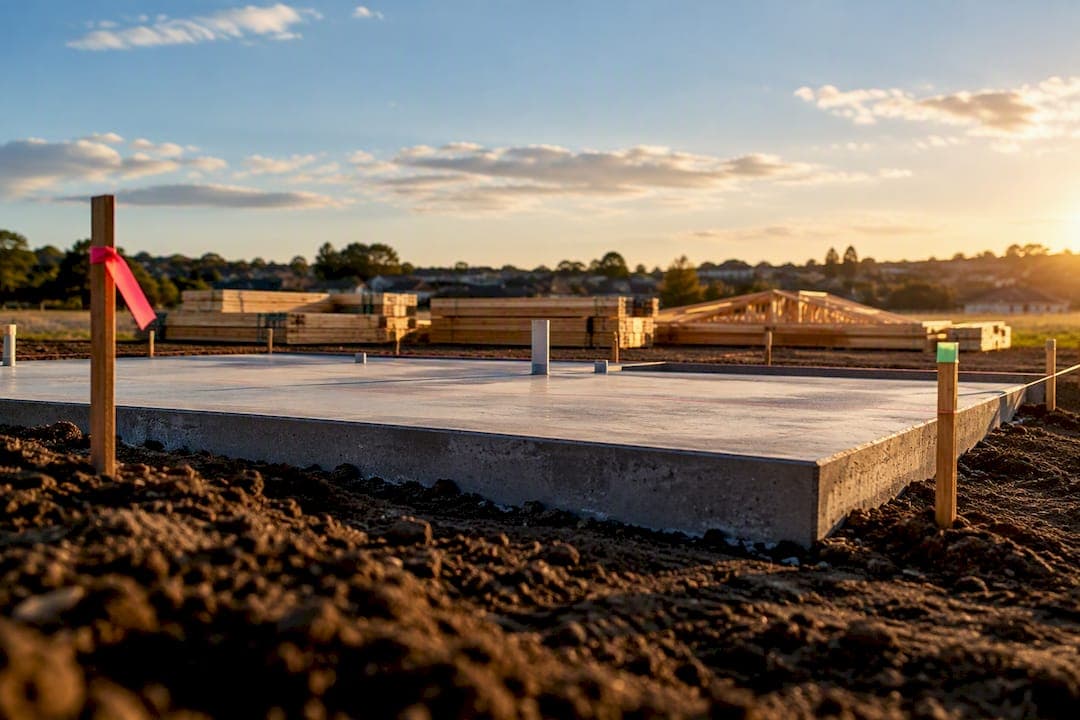
House and land finance usually runs as two linked loans, a land loan followed by a construction loan, or one facility that converts between the two. Before you sign anything, get conditional pre-approval, confirm your builder is on your lender's approved list, and check your First Home Owner Grant and stamp duty eligibility. Get that order right and the rest of the process runs far more smoothly.
TL;DR:
- Most house and land finance involves initial land loans followed by construction loans, with some lenders offering a single convertible facility for simplicity.
- Construction funds are released in stages tied to milestones like slab, framing, lock-up, fit-out, and final inspection, with interest-only payments on drawn amounts during this period.
- A minimum deposit of 5 to 20 percent of the property’s total value is typically required, with higher deposits reducing LMI costs and increasing borrowing options.
- Eligibility for grants and stamp duty concessions varies by state and depends on meeting specific criteria such as buyer status, location, and property type, so up-to-date verification is essential.
- Ensuring builder accreditation with your lender is critical, as it influences loan approval and timelines; a broker can coordinate this process seamlessly from the start.
Table of Contents
- How house and land finance actually works
- How do construction loan progress payments work?
- How much deposit do you need for a house and land package?
- Do you qualify for the First Home Owner Grant?
- What extra costs should you budget for beyond the package price?
- Why do some lenders reject certain builders or blocks?
- How do you arrange finance from pre-approval to final drawdown?
- Why builder accreditation is the detail everyone underestimates
- Ready to start your house and land finance conversation?
- Where to check exact grant and duty figures
- Sources
- FAQ
How house and land finance actually works
Most house-and-land purchases run on a two-part structure. The land loan settles first after exchanging contracts, and behaves like a standard mortgage: you draw the full amount and start repaying it straight away. The construction loan sits behind it and only springs into life once your builder gets council approval and is ready to break ground.
Some lenders instead offer a single facility that starts as a land loan and converts automatically into a construction loan once building begins. This can be simpler to manage since it avoids two separate approvals and two sets of fees, though not every lender offers it, and the interest rate or product features attached to the construction phase may differ from what you'd get shopping the two loans separately.
Whichever structure you use, your lender will want an on-completion valuation before releasing the final drawdown. This values the finished home against the fixed-price building contract, not just the land, and it's usually the last check before your loan converts fully to principal and interest.
Before your first drawdown, most lenders will ask for:
- A signed, fixed-price building contract with the full specification schedule attached
- Council-approved plans and a building permit
- Confirmation your builder holds current licensing and insurance
- Evidence of your deposit and, in most cases, lenders mortgage insurance approval if your deposit is under the threshold
Getting these documents organised before you approach a lender is often what separates a smooth settlement from a stressful one.
How do construction loan progress payments work?
Once building starts, your lender doesn't hand your builder the full loan amount in one go. Funds release in stages, tied to construction milestones, and you're only charged interest on the amount actually drawn at each point, not the full approved loan.
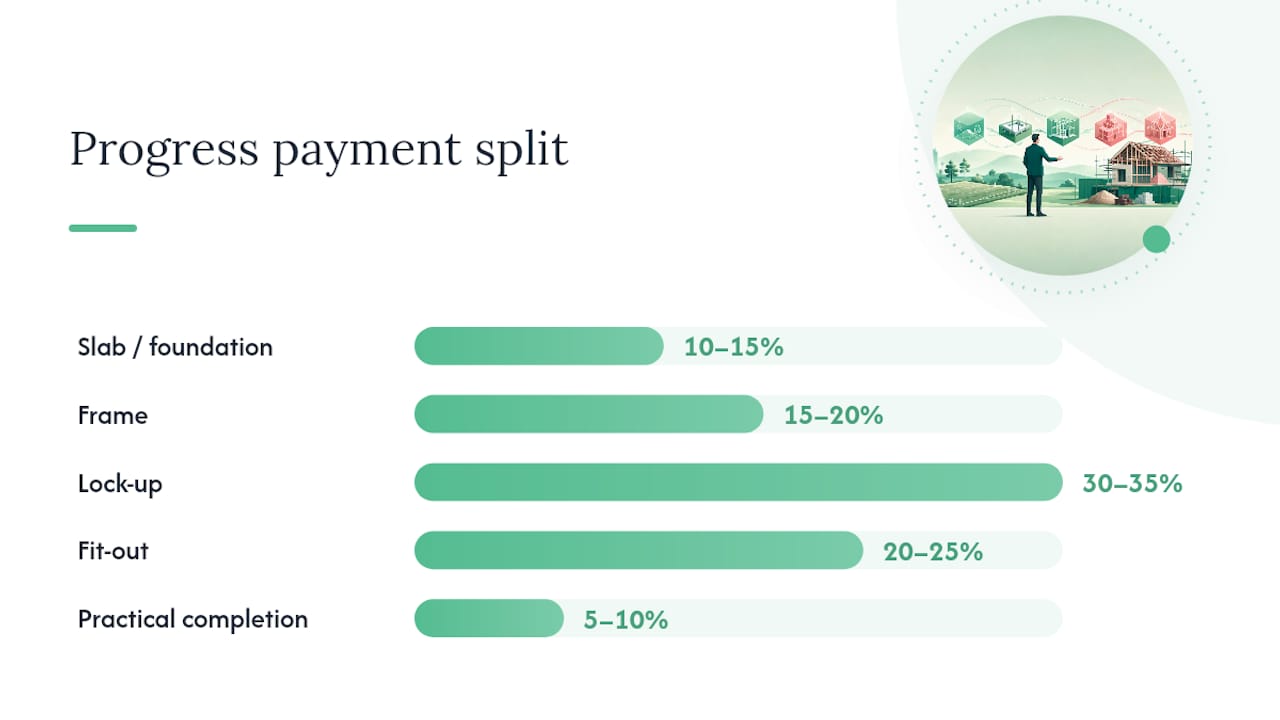
The industry-standard stages, though exact splits vary by builder and contract, typically run:
- Slab or foundation — roughly 10 to 15% of the build cost, released once footings and slab are poured
- Frame — around 15 to 20%, paid when the timber or steel frame is up and roof trusses are in place
- Lock-up — often the largest single stage at 30 to 35%, covering external walls, windows, doors and roofing
- Fit-out — around 20 to 25%, covering plastering, cabinetry, tiling and fixtures
- Practical completion — the final 5 to 10%, released once the home passes final inspection and is ready to hand over
These percentage splits come directly from the building contract, and your lender releases each payment only after a valuer or building certifier confirms the stage is genuinely complete.
During this phase you pay interest-only on drawn funds, which keeps repayments manageable while you're potentially still paying rent elsewhere. Once the final certificate is issued and the last drawdown clears, your loan automatically shifts to standard principal and interest repayments on the full amount.
Pro Tip: Ask your builder for a written progress payment schedule before you sign, and compare it against your loan's drawdown conditions. A mismatch between when the builder expects payment and when your lender is willing to release funds is one of the most common causes of build delays.
Delays, contract variations and retention amounts (a small percentage lenders hold back until defects are fixed) are all normal parts of the process, but they can throw out your timeline if you haven't budgeted a buffer for them.
How much deposit do you need for a house and land package?
Lenders calculate your deposit against the completed value of the property, which means land price plus the full build cost, not just the land component. This trips up a lot of first-home buyers who assume their deposit only needs to cover the land purchase.
Most lenders want a minimum deposit of 5 to 20% of that combined value. Drop below 20% and you'll typically be charged lenders mortgage insurance (LMI), a one-off premium that protects the lender, not you, if you default. LMI can add thousands of dollars to your upfront costs, so it's worth factoring in early rather than discovering it at the last minute.
Whether you can use one of these schemes for a house-and-land package depends on state-specific price limits and construction timeframes, so it's worth checking early rather than assuming eligibility.
A few practical ways to manage your deposit and reduce LMI exposure:
- Save toward the full completed value, not just the advertised land price
- Ask whether a guarantor arrangement could lift your effective deposit above 20%
- Check if you qualify for a government scheme before assuming you'll need to pay LMI
- Get a broker to model a few deposit scenarios side by side, since LMI premiums shift quite a bit between 85%, 90% and 95% LVR bands
Do you qualify for the First Home Owner Grant?
The First Home Owner Grant is managed state by state, and amounts, eligibility criteria and property price caps all differ depending on where you're building. New South Wales, for instance, runs its own First Home Owner Grant for new homes with its own thresholds, while Queensland administers a separate First Home Grant with different rules entirely. Never assume a figure you've read for one state applies in another.
Stamp duty treatment is where house-and-land packages genuinely work in your favour. Duty is typically calculated on the land value at settlement, not on the full package price once the home is built. Buy land now and build later, and you generally pay duty only on the land, which is a meaningful saving compared with buying an already-completed house of the same value.
On top of that, most states offer additional stamp duty concessions or exemptions for first-home buyers building a new home, stacked on top of the standard land-only duty calculation. Our guide to first-home buyer government schemes breaks down how these concessions interact across different states.
A few things worth checking before you rely on either benefit:
- FHOG amounts and price caps change periodically, so confirm current figures on your state revenue office site, not a general guide
- Duty concessions usually have their own price thresholds separate from the FHOG cap
- Grant money can sometimes count toward your deposit, which affects your LVR and whether LMI applies
- Eligibility is usually tied to being a genuine first-home buyer and an owner-occupier, not an investor
What extra costs should you budget for beyond the package price?
The advertised price on a house-and-land package rarely covers everything you'll actually pay. Experienced buyers build in a contingency of 5 to 10% of the build cost specifically because so many essential items sit outside the headline figure.
Site-related costs catch people out the most:
- Site works including earthworks, retaining walls, drainage and rock removal if the block isn't perfectly flat
- Driveway construction, fencing and basic landscaping, which are almost never included in the base price
- Council connection fees for water, power and NBN, plus any additional inspections or geotechnical reports your council requires
Then there are the choices you make along the way:
- Upgrades to fixtures, flooring or appliances beyond the display-home standard
- Contract variations if you change your mind mid-build
- Loan-related fees, including valuation fees and application fees, which vary by lender
Ask your builder for an itemised site cost estimate before signing, not just the headline package figure, so your finance application reflects what you'll actually need to borrow.
Why do some lenders reject certain builders or blocks?
Not every lender accepts every builder. Many maintain an approved builder list, and if your builder isn't on it, your application can stall or get declined outright, even if your income and deposit are perfectly fine. Checking builder accreditation before you sign a building contract is one of the simplest ways to avoid a wasted application.
Lender appetite also varies by location and block type. Some lenders are cautious about particular growth corridors, small or irregular blocks, or certain construction methods, and will restrict lending in those areas even when the builder itself is accredited elsewhere. If you're building in a newer estate, smaller lenders may have limited appetite for that postcode, while a broker with a wider panel can often find an alternative that will fund it.
A few checks worth running before you commit:
- Confirm your builder's accreditation status with your preferred lender before signing the building contract
- Ask whether your specific estate or block type has any known lender restrictions
- Get your contract reviewed for variation clauses and payment triggers before you sign
- Have a backup lender identified in case your first choice has policy issues with your builder or block
Pro Tip: If a lender says no because of the builder, don't assume every lender will. Builder acceptance policies vary enormously between banks and non-bank lenders, and a broker checking multiple panels at once can save you weeks of back-and-forth.
How do you arrange finance from pre-approval to final drawdown?
Getting the sequencing right matters as much as getting the numbers right. Here's the order that keeps land settlement, construction finance and your builder's timeline all lined up.
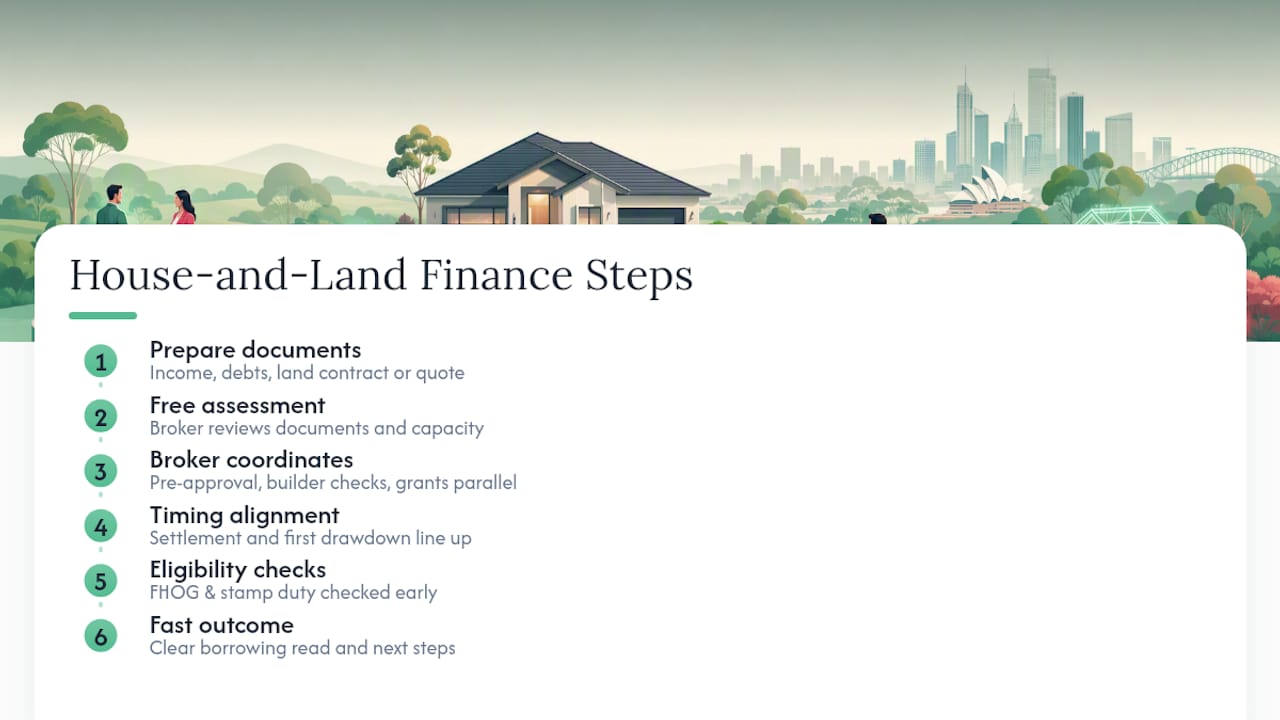
- Get your borrowing capacity assessed and secure conditional pre-approval before you sign a land contract. This tells you what you can realistically spend and gives you negotiating confidence with the land vendor.
- Have your building contract and fixed-price quote independently reviewed before signing. Confirm the progress payment schedule matches what your lender will actually release at each stage, and check your builder's accreditation with your shortlisted lenders.
- Lodge your construction loan application early, ideally as soon as your building contract is signed, so formal approval is sitting ready before land settlement. This avoids a gap between settling the land and being able to start the first drawdown.
- Coordinate valuation timing with your broker or lender so the on-completion valuation doesn't hold up your final drawdown once the build is finished.
- Keep a paper trail of every variation, invoice and progress certificate, since lenders will want this documentation before releasing each stage payment.
Buyers who leave the construction loan application until after land settlement often find themselves waiting weeks longer than expected for the first drawdown, right when the builder is chasing payment. Starting both applications in parallel, rather than sequentially, is the single biggest timeline saver in this whole process.
Why builder accreditation is the detail everyone underestimates
Most first-home buyers spend weeks agonising over interest rates and almost no time checking whether their chosen builder is actually acceptable to their preferred lender. That's backwards. A quarter-point rate difference costs you a few dollars a week. A builder your lender won't fund costs you the entire timeline, and potentially the deposit you've already paid the land vendor.
The uncomfortable truth is that builder accreditation policy is inconsistent and rarely advertised upfront. Two lenders can look identical on rate and fees, then diverge completely the moment you name your builder. This is exactly where a broker earns their keep, coordinating land settlement and construction finance so they land in the right order rather than in a race against each other.
What experienced buyers do differently is treat the finance application and the building contract as one connected process from day one, not two separate errands. ZENRG Finance structures loans this way as a matter of course, checking builder acceptance and lender appetite before a client signs anything, precisely because the alternative, discovering a problem after contracts are exchanged, is far more expensive to fix than to prevent.
— Allen
Ready to start your house and land finance conversation?
Here's the honest problem with most house-and-land finance: buyers often deal with the land vendor, the builder and the bank as three separate conversations, and nobody's coordinating the timing between them. A mortgage broker can help close that gap. Rather than you chasing pre-approval, builder accreditation checks and grant paperwork separately, one broker may handle all three in parallel, so your land settlement and first construction drawdown actually line up.

For first-home buyers specifically, that means pre-approval sorted before you sign a land contract, your builder checked against lender policy before you commit to a building contract, and FHOG and stamp duty concession eligibility confirmed early enough to actually affect your deposit planning. If your build sits in a growth corridor some lenders shy away from, access to a broader lender panel matters more than the fine print on any single bank's rate sheet.
Start with a free initial assessment. Have your income details, existing debts, and any land contract or builder quote you've already received ready to go, and you'll get a clear read on borrowing capacity and next steps within days rather than weeks. Visit the First Home Buyer Loans page to book a consultation and get your house-and-land finance moving in the right order from the start.
Where to check exact grant and duty figures
Grant amounts, price caps and duty concessions change and differ by state, so confirm the current numbers before you budget against them:
- First Home Owner Grant (New homes) — Revenue NSW
- First Home Grant — Queensland Revenue Office
- Your own state or territory revenue office site for eligibility, deadlines and current thresholds
If your situation involves an SMSF purchase, an investment property alongside your build, or anything outside a straightforward owner-occupier scenario, speak with a broker early rather than assuming standard FHOG rules apply.
This article is general information, not a substitute for advice from a qualified financial advisor. Consult a qualified financial professional about your own circumstances before acting on anything here.
Sources
- First Home Owner Grant (New homes) — Revenue NSW
- House and Land Package Finance — Settled Funding Group
- What is a house and land package? — Plantation Homes
FAQ
How much will I need to repay monthly on a $1,000,000 mortgage?
Monthly repayments depend heavily on your interest rate, loan term and whether you're paying interest-only or principal and interest. Rather than relying on a rough guide, get a personalised figure from a broker who can model your actual rate and term, since even a small rate difference on a loan this size changes repayments substantially.
What salary do you need for a $500,000 loan?
There's no fixed salary figure lenders use, since borrowing capacity depends on income, existing debts, dependents, living expenses and the interest rate buffer each lender applies. A broker can run your specific numbers through multiple lenders' calculators to give you a realistic answer rather than a generic estimate.
Are house and land packages a good investment?
House-and-land packages can offer stamp duty savings, since duty is often calculated on land value only, plus the appeal of a brand-new home with fewer maintenance surprises. Whether it's a good investment for you depends on the location's growth prospects, build quality and how realistically you've budgeted for the extra costs beyond the package price.
Can I get a loan to buy land in Australia?
Yes, land loans are a standard product offered by most Australian lenders, though they often come with slightly different LVR limits than a standard home loan since there's no dwelling to secure the debt against yet. Most buyers pair a land loan with a construction loan, or use a single facility that converts between the two once building starts.