
Yes, you can get a home loan with casual employment in Australia. Lenders don't rule casual workers out automatically, but they do want proof of continuity and serviceability, typically six to twelve months in the role, a steady income pattern, healthy savings, and a clean credit file before they'll say yes.
TL;DR:
- Lenders prefer casual workers to demonstrate six to twelve months of consistent employment, steady hours, and a stable industry to qualify for a home loan.
- Proper documentation, including pay slips, a verification letter, and matching bank statements, can significantly improve approval chances.
- Casual employment impacts borrowing capacity and deposit requirements, with options like the 5% Deposit Scheme or guarantor loans offering potential pathways.
- Building a comprehensive evidence pack and working with a mortgage broker familiar with casual employment policies increases the likelihood of success.
- Maintaining a stable job, growing savings, and early preparation are key factors in securing a home loan as a casual worker.
Table of Contents
- What Australian lenders check for when you have casual income
- Documents that prove your casual income is real
- How casual income affects your borrowing power and deposit
- An action plan to improve your approval odds
- How a mortgage broker helps casual workers get across the line
- Realistic encouragement for casual workers eyeing a home loan
- Ready to talk about your home loan options?
- Sources
What Australian lenders check for when you have casual income
Every lender runs your casual employment mortgage application through the same basic question: is this income likely to keep showing up? NAB's guidance on casual income confirms that consistency and length of employment matter more than the "casual" label on your contract. Most lenders want to see six to twelve months in the same role, though Finder's research on casual worker loans notes that some will move faster if the rest of your file is strong.
Here's what a lender actually looks at:
- Time in role — the longer you've held the position, the more comfortable they are treating your income as ongoing rather than temporary.
- Hours pattern — a roster that bounces between 15 and 40 hours a week reads very differently to one that sits steadily around 30.
- Industry stability — sticking with the same employer or sector counts for more than hopping between unrelated jobs.
- Serviceability buffers — lenders often average your income over recent periods and then apply a discount (sometimes 20% or more) before deciding what you can borrow.
If your file doesn't tick those boxes, don't expect a flat rejection. Expect a smaller loan-to-value ratio, a higher interest rate, or a request for extra documentation. It's rarely all or nothing. Bank policy pages themselves describe this as case-by-case assessment under responsible lending rules, not a blanket cutoff for casual employees.
Documents that prove your casual income is real
Getting your paperwork right is the fastest way to move a casual job home financing application from "maybe" to "approved." Lenders generally want to see:
- Several months of pay slips showing a consistent, if not identical, income pattern.
- Matching bank statements, so your salary deposits and pay slips align.
- An employment verification letter from your employer, ideally covering how long you've worked there, your typical hours, and how likely ongoing work is.
- ATO income statements or PAYG summaries, which the ATO's own guidance confirms lenders treat as reliable third-party evidence.
- Your Casual Employment Information Statement (CEIS), if your employer has issued one. It won't prove income on its own, but it does confirm your employment status under the Fair Work Ombudsman's casual employment rules.
Overtime, commissions, and regular allowances can usually be included, though most lenders average them rather than count the best month. Cash-in-hand work won't count at all, since there's no paper trail to verify it.
Pro Tip: Ask your employer for a letter that names your roster pattern directly ("consistently rostered 25 to 30 hours per week since March 2025") rather than a vague confirmation of employment. Specific wording moves faster through underwriting than generic letters.
How casual income affects your borrowing power and deposit
Casual status doesn't just affect whether you get approved. It affects how much you can borrow and how big your deposit needs to be. Because lenders often discount or average variable income before running serviceability calculations, your assessed borrowing capacity can end up noticeably lower than your actual take-home pay would suggest, which is worth modelling properly with a home loan offset calculator before you go house hunting.
Deposit size is where casual employment mortgage options really diverge from what a permanent employee faces:
- Without a strong track record, some lenders push casual applicants toward a larger deposit to avoid Lenders Mortgage Insurance (LMI) altogether.
- The Australian Government's 5% Deposit Scheme lets eligible first home buyers, including many casual workers, buy with just a 5% deposit, with the government guaranteeing the rest to the lender in place of LMI.
- The catch: the scheme changes the deposit hurdle, not the serviceability test. You still need to prove you can service the loan.
- Where mainstream lenders won't budge, a guarantor, a joint application with a partner on stable income, or a specialist lender built for non-standard income can bridge the gap. Pepper Money's non-standard income lending is one example of a lender that assesses a larger share of casual and irregular income than a typical major bank.
An action plan to improve your approval odds
Treat your application like a project with a timeline, not a single form you fill out and submit; understanding how lenders assess irregular income is crucial to this process, as explained in our Self-Employed Income Mortgage: How to Qualify and Prepare guide.
Do this now:
- Pull together your last three to six months of pay slips and matching bank statements.
- Ask your employer for an employment verification letter today, since these can take a week or two to arrive.
- Pay down credit card balances. Even unused limits can drag down your serviceability calculation.
Do this over the next six to twelve months: 4. Stay in the same role or industry where you can. Job hopping between unrelated fields resets the "stability clock" lenders use. 5. If your employer offers casual conversion under the Fair Work Act's casual employment pathway, ask about it. Moving to permanent status, even part-time permanent, often opens better rates. 6. Keep growing your savings buffer. A consistent savings pattern is one of the strongest signals lenders look for beyond income itself.
Pro Tip: Talk to a mortgage broker before you apply, not after a knockback. A broker who works across multiple lenders can tell you which ones are genuinely comfortable with casual employment mortgage applications, saving you from a rejection sitting on your credit file.
The most common pitfall is applying to your everyday bank first, getting a soft no, and assuming that's the industry answer. Policy varies enormously between lenders, and one rejection is not gospel.
How a mortgage broker helps casual workers get across the line
This is exactly the gap Zenrgfinance was built to close. As a client-centric mortgage brokerage, Zenrgfinance works through the specific hurdles casual employees face rather than pointing them at a generic checklist.
In practice, that looks like:
- Building a complete evidence pack (pay slips, bank statements, ATO records, and an employer letter) before you go anywhere near a lender.
- Matching you to lenders known to accept a higher proportion of casual and irregular income, rather than the first bank on the high street.
- Advising on deposit strategy, including when the 5% Deposit Scheme genuinely helps and when a guarantor makes more sense.
- Providing an employment verification letter template that's worded the way underwriters actually want to see it, which cuts down back-and-forth delays.
Given that ABS data shows casual work is common across Australian industries, this isn't a niche problem. It's a mainstream one that most lenders have policies for, even if their front-line staff don't always know how to apply them.
Realistic encouragement for casual workers eyeing a home loan
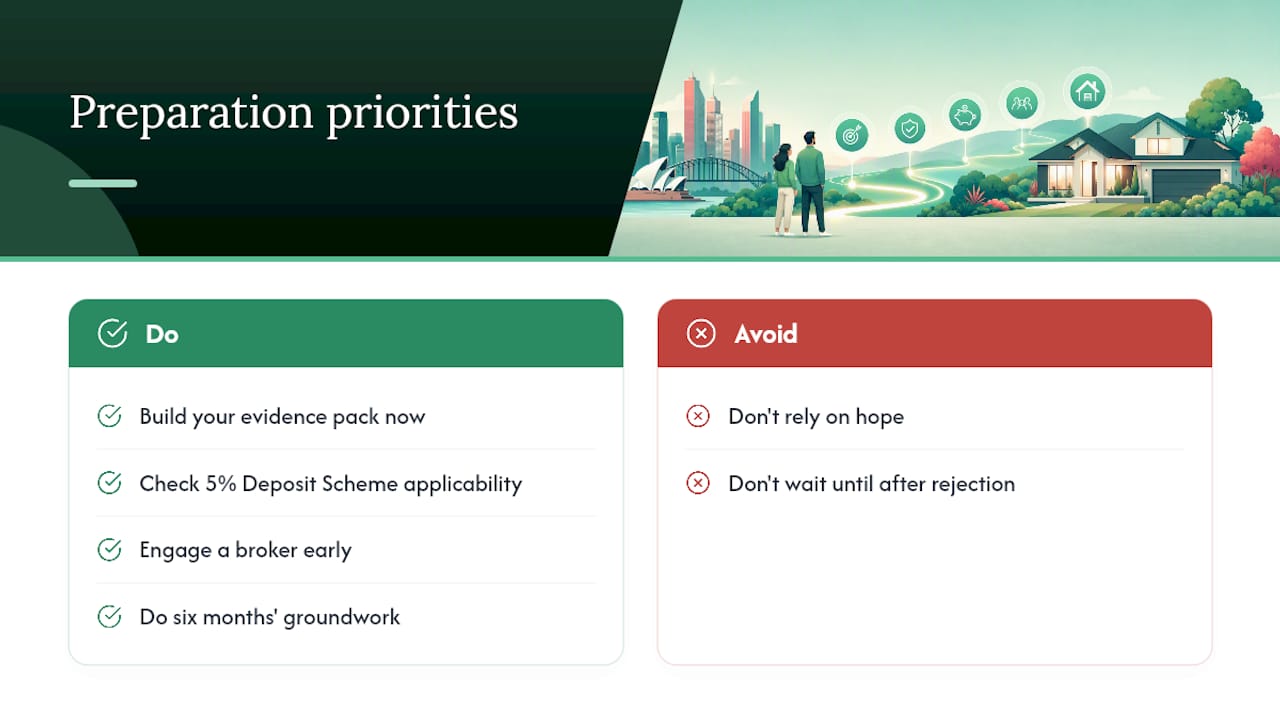
Casual employment mortgage approval is achievable, but it rewards preparation over hope. The applicants who get through fastest aren't the ones with the highest income. They're the ones who show up with a complete, well-organised file and a clear employment story.
If you're serious about buying, start building your evidence pack now, check whether the 5% Deposit Scheme applies to your situation, and get a broker involved early rather than after a rejection. Six months of groundwork now beats a knockback later.
— Allen
Ready to talk about your home loan options?
A mortgage broker works as your alternative to walking into a single bank branch and hoping for the best. Instead of one lender's rigid policy, you get a broker comparing multiple lenders' appetite for casual income against your actual situation, deposit size, and goals.

At a first conversation, bring your recent pay slips, bank statements, and any employment letter you already have. We'll tell you honestly where you stand, which lenders suit your income pattern, and whether the 5% Deposit Scheme or a guarantor arrangement makes more sense for your deposit. If you're weighing up investment property down the track too, our property investment resources are worth a look once your first loan is sorted. Start by visiting our mortgage relationship manager page to book a time and get your options mapped out properly.
Sources
For primary guidance beyond this article, check the Fair Work Ombudsman on casual employment, Housing Australia's 5% Deposit Scheme, and ATO guidance on PAYG records. For serviceability tips, read mortgage serviceability: how to jump through the hoops.
- Casual Employment Information Statement - Fair Work Ombudsman
- Home loans for casual and irregular income | Tips and guidance - NAB
- Australian Government 5% Deposit Scheme — Housing Australia